Entity · Concept
Ha-satan in Job
A reference page linking a name, group, or concept to the materials that discuss it.
The adversary or accuser in Job, with the Hebrew definite article; among the sons of God, acting within permission and limits rather than carrying every later Satanic trait.
Text
The title in the scene
Ha-satan in Job carries the definite article: the adversary or accuser. He appears among the sons of GodSons of GodA Hebrew expression for heavenly beings in texts such as Job; context determines its meaning, rather than biological descent or a fixed angelic roster.Glossary · Click to read the explanation before YahwehYahwehThe divine proper name written YHWH in the Hebrew Bible.Glossary · Click to read the explanation and challenges Job’s motives for righteousness. This role does not automatically include every characteristic of Satan in later religious traditions.[1]
Permission and limits
Job 1 permits action against Job’s possessions without touching him. Job 2 expands the test while excluding his life. The character is active and harsh, but operates within Yahweh’s permission and limits, not as an independent equal power.[2]
What follows from this?
Warren Zev Harvey reads the character as a heavenly being among God’s sons with a special role. This interpretation of Job proves no origin in a particular Canaanite god and does not reduce Satan’s entire conceptual history to this scene.[3]
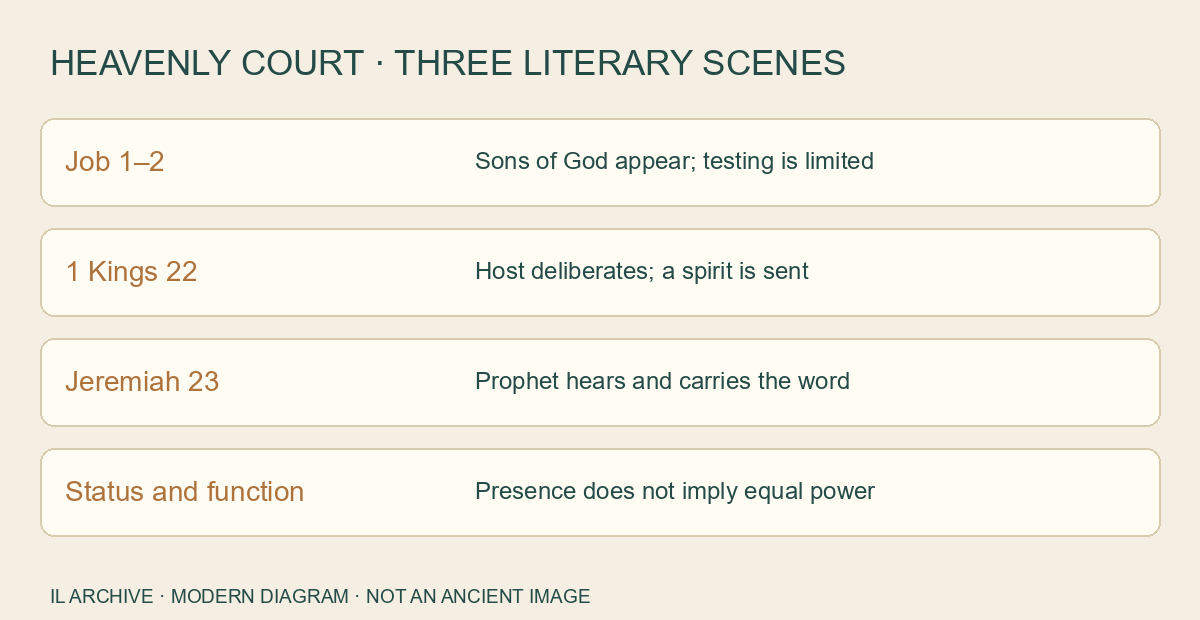
The image is a modern council-and-functions diagram, not a portrait of Satan or an artifact documenting his appearance.
References and notes
- Hebrew Bible / Bible hébraïque — Job 1:6–12. Mechon-Mamre, Hebrew text and JPS 1917 English translation. Verses 6–12: sons of God, ha-satan and limited permission. Scene in the surviving narrative, not a fixed date for a religious stage. Return to the text ↑
- Hebrew Bible / Bible hébraïque — Job 2:1–7. Mechon-Mamre, Hebrew text and JPS 1917 English translation. Verses 1–7: renewed audience and permission excluding Job’s life. Later conceptions of Satan are not projected onto this character. Return to the text ↑
- Warren Zev Harvey (2022 online; 2023 issue). Questions on the Book of Job. Religious Studies 59, S1, S7–S16. doi:10.1017/S0034412521000585. Open passage in The Framework Story read on satan as adversary/accuser and a celestial being with a special role, and permission. Other philosophical interpretations are not adopted; full-article reading not claimed. Return to the text ↑
Research history
Substantive changes are retained here. Minor copy edits remain in the internal operational log.
-
Substantive record update
Suggest a correction · Suggest a source for this record
Cite this record
IL Archive, «Ha-satan in Job», Edition 2, https://ilarchive.com/en/entities/ha-satan