Entity · Concept
Gehenna and Jahannam: from the Hinnom Valley to the language of punishment
A reference page linking a name, group, or concept to the materials that discuss it.
- Names
- Gehenna · Gehinnom · Jahannam · Γέεννα · גֵּי הִנֹּם
- Region
- Jerusalem and its historical surroundings in the Levant; the term’s history in Jewish, Christian and Islamic traditions
The history of the Valley of Hinnom and Gehenna in Jewish and Christian texts and Quranic Jahannam, distinguishing geography, Jeremiah’s warnings, afterlife imagery, archaeological limits and exegetical disputes.
Estimated reading time: 10 min Published Last reviewed:
Share article
Text
Introduction
How did the name of a valley beside JerusalemJerusalemJerusalem is a city of religious importance in Judaism, Christianity and IslamGlossary · Click to read the explanation become a word for punishment in the afterlife? An answer must distinguish three levels: the geographical Valley of Hinnom, Gehenna in Jewish and Christian writings composed in different periods, and Jahannam in the QuranThe QuranThe central scripture of Islam, consisting of 114 Arabic surahs; its study distinguishes Quranic discourse from manuscript history, reading traditions, and historical inference.Glossary · Click to read the explanation and its interpretation. The names have a substantial linguistic relationshipLinguistic relatednessCommon linguistic descent demonstrated by systematic sound and morphological correspondences, unlike borrowing or accidental resemblance.Glossary · Click to read the explanation, but each text has its own questions, imagery and audience. Etymology alone neither makes all descriptions of fire identical nor establishes one exclusive route of transmission.
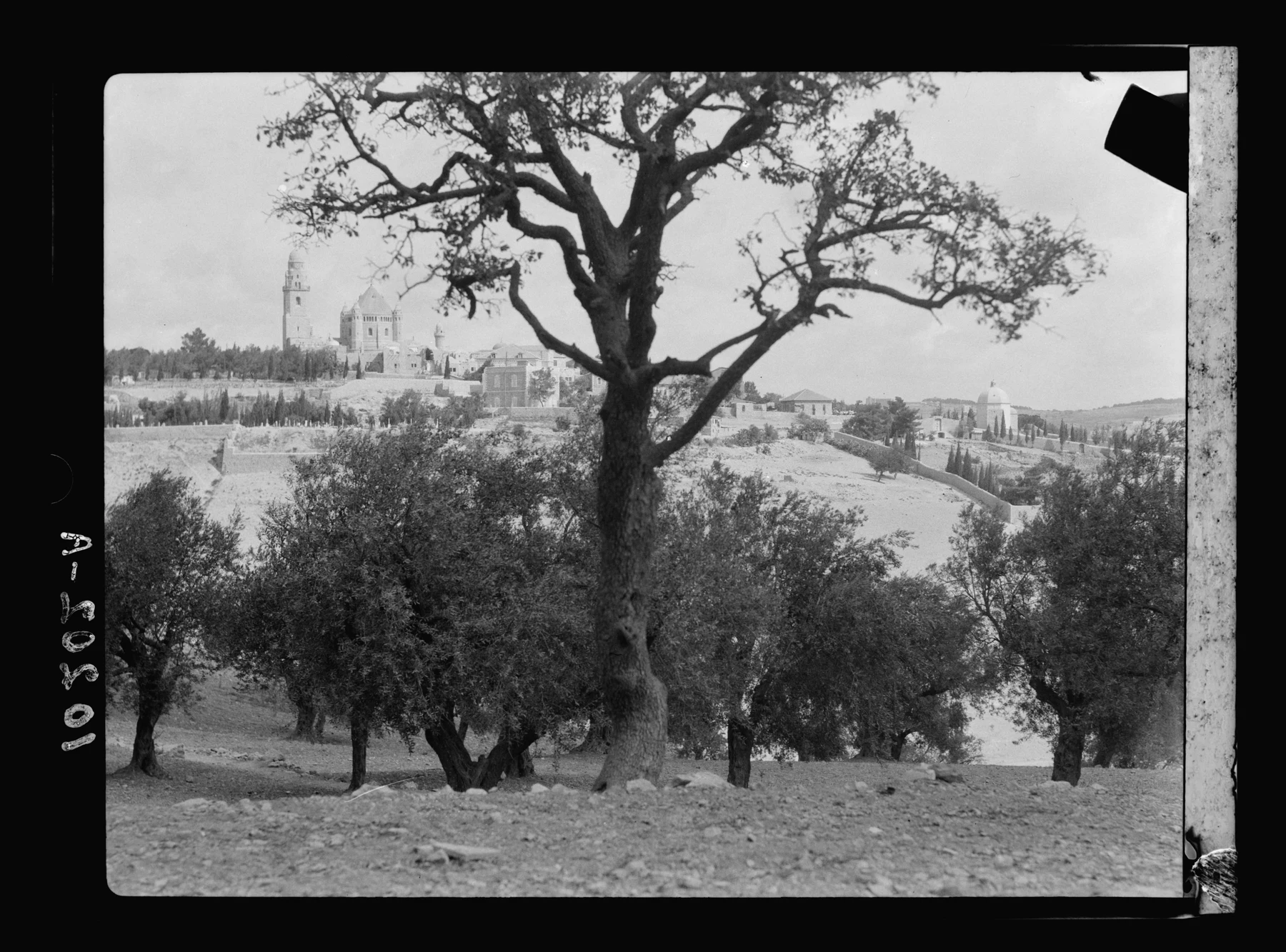
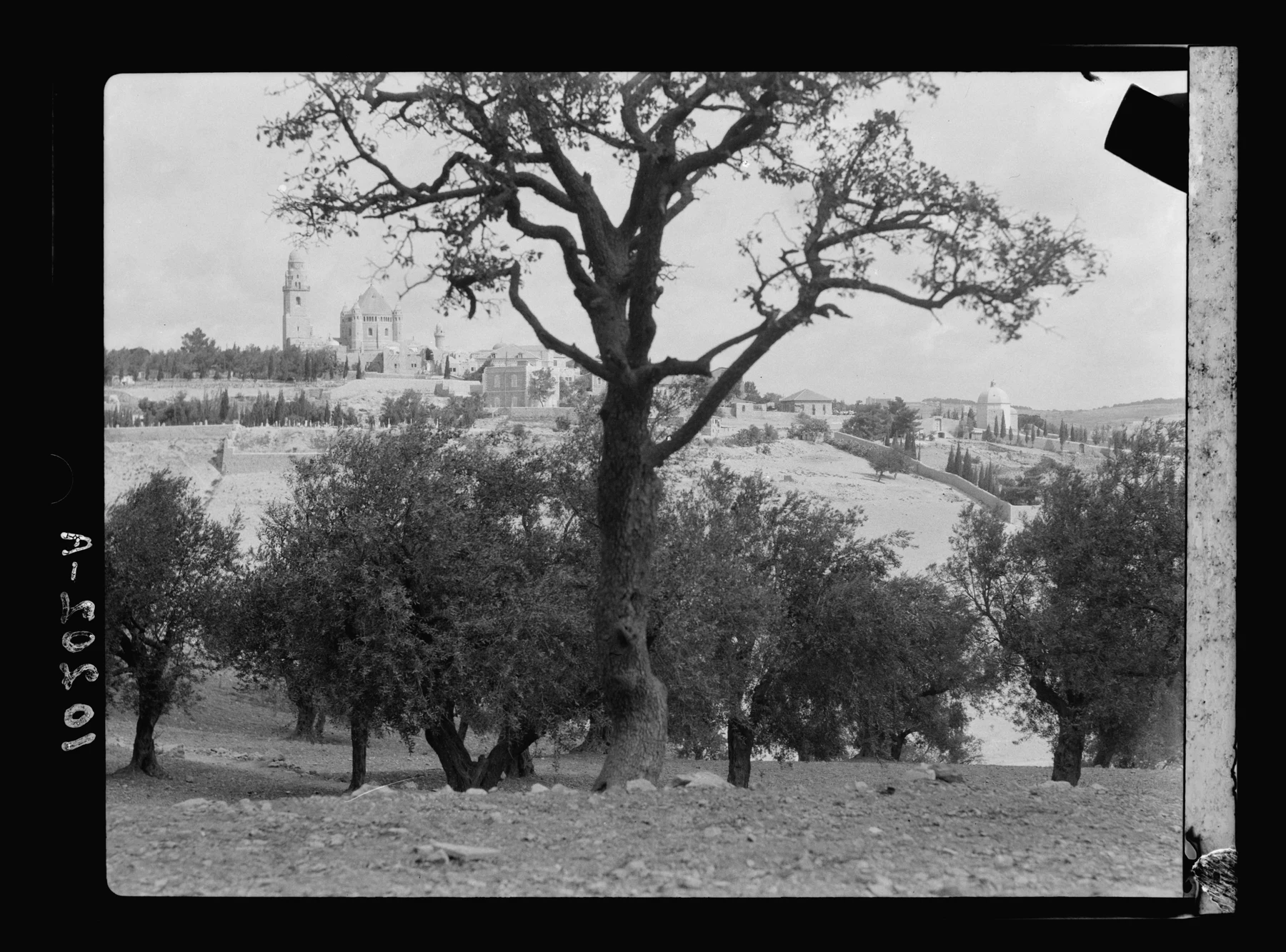
This article follows the witnesses in context, distinguishing what religious texts say from what can be established about the valley historically, and from later interpretation. Its cover is a twentieth-century photograph of the site, not an image of the afterlife.
Guide to the article
- The valley and its name; the condemnation of Topheth and the limits of evidence; Isaiah's fire.
- Jewish apocalypse and the Mishnah; the Gospels and their textual variants; SheolSheol: a Hebrew term for the realm of the deadHebrew word used for death, grave imagery and the abode of the dead in diverse texts; neither later punitive hell nor one specific physical tomb in every occurrence.Glossary · Click to read the explanation and Hades.
- Quranic Jahannam and its interpretation; etymology and transmission; the historical photograph and conclusion.
The Valley of Hinnom before it became an afterlife term
The book of Joshua mentions the “Valley of the Son of Hinnom” in a description of territorial boundaries south and west of JerusalemJerusalemJerusalem is a city of religious importance in Judaism, Christianity and IslamGlossary · Click to read the explanation. At this textual level it is an earthly place with an identifiable geographical setting, not already a name for a site of punishment after death. It is usually associated with a ravine running south and west of the city; precise ancient boundaries must be established through historical geography rather than etymology alone. [2]
We cannot securely identify the individual named Hinnom or supply a biography of him. Nor should the valley be confused with the Ketef Hinnom archaeological locality, known for burials and inscribed finds: a shared geographical designation does not turn those objects into evidence for an afterlife hell.
From the Hebrew place-name to Gehenna
HebrewHebrewA Northwest Semitic language of the Canaanite group, encompassing Iron Age epigraphy, Biblical, Rabbinic, medieval and Modern Hebrew; its scripts and pronunciations changed over time.Glossary · Click to read the explanation texts use forms such as gê ben-Hinnom and gê Hinnom; later forms include Gehinnom, while biblical Greek has Γέεννα and European languages use Gehenna or Géhenne. That linguistic sequence does not imply that the Greek word already contained every later feature of infernal punishment. It records, first, the history of a name entering new settings. Arabic Jahannam is normally explained within this linguistic family, through intermediary Semitic usage; the whole Quranic depiction of punishment cannot be derived from its spelling alone. [20]
It helps to distinguish etymology, the historical relationship between words, from a history of concepts, the study of meanings and images associated with those words. Evidence for the former does not on its own establish the transmission of every scene or teaching from one tradition to another.
Jeremiah and Topheth: denunciation and threat
In the Book of JeremiahBook of JeremiahProphetic book addressing Judah and the Babylonian crisis; chapter 34 recounts liberation followed by renewed subjection.Glossary · Click to read the explanation 7:30–34, people in Judah are rebuked for establishing the high places of Topheth in the valley to burn sons and daughters. The prophet warns that the site will be called the “Valley of Slaughter” and that there will be too little space to bury the dead. This is prophetic denunciation of a practice and a warning of disaster for the city and community, not a systematic description of compartments of a postmortem hell. [1]
Second Kings 23:10 says that King Josiah defiled Topheth to prevent children being passed through fire “to Molekh”; Jeremiah 19:1–9 stages an announcement of judgment in the valley, with a shattered vessel symbolizing the city's destruction. These passages have different literary roles: a report of royal reform, a prophetic charge, and a prophetic symbolic action. Their varying expressions, including references to Molekh and Baal, should not be flattened into a single unproblematic identification of the recipient. Whether molekh in certain contexts is a deity's name or a type of offering remains debated. [3][4]
What the texts establish—and what archaeology cannot yet establish
These passages are strong evidence for a tradition associating Topheth and the valley with burning children and condemned worship. But confirmation of every detail, exact location, date and number of victims would require independent evidence. Archaeological remains have not securely identified the Jerusalem Topheth and its rites in the valley. This uncertainty does not establish that the biblical allegations were fictitious; it prevents treating prophetic accusation as a complete excavation report. [5]
Nor does every mention of children and fire show that all early Hebrew writings taught one doctrine of conscious torment after death. In Jeremiah's warnings the bodies of the dead and the fate of the land and historical community are central.
Was the valley a rubbish dump burning forever?
A frequently repeated story describes refuse and corpses burning continually in the Valley of Hinnom in Jesus' day and presents these fires as the origin of hell imagery. The critical assessment of the evidence does not find an adequate early literary or archaeological basis for such a permanently burning dump. Later discussions quote Lloyd Bailey's objection; for this review his position was examined as reported by a secondary source, not by claiming to have read his entire original article. [25]
The general possibility that cities discarded waste outside their boundaries is not the same as the specific historical assertion of an everlasting incinerator in this valley. The sounder approach is to examine the scriptural images of burial, defilement and judgment before relying on an unverified anecdote.
Isaiah: worms, fire and visible corpses
IsaiahBook of IsaiahProphetic collection in the Hebrew Bible; its first chapter addresses justice and the cases of the fatherless and widow.Glossary · Click to read the explanation 66:23–24 ends with worshippers looking upon the corpses of rebels, whose worm does not die and whose fire is not quenched. These verses do not name the Valley of Hinnom, nor do they on their own explain torment of souls separated from bodies. The scene places dead bodies before onlookers after judgment. Its language of worms and fire nevertheless became important for later writers. [6]
The words “not quenched” cannot settle the philosophical duration of punishment by themselves. In prophetic rhetoric they can stress an unstoppable judgment; subsequent eschatological readings may go on to describe a prolonged destiny.
An accursed valley in 1 Enoch
In 1 EnochFirst EnochA composite Second Temple Jewish apocalyptic collection on the Watchers, parables, celestial cycles, historical visions, and judgment, preserved complete in Geʽez.Glossary · Click to read the explanation 26–27, an accursed valley appears in visionary geography as a place where those under a curse gather for judgment. The sections were checked in R. H. Charles's historical English translation. It contains editorial decisions and textual comparisons and is not a new independent reading of the ancient languages. Associating the visionary valley with the Jerusalem Hinnom Valley is a defensible scholarly interpretation supported by contextual features; the examined verses do not explicitly name it “Gehinnom.” [7]
Jewish literature of the Second Temple periodSecond Temple JudaismDiverse Jewish traditions between the rebuilding of Jerusalem’s temple around 515 BCE and its destruction in 70 CE: institutions, diaspora, groups and texts, with distinctions between events, composition, manuscripts and the limits of evidence.Glossary · Click to read the explanation increasingly developed a variety of images of judgment after death or at the end of time. They should not be lined up as a single, certain evolutionary chain from Jeremiah directly to every subsequent Christian or Islamic representation. Scholarly surveys instead recognize several strands of thought. [8]
Gehenna in rabbinic literature
The Mishnah, Eduyot 2:10, states that the judgment of the wicked in Gehinnom lasts twelve months, and also records a shorter estimate attributed to Rabbi Yohanan ben Nuri. This makes clear that Gehinnom became part of the vocabulary of judgment, while showing disagreement over duration within one tradition. [9]
Later rabbinic compilations include accounts of Gehenna's entrances, names, locations and the fates of different people. These do not amount to one official doctrine held by every Jewish community in every century. Nor should each element be projected back onto the ancient valley. The historical Jewish Encyclopedia entry was consulted for comparison with the Mishnah rather than substituted for that primary passage. [10]
Gehenna in the Synoptic Gospels
Gehenna appears in sayings attributed to Jesus in Matthew, Mark and Luke. Mark 9:43–48 associates it with forceful warnings, fire and worms; Matthew 10:28 speaks of the destruction of both soul and body in Gehenna; and Luke 12:4–5 invokes the authority to cast someone there after death. The three contexts do not make the same argument in exactly the same language, and none provides a survey of the physical valley in the first century. [13][14][15]
Many translations simply render the term as “hell”, enfer, or another general equivalent, obscuring the place-name in the original wording. Retaining “Gehenna” where appropriate makes that history of usage easier to examine.
A textual problem in the numbering of Mark
Some older editions repeat the clause about the undying worm and unquenched fire at Mark 9:44, 9:46 and 9:48. Yet several important early Greek witnesses omit verses 44 and 46; critical editions therefore generally regard them as repetitions inserted from verse 48. Mark 9:48 remains a textual witness to the imagery. Counting all three verses without mentioning their manuscript status would exaggerate the number of independent attestations. [12]
Sheol, Hades and the lake of fire are not always synonyms
SheolSheol: a Hebrew term for the realm of the deadHebrew word used for death, grave imagery and the abode of the dead in diverse texts; neither later punitive hell nor one specific physical tomb in every occurrence.Glossary · Click to read the explanation in many Hebrew Bible contexts is the realm of the dead. Hades, the abode of the deadHades, abode of the deadHades is a Greek name for the abode of the dead, whose function varies with the text.Glossary · Click to read the explanation, has several functions in Greek writings and translations. In RevelationBook of RevelationChristian apocalypse commonly dated in its present form to the late first century CE, reusing earlier scriptural imagery.Glossary · Click to read the explanation 20:14, “Death and Hades” are thrown into “the lake of fire.” That scene itself distinguishes Hades from the lake of fire; neither expression should automatically be equated with Gehenna merely because a modern translation uses “hell” for more than one of them. [16][8]
Likewise Arabic translations of the Bible may use Jahannam as a translator's choice rather than as the original word written in Hebrew or Greek. Comparative claims require checking the actual word at each passage.
Jahannam in the Quran: name and imagery
The QuranThe QuranThe central scripture of Islam, consisting of 114 Arabic surahs; its study distinguishes Quranic discourse from manuscript history, reading traditions, and historical inference.Glossary · Click to read the explanation uses Jahannam as the name of a destination of punishment. In al-Hijr 15:43–44, it has seven gates, with an apportioned group for each gate. That is an explicit statement about gates, not, by itself, a settled list of seven named levels. Such lists are elaborated and vary in later exegetical and narrative sources. [21]
Al-Naba' 78:21–30 describes Jahannam as lying in wait and as a destination for transgressors, with imagery of hot liquids, reckoning and requital. Al-Nisa' 4:56 describes skin being replaced so that punishment is felt again. Qaf 50:30 depicts a question addressed to Hell about whether it has been filled. Together, these form a Quranic discourse with its own rhetorical organization, not merely a renamed ravine outside Jerusalem. [22][23][24]
The related word and the limits of transmission hypotheses
Mahmoud Omidsalar, writing for Encyclopaedia Iranica, traces Jahannam to Hebrew Gehinnom and rejects speculative Avestan derivations. This supports the historical kinship of the term; possible Aramaic or SyriacSyriacAn Aramaic literary language rooted in Edessa, first attested in non-Christian inscriptions and later prominent in Christian writing, scholarship, translation and liturgy.Glossary · Click to read the explanation intermediaries are not proved in precise detail by that article alone. Conversely, similarity of infernal vocabulary or numbered gates cannot prove a single route of borrowing or full equivalence between all traditions' depictions of judgment. [20][8]
A critical distinction is between the Quranic statement that Jahannam has seven gates and commentators' schemes of levels, inhabitants and names. Identifying an additional interpretive layer does not deny its existence; it attributes it to the appropriate sources.
The valley photograph and its evidentiary limits
The retained photograph looks toward Mount Zion from the Valley of Hinnom and was taken by the American Colony (Jerusalem) Photo Department between 1934 and 1939. The Library of Congress holds the original nitrate negative under digital reproduction number `LC-DIG-matpc-19029` and reports no known publication restrictions. It cannot show the ancient rites of Topheth or any eschatological realm: it documents the appearance of the valley when photographed. [26]
Conclusion: several historical levels, not one map
We can follow a geographical name in boundary descriptions, judgment associated with the valley in Jeremiah, and later eschatological Gehenna in Jewish and Christian writings and Jahannam in the Quran. This does not make all the texts descriptions of the same physical location, or Jeremiah's concern with children, death and the city identical to detailed accounts of final judgment. Sound historical comparison specifies each source, its textual period, the kind of image it uses, and the certainty of its conclusions—making differences as visible as connections. [1][6][21]
References and notes (22)
- Book of Jeremiah 7:30–34, public-domain King James Version; all five verses read. 7:30–34; translation KJV, not a Hebrew critical edition Return to the text ↑
- Joshua 15:8, Ben-Hinnom in a boundary description; verse checked in displayed English translations. Joshua 15:8 only; not the whole book Return to the text ↑
- 2 Kings 23:10 in the presented Hebrew and English within Daniel Vainstub’s essay; Josiah section. Paragraphs around 2 Kings 23:10; the displayed transcription and translation, not the whole biblical book Return to the text ↑
- Jeremiah 19:1–9 in the King James Version; vessel and Valley of Slaughter scenes. 19:1–9 only; English translation Return to the text ↑
- Daniel Vainstub, “Molekh: The Sacrifice of Babies” (13 May 2024); read Judahite rites, molekh interpretation and Josiah sections; no field archaeology performed. Relevant subsections and qualifications only; not an independent excavation report Return to the text ↑
- Isaiah 66:23–24 in the public-domain English KJV; corpses, worm and fire. Both verses, English translation only Return to the text ↑
- 1 Enoch 26–27 in R. H. Charles’s historical English translation; read the accursed-valley passage and visible variant comparisons, not ancient-language originals. Chapters 26–27 only; historical English translation Return to the text ↑
- Oxford Bibliographies, “Hell” (2013); publisher’s public abstract only, not the restricted chapter. Abstract only; full chapter unavailable Return to the text ↑
- Mishnah Eduyot 2:10; checked displayed Hebrew and published English translation concerning the duration and dissent. 2:10 only; displayed Hebrew and English translation, not a manuscript collation Return to the text ↑
- Kaufmann Kohler and Ludwig Blau, “Gehenna,” Jewish Encyclopedia (early twentieth century); historical and judgment sections inspected, not an entire printed volume. Relevant entry sections only; older secondary synthesis Return to the text ↑
- NET Bible textual-critical notes on Mark 9:44 and 9:46; assessed listed manuscript witnesses as reported, without consulting those manuscripts. Textual-critical notes for verses 44 and 46 only Return to the text ↑
- Mark 9:42–50, displayed Greek, Latin and English on New Advent; passage checked, not primary manuscripts. 9:42–50; displayed editions and numbering differ Return to the text ↑
- Matthew 10:28; printed Greek verse and displayed English translation read on Online Greek Bible; no Greek textual collation. Matthew 10:28 alone; displayed Greek edition and English translation Return to the text ↑
- Luke 12:4–5; English translations and printed Greek-term note identifying Gehenna in 12:5. Luke 12:4–5 only; translations and publisher’s lexical note Return to the text ↑
- Revelation 20:14; parallel English translations showing Hades distinct from the lake of fire. Revelation 20:14 only; parallel translations Return to the text ↑
- Mahmoud Omidsalar, “Hell ii. Islamic Period,” Encyclopaedia Iranica (2000; updated 2013); etymology, gates/levels and selected paragraphs read; cited underlying works not independently checked. Etymology and selected sections, not all cited books Return to the text ↑
- Quran, al-Hijr 15:43–44; both complete Arabic verses and the displayed translation read. 15:43–44, Arabic primary text and displayed translation Return to the text ↑
- Quran, al-Naba 78:21–30; all ten Arabic verses and displayed translation read. 78:21–30 only, original Arabic and displayed translation Return to the text ↑
- Quran, al-Nisa 4:56; Arabic verse and displayed translation on replacing skin. 4:56 only, Arabic and displayed translation Return to the text ↑
- Quran, Qaf 50:30; Arabic verse and displayed translation of the question posed to Jahannam. 50:30 only, Arabic and displayed translation Return to the text ↑
- Todd Bolen, “The Fires of Gehenna: Views of Scholars” (2011); sections quoting Bailey 1986, Kimhi and other scholars read. Bailey’s original paper was not read. Article paragraphs discussing the refuse-dump claim, secondary reporting only Return to the text ↑
- Library of Congress, “Mt. Zion from valley of Hinnom”; complete item catalogue metadata read and compared with attached image; 1934–39, LC-DIG-matpc-19029. Whole item record and local image; original negative not physically examined Return to the text ↑
Suggest a correction · Suggest a source for this record
Cite this record
IL Archive, «Gehenna and Jahannam: from the Hinnom Valley to the language of punishment», https://ilarchive.com/en/entities/gehenna
Continue reading