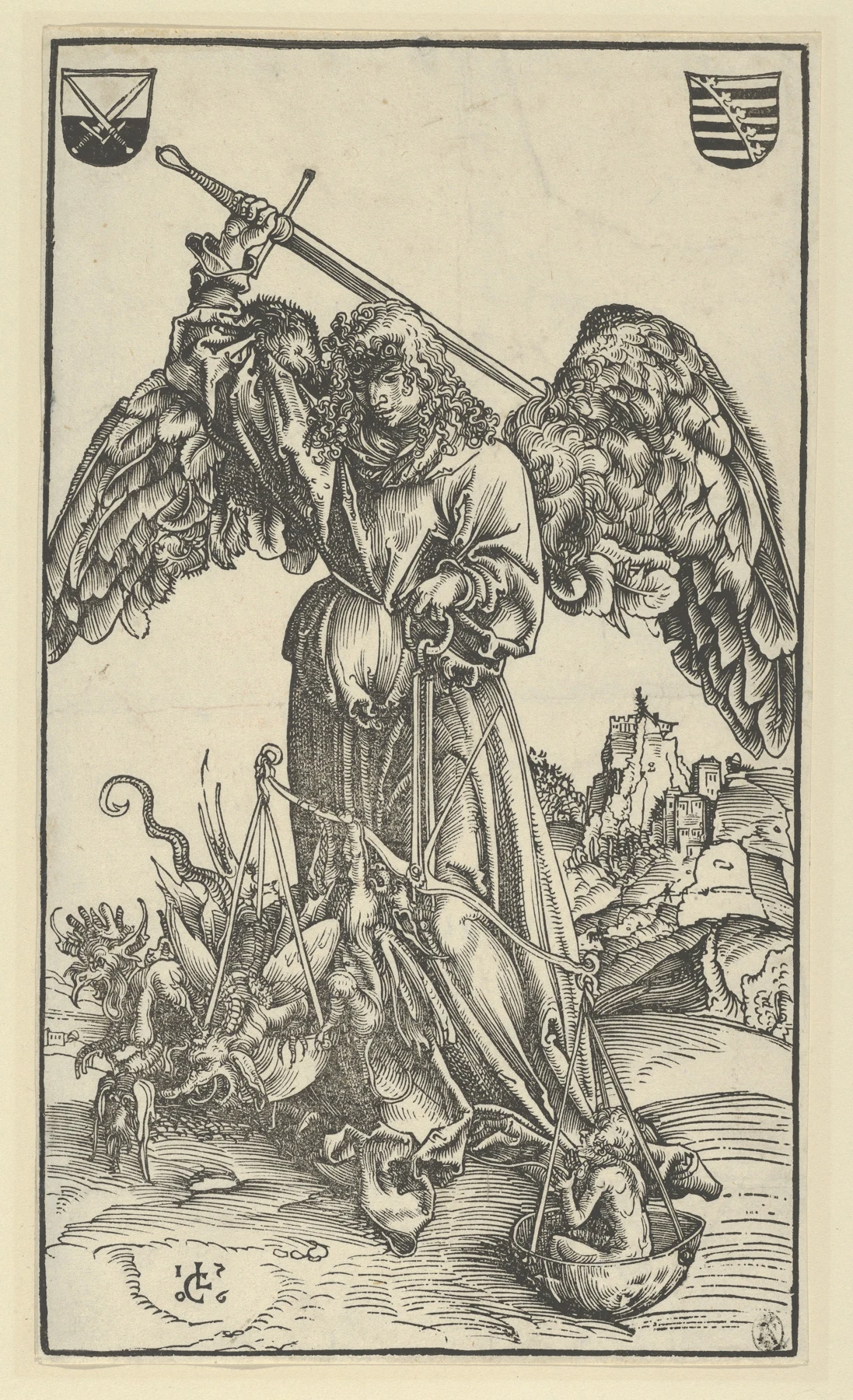
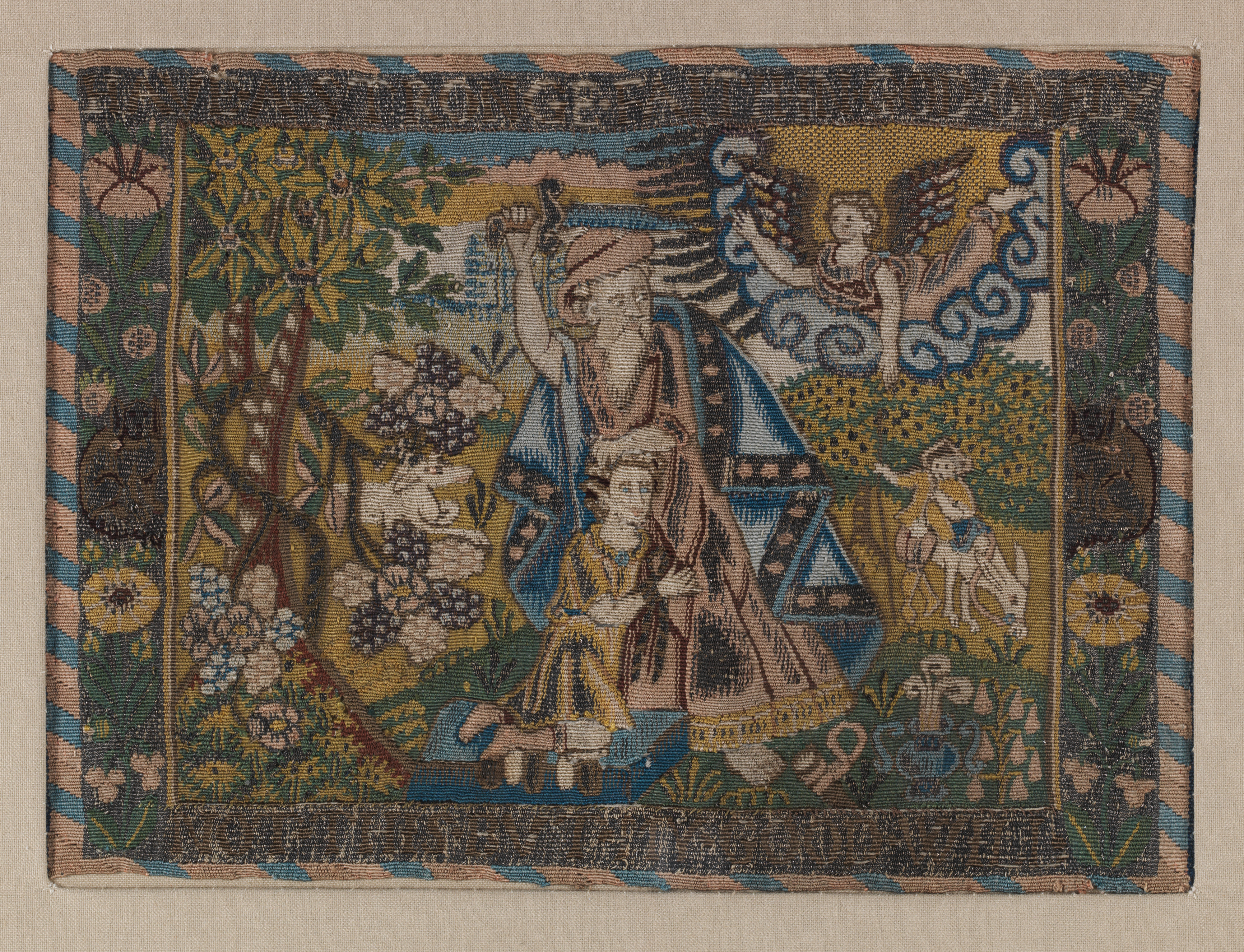
Entity
Testament of Abraham
A reference page linking a name, group, or concept to the materials that discuss it.
An anonymous ancient narrative of Abraham’s death and visit to the court of souls, preserved in two distinct Greek recensions; it explores judgment, mercy and intercession.
Estimated reading time: 9 min Published Last reviewed:
Share article
Text
Introduction
The Testament of Abraham is an ancient story about the approaching death of AbrahamAbrahamCentral figure in Genesis, the Qur'an and Jewish, Christian and Islamic traditions; the sacrifice study compares what each text says about him.Glossary · Click to read the explanation, Isaac’s father in the biblical narrative, and his journey to see the world and the judgment of souls. It is not a will written by the historical Abraham, part of GenesisBook of GenesisHebrew book of the Torah containing Noah’s flood, survival offering and covenant with living creatures.Glossary · Click to read the explanation, or the separate work called the Apocalypse of Abraham. Its interest here lies in how later traditions reshaped the righteous patriarch and explored death, justice and mercy through a story combining solemnity with incongruity.
The longer Greek recension A must be distinguished from the shorter B. Their differences concern not just length but the sequence of events, characters and the fate of souls. Our question is not what the afterlife actually looks like, but how this text imagined judgment—and why Abraham himself needed to learn mercy.[1]
The book and its chronology
The title “testament” prepares the reader for a dying father’s farewell. Yet Abraham postpones his departure and, in the long recension, never delivers an extended testamentary discourse summing up his teaching for his children. The work combines a testamentary setting, an angelic visit and a revelatory journey: a heavenly guide reveals things normally hidden from human sight. Its author is unknown; it is not contemporary testimony to the life of its protagonist.[1]
- Narrative time: the end of Abraham’s life within the world of the biblical patriarchs. This setting supplies no absolute date for the book’s composition. In A, SarahSarahAbraham's wife and Isaac's mother in Genesis; her story with Hagar and Ishmael appears in chapters 16 and 21, not in the Genesis 22 scene itself.Glossary · Click to read the explanation, his wife and Isaac’s mother, is still alive when he dies, unlike the sequence in Genesis; in B she dies during his absence. This reshapes the story rather than providing a documented historical addition to his biography.[1]
- Proposed composition: Writing in 2017, Meredith J. C. Warren describes most scholars as favouring composition before the third century CE, perhaps near the turn of the era. E. P. Sanders favours the late first century CE and a Jewish Egyptian origin. Warren also reports James R. Davila’s cautious position, which assumes Christian composition no later than the fifth century. The dispute concerns provenance and the separation of layers, not simply two equally established dates; neither automatically dates every surviving form.[2][4]
- Surviving witnesses: Schmidt mentions a fifth-century Sahidic Coptic fragment and lists Greek manuscripts including witnesses he dates to the eleventh century and later. These are dates of copies, not of Abraham or proof that a complete original survives.[3]
- Modern editions: M. R. James published both Greek recensions in 1892; Francis Schmidt produced a more extensive critical edition in 1986. An edited text may combine readings or follow a particular witness; it is not automatically identical with one manuscript.[3][5]
The scale of the manuscript evidence has changed since the first edition. James used three manuscripts for B and six for A in 1892; Schmidt was able to examine nine for B and twenty-three for A. Named examples in Schmidt’s inventory include Milan, Biblioteca Ambrosiana, Greek 405 (G. 63 sup.), fols. 164r–171r (eleventh century, B), and Paris, Bibliothèque nationale de France, Greek 770, fols. 225v–241r (dated 1315, A). These details come from a critical editor’s manuscript inventory, not personal inspection of the codices; the counts concern witnesses Schmidt obtained, not every copy in existence.[3]
From hospitality to resistance to death
A opens with Abraham welcoming strangers of every condition near Mamre. God sends MichaelMichael / MīkālA name meaning “Who is like God?”, borne by humans and an angel. The angel protects Daniel’s people, is called archangel in Jude and fights the dragon in Revelation. The Qurʾan names Mīkāl without assigning a task; later traditions develop different roles.Glossary · Click to read the explanation, the story’s chief angel, to announce his approaching death. Hospitality makes the messenger himself reluctant to deliver the news. IsaacIsaacSon of Abraham and Sarah in Genesis; named explicitly in Genesis 22's sacrifice episode, while named after the unnamed-son scene in Qur'an 37.Glossary · Click to read the explanation, Abraham’s son, dreams of the sun and moon, and Michael interprets the vision in relation to separation from his parents. Family emotion and marvels, including the angel’s tears becoming precious stones, accompany the preparation for death.[1]
Abraham does not behave as an invariably obedient hero. He requests a tour of the world before departing, then renews his refusal after the journey. In A 16–20, Death himself becomes a speaking character, initially beautiful, then revealing terrifying forms that explain different ways of dying. Servants die of fright and are revived after prayer. Finally Death tricks Abraham into kissing his hand; the patriarch’s soul leaves him and angels carry it to Paradise. B 14 instead has God remove the soul “as in a dream,” after which Michael carries it away. These endings should not be combined into one event.[1]
Humour does not remove the seriousness of death. The incongruity lies in the righteous friend’s unwillingness to leave life and the powerful messenger’s difficulty in telling him the news. The story gives human fear a place within its portrait of an honoured figure, rather than presenting Abraham without tension or error.[1][7]
The court: who judges and who weighs?
In A 10 Abraham sees wrongdoing on earth and calls down lethal punishments. God stops the tour lest Abraham destroy the world, then directs him to observe judgment. At the broad and narrow gates stands AdamAdamAdam is a figure in Genesis’s narratives of beginnings, linked with Cain, Seth and Abel.Glossary · Click to read the explanation, humanity’s first father in the narrative, grieving for his descendants’ destruction and rejoicing at their salvation. Adam is not the judge Abraham encounters in the following scene.[11]
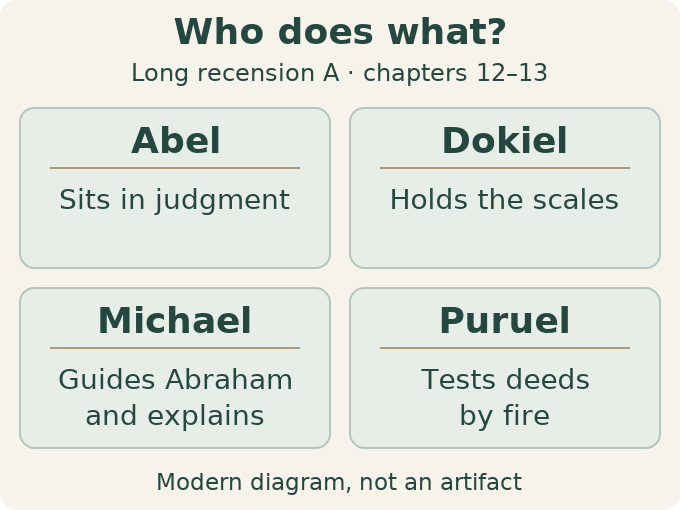
A 12–13 distributes the functions clearly:
- AbelAbelAbel is Adam’s son and Cain’s brother in Genesis, and the judge in the long Testament of Abraham.Glossary · Click to read the explanation, Adam’s son killed by his brother Cain, sits in judgment.
- Two angels record righteous deeds and sins.
- DokielDokielDokiel is an angel in the long Testament of Abraham who holds the scales.Glossary · Click to read the explanation holds the balance and weighs good and evil.
- PuruelPuruelPuruel is an angel in the long Testament of Abraham who tests deeds by fire.Glossary · Click to read the explanation tests deeds by fire.
- Michael accompanies Abraham and explains what he sees; he does not perform Dokiel’s function in this scene.[11]
Scales, writing and fire are complementary ways of representing accountability, not different names for a single mechanism. A 13, as printed by James, also describes successive judgments involving Abel, Israel’s tribes and finally God. This should not be presented as a universal Jewish doctrine or confused with the court’s individual functions; the passage’s redactional history is itself debated.[4][5]
Two passages about learning mercy
The text states its objection to Abraham directly. In A 10 the heavenly voice says, in James’s printed Greek:
This is a direct modern translation of the excerpt, not an ancient English text. The passage appears on p. 88 of the 1892 edition; the quoted words contain no editorial restoration brackets. The paradox is that the righteousness praised at the beginning does not itself ensure understanding of a wrongdoer: Abraham judges by an action he observes, not the person’s entire life.[5]
In A 12–14 the judge encounters a soul whose good and bad deeds balance exactly, leaving its fate undecided. Abraham proposes praying for it with Michael; after their prayer it is taken to Paradise. He then returns to the victims of his earlier petitions and seeks mercy for them, saying in A 14:
The words appear on p. 94 of James’s edition; the direct translation here involves no proposed restoration. The movement from “has not sinned” to an admission of wrongdoing grounds a reading of the character’s transformation; it is not simply a modern interpretation imposed on the story. God’s reply grants forgiveness and restores those who perished to life, although this passage alone does not spell out every detail of their subsequent condition.[6]
Yet the contrast is not simply between a harsh human and a merciful God: the initial punishments were carried out, and human prayer then affected the outcome. Warren’s study highlights this tension. A is best read here as exploring the interaction of judgment and intercession, not offering an arithmetic formula that makes mercy unnecessary.[4]
Why “the abridged version” is not enough
A has twenty chapters and B fourteen in the usual division. B 8–11 also depicts the court, but EnochEnoch son of JaredEnoch son of Jared is a figure in the genealogy of Genesis 5, seventh when counted from Adam.Glossary · Click to read the explanation, the biblical figure associated with traditions of heavenly writing, acts as scribe and witness. In B 10 a woman is condemned after her daughter’s murder and her denial of the crime are exposed; this is not an equivalent replacement for the rescued soul in A 14. In Box’s chapter sequence, earthly punishments occur in B 12 after the court visit, whereas they precede it in A 10. New Advent places part of B 12 earlier on its page; that webpage order is not an independent manuscript numbering.[1][11]
The judge’s question in B 10 makes the difference sharper. The following is G. H. Box’s 1927 English translation, p. 49, not a quotation from a Greek B manuscript examined here:
The woman’s deeds initially appear evenly balanced, but testimony recorded in the books exposes her murder of her own daughter and her denial. This is not another instance of the balanced soul saved in A 14: both the evidence and the verdict differ. The quotation above is Box’s mediated English rendering, not a newly established Greek reading.[1][4]
A’s structure clearly connects punishment, learning and intercession, making it a useful basis for explaining that progression. Sanders likewise judges A more likely to preserve the earlier work’s contents, while B may sometimes preserve older wording; priority of plot must not be equated with priority of every reading.[2] Ludlow argues that A preceded B and that B toned down its humour; the material available here from his book is the publisher’s description, not the complete detailed argument. Narrative coherence alone cannot prove the priority of every wording or rule out earlier shared traditions. Reading each recension as it stands is therefore distinct from reconstructing their lost antecedents.[7][3]
Origins, reception and comparison
Biblical names, hospitality and ascent make an investigation of Jewish backgrounds understandable. Christian communities nevertheless preserved the text, whose surviving forms include overt Christian formulations, including praise of Father, Son and Spirit in the printed endings. Warren notes that the narrative does not emphasize Sabbath observance, circumcision or specific Torah requirements, nor make Christ the eschatological judge; biblical names or the communities preserving manuscripts cannot therefore settle its origin on their own. Such formulations do not date the whole story, and removing them does not automatically recover an uncontaminated Jewish original. Nor can an Egyptian origin be demonstrated merely by the presence of scales or a heavenly court: wording, structure, chronology and contexts of contact must be examined.[1][2][4]
A catalogue offers a concrete example of later reception, not an early date for composition. The Beta maṣāḥǝft project describes Cambridge University Library, Or. 1878, as a nineteenth-century Ethiopic manuscript containing the Testament of Abraham in Gǝʿǝz on fols. 5r–19v, followed by the Testaments of Isaac and Jacob. We consulted the catalogue description and folio references, not the manuscript’s text or images. This copy’s date must not be treated as the composition date of Abraham’s testament.[8]
The work circulated in other linguistic traditions, including Coptic, Arabic, Ethiopic, Slavonic and Romanian. This transmission does not mean that every version preserves identical roles and endings. For the Archive, it is both a witness to the rewriting of Abraham and a demonstration of why a recension must be specified before comparing religious representations of judgment and intercession. The focus remains identifiable texts, not a supposed chain of borrowing inferred solely from similar scenes.[2]
References and notes (9)
- G. H. Box, The Testament of Abraham (1927). Both recensions and their notes were read in full on pp. 1–54. Box translated the Greek; S. Gaselee translated the separate Coptic Isaac/Jacob appendix, not the Abraham text used here. B’s sequence and ending remain distinct from A. Recension A, chapters 1–20, pp. 1–38; recension B, chapters 1–14, pp. 39–54; especially A 1–9 and 15–20, B 12–14. Return to the text ↑
- E. P. Sanders, “The Testament of Abraham,” in Outside the Old Testament (1986), pp. 56–70. Only the extract displayed on Cambridge’s chapter page was read, not the complete chapter; used for its proposed date, provenance and linguistic traditions. Online publication in 2012 is not the ancient composition date or the book’s print date. Public extract: opening paragraph and “The textual witnesses.” Return to the text ↑
- Francis Schmidt, Le Testament grec d’Abraham (1986). Read the preface p. V, publication details and contents, pp. 1–6 of the publisher preview, and an excerpt on p. 12. It includes witnesses absent from James and favours a manuscript family and base witness over a hypothetical composite original. The complete edited Greek text and translation were not read. Manuscript dates cited here belong to Schmidt’s inventory, not a claim about every subsequent redating. Preface p. V: Sahidic fragment; pp. 1–3: witness inventory; pp. 4–5: editorial method. Return to the text ↑
- Meredith J. C. Warren, “Human and Divine Justice in the Testament of Abraham” (2017), in The Embroidered Bible, pp. 928–940. The accepted manuscript was read in full. Davila’s provenance argument and the redactional discussion of A 13 are reported through Warren and her notes, not from a complete reading of Davila’s book or Dochhorn’s study. The interpretation of judgment and intercession also rests on directly read A 10 and 12–14. Accepted manuscript, sections 1–4; n. 1 on dating; nn. 5–6 and 10–12 on provenance and redaction. Return to the text ↑
- M. R. James, The Testament of Abraham (1892), recension A, in the Open Greek and Latin/Harvard transcription. Chapters 10, 13, 14 and 20 were read, distinguishing the apparatus from the running text. The first excerpt and its modern translations follow printed A 10, not the modern interpretive cover. Absence of restoration brackets does not establish agreement among all manuscripts. Chapter 10, p. 88, ἰδοὺ γὰρ…οὐκ ἐλεᾷ; chapter 13, pp. 92–93; compared with Box, pp. 16–17 and 21–23. Return to the text ↑
- Abraham’s confession in printed James A 14, with direct modern translations in each language and comparison with Box. The subsequent reply granting forgiveness and restoration to life was also read. The excerpt alone does not establish a universal doctrine about the fate of all the dead. Recension A, chapter 14, p. 94: νῦν ἔγνωκα…ἡμῶν; reply on pp. 94–95; Box, pp. 23–25. Return to the text ↑
- Jared Ludlow, Abraham Meets Death: Narrative Humor in the Testament of Abraham; publisher page for ISBN 9780826462046 (dated 1 February 2003 there). Only the publisher description was read: A’s priority and B’s reduction of humour. No unexamined detailed manuscript argument is attributed to that description. The idea was compared with Box’s actual narratives and Warren’s discussion. Publisher “Description”; no claim to unconsulted internal pages. Return to the text ↑
- Beta maṣāḥǝft, Pietro Maria Liuzzo, “Cambridge, Cambridge University Library Collections, CUL Or. 1878,” catalogue record derived from Cambridge’s Ethiopian manuscript catalogue. Catalogue description only; neither the Gǝʿǝz manuscript text nor manuscript images were inspected. The licence for the catalogue text does not establish rights to reproduce any manuscript photographs. CUL Or. 1878 catalogue: dating, contents, and Testament of Abraham on fols. 5r–19v; metadata only. Return to the text ↑
- W. A. Craigie’s Testament of Abraham translation in Ante-Nicene Fathers 9 (1896 according to the page), revised for New Advent. The judgment scenes in both recensions were read and compared with Box and the long Greek text. This preserves the previous entry’s source while noting that the webpage moves part of short chapter 12 before the rest of chapter 8; webpage order is not used to establish manuscript sequence. Long recension 10–14, especially 13; short 8–12, especially 10–11; translator information at the foot of the page. Return to the text ↑
Suggest a correction · Suggest a source for this record
Cite this record
IL Archive, «Testament of Abraham», https://ilarchive.com/en/entities/testament-of-abraham
Continue reading