Entity
Apocalypse of Abraham
A reference page linking a name, group, or concept to the materials that discuss it.
An apocalyptic pseudepigraphon attributed to Abraham, surviving in East Slavic manuscripts: critique of Terah’s idols, then ascent with the angel Yahoel. The entry separates possible ancient composition from medieval transmission.
Estimated reading time: 10 min Published Last reviewed:
Share article
Text
Introduction
The Apocalypse of Abraham, also called the Revelation of Abraham, is a pseudepigraphal work attributed in its story to AbrahamAbrahamCentral figure in Genesis, the Qur'an and Jewish, Christian and Islamic traditions; the sacrifice study compares what each text says about him.Glossary · Click to read the explanation. It combines a young Abraham's rejection of the idols made in TerahTerahFather of Abram, Nahor and Haran in Genesis; later idol-breaking narratives give him different roles.Glossary · Click to read the explanation's household with a visionary ascent that discloses heavenly worship, the history of Abraham's descendants, and the end of an unrighteous age. It is not a document from Abraham's lifetime: it reinterprets traditions in the Book of GenesisBook of GenesisHebrew book of the Torah containing Noah’s flood, survival offering and covenant with living creatures.Glossary · Click to read the explanation from an ancient Jewish apocalyptic perspective, though it survives through medieval Christian Slavonic transmission. Many scholars favor a setting around or after the destruction of the JerusalemJerusalemJerusalem is a city of religious importance in Judaism, Christianity and IslamGlossary · Click to read the explanation Temple in 70 CE, while the dating and editing of particular layers remain disputed. [13][16]
What work is this, and how is it structured?
A pseudepigraphon is a work presented under the name of an earlier figure without a reliable claim that this figure authored it. This book is not the Testament of AbrahamTestament of AbrahamAn anonymous ancient narrative of Abraham’s death and visit to the court of souls, preserved in two distinct Greek recensions; it explores judgment, mercy and intercession.Glossary · Click to read the explanation, whose Greek recensions deal with the patriarch's approaching death, angelic visitation, and the soul's fate. Nor is it merely one story about smashing idols. The usual division gives chapters 1–8 to a narrative expansion about idols and chapters 9–32 to a revelation concerning sacrifice, ascent, and history. Some recent enumerations finish with 31:12: what Box calls chapter 32 is incorporated into the close of chapter 31 in Kulik's translation. These different numbers do not indicate different works. [6][14][21]
The transmitted whole is united by a theme: idols unable to protect themselves in Terah's house are contrasted with the worship of heaven, and idolatry reappears within the vision of the Temple. In 10:12 the guiding angel identifies himself as the one commissioned to burn Terah's house, explicitly connecting the revelation to chapter 8. This continuity does not prove that both sections were written by one person; it does mean that their final arrangement is more than an unstructured juxtaposition. [6][13][14]
Witnesses, languages, and chronology
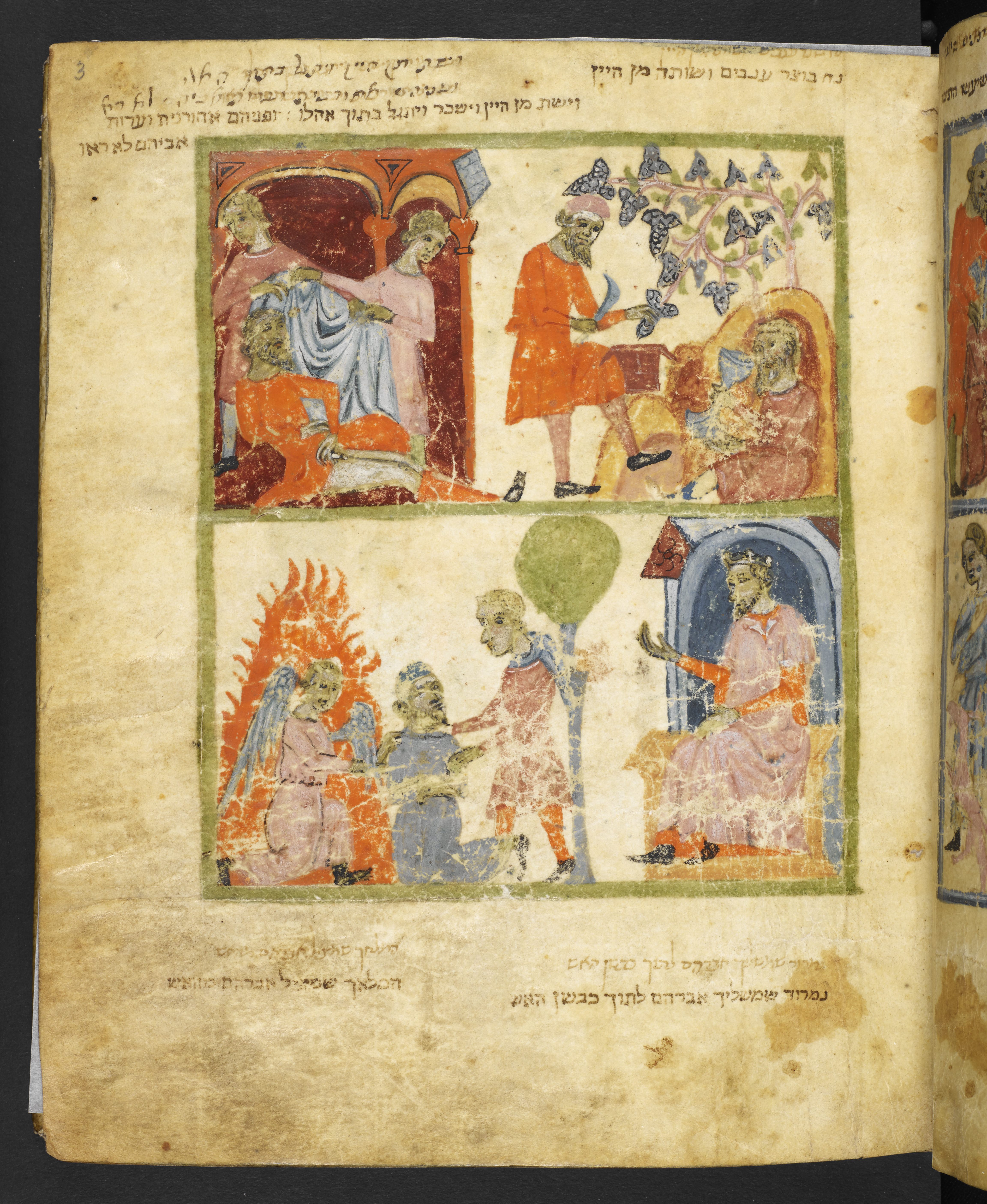
No ancient HebrewHebrewA Northwest Semitic language of the Canaanite group, encompassing Iron Age epigraphy, Biblical, Rabbinic, medieval and Modern Hebrew; its scripts and pronunciations changed over time.Glossary · Click to read the explanation, Aramaic, or Greek manuscript of the Apocalypse of Abraham survives. Its earliest substantial surviving witness is the fourteenth-century East Slavic Sylvester Codex, where the work stands as a separate item within a collection. Other East Slavic witnesses, from roughly the fourteenth through seventeenth centuries, preserve it within the Explanatory Palaea, a compilation combining biblical history with Christian interpretations. Studies describe six relatively full manuscripts alongside excerpts and abridgments. The miniatures in the Sylvester Codex belong to its medieval reception, not to the proposed era of original composition. [13][15]
Linguistic studies argue that a Semitic form, whether Hebrew or Aramaic, lies behind the transmission; a lost Greek intermediary is usually proposed as well. Reconstructing a hypothetical Semitic original from Slavonic is an inference dependent on translators' and copyists' decisions, not a transcription of an extant Semitic document. Alexander Kulik's English version, published with his 2004/2005 textual research, uses square brackets for explanatory supplementation and angle brackets for material absent from the Sylvester witness in his comparison. Those marks should not be read as Abraham's words. Boris Uspenskij has also suggested that some apparent Semitisms entered the Slavonic tradition through medieval revision—a hypothesis not to be imposed indiscriminately upon the entire work. [14][22][23]
The burning of the Temple in chapter 27 is strong evidence for locating the visionary material after 70 CE; a late-first- or second-century date is therefore common. Yet a vision written as a prophecy does not automatically date every sentence, and earlier proposals exist for some traditions. Its geographical setting, Judea or a Jewish diaspora milieu, is not established. A possible resemblance to an Abrahamic tradition in the Clementine Recognitions cannot securely date the entire surviving text. Amy Paulsen-Reed has argued for an early Jewish work close to the Temple's destruction, whose sustained exegesis of Genesis 15 holds the document together. That view still requires the medieval Christian transmission to be assessed on its own terms. [13][16][15]
A short chronology, distinguishing what each date actually describes
- Story time: the biblical-patriarchal era of Abraham; not a verified historical date for a heavenly revelation.
- First and second centuries CE: debated scholarly estimates for composition and layers, with particular attention to the Temple's destruction in 70 CE.
- Fourteenth–seventeenth centuries: surviving East Slavic copies; the Sylvester Codex is an early witness, not an autograph.
- 1863, 1891, 1918–1919, 1987, and 2004–2005: landmarks in editions, facsimiles, translations, and textual criticism—not dates of ancient authorship. [6][13][14][15]
The impotence of idols, chapters 1–8
Abraham works in Terah's workshop making and selling images. A stone idol named Mar-Umath falls, losing its head when it is restored. Three of five other images carried on a donkey are broken when a camel frightens the animal. Abraham argues that what cannot save itself cannot preserve a worshipper, and asks why the maker should become the servant of his product. In chapter 5 a wooden image named Bar-Eshath burns after Abraham assigns it to tend a cooking fire; the idol cannot even protect itself from the heat. [6][14]
Chapter 7 extends the argument beyond manufactured images. Fire is overpowered by water, water by earth, and earth by the sun; the sun, moon, and stars are limited in turn. Abraham's reasoning seeks the creator of all these dependent things. In chapter 8 a heavenly voice calls him away, and Terah's house burns after his departure. The Apocalypse does not narrate Abraham's rescue from Nimrod's furnace, nor does it make the largest image smash the rest. Those are episodes in other Abrahamic retellings, not passages to be inserted here. [14][20]
Sacrifice, angel, and adversary, chapters 9–16
Chapter 9 expands GenesisBook of GenesisHebrew book of the Torah containing Noah’s flood, survival offering and covenant with living creatures.Glossary · Click to read the explanation 15:9–17: a heifer, a goat, a ram, a turtledove, and a pigeon, followed by forty days of preparation. The angel Yahoel (also written Jaoel), bearer of the divine name, raises Abraham, guides him to Horeb, and teaches him a heavenly song. At the sacrifice an unclean bird approaches the carcasses. The angel identifies the adversary as Azazel, drives him away, and contrasts the adversary's allotted earthly realm with Abraham's heavenly portion. This concerns Azazel as portrayed in this work; it does not prove that every occurrence of the name in Leviticus and 1 EnochFirst EnochA composite Second Temple Jewish apocalyptic collection on the Watchers, parables, celestial cycles, historical visions, and judgment, preserved complete in Geʽez.Glossary · Click to read the explanation denotes an identical figure in an identical narrative role. [14]
In chapter 15 Abraham and Yahoel rise on the wings of the two sacrificial birds left uncut in Genesis. Such a creative transformation of the covenantal scene into a heavenly ascent illustrates the work's internal interpretation of Scripture. It does not compel us to posit an otherwise unattested lost source with precisely the same wording. [14][18]
The throne, the voice, and celestial worship, chapters 17–20
Abraham encounters fire and a sound like roaring waters. He recites a hymn with his guide and then beholds a fiery throne, a chariot with many-eyed wheels, and four living creatures, each with four faces and six wings. Motifs recall EzekielEzekielEzekiel is a priest and prophet in the Hebrew Bible, whose book is associated with the Judean exile in Babylonia in the sixth century BCE.Glossary · Click to read the explanation 1 and 10 and Isaiah 6, but they are rearranged: the angel teaches the creatures a hymn of peace, and Abraham hears divine speech from the fire without seeing God's form. It is more exact to call this a creative reuse than a word-for-word copy of Ezekiel. Ezekiel's first vision assigns four wings to each creature, not six, and the prophet himself is not carried upward on the wings of sacrificial birds. [14][15]
Andrei Orlov interprets this emphasis as a reworking of chariot and heavenly-sanctuary traditions around God's name and voice rather than an anthropomorphic divine body. Comparing the texts in detail, John Dik observes that heavenly song prepares the throne revelation and that the withheld human figure is meaningful in the literary composition. This is an argument about a particular text, not proof that all ancient Jewish traditions rejected visible representations of God. [13][15]
The world-image, evil, and the Temple, chapters 21–31/32
From above, Abraham sees a representation of the world with the sea, Leviathan, EdenEden: The Setting of Genesis’s GardenThe place in which the garden of Genesis 2–3 is planted; the story describes rivers, trees and a human test, while its archaeological location and name’s derivation remain unsettled.Glossary · Click to read the explanation, and humanity divided between two sides. He sees Adam and Eve beneath a tree, and a serpent-like figure associated with Azazel and corruption. He asks why evil is permitted if the world's unfolding is already known to God. In chapter 26 the response invokes Terah's will and Abraham's contrary choice while affirming the inevitability of God's purpose. Predetermination and human agency thus coexist in a difficult passage; the work does not offer a single, unambiguous philosophical definition of free will. [14][6]
The Temple scene of chapter 25 returns to the idolatry of the opening narrative. Chapter 27 then depicts the burning of the Temple, deportation, and seizure of its sacred possessions. This carries historical weight for dating the author's outlook but remains a theological interpretation of disaster, not an eyewitness chronicle of the siege of Jerusalem in 70 CE. The conclusion imagines the end of evil in twelve symbolic periods or “hours,” ten plagues, and the regathering of the chosen. These hours are not a reliable calendar of specified historical years. Box prints a short chapter 32; Kulik gives this closing material as 31:9–12. [6][14][16]
The disputed man of chapter 29
In 29:4–13 a man emerges from the side of the nations, is worshipped by some and struck or shamed by others, and receives homage from Azazel. Another statement links a man with Abraham's descendants. Some scholars have identified Jesus and excised the passage as a Christian interpolation. Daniel Harlow instead proposes that the passage may be an integrated Jewish polemic against a falsely worshipped messianic figure, consistent with the book's opening rejection of idolatry. The figure's origin on the nations' side and Azazel's worship support his case. The language about descent and salvation, variant renderings, and the possibility of redaction make certainty difficult. Harlow's particular argument is reported here from the publisher's abstract, not from a claim to have read his restricted full article. [14][17]
The contrast between proper worship in chapters 7, 17, and 25 and misdirected worship in chapter 29 explains why some scholars favor the coherence of the extant whole. Whether one or another clause entered later is a separate textual question. The presence of the work in Christian Slavonic manuscripts and the later addition of exegesis and pictures establish a history of Christian reception; they do not, by themselves, establish Christian authorship of the original work. [13][15][16]
Comparisons and the limits of visual evidence
In the Book of JubileesBook of JubileesJewish retelling of Genesis and Exodus framed as angelic teaching to Moses, adding chronology, narratives and interpretation.Glossary · Click to read the explanation 12:12–14, Abraham himself sets fire to the house of idols, and his brother HaranHaran, brother of AbrahamTerah’s son, Abram’s brother and Lot’s father in Genesis; later narratives explain his death differently.Glossary · Click to read the explanation dies while trying to rescue them. In Genesis RabbahGenesis RabbahJewish exegetical midrash on Genesis, mainly redacted around the fifth century CE in Roman Palestine. It assembles interpretations and narratives from different layers, including 38:13 on Abraham and the idols.Glossary · Click to read the explanation 38:13, Abraham puts a staff into the largest idol's hand after breaking the others and confronts Nimrod's furnace. The stories share a critique of manufactured gods and the setting of Terah's household, but differ in who starts the fire, the outcome, and the sequence. Resemblance alone does not establish a direct line of borrowing or the date of every detail. [19][20][14]
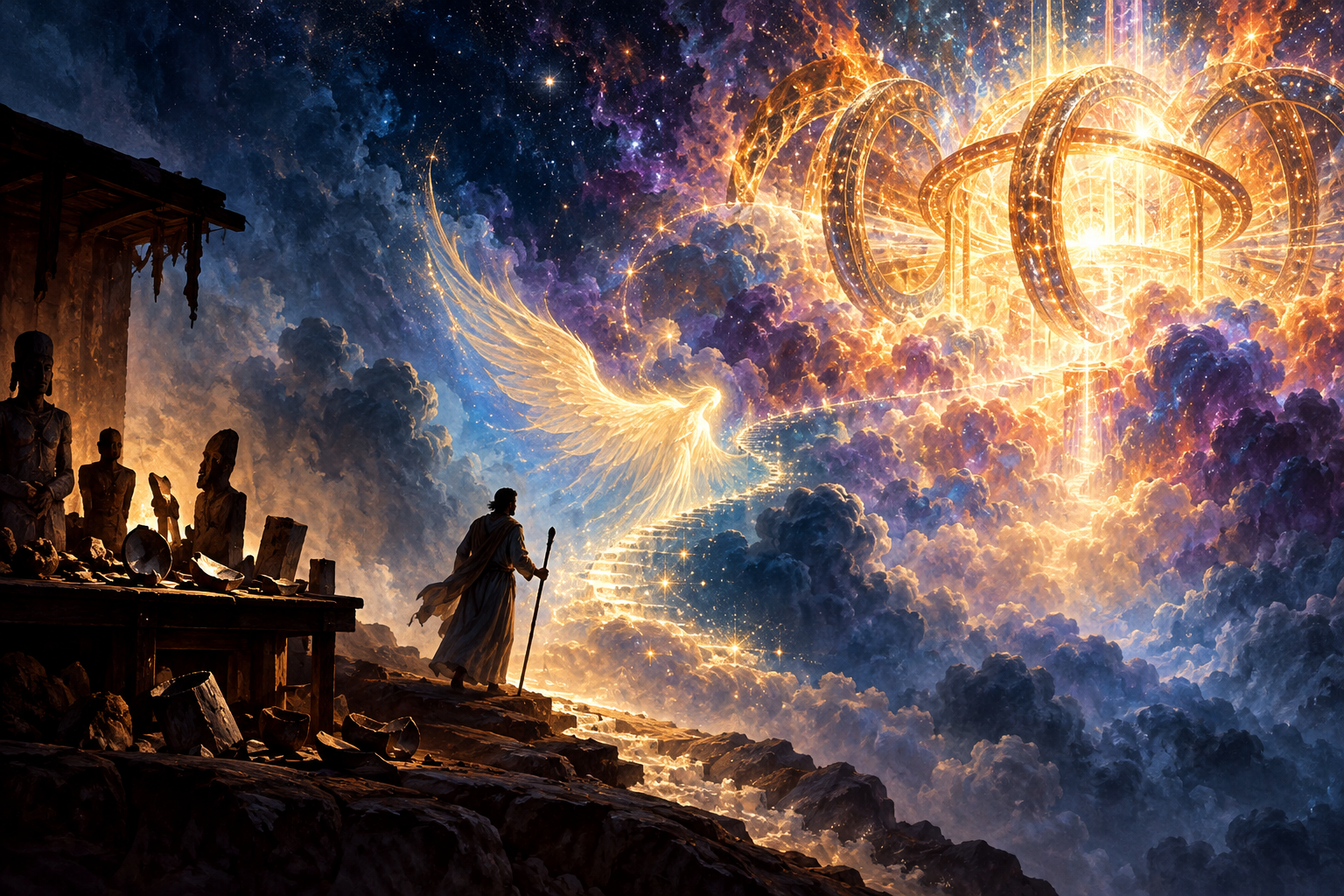
The Sylvester Codex's medieval miniatures testify to a fourteenth-century Christian visualization of the work. Dik notes that one picture portrays God as a human figure on the throne, in tension with the book's refusal to describe a visible divine body. Those miniatures cannot be treated as direct evidence of a first-century Jewish author's mental image. The cover shown here is likewise a newly generated interpretive illustration, combining the idol workshop, visionary ascent, and celestial wheels. It is neither a historical manuscript image nor a verified archaeological reconstruction. [15]
References and notes (12)
- G. H. Box, with J. I. Landsman, The Apocalypse of Abraham, first ed. 1918, second impression 1919; scanned print, introduction, chs. 1–3, 9, 18, 25–32 PDF introduction pp. 5–7; chs. 1–3 pp. 21–23; 9 p. 27; 18 pp. 37–39; chs. 25–32 pp. 45–54 (PDF page numbers, not printed pagination) Return to the text ↑
- Andrei A. Orlov, “Apocalypse of Abraham,” introduction, Marquette University (sections Structure, Manuscripts, Original Language, Date and Theology) Introduction: Structure; Manuscripts; Original Language; Date; Authorship; Theology Return to the text ↑
- Alexander Kulik, The Apocalypse of Abraham, online English translation based on Retroverting Slavonic Pseudepigrapha (2004/2005) Translator’s introduction and chapters 1–31:12, esp. 1–8, 9–18, 21–29, 30–31; ch. 32 in Box = end of 31 here Return to the text ↑
- John Dik, “The reception of Ezekiel’s throne vision in the Apocalypse of Abraham and its manuscript tradition,” Journal for the Study of the Pseudepigrapha 34/2 (2024), 107–126 Full open-access article: Introduction; Throne visions in Ezekiel and Apocalypse; Sylvester miniature; Concluding observations; footnotes 1–4 Return to the text ↑
- Amy Elizabeth Paulsen-Reed, The Origins of the Apocalypse of Abraham (Harvard Divinity School PhD dissertation, 2016) Harvard repository abstract only; full PDF was not successfully opened (HTTP 429). Supports thesis-level claim, not detailed chapter-specific claims. Return to the text ↑
- Daniel C. Harlow, “Anti-Christian Polemic in the Apocalypse of Abraham: Jesus as a Pseudo-Messiah in Apoc. Ab. 29.3–14,” Journal for the Study of the Pseudepigrapha 22/3 (2013), 167–183 Publisher’s abstract and bibliographic information only; full article restricted Return to the text ↑
- Genesis 15:9–17, Hebrew Masoretic passage, Sefaria text viewer Hebrew Genesis 15:9–11, 17 and surrounding narrative; quoted Hebrew words from 15:11 Return to the text ↑
- Jeremiah Coogan, “The reception of Jubilees in Greek catena manuscripts of Genesis,” Journal for the Study of the Pseudepigrapha 31/4 (2022) Open-access article: Introduction and chronographic reception, especially Jubilees 12:12–15 paraphrases in catena and Synkellos Return to the text ↑
- Genesis Rabbah 38:13, narrative of Abraham and Terah’s idols, Sefaria Sefaria’s indexed English rendering of 38:13, including the largest-idol staff, Nimrod, and furnace; no independent manuscript collation Return to the text ↑
- Françoise Mirguet, “Attachment to the Body in the Greek Testament of Abraham: A Reappraisal of the Short Recension,” JSP 19/4 (2010), 251–275 Publisher abstract and notes visible, not subscriber-only full text; Greek two-recension distinction and Michael/death theme Return to the text ↑
- Alexander Kulik, Retroverting Slavonic Pseudepigrapha: Toward the Original of the Apocalypse of Abraham, Brill (2005) Publisher synopsis/bibliography only; conclusions concerning language are cross-checked against Kulik’s freely available translation introduction, not assumed from unread book pages Return to the text ↑
- Boris A. Uspenskij, “Philological observations on the Apocalypse of Abraham,” Voprosy Jazykoznanija 5 (2015), 49–86 Journal abstract only; medieval Jewish revisions presented as author’s hypothesis, not demonstrated via full article Return to the text ↑
Suggest a correction · Suggest a source for this record
Cite this record
IL Archive, «Apocalypse of Abraham», https://ilarchive.com/en/entities/apocalypse-of-abraham
Continue reading