Entity
Genesis Rabbah
A reference page linking a name, group, or concept to the materials that discuss it.
A Jewish exegetical midrash on Genesis, probably redacted mainly in Roman Palestine in the fifth century CE. The entry compares the story of Abraham and the idols with other sources without assuming direct borrowing.
Estimated reading time: 8 min Published Last reviewed:
Share article

Text
Introduction
Genesis Rabbah is a rabbinic collection interpreting the Book of GenesisBook of GenesisHebrew book of the Torah containing Noah’s flood, survival offering and covenant with living creatures.Glossary · Click to read the explanation, rooted in Roman Palestine and usually assigned, in its main stage of redaction, to approximately the fifth century CE. It brings inherited teachings, parables, arguments and stories into conversation with scriptural verses. Neither a single author's commentary nor a uniform expression of Jewish belief, it preserves different voices. Its opening explores creation, its account of AbrahamAbrahamCentral figure in Genesis, the Qur'an and Jewish, Christian and Islamic traditions; the sacrifice study compares what each text says about him.Glossary · Click to read the explanation and the idols amplifies a terse biblical notice, and other passages reflect the Roman world in which rabbis lived. The discussion distinguishes the time of events within narratives, the formation of traditions and compilation, and the much later witnesses that transmit the text. [1][2]
Name, scope and composition
The HebrewHebrewA Northwest Semitic language of the Canaanite group, encompassing Iron Age epigraphy, Biblical, Rabbinic, medieval and Modern Hebrew; its scripts and pronunciations changed over time.Glossary · Click to read the explanation title Bereshit Rabbah (בראשית רבה), conventionally translated Genesis Rabbah, designates an exegetical midrash that follows the sequence of Genesis. Here midrash means an interpretive search within Scripture, carried out through verbal connections, parables, narrative expansions and arguments, rather than merely a glossary of difficult words. The collection belongs predominantly to aggadic or non-legal midrash, unlike works organized chiefly around legal deductions. Larger units, called parashiyyot, are subdivided into passages in commonly used editions. Hence “38:13” identifies a section and subsection in a conventional system, not a folio in one original, uniform manuscript. [1][2]
Sayings are attributed to Palestinian rabbis of more than one generation, including Rabbi Hoshaya, Rabbi Yirmiyah ben Elazar and Rabbi Samuel bar Nahman. Their lifetimes must not be equated with the date of the surviving written formulation. Hoshaya's appearance at the beginning does not make him the author of the entire collection. Rabbinic Hebrew, Palestinian Aramaic and Greek loanwords coexist in the material, placing it within the late antique eastern Roman cultural environment without assigning a date to each individual passage. [2]
Proems and the interpretation of creation
An important device is the petiḥah or proem: an opening exposition of a verse that initially seems remote from the Genesis verse in question but is gradually connected to it. Genesis Rabbah 1:1 opens with Proverbs 8:30 and the word amon, applied to Wisdom. It explores various meanings before taking it as oman, a craftsman or architect. A king's palace, planned with drawings and records, becomes a parable for the creation of the world. [2][3]
In this short Hebrew excerpt, “Thus the Holy One, blessed be He, would look into the Torah and create the world.” The comparison connects the “beginning” of Genesis 1:1 with Wisdom as the “beginning” in Proverbs 8:22. It is a textual and theological image, not a historical report of the mechanics of creation. Some scholars read it against Jewish-Christian debates about Wisdom and the Word; its resemblance to Christian ideas alone does not establish a direct rebuttal of a particular Christian text. [3][2]
Adam and competing interpretive voices
Genesis Rabbah 8:1 offers another example of diversity. In interpreting “male and female he created them” (Genesis 1:27; 5:2), a saying attributed to Rabbi Yirmiyah ben Elazar describes the first human as androgynos, a Greek-derived word suggesting male and female together in that interpretive setting. Rabbi Samuel bar Nahman supplies a different account, of a being formed with two faces or sides before being divided. The discussion reads the “rib” of Genesis 2:21 in light of the alternative sense “side.” [4]
That is, “He created him androgynous,” in the saying attributed to Rabbi Yirmiyah. This is neither a modern biological classification nor the position of every rabbi. The passage shows how distinct exegetical proposals sought to relate different biblical descriptions of the first human. [4]
Abraham, the idols, the furnace and Haran
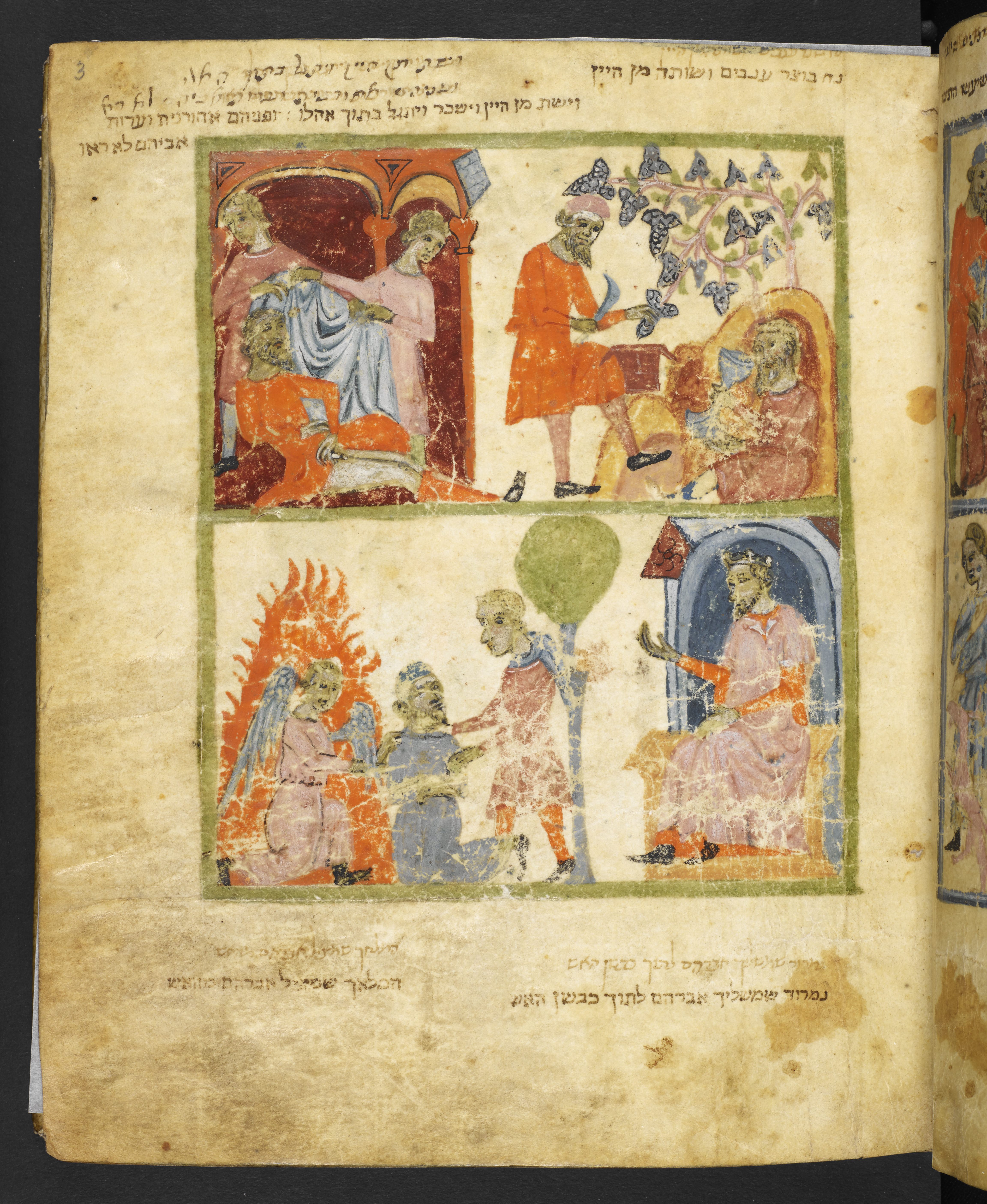
Genesis Rabbah 38:13 expands Genesis 11:28, which records the death of Haran, Abraham's brotherHaran, brother of AbrahamTerah’s son, Abram’s brother and Lot’s father in Genesis; later narratives explain his death differently.Glossary · Click to read the explanation, during the lifetime of his father TerahTerahFather of Abram, Nahor and Haran in Genesis; later idol-breaking narratives give him different roles.Glossary · Click to read the explanation without describing an idol-house fire. The midrash attributes the story to Rabbi Hiyya, grandson of Rabbi Adda of Jaffa. Terah makes or sells idols and leaves Abraham in charge of the shop. Abraham challenges buyers for worshipping objects made only recently, breaks the images, and places the club in the hand of the largest idol. When Terah objects that idols cannot think or act, Abraham exposes the contradiction between this admission and their worship. [5]
Terah hands Abraham over to NimrodNimrodFigure associated with hunting and kingship in Genesis, appearing in Genesis Rabbah as a ruler who opposes Abraham and casts him into fire.Glossary · Click to read the explanation. The ruler proposes worshipping fire; Abraham counters with water that extinguishes it, followed by clouds, wind and human beings. The exchange stages the limitations of successive natural powers as objects of ultimate worship. Nimrod has Abraham thrown into a furnace, but he survives. Haran waits to see which side prevails and only then announces his loyalty to Abraham. When he too is cast into the fire, his innards are burned and he dies before Terah. The ending becomes an explanatory narrative for the biblical wording about Haran's death “before his father.” [5]
“Haran stood there undecided.” The short Aramaic passage is from Genesis Rabbah 38:13 and identifies the moral problem of hesitation, alongside the fire itself. The book of Genesis 11 does not narrate the smashing of the idols or the furnace in this form. Nor does the midrash date a historically verified event in Abraham's lifetime: that is the narrative setting, not the date at which this version was recorded. [5]
A story set in Roman society
The compilation is not restricted to the patriarchs. In 63:8, within the exposition of Esau and Jacob, a narrative features the emperor Diocletian and a rabbinic patriarch called simply “Rabbi” in this version. A parallel in the Palestinian Talmud identifies him as Judah Nesiah. The rabbis receive a summons to Paneas timed so that Sabbath observance makes travel difficult. A wondrous being named Argintin helps them reach the emperor and survive his challenges. The exchange acknowledges imperial authority while preserving a distinctive religious and communal allegiance. [14]
MosheMosesCentral figure in Exodus, Torah traditions and the Qur’an; childhood accounts differ in detail.Glossary · Click to read the explanation Simon-Shoshan reads the narrative within Roman political culture and the late antique world of intermediary or supernatural beings, rather than reducing it to a simple struggle of Jewish virtue against Roman vice. Diocletian reigned from 284 to 305 CE: this dates a figure within the narrated world, not the story's proven composition or an independently verified audience with the emperor. [14]
Comparing Abraham traditions without conflating them
Related motifs occur in other writings, with significant changes of agents and outcomes. In the Book of JubileesBook of JubileesJewish retelling of Genesis and Exodus framed as angelic teaching to Moses, adding chronology, narratives and interpretation.Glossary · Click to read the explanation 12:12–14, a Jewish work generally dated to the second century BCE, Abram secretly sets the house of idols on fire; Haran enters to rescue them and dies. The passage does not depict Abram being cast into Nimrod's furnace. The text was consulted here in R. H. Charles's English translation, based on a tradition preserved principally in Geʽez, not by direct examination of the Geʽez or Hebrew manuscripts. [9][6]
In the Apocalypse of AbrahamApocalypse of AbrahamA self-contained source-critical study of the Apocalypse of Abraham, its Slavonic witnesses, date, idol polemic, heavenly vision, chapter 29, and contrasts with the Testament and other Abrahamic traditions.Glossary · Click to read the explanation 8:1–6, preserved through a Slavonic textual tradition, Abraham is told to leave his father's house, which is then destroyed with Terah inside. Fire has a different function from its role in the midrash. In the QuranThe QuranThe central scripture of Islam, consisting of 114 Arabic surahs; its study distinguishes Quranic discourse from manuscript history, reading traditions, and historical inference.Glossary · Click to read the explanation, 21:51–70, Abraham breaks the idols except for the largest, the people call for him to be burned, and the command is issued, “O fire, be cool and safe for Abraham” (21:69). Those verses name neither Haran nor Nimrod. [7][8]
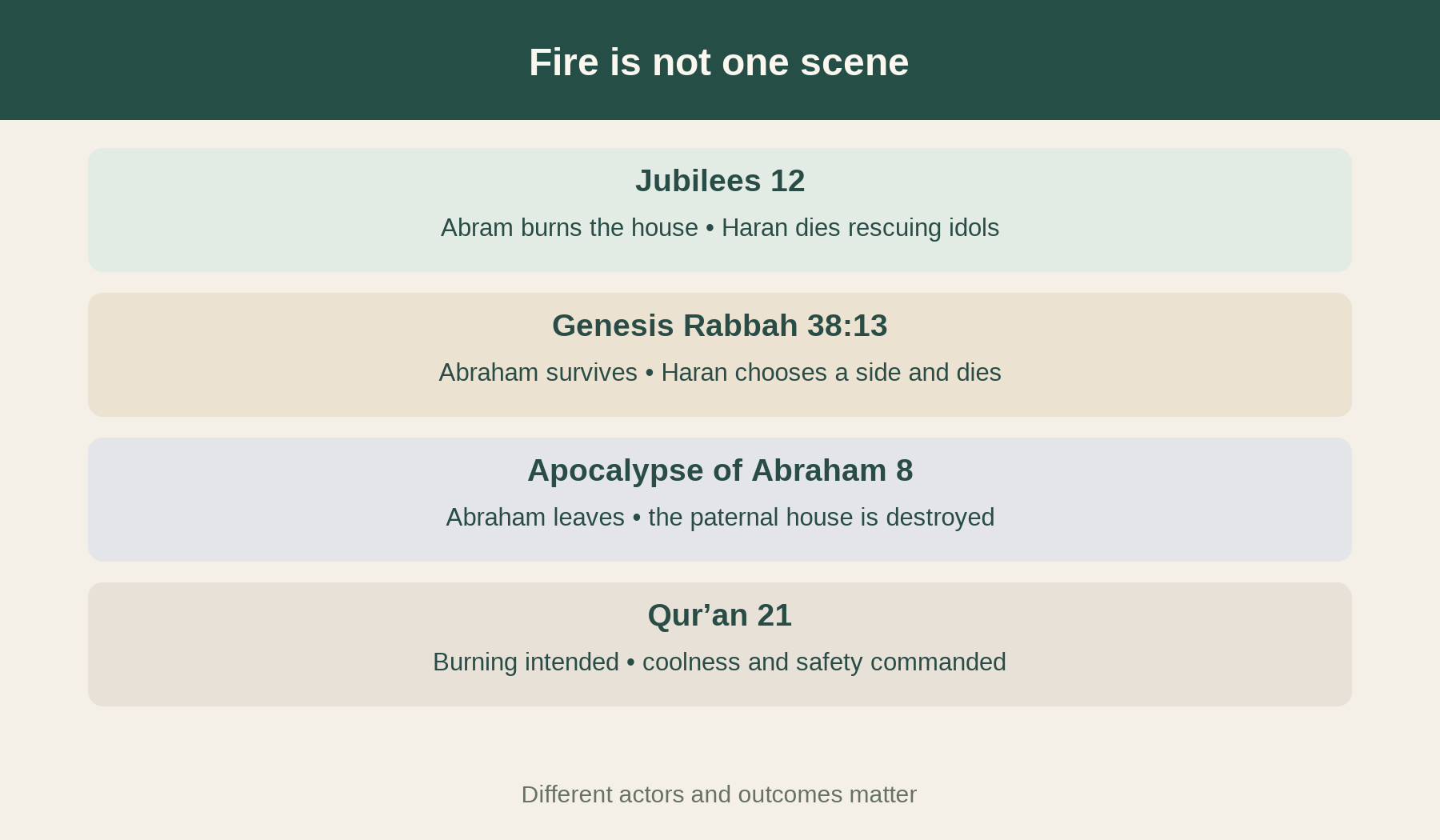
The inherited four-way comparative diagram is a modern editorial aid, not an ancient artifact or a proven route of literary borrowingLiterary borrowingUse of verbal or narrative material from an earlier text or tradition in a later work, distinguishing evidence of transfer from mere resemblance.Glossary · Click to read the explanation. The fire involves an idol-house, a paternal home or Abraham's furnace depending on the account, while Haran's role and the person who initiates the burning also differ. The texts may draw on overlapping repertoires of stories and exegesis, but similar images cannot establish the direction of influence between surviving literary versions, especially given their different redactional dates and modes of transmission. [2][6][7][8]
A brief chronological framework
- Approximately the second century BCE The usual proposed date for the composition of Jubilees, not for the events it narrates about Abraham. [9]
- Late third to early fourth century CE The reign of Diocletian evoked by Genesis Rabbah 63:8; the passage's own date remains uncertain. [14]
- Approximately the fifth century CE The probable main compilation and redactional phase of Genesis Rabbah in Roman Palestine, incorporating earlier sayings and subject to later additions. [1][2]
- Seventh century CE The appearance of the Quran as an independent literary witness compared here, not evidence for one manuscript form of Genesis Rabbah.
- Eleventh and twelfth centuries The approximate dates of significant manuscripts such as Vatican Hebrew 30 and the London witness used in the critical edition, centuries after the presumed principal redaction. [10]
- 1512 CE onward An early printing in Constantinople and, much later, critical editorial work by Julius Theodor and Chanoch Albeck in the twentieth century. [10][2]
Manuscripts, editions and citation limits
Common printed editions contain one hundred major sections, whereas the divisions found in manuscripts examined by scholars range from 97 to 101. This reflects changing compilation, textual transmission and organization, not merely an arithmetical error. Vatican Hebrew MS 30 is a particularly important witness; the London manuscript selected by Theodor represents another textual form, whose relative merits scholars have assessed. Neither should be treated as an autograph contemporary with the fifth-century editorial layer. Portions of the final sections have also prompted specific questions about later accretions. [2][10]
The Theodor–Albeck critical edition began appearing in the early twentieth century and makes variant readings more visible; it does not prove there was one immutable original. The examples above use the customary electronic subsection numbers 1:1, 8:1, 38:13 and 63:8. Short passages were checked in accessible textual transcriptions, not collated directly against every manuscript image. Consequently no quoted wording here is attributed to a specific surviving folio. A claim based on small verbal differences would require identifying and comparing the precise edition and manuscript witnesses. [2][3][4][5][10]
What the collection can and cannot establish
Genesis Rabbah documents varied Jewish approaches to scriptural interpretation in late antiquity, not a single author's voice or a direct historical chronicle of the patriarchs. Its accounts of creation, the first human, Abraham's challenge to idolatry and Roman authority show several distinct literary functions. Reconstructing the oldest version of any one tradition and tracing its movement between communities are separate historical questions requiring detailed textual comparison; neither the approximate date of the collection nor a shared fire motif resolves them. [2][14]
References and notes (11)
- Austrian Academy of Sciences, Genesis Rabbah project, collection overview, date, languages and bibliography. Overview page; principal redaction around the fifth century. Return to the text ↑
- Sarit Kattan Gribetz and David M. Grossberg, “Introduction: Genesis Rabbah, a Great Beginning,” in Genesis Rabbah in Text and Context, ed. Gribetz, Grossberg, Himmelfarb and Schäfer (Mohr Siebeck, 2016). Printed pp. 1–10; PDF pp. 12–21 approximately; formation, proems, divisions, transmission, Roman setting and editions. Return to the text ↑
- Genesis Rabbah 1:1, Hebrew text and commentary in the Sefaria presentation; short excerpt independently translated here. Section 1, paragraph 1; Proverbs 8:30 and 8:22; Genesis 1:1. Return to the text ↑
- Genesis Rabbah 8:1; sayings attributed to Rabbi Yirmiyah ben Elazar and Rabbi Samuel bar Nahman on the first human; Hebrew in accessible transcriptions. Section 8, paragraph 1; Genesis 1:27, 2:21 and 5:2. Return to the text ↑
- Genesis Rabbah 38:13, accessible Hebrew/Aramaic text and the shop, idol, Nimrod and Haran narrative; short excerpts also checked against Hebrew Wikisource. Section 38, paragraph 13; exposition of Genesis 11:28; electronic section numbering, not a verified manuscript folio. Return to the text ↑
- Book of Jubilees, chapter 12, older English translation by R. H. Charles as hosted by the Christian Classics Ethereal Library; Geʽez originals not collated. 12:12–14; destruction of idol-house and Haran’s death. Return to the text ↑
- Apocalypse of Abraham, Alexander Kulik’s English translation hosted by Marquette University; translation of a Slavonic textual tradition, not manuscript autopsy. 8:1–6; Abraham commanded to leave, destruction of Terah’s house. Return to the text ↑
- Quran, Sūrat al-Anbiyāʾ, Arabic passage displayed by Quran.com; the text distinguished from later exegetical elaborations. 21:51–70, especially 21:58, 21:63 and 21:68–70. Return to the text ↑
- John C. Endres, “Book of Jubilees,” Oxford Bibliographies in Biblical Studies (2012); accessible introductory abstract only, not the paywalled full study. Accessible introduction only; second-century BCE date and preservation. Return to the text ↑
- Moshe David Herr and Stephen G. Wald, “Genesis Rabbah,” Encyclopaedia Judaica, online edition; manuscripts, early printings and additions. Sections “Redaction,” “Later Additions” and “Editions”; Vatican 30, London manuscript, 1512 printing. Return to the text ↑
- Moshe Simon-Shoshan, “Did the Rabbis Believe in Agreus Pan? Rabbinic Relationships with Roman Power, Culture, and Religion in Genesis Rabbah 63,” Harvard Theological Review 111, no. 3 (2018): 425–450. Accessible full HTML: “The Story,” “Historical Context,” analytical sections and conclusion; Genesis Rabbah 63:8, not the Abraham scene. Return to the text ↑
Suggest a correction · Suggest a source for this record
Cite this record
IL Archive, «Genesis Rabbah», https://ilarchive.com/en/entities/genesis-rabbah
Continue reading