Study
Abraham and the breaking of idols: between midrash and Qur’an
An extended study of a topic, with evidence and references.
From Jubilees, the Apocalypse of Abraham and Genesis Rabbah to the Qur’an: the largest idol, fire and Haran, and the limits of identifying direct sources.
Estimated reading time: 10 min Published Last reviewed:
Share article
Text
Introduction
Why does the story of AbrahamAbrahamCentral figure in Genesis, the Qur'an and Jewish, Christian and Islamic traditions; the sacrifice study compares what each text says about him.Glossary · Click to read the explanation breaking idols resemble some Jewish accounts and the Qur'an, while the father, fire and brother's fate have different roles? This study compares the scenes in JubileesBook of JubileesJewish retelling of Genesis and Exodus framed as angelic teaching to Moses, adding chronology, narratives and interpretation.Glossary · Click to read the explanation, Genesis RabbahGenesis RabbahJewish exegetical midrash on Genesis, mainly redacted around the fifth century CE in Roman Palestine. It assembles interpretations and narratives from different layers, including 38:13 on Abraham and the idols.Glossary · Click to read the explanation, the Apocalypse of Abraham and Qur'anic passages, starting from the family account in Genesis. It follows what each narrative adds, when its written witness appears and how the story's function changes.
The earlier date of some Jewish texts helps place the witnesses in sequence, but does not by itself identify a route into the Qur'an. We examine specific parallels, such as the largest-idol trick, alongside differences that distinguish each account, before considering what the evidence permits us to say about shared narrative traditions and possible direct transmission.
The familiar story is not a single text
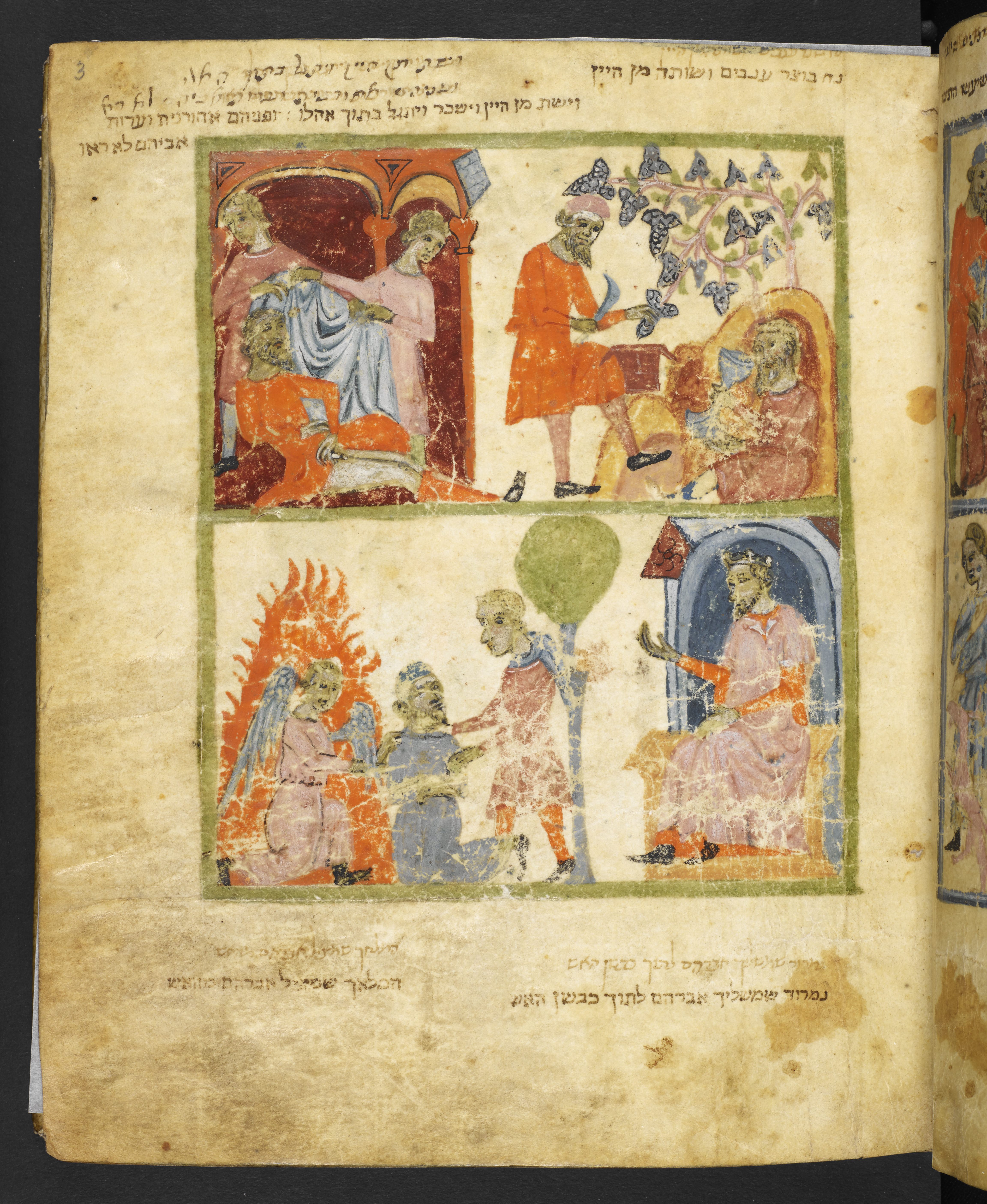
Abraham breaks the idols, leaves the largest, and challenges their worshippers to ask who did it. His opponents decide to burn him, but the fire does not kill him. Muslim readers recognize this scene, which has striking counterparts in Jewish literature. Placing the accounts alongside one another, however, reveals differences in the actors, the cause of the fire, and even who dies. [5] [7]
The accounts examined here are separated by centuries, and each is read in its own setting. A witness means a surviving text that can be consulted. The time of its narrated event, its composition and its surviving manuscript are distinct questions.
What does Genesis say?
Genesis 11:26–32 introduces TerahTerahFather of Abram, Nahor and Haran in Genesis; later idol-breaking narratives give him different roles.Glossary · Click to read the explanation's family and his sons Abram, NahorNahor, son of TerahSon of Terah and brother of Abram and Haran in Genesis, distinct from Terah’s father of the same name.Glossary · Click to read the explanation and HaranHaran, brother of AbrahamTerah’s son, Abram’s brother and Lot’s father in Genesis; later narratives explain his death differently.Glossary · Click to read the explanation. Haran dies in his native land, Ur of the ChaldeansUr of the ChaldeansCity named in Genesis’s account of Abraham’s family, commonly associated with archaeological Ur near Nasiriyah in southern Iraq.Glossary · Click to read the explanation, before his father or in his presence. The family then moves towards CanaanCanaanRegional name in the Mediterranean Levant, associated with Canaanite cities and cultures in the second millennium BCE and with Abraham’s family’s destination in Genesis.Glossary · Click to read the explanation and settles in HarranHarranHistoric city in southeastern Türkiye, south of Şanlıurfa; Genesis places Abraham’s family there on its journey towards Canaan.Glossary · Click to read the explanation. The brother and the place have similar names in Arabic transcription, but are distinct. The passage does not explain Haran's death through fire or portray Abram breaking idols. [1]
Genesis 12:1–3 brings the divine command to leave, with promises of nationhood and blessing. In these passages, no idol shop or rescue from a furnace precedes the call. This distinguishes the surviving narrative from later expansions; it does not prove that Genesis's writers knew no other Abrahamic tradition. [2]
Ancestral worship appears in Joshua
Joshua, a book of the HebrewHebrewA Northwest Semitic language of the Canaanite group, encompassing Iron Age epigraphy, Biblical, Rabbinic, medieval and Modern Hebrew; its scripts and pronunciations changed over time.Glossary · Click to read the explanation Bible, connects the family with worship of other gods. Joshua 24:2–3 says that the ancestors beyond the River, including Terah, father of Abraham and Nahor, served other gods. God then took Abraham and brought him to Canaan. [3]
Joshua supplies a framework that later accounts develop: a family worshipping other gods and a son chosen to leave. Abraham’s manner of opposing them, the largest-idol trick and the fire remain outside this passage. The following texts give these scenes different details and functions.
Jubilees: a father afraid of his community
The Book of JubileesBook of JubileesJewish retelling of Genesis and Exodus framed as angelic teaching to Moses, adding chronology, narratives and interpretation.Glossary · Click to read the explanation, a Jewish work generally dated to the second century BCE, fills this space with a fuller account. In chapter 12 Abram asks his father what benefit the idols provide, describes them as silent human products without spirit, and urges worship of heaven's God, who sends rain and dew. Surprisingly, the father acknowledges the problem but fears the people who appointed him to minister to their worship: they would kill him if he opposed them. He asks his son to keep silent. [4]
This father is more than an ignorant opponent defeated by his son. He is constrained by office, community and fear. Abram's brothers also become angry when he raises the matter. The account portrays family and social pressure on the dissenter, without a woman offering food or a large idol holding the tool of destruction.
The fire in Jubilees kills Haran
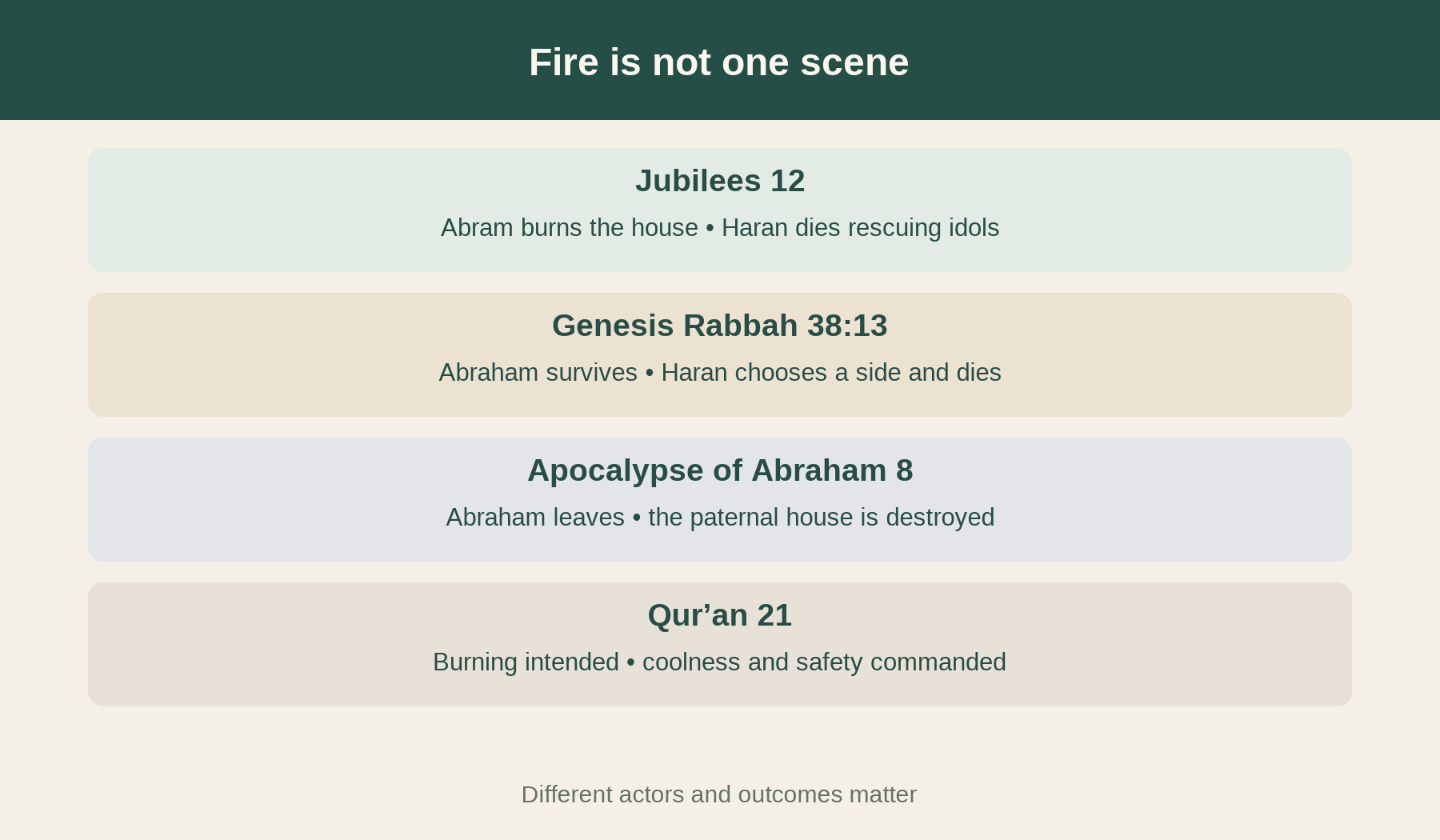
In Jubilees 12:12–14 Abram rises at night and burns the house of idols and its contents. People try to rescue their gods; Haran enters to save them, is overtaken by fire, and dies in Ur before his father. The family subsequently moves to Harran. Abram lights this fire, and his brother's death is what it explains. [4]
Here the fire explains Haran’s death while trying to rescue the idols. Genesis Rabbah places the father and brother in a different ordeal. The relationship with the father also ends differently: at the chapter’s conclusion, Terah blesses his son’s journey and asks him to return and bring him to the new land. Opposition to worship coexists with a continuing family bond.
The stars do not yield one account
Later in Jubilees, Abram watches the stars to predict rainfall. He realizes that sun, moon and celestial signs lie in God's hands, abandons seeking guidance from them, and prays for direction. This passage does not recount successive beliefs in the divinity of a star, the moon and the sun. [4]
Qur'an 6:74–79 confronts Abraham with his father AzarAzarName in Qur’an 6:74 when Abraham addresses his father about idol worship, differing from the name Terah in Genesis.Glossary · Click to read the explanation and presents a star, moon, sun and their setting, ending with orientation towards the maker of heaven and earth. Religious interpretations of these statements, as inquiry or disputation, have their own exegetical debate. Historical comparison here confines itself to the written structure: celestial forms disappear, while the creator cannot be reduced to them. The association of Abraham with stars matters, but the sequences and functions are not identical. [10]
Genesis Rabbah: a shop and ironic reasoning
Genesis RabbahGenesis RabbahJewish exegetical midrash on Genesis, mainly redacted around the fifth century CE in Roman Palestine. It assembles interpretations and narratives from different layers, including 38:13 on Abraham and the idols.Glossary · Click to read the explanation 38:13 links the story to Haran's death in Genesis 11:28. Terah leaves Abraham to sell idols. Abraham asks a customer's age and embarrasses him for wanting to worship a newly made object when he is decades older. A woman brings food for the idols. Abraham smashes them with a club and places it in the largest idol's hand. [5]
When the father returns, the son says the idols argued over the food and the largest smashed the others. Terah objects that they cannot know or act this way. Abraham asks his father to listen to what his own mouth says. The argumentative trick extracts an admission of helplessness from the worshipper. It does not require assuming that the narrator thinks the idols actually fought.
Nimrod and the furnace in the midrash
Terah delivers his son to NimrodNimrodFigure associated with hunting and kingship in Genesis, appearing in Genesis Rabbah as a ruler who opposes Abraham and casts him into fire.Glossary · Click to read the explanation. The ruler proposes worshipping fire; Abraham counters with water that quenches it, then clouds, wind and the human being follow. Nimrod refuses to continue and decides to test Abraham's God by throwing him into fire. Abraham survives. Haran waits to see who wins before choosing a side. After declaring allegiance to Abraham, he too is thrown into fire; his innards burn, and he dies before his father. [5]
Abraham emerges alive; Haran then dies after choosing his side. This differs from dying while rescuing idols in Jubilees. The midrash, a narrative exposition of scripture, connects opposition to worship, conflict with the ruler and explanation of the brother’s death. [5]
The Prophets: questioning before the people
Qur'an 21:51–70 has Abraham confront his father and people. They invoke ancestral worship; he declares their Lord the creator of heaven and earth. He then reduces the idols to fragments while leaving a large one. Asked who did it, he assigns the action to the large idol and invites questioning if they can speak. They reconsider, then acknowledge that the idols cannot talk. [7]
The closest specific parallel to the midrash is more than rejecting idols: smashing them, retaining the largest, and transferring responsibility to expose their incapacity. Yet the Qur'anic interrogation is public and the opponents collective. The passage does not narrate Terah's shop, the woman with food, or placing a club in the largest idol's hand. Specific agreement outweighs general resemblance; specific difference prevents equating the accounts.
Those Ranged in Ranks and The Spider: food, fire and departure
Qur'an 37:83–99 supplies another sequence: looking at stars, the people's departure, questions to their gods about eating and speaking, and striking with the right hand. The opponents decide to construct a building and cast Abraham into the blaze, but their scheme fails. He then declares his journey to his Lord. Human manufacture and incapacity to eat or speak are connected; no axe is named as the striking implement. [8]
Qur’an 29:16–27 includes a decision to kill or burn him, rescue from fire, LotLotFigure in Genesis and the Qur’an; Haran’s son and Abraham’s nephew in the biblical genealogy, whose belief appears in a Qur’anic migration scene.Glossary · Click to read the explanation’s belief and migration. This passage broadens the comparison: the story also concerns departure and the formation of a new bond of faith, alongside confrontation with the community’s worship. [9]
What the Qur'anic text does not name
The Prophets commands fire to become coolness and safety for Abraham. It names neither Nimrod nor Haran, and does not recount a brother's death during the ordeal. Qur'an 2:258 presents a disputant granted kingship, but the verse itself does not name Nimrod. Identifying him as Nimrod belongs to interpretation. [7] [11]
Qur'an 6 names Azar, whereas Genesis names Terah. Textual comparison alone cannot resolve exegetical reconciliations of these names or the kinship discussed in commentaries. A catapult and details of collecting fuel likewise must not be inserted into the Qur'anic scene from its popular retelling. First establish what each witness says, then examine its interpretive additions separately. [1] [10]
Apocalypse of Abraham: collapsing idols and heavenly fire
The Apocalypse of AbrahamApocalypse of AbrahamA self-contained source-critical study of the Apocalypse of Abraham, its Slavonic witnesses, date, idol polemic, heavenly vision, chapter 29, and contrasts with the Testament and other Abrahamic traditions.Glossary · Click to read the explanation 1–8 offers another path. Abraham participates in serving his father's idols, sees a stone statue fall and lose its head, and watches idols break while being carried on a donkey. He wonders how manufactured objects that cannot save themselves could save a human. He places a wooden statue beside the cooking fire. It burns, allowing him to mock its supposed ability to tend the fire. [6]
He later compares fire, water, earth and celestial bodies, then hears a command to leave his father's house. Destruction by fire follows his departure. This version's central scene is not Abraham's survival within Nimrod's furnace. Moreover, the translation marks manuscript additions; material in its notes must not be assembled into one stable original text.
Dating a story and dating its manuscript
Jubilees belongs to Jewish literature before the Common Era and is generally dated to the second century BCE; the growth of its text is not settled in every detail. Eibert TigchelaarEibert J. C. TigchelaarScholar of the Hebrew Bible, ancient Judaism and the Dead Sea Scrolls; professor at KU Leuven from 2009 to 2024, with research on Jubilees’ textual growth.Glossary · Click to read the explanation's abstract discusses possible first-century BCE additions. An early attribution does not automatically date every sentence to one year. [15]
Genesis Rabbah’s compilation is placed in the late fourth or early fifth century CE; the age of the tales it collects remains a separate question. Andrei OrlovAndrei A. OrlovMarquette University scholar of ancient Judaism and Christianity, specializing in Jewish apocalypticism and mysticism in relation to Christian origins.Glossary · Click to read the explanation’s overview dates the Apocalypse of Abraham after 70 CE and before the end of the second century CE, while its surviving Slavonic manuscripts are medieval, including witnesses of the fourteenth through seventeenth centuries. These are dates of composition and transmission, not of Abraham’s lifetime. [13] [14]
What can travel?
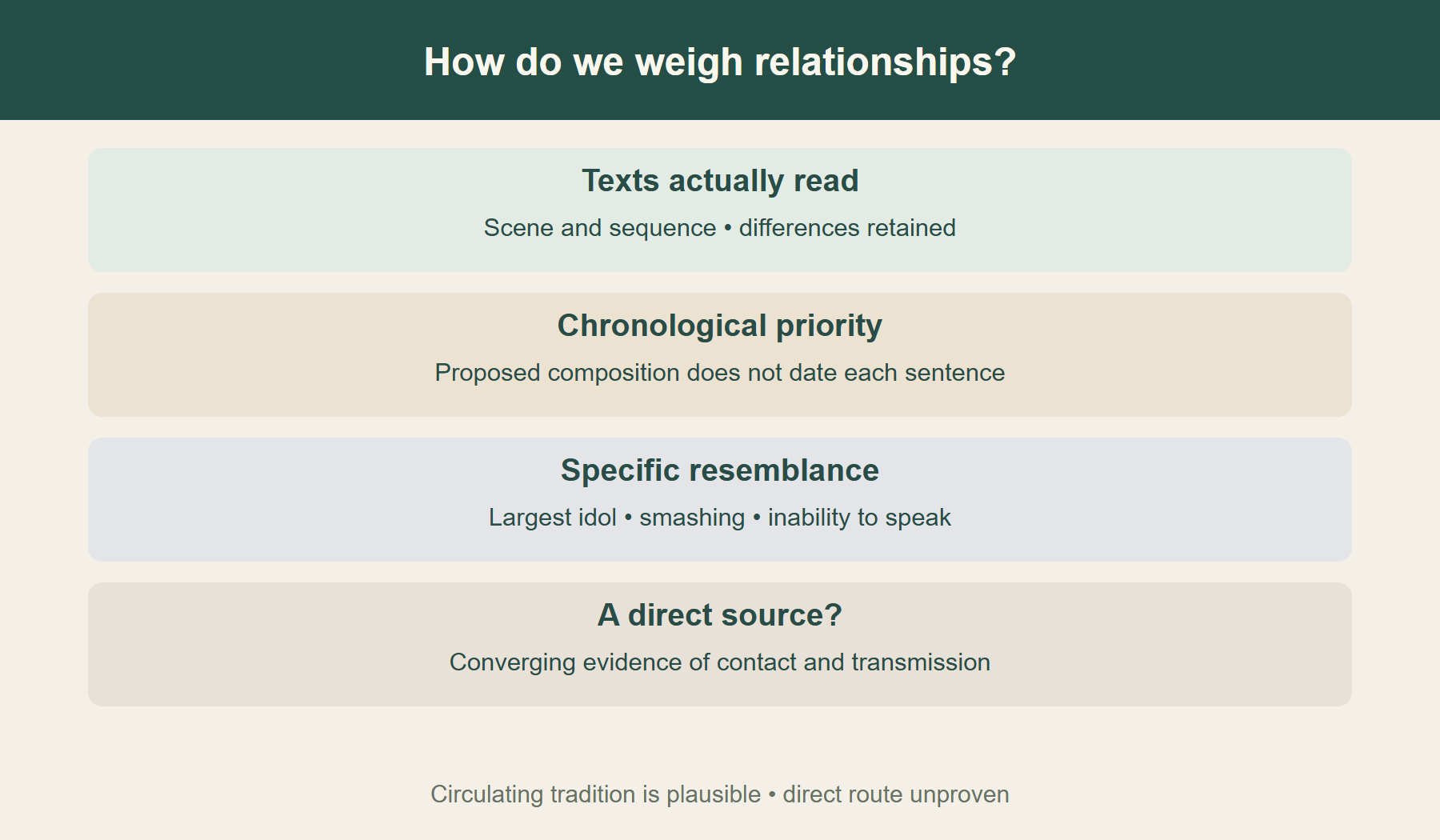
A text can travel through translation, a scene through oral storytelling, teaching, debate or rewriting. The general argument against helpless manufactured objects might arise repeatedly. The particular sequence of smashing, retaining the largest, assigning responsibility to it, and admitting its inability to speak is more specific and calls for historical explanation. [5] [7]
Jewish witnesses precede the Qur'an, and Abrahamic traditions could circulate across multiple settings. But the passages examined identify no particular manuscript used by an author, named intermediary, or documented translation route directly leading to the verses. Participation in a circulating narrative world is a serious possibility; naming one version as the direct source requires additional evidence. A blanket designation such as “Isra'iliyyat” cannot replace that examination.
The story's function changes
Etsuko KatsumataEtsuko KatsumataDoshisha University scholar of Jewish studies, rabbinic literature and Aramaic, who compared accounts of Abraham breaking idols.Glossary · Click to read the explanation's comparison encourages questions about the relationship with the father and the scene's function, beyond counting common features. Destruction may explain a death, demonstrate images' helplessness, or connect divine election with an ordeal. Each interpretation must be tested on the individual text: Qur'anic migration, for instance, prevents reducing all passages to Abraham remaining among his people. [12] [9]
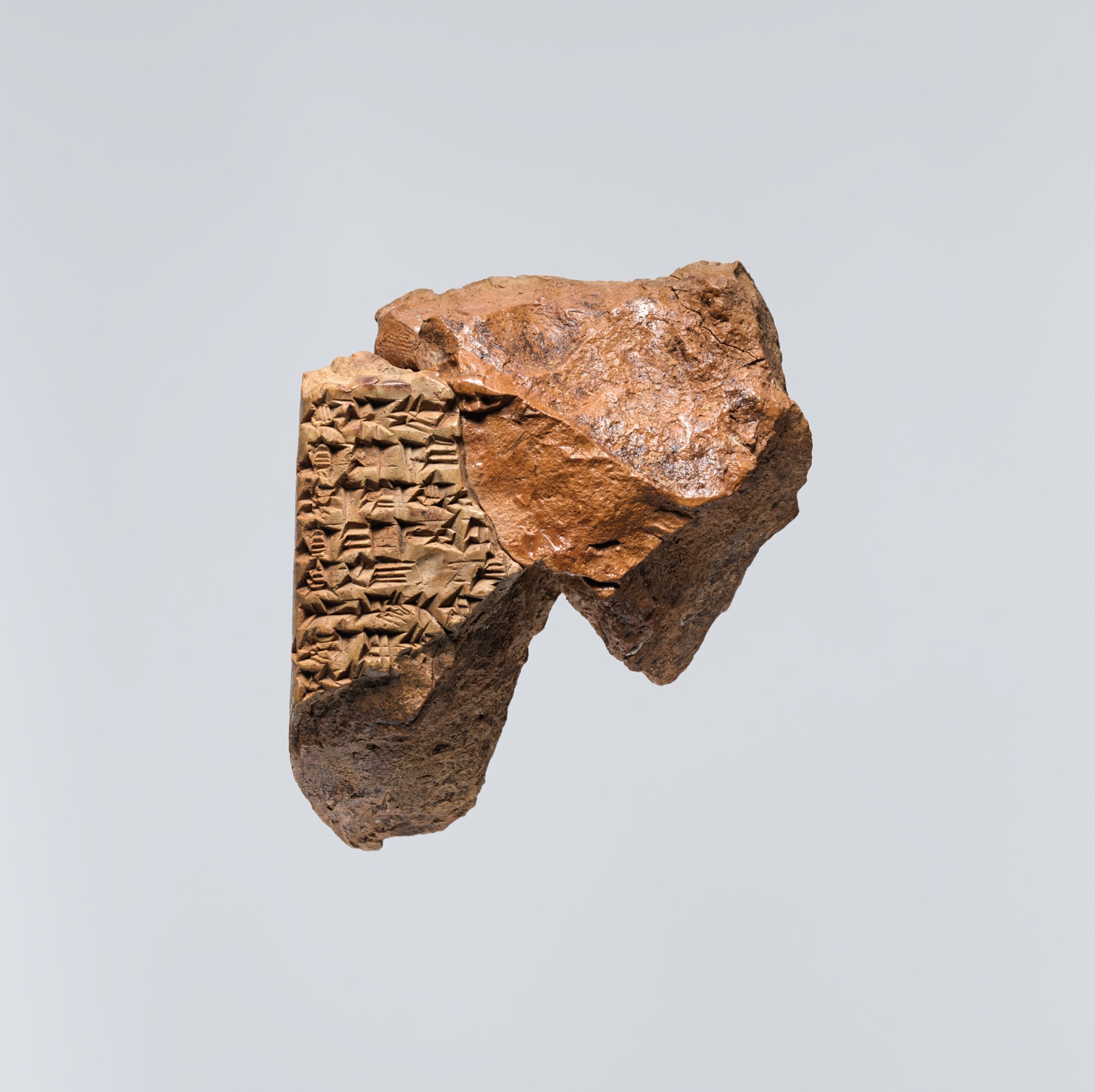
The texts portray idols through Abraham and opponents shaped by their narrators. They provide evidence for religious argument, alongside the archaeology and other texts that illuminate worship in practice. Ur of the Chaldeans and Nimrod belong to the narrative’s setting. Genesis 10 links Nimrod with cities including BabylonBabylonBabylon is an ancient city in central present-day Iraq, south of BaghdadGlossary · Click to read the explanation and UrukUrukAncient city at Warka in southern Iraq, a major urban centre around 3200 BCE that preserved early writing and accounting tablets.Glossary · Click to read the explanation; his confrontation with Abraham appears in later traditions. Identifying a historical Mesopotamian king behind that figure requires other evidence. [16]
Degrees of evidence
The examined passages demonstrably preserve different portrayals of Abraham opposing idol worship. The midrash and The Prophets share the specific largest-idol trick. Fire, Haran and the father do not perform identical roles in all witnesses. Comparison gains strength by locating differences alongside agreements. [4] [5] [6] [7]
Circulating Abrahamic traditions may help explain relationships between some scenes. The identity of a direct source and its route of transmission, as well as the historical event behind the account, remain open questions here. What comparison enables is tracing how different texts rebuild scenes and their meanings.
References and notes (16)
- Family, Haran’s death and departure; no smashing scene here. Genesis 11:26–32 Return to the text ↑
- Call and blessing in three verses. Genesis 12:1–3 Return to the text ↑
- Ancestral worship of other gods is explicit. Joshua 24:2–3 Return to the text ↑
- Complete chapter in a historical translation; fire differs from the furnace. Jubilees 12:1–31; R. H. Charles translation, 1913. Return to the text ↑
- Hebrew/Aramaic passage and translation: shop, club, Nimrod and Haran. Genesis Rabbah 38:13; Hebrew/Aramaic text and Sefaria translation. Return to the text ↑
- Chapters1–8; historical edition distinguishes manuscript additions. Apocalypse of Abraham 1–8; Box/Landsman, 1918, second impression 1919; PDF pages 22–27. Return to the text ↑
- Complete Arabic passage: largest idol, questioning and fire. Qur’an, The Prophets 21:51–70 Return to the text ↑
- Eating, speech, striking and departure; no named axe. Qur’an, Those Ranged in Ranks 37:83–99 Return to the text ↑
- Rescue, Lot and migration prevent generalizing continued residence. Qur’an, The Spider 29:16–27 Return to the text ↑
- Azar, celestial bodies and setting; exegetical debate not settled. Qur’an, Cattle 6:74–79 Return to the text ↑
- Disputant granted kingship but unnamed in the verse. Qur’an, The Cow 2:258 Return to the text ↑
- Selected comparisons and partial conclusion; functions checked against texts. Etsuko Katsumata, JISMOR 8 (2013), pp. 37–58; comparison and father/brother relationships. Return to the text ↑
- Academic overview of dating and Slavonic transmission; not all cited works read. Andrei A. Orlov, Apocalypse of Abraham introduction; structure, manuscripts, original language and date. Return to the text ↑
- Selected compilation-dating passages only, not Abraham-scene analysis. Moshe Simon-Shoshan, HTR 111/3 (2018), pp. 425–450; historical context and redaction. Return to the text ↑
- Abstract only: possible textual growth, not dating every sentence. Eibert J. C. Tigchelaar, Revue de Qumran 26/4 (2014), pp. 579–594; publisher’s abstract. Return to the text ↑
- Nimrod and cities; no Abraham confrontation in these verses. Genesis 10:8–12 Return to the text ↑
Suggest a correction · Suggest a source for this record
Cite this record
IL Archive, «Abraham and the breaking of idols: between midrash and Qur’an», https://ilarchive.com/en/studies/abraham-idols-and-jewish-traditions
Continue reading