Study
Abraham and the breaking of idols: between midrash and Qur’an
An extended study of a topic, with evidence and references.
From Jubilees, the Apocalypse of Abraham and Genesis Rabbah to the Qur’an: the largest idol, fire and Haran, and the limits of identifying direct sources.
Share article
Text
The familiar story is not a single text
Abraham breaks the idols, leaves the largest, and challenges their worshippers to ask who did it. His opponents decide to burn him, but the fire does not kill him. Muslim readers recognize this scene, which has striking counterparts in Jewish literature. Placing the accounts alongside one another, however, reveals differences in the actors, the cause of the fire, and even who dies. [5] [7]
The historical question is neither which religion owns Abraham nor which account deserves belief. It concerns witnesses: when are these scenes attested in writing? How does each text construct Abraham? Do their relationships establish direct transmission or reveal a wider circulating narrative tradition? We begin with surviving texts, without merging them into a composite account that none tells in full.
What does Genesis say?
Genesis 11:26–32 introduces Terah's family and his sons Abram, Nahor and Haran. Haran dies in his native land, Ur of the Chaldeans, before his father or in his presence. The family then moves towards Canaan and settles in Harran. The brother and the place have similar names in Arabic transcription, but are distinct. The passage does not explain Haran's death through fire or portray Abram breaking idols. [1]
Genesis 12:1–3 brings the divine command to leave, with promises of nationhood and blessing. In these passages, no idol shop or rescue from a furnace precedes the call. This distinguishes the surviving narrative from later expansions; it does not prove that Genesis's writers knew no other Abrahamic tradition. [2]
Ancestral worship appears in Joshua
The absence of smashing from these passages must not become a claim that the HebrewHebrewA Northwest Semitic language in the Canaanite group, with ancient and modern forms.Glossary · Click to read the explanation Bible knows nothing of Abraham's family serving other gods. Joshua 24:2–3 says that the ancestors beyond the River, including Terah, father of Abraham and Nahor, served other gods. God then took Abraham and brought him to Canaan. [3]
This offers a starting point for narrative expansion: a family serving other gods and a son chosen to leave. Joshua does not describe how Abraham discovered the error of that worship, the largest-idol trick, or the fire. An earlier framework does not implicitly contain every later detail. Distinguishing framework from detail enables us to trace literary expansion rather than assign the entire scene to Genesis.
Jubilees: a father afraid of his community
The Book of JubileesBook of JubileesJewish retelling of Genesis and Exodus framed as angelic teaching to Moses, adding chronology, narratives and interpretation.Glossary · Click to read the explanation fills this space with a fuller account. In chapter 12 Abram asks his father what benefit the idols provide, describes them as silent human products without spirit, and urges worship of heaven's God, who sends rain and dew. Surprisingly, the father acknowledges the problem but fears the people who appointed him to minister to their worship: they would kill him if he opposed them. He asks his son to keep silent. [4]
This father is more than an ignorant opponent defeated by his son. He is constrained by office, community and fear. Abram's brothers also become angry when he raises the matter. The account portrays family and social pressure on the dissenter, without a woman offering food or a large idol holding the tool of destruction.
The fire in Jubilees kills Haran
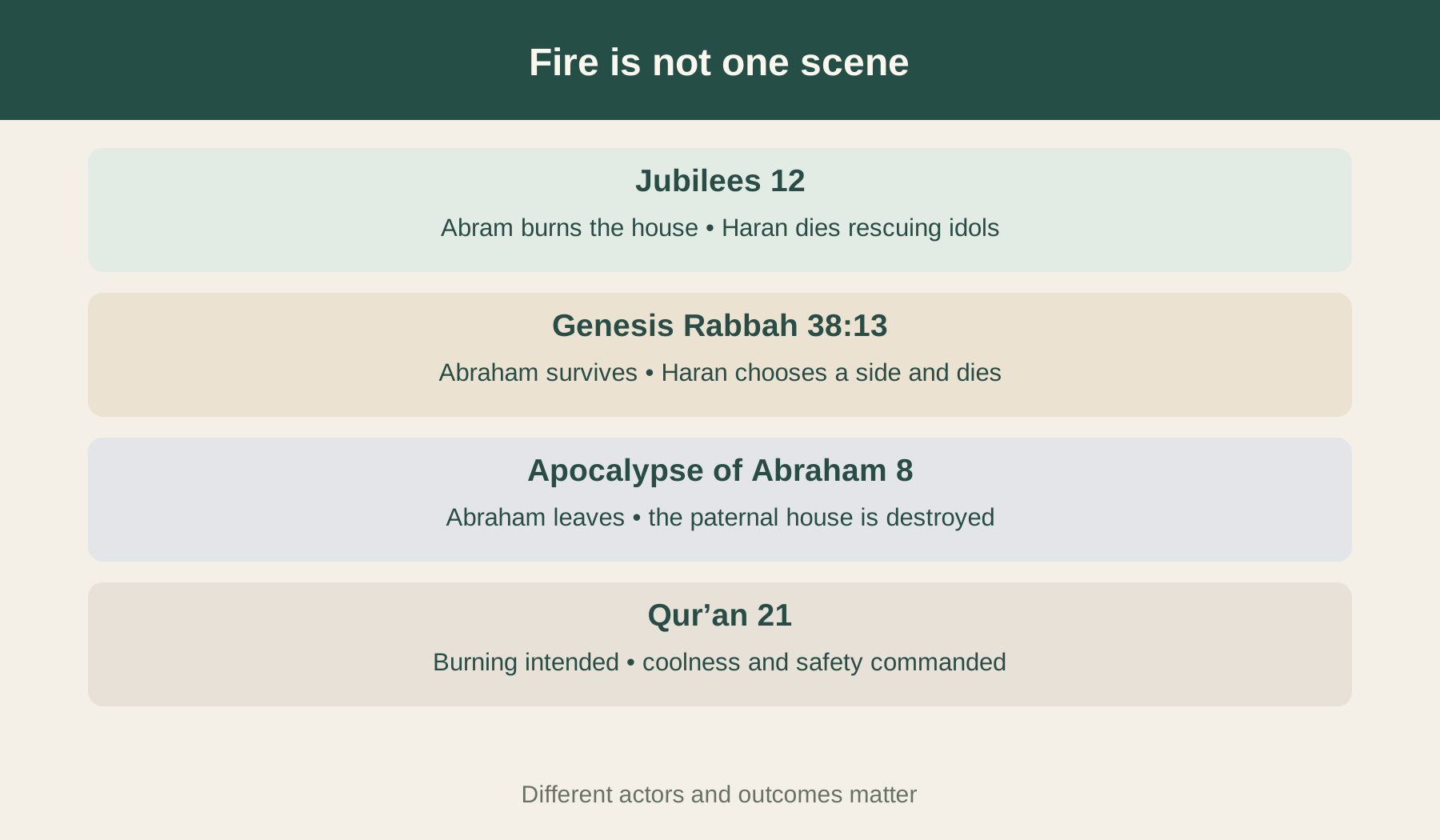
In Jubilees 12:12–14 Abram rises at night and burns the house of idols and its contents. People try to rescue their gods; Haran enters to save them, is overtaken by fire, and dies in Ur before his father. The family subsequently moves to Harran. Abram lights this fire, and his brother's death is what it explains. [4]
The passage does not say Abram was thrown into a furnace and emerged unharmed. Haran does not hesitate and select the winning side: another text assigns him that role. Even the relationship with the father ends differently. At the chapter's conclusion Terah blesses his son's journey and asks him to return and bring him to the new land. Destroying idols does not sever family ties in the same way across all accounts.
The stars do not yield one account
Later in Jubilees, Abram watches the stars to predict rainfall. He realizes that sun, moon and celestial signs lie in God's hands, abandons seeking guidance from them, and prays for direction. This passage does not recount successive beliefs in the divinity of a star, the moon and the sun. [4]
Qur'an 6:74–79 confronts Abraham with his father Azar and presents a star, moon, sun and their setting, ending with orientation towards the maker of heaven and earth. Religious interpretations of these statements, as inquiry or disputation, have their own exegetical debate. Historical comparison here confines itself to the written structure: celestial forms disappear, while the creator cannot be reduced to them. The associationShirkAssociating others with God in Quranic discourse; not equivalent to denying God’s existence.Glossary · Click to read the explanation of Abraham with stars matters, but the sequences and functions are not identical. [10]
Genesis Rabbah: a shop and ironic reasoning
Genesis RabbahGenesis RabbahJewish midrashic collection interpreting Genesis;38:13 narrates Abraham, idols, Nimrod and Haran’s death.Glossary · Click to read the explanation 38:13 links the story to Haran's death in Genesis 11:28. Terah leaves Abraham to sell idols. Abraham asks a customer's age and embarrasses him for wanting to worship a newly made object when he is decades older. A woman brings food for the idols. Abraham smashes them with a club and places it in the largest idol's hand. [5]
When the father returns, the son says the idols argued over the food and the largest smashed the others. Terah objects that they cannot know or act this way. Abraham asks his father to listen to what his own mouth says. The argumentative trick extracts an admission of helplessness from the worshipper. It does not require assuming that the narrator thinks the idols actually fought.
Nimrod and the furnace in the midrash
Terah delivers his son to Nimrod. The ruler proposes worshipping fire; Abraham counters with water that quenches it, then clouds, wind and the human being follow. Nimrod refuses to continue and decides to test Abraham's God by throwing him into fire. Abraham survives. Haran waits to see who wins before choosing a side. After declaring allegiance to Abraham, he too is thrown into fire; his innards burn, and he dies before his father. [5]
Rescue is not resurrectionResurrection of the deadThe dead returning to life, distinguished from soul immortality, with differing scope and form among texts.Glossary · Click to read the explanation from death in this passage. Nor does Haran die while rescuing idols, as in Jubilees. The midrash combines criticism of worship, conflict with a ruler, and explanation of a biblical statement about the brother's death. Comparison must preserve these functions.
The Prophets: questioning before the people
Qur'an 21:51–70 has Abraham confront his father and people. They invoke ancestral worship; he declares their LordRabbTitle of lordship, ownership or care by context; applied to God in Lord of worlds.Glossary · Click to read the explanation the creator of heaven and earth. He then reduces the idols to fragments while leaving a large one. Asked who did it, he assigns the action to the large idol and invites questioning if they can speak. They reconsider, then acknowledge that the idols cannot talk. [7]
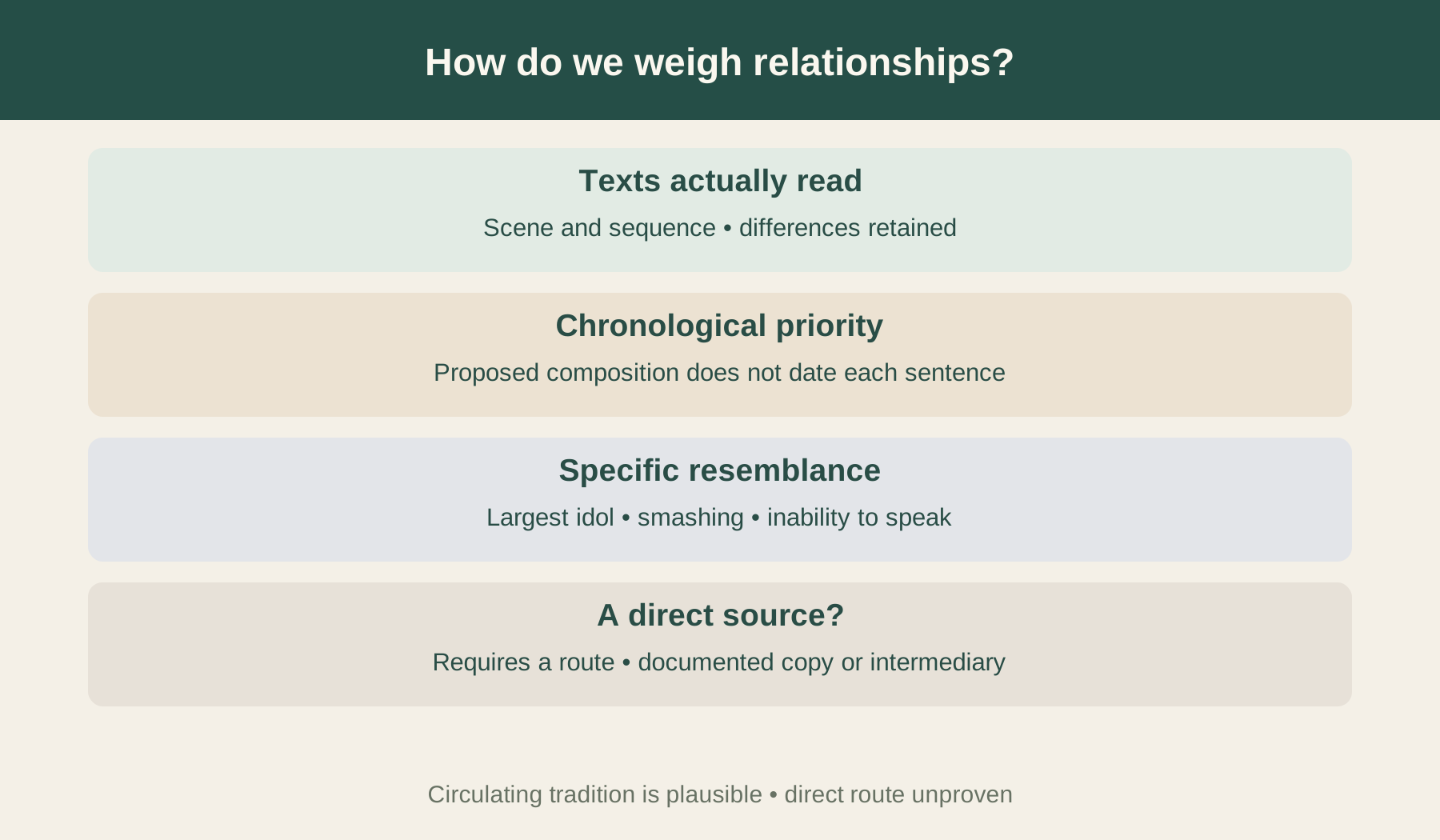
The closest specific parallel to the midrash is more than rejecting idols: smashing them, retaining the largest, and transferring responsibility to expose their incapacity. Yet the Qur'anic interrogation is public and the opponents collective. The passage does not narrate Terah's shop, the woman with food, or placing a club in the largest idol's hand. Specific agreement outweighs general resemblance; specific difference prevents equating the accounts.
Those Ranged in Ranks and The Spider: food, fire and departure
Qur'an 37:83–99 supplies another sequence: looking at stars, the people's departure, questions to their gods about eating and speaking, and striking with the right hand. The opponents decide to construct a building and cast Abraham into the blaze, but their scheme fails. He then declares his journey to his Lord. Human manufacture and incapacity to eat or speak are connected; no axe is named as the striking implement. [8]
Qur'an 29:16–27 includes a decision to kill or burn him, rescue from fire, Lot's belief, and migration. Not every Qur'anic formulation ends with rescue while remaining among his people. Departure and migration must also be read, rather than reducing Abraham's function to persuading the community in place. [9]
What the Qur'anic text does not name
The Prophets commands fire to become coolness and safety for Abraham. It names neither Nimrod nor Haran, and does not recount a brother's death during the ordeal. Qur'an 2:258 presents a disputant granted kingship, but the verse itself does not name Nimrod. Identifying him as Nimrod belongs to interpretation. [7] [11]
Qur'an 6 names Azar, whereas Genesis names Terah. Textual comparison alone cannot resolve exegetical reconciliations of these names or the kinship discussed in commentaries. A catapult and details of collecting fuel likewise must not be inserted into the Qur'anic scene from its popular retelling. First establish what each witness says, then examine its interpretive additions separately. [1] [10]
Apocalypse of Abraham: collapsing idols and heavenly fire
The Apocalypse of AbrahamApocalypse of AbrahamWork attributed to Abraham and preserved in Slavonic transmission; opens with idol criticism before heavenly revelation.Glossary · Click to read the explanation 1–8 offers another path. Abraham participates in serving his father's idols, sees a stone statue fall and lose its head, and watches idols break while being carried on a donkey. He wonders how manufactured objects that cannot save themselves could save a human. He places a wooden statue beside the cooking fire. It burns, allowing him to mock its supposed ability to tend the fire. [6]
He later compares fire, water, earth and celestial bodies, then hears a command to leave his father's house. Destruction by fire follows his departure. This version's central scene is not Abraham's survival within Nimrod's furnace. Moreover, the translation marks manuscript additions; material in its notes must not be assembled into one stable original text.
Dating a story and dating its manuscript
Jubilees belongs to Jewish literature before the Common Era and is generally dated to the second century BCE; the growth of its text is not settled in every detail. Eibert Tigchelaar's abstract discusses possible first-century BCE additions. An early attribution does not automatically date every sentence to one year. [15]
Genesis Rabbah's compilation is usually placed in late antiquityLate antiquityHistorical frame for late ancient transformations; boundaries vary by region and subject.Glossary · Click to read the explanation, particularly the fifth century CE. This dates a collection, not independently every tale. Andrei Orlov's overview places the Apocalypse of Abraham after 70 CE in the early centuries CE, while its surviving Slavonic witnesses are medieval. Composition and transmission must be distinguished: a late copy does not entail a late invention, but does not date every reading without investigation either. [13] [14]
What can travel?
A text can travel through translation, a scene through oral storytelling, teaching, debate or rewriting. The general argument against helpless manufactured objects might arise repeatedly. The particular sequence of smashing, retaining the largest, assigning responsibility to it, and admitting its inability to speak is more specific and calls for historical explanation. [5] [7]
Jewish witnesses precede the Qur'an, and Abrahamic traditions could circulate across multiple settings. But the passages examined identify no particular manuscript used by an author, named intermediary, or documented translation route directly leading to the verses. Participation in a circulating narrative world is a serious possibility; naming one version as the direct source requires additional evidence. A blanket designation such as “Isra'iliyyat” cannot replace that examination.
The story's function changes
Etsuko Katsumata's comparison encourages questions about the relationship with the father and the scene's function, beyond counting common features. Destruction may explain a death, demonstrate images' helplessness, or connect divine election with an ordeal. Each interpretation must be tested on the individual text: Qur'anic migration, for instance, prevents reducing all passages to Abraham remaining among his people. [12] [9]
These texts' arguments against idols also do not independently provide a neutral description of what every image-worshipper believed. Authors construct opponents for an argument; historians investigate it without adopting it as a judgment on others' religions. Ur of the Chaldeans or Nimrod in a narrative likewise does not establish an identical cuneiformCuneiformWriting with wedge-shaped signs, developed from Mesopotamian recording traditions and used for several languages from the third millennium BCE.Glossary · Click to read the explanation story or identify a historical Mesopotamian king as Abraham's antagonist. Genesis 10 connects Nimrod with cities including BabylonBabylonBabylon is an ancient city in central present-day Iraq, south of BaghdadGlossary · Click to read the explanation and UrukUrukAncient city at Warka in southern Iraq, a major urban centre around 3200 BCE that preserved early writing and accounting tablets.Glossary · Click to read the explanation, but does not narrate his confrontation with Abraham. [16]
Degrees of evidence
The examined passages demonstrably preserve different portrayals of Abraham opposing idol worship. The midrash and The Prophets share the specific largest-idol trick. Fire, Haran and the father do not perform identical roles in all witnesses. Comparison gains strength by locating differences alongside agreements. [4] [5] [6] [7]
Circulating Abrahamic traditions plausibly help explain relationships between some scenes. A single direct source for them all, a Mesopotamian cuneiform route, and the detailed historical event behind them remain unestablished here. A religious narrative's history differs from the history of the event it presents. Within these limits, comparison explains the formation and transmission of meaning while leaving doctrinal judgment outside the study.
References and notes
- Family, Haran’s death and departure; no smashing scene here. Genesis11:26–32 Return to the text ↑
- Call and blessing in three verses. Genesis12:1–3 Return to the text ↑
- Ancestral worship of other gods is explicit. Joshua24:2–3 Return to the text ↑
- Complete chapter in a historical translation; fire differs from the furnace. Jubilees12:1–31; R.H.Charles1913 Return to the text ↑
- Hebrew/Aramaic passage and translation: shop, club, Nimrod and Haran. GenesisRabbah38:13; Sefaria official API context0 Return to the text ↑
- Chapters1–8; historical edition distinguishes manuscript additions. ApocalypseofAbraham1–8; Box/Landsman1918, second impression1919; PDF22–27 Return to the text ↑
- Complete Arabic passage: largest idol, questioning and fire. Quran21:51–70; Arabic Uthmani primary text; official public API Return to the text ↑
- Eating, speech, striking and departure; no named axe. Quran37:83–99; Arabic primary text; official API Return to the text ↑
- Rescue, Lot and migration prevent generalizing continued residence. Quran29:16–27; Arabic primary text; official API Return to the text ↑
- Azar, celestial bodies and setting; exegetical debate not settled. Quran6:74–79; Arabic primary text; official API Return to the text ↑
- Disputant granted kingship but unnamed in the verse. Quran2:258; Arabic primary text; official API Return to the text ↑
- Selected comparisons and partial conclusion; functions checked against texts. EtsukoKatsumata, JISMOR8(2013), pp37–58; selected37–54 Return to the text ↑
- Academic overview of dating and Slavonic transmission; not all cited works read. AndreiA.Orlov, Introduction; Structure, Manuscripts, OriginalLanguage, Date Return to the text ↑
- Selected compilation-dating passages only, not Abraham-scene analysis. MosheSimon-Shoshan, HTR111/3(2018), pp425–450; HistoricalContext and redaction comments Return to the text ↑
- Abstract only: possible textual growth, not dating every sentence. EibertJ.C.Tigchelaar, RevuedeQumran26/4(2014), pp579–594; publisherabstract Return to the text ↑
- Nimrod and cities; no Abraham confrontation in these verses. Genesis10:8–12; Hebrew and historicalEnglish Return to the text ↑
Suggest a correction · Suggest a source for this record
Cite this record
IL Archive, «Abraham and the breaking of idols: between midrash and Qur’an», Edition 1, https://ilarchive.com/en/studies/abraham-idols-and-jewish-traditions
Continue reading