Period
Late Antiquity
A flexible period of change in Roman, Sasanian and Arabian societies, roughly the third to eighth centuries CE; it discusses where the emergence of Islam and the Qur’an fits, without assuming one line of transmission.
Estimated reading time: 10 min Published Last reviewed:
Share article
Text
Introduction
When did the ancient world end, and did it end everywhere at once? “Late antiquity” is a historians' term for centuries in which states, cities, religions, and languages were reconfigured, not an age opened and closed by a single decree. This entry follows evidence from the Mediterranean to IranIranIran is the modern country containing Shush, ancient SusaGlossary · Click to read the explanation and Arabia, and then asks how that framework can illuminate the emergence of Islam and Qur'anic discourse without reducing either to the inevitable outcome of earlier traditions.
It distinguishes the dates of events from the composition of texts and the surviving copies that transmit them, and sets political narratives beside the archaeology of everyday life. Shared transformations, regional differences, and the scholarly debate over “collapse” and “continuity” all belong in the account.
Reading guide
We begin with the Qur'anic-context question that shaped the original entry. The perspective then expands to the period's boundaries, Roman and Sasanian states, religious communities, and Arabia, before returning to material records, the Qur'an, and the dating of manuscripts. This is a guide to questions, not a timeline presuming that all societies followed the same path.
From Qur'anic context to a wider historical question
The label “late antiquity” helps situate the Qur'anThe QuranThe central scripture of Islam, consisting of 114 Arabic surahs; its study distinguishes Quranic discourse from manuscript history, reading traditions, and historical inference.Glossary · Click to read the explanation, whose emergence is associated with seventh-century Arabia, among societies possessing diverse written and oral traditions. But the label does not by itself explain a verse or narrative. In a 2022 article, Valentina A. Grasso reviewed and assessed the collaborative Le Coran des historiens. She emphasized the value of work on Arabian, Jewish, Christian, and SyriacSyriacAn Aramaic literary language rooted in Edessa, first attested in non-Christian inscriptions and later prominent in Christian writing, scholarship, translation and liturgy.Glossary · Click to read the explanation settings while questioning whether specialized studies placed side by side can illuminate their connections without a shared argument. Hers is a review of a multiauthor publication, not evidence that she personally examined every inscription or that the Archive read all the volumes reviewed. [1]
One testable example concerns al-RaḥmānAl-RaḥmānQuranic divine designation co-referring with Allah.Glossary · Click to read the explanation, “the Merciful.” The South Arabian form Raḥmānān occurs in inscriptions from late pre-Islamic Yemen within varied religious settings. Sigrid K. Kjær traces such usages and proposes interpretations of these different milieus. She also recognizes that a common linguistic root does not establish South Arabia as the sole or direct source of the Qur'anic usage. We have not physically examined those inscribed stones. [2]
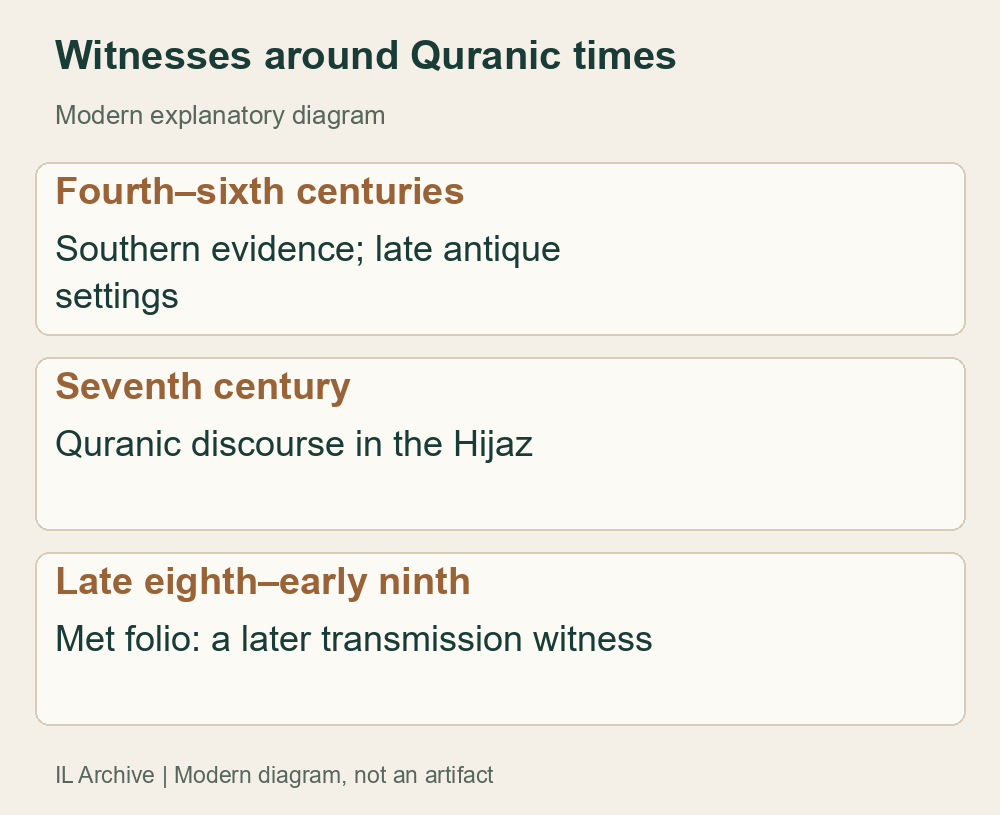
Surviving material also belongs to more than one moment. A Qur'an folio in the Metropolitan Museum of Art, accession 1979.201, is dated to the late eighth or early ninth century: it is a later witness, not direct proof of how Qur'anic passages were written in the seventh century. The following modern Archive diagram compares the time of South Arabian evidence, Qur'anic discourse, and that later folio; it does not assert a chain of borrowing among them. [3]
A modern label with flexible dates
Oxford's Centre for Late Antiquity works with an approximate range of 250–750 CE; Gillian Clark's short introduction takes roughly 300–800 CE. Peter Brown's influential The World of Late Antiquity explicitly frames its subject from 150 to 750 CE. Those different windows reflect the historian's question and geographic focus, not disagreement over one precisely measurable starting year. [4][5][6]
The label gained currency as historians moved beyond a story told solely as Rome's fall and treated religious, cultural, and material changes as history in their own right. Yet Averil Cameron, assessing the relationship between late-antique and Byzantine studies, warns that an expansive frame can make the Eastern Roman state's continuing history disappear from view. The dispute concerns scope and interpretation, not whether major transformations occurred. [7]
No definitive opening or closing year is therefore assigned to this record. The decline of imperial authority in the West, the persistence of administration in the East, and the end of Sasanian rule did not occur in the same places or on the same dates. A fifth- or eighth-century case may belong in the study when its particular question warrants it.
Western Rome: a changing state, enduring communities
Roman government took new forms with Diocletian's reforms in the late third century. Under Constantine IConstantine IRoman emperor, reigning in 306–337 CE, who convened Nicaea in 325.Glossary · Click to read the explanation, ConstantinopleConstantinopleLate antique and medieval city on the historic peninsula of modern Istanbul.Glossary · Click to read the explanation was dedicated as an imperial center in 330 CE. The conventional end of the western imperial office in 476 did not mark the disappearance of Roman populations, Latin, legal practices, or Christianity. Cities, bishops, local elites, and institutional networks continued, although their positions changed. [8]
Trade, farming, and urban life shifted with warfare, taxation, and changing local rulers. Britain, Italy, and North Africa cannot be made into one case: the speed and nature of economic contraction or continuity varied, as did the meaning of “Roman” once a western emperor no longer ruled. Oxford's researchers explicitly acknowledge substantial disagreement over the degree of economic and social disruption in the post-Roman West. [9]
Iran and Iraq: the Sasanian world
The Sasanian dynasty governed Iran, IraqIraqIraq is a modern country encompassing much of ancient MesopotamiaGlossary · Click to read the explanation, and neighboring regions approximately from 226 to 651 CE. Its state rivaled Eastern Rome over borders, routes, and resources, alternating warfare with diplomacy; for a short period in the early seventh century it even controlled Egypt and parts of the LevantThe LevantThe Levant is a regional name for lands along the eastern MediterraneanGlossary · Click to read the explanation. Sasanian history is not merely that of an adversary of Rome, however: it also encompasses administration, trade, and long-distance connections. [10]
ZoroastrianismZoroastrianism: Hymns, Rituals and the Changing TraditionA living Iranian religious tradition examined through Avestan hymns, Middle Persian writings and royal inscriptions, separating textual evidence, later interpretation and hypotheses of influence.Glossary · Click to read the explanation was associated with Sasanian kingship, but subjects included Jewish and Christian populations alongside other religious communities. Rabbinic traditions associated with the Babylonian Talmud developed in Sasanian Iraq. Neither “Persian religion” nor “Eastern Christianity” nor “Judaism” was an unchanging doctrinal block. Shared political rule alone cannot establish that one particular text influenced another.
Eastern Rome, Byzantium, and the churches
The year 476 did not end the Eastern Roman state. Constantinople remained its center, while rulers continued to collect taxes, administer armies, and operate courts; Justinian's sixth-century campaigns even recovered parts of the West for a time. Early seventh-century Roman–Sasanian wars, followed by Muslim conquests, then altered the state's borders, revenues, and institutions. [11]
Christianity took many linguistic and institutional forms in Greek, Latin, Coptic, SyriacSyriacAn Aramaic literary language rooted in Edessa, first attested in non-Christian inscriptions and later prominent in Christian writing, scholarship, translation and liturgy.Glossary · Click to read the explanation, and Armenian contexts. Councils did not erase disagreements over Christology or ecclesiastical authority, and the abundance of Christian writing should not be mistaken for uniform belief or practice. A work produced in Syriac must be located by language, date, and community rather than treated as the single voice of Eastern Christians.
Jewish communities beyond a simple division of religions
Following the destruction of the JerusalemJerusalemJerusalem is a city of religious importance in Judaism, Christianity and IslamGlossary · Click to read the explanation Temple in 70 CE, Jewish communities reorganized worship, teaching, and social identity in multiple ways. Rabbinic schools developed in Palestine and Iraq, while other regional and diasporic practices endured under very different conditions within and beyond Roman territory. This is a continuation and transformation of the history of Second Temple JudaismSecond Temple JudaismDiverse Jewish traditions between the rebuilding of Jerusalem’s temple around 515 BCE and its destruction in 70 CE: institutions, diaspora, groups and texts, with distinctions between events, composition, manuscripts and the limits of evidence.Glossary · Click to read the explanation, neither its unchanged reproduction nor its total disappearance. [12]
The age also raises questions about monasteries, bishops, holy figures, philosophers, Manichaeans, and other communities—not just three supposedly homogeneous “religions.” The Oxford Handbook of Late Antiquity includes topics from Egypt, Arabia, Central Asia, and the Balkans, broadening the relevant geographic map. Our access here was to the publisher's overview, not a reading of every chapter. [13]
Southern Arabia, Aksum, and inscriptions
Southern Arabian kingdoms, including Ḥimyar, belonged to Red Sea networks of commerce, politics, and contact with Aksum in the Horn of Africa. Fourth- to sixth-century inscriptions attest different languages of prayer, allegiance, and religious identity, as well as conflicts involving rulers and Jewish and Christian groups. They do not authorize attaching a later confessional label to every inhabitant. Kjær's interpretation of texts mentioning Raḥmānān also draws attention to how difficult the religious identification of some dedicants remains.
The DASI archive, led from the University of Pisa with research partners, has made thousands of inscriptions from Southern and Northern Arabia more accessible for comparison. The presence of an entry in a database is not the same as reading its stone or verifying its letters firsthand. This review consulted the project's description and selected published discussion of inscriptions, not the entire corpus or an independent physical reading of a particular artifact. [14]
A material witness: what can one object establish?
A mosaic floor from an Antioch public bath illustrates the possibility of dating local urban activity quite precisely. The Metropolitan Museum of Art preserves a section, accession 40.185, dated to 537/538 CE on the basis of a Greek inscription associated with the restoration of a bath, possibly after the earthquake of 526. It is evidence for local building work, not proof of the condition of every imperial city. The museum provides an identified record and labels its image public domain; the photograph is not reproduced here. [15]
Coins, pottery, inscriptions, tax documents, and building remains can test written claims of prosperity or decline. An object's manufacture predates its discovery, just as a manuscript's production date differs from the date of events it narrates. Keeping such layers separate yields a richer account than political narrative alone.
Collapse, transformation, and climate: real disputes
Peter Brown foregrounded innovation and long-term transformations rather than reducing the period to degeneration. By contrast, Bryan Ward-Perkins uses the manufacture, standardization, and distribution of pottery to argue that parts of the post-Roman West experienced severe material and economic losses. These perspectives need not contradict each other at every point: a religious discourse or institution may persist while access to manufactured goods contracts. The Archive consulted an Oxford-published extract from Ward-Perkins's book, not the whole book. [16]
Sixth-century epidemics and climate disturbances also enter the discussion, but environmental change by itself does not disclose the social and political chain of causes. John Moreland questions arguments that turn the volcanic dust veil of 536 CE into a single force that “compelled” sweeping transformations. This is a challenge to deterministic explanation, not a denial that climatic evidence exists. The point is based on the published article abstract. [17]
The rise of Islam and the changing map of government
Islam emerged in seventh-century Arabia, and the following decades saw the establishment of rule over Syria, Iraq, Egypt, and eventually more distant regions. Oxford notes that by the early eighth century the Umayyad polity stretched from the Atlantic to Central Asia. Political conquest, however, did not mean that every inhabitant immediately became Muslim or adopted Arabic. Local populations, languages, and institutions continued under new arrangements. [18]
The late-antique frame makes it possible to examine Qur'anic audiences, vocabulary, and narrative settings historically, provided each comparison is tested: Is there a securely dated earlier text? Does a contemporary copy survive? What evidence of contact or intermediary exists, and what independent explanations remain possible? A resemblance may indicate a shared world of discourse without proving the copying of a specific source or the direction of transmission.
Qur'an manuscripts: the date of parchment is not the date of the account
BirminghamBirmingham, United KingdomBirmingham is a city in England whose university preserves early Qur’anic parchment leavesGlossary · Click to read the explanation's Cadbury Research Library holds two Qur'an leaves, Mingana Islamic Arabic 1572a, containing passages from surahs 18, 19, and 20. Radiocarbon testing dated the animal skin used to make the parchment to the calibrated interval 568–645 CE at 95.4% probability; it did not independently date the ink. The early Ḥijāzī script contributes other evidence for the time of writing, but cannot equate that act with the animal's death. [19]
The dating of the standard Qur'anic consonantal skeleton (rasm) has been examined by Nicolai SinaiNicolai SinaiScholar of the Quran, its interpretation and its relations to Arabic poetry and Jewish and Christian traditions.Glossary · Click to read the explanation against both the traditional association with ʿUthmān's reign (644–656) and proposals for substantial revision as late as about 700 CE. The published abstract of part II concludes that, in the absence of compelling evidence for late passages of a distinct profile, closure by about 650 or earlier remains the best default. This is a scholar's argument, not the result of our own examination of all the manuscripts. [20]
Conclusion: a research framework, not an automatic explanation
Late antiquity brings into focus a world of entangled states, trading routes, languages, books, and ritualRitualAn organised or distinguished practice meaningful to a community; it may leave traces, but its form alone does not reveal an associated doctrine.Glossary · Click to read the explanation practices, yet considerable differences in the speed and scale of change. The label makes Roman, Sasanian, and Arabian histories comparable without erasing their distinctions. It places the formation of Islam within a wider regional history while leaving its particular evidence and questions open to study in their own terms.
A historical claim should always specify what kind of witness supports it, and what that witness actually preserves: an author's statement, a dated inscription, a museum object, or a modern explanatory model. Confidence follows from the combined strength and limitations of the evidence, never from the name of a period alone.
References and notes (20)
- Valentina A. Grasso, “The Qu’rān through the Lens of Late Antiquity, Late Antiquity through the Lens of the Qu’rān: Approaches, Perspectives and Possibilities”, Harvard Theological Review 115/3 (2022), 466–476. DOI: 10.1017/S001781602200027X. A review essay of Le Coran des historiens, not a first-hand epigraphic study. Open HTML: framing of the reviewed collection and selected critical passages, especially its discussion following publication data; the volumes under review were not read through this essay. Return to the text ↑
- Sigrid K. Kjær, “‘Rahman’ before Muhammad: A pre-history of the First Peace (Sulh) in Islam”, Modern Asian Studies 56.3 (2022), 776–795. DOI 10.1017/S0026749X21000305. Research-article HTML: abstract, introduction, selected southern/Jewish inscription sections, and conclusion. Published readings, not personal examination of stones. Return to the text ↑
- The Metropolitan Museum of Art, Folio from a Qur’an Manuscript, accession 1979.201, object 452935. Museum record for 1979.201: folio identity, script description, date, materials and public-domain statement; no direct physical inspection. Return to the text ↑
- Oxford Centre for Late Antiquity, “Home”, University of Oxford, period definition c. 250–750 CE. Opening definition of the period and geographical scope. Return to the text ↑
- Gillian Clark, Late Antiquity: A Very Short Introduction, Oxford University Press, 2011, publisher abstract. Publisher’s abstract only, giving c. 300–800 CE; the book was not read in full. Return to the text ↑
- Peter Brown, The World of Late Antiquity: AD 150–750 (1971), Thames & Hudson publisher description of a later edition. Book title and publisher description only; chapters not read. Return to the text ↑
- Averil Cameron, “Late antiquity and Byzantium: an identity problem”, Byzantine and Modern Greek Studies 40/1 (2016), 27–37, DOI 10.1017/byz.2015.4. Shared HTML extract and consulted passages on periodization, Byzantium and archaeology; no independent PDF page examination. Return to the text ↑
- Oxford Centre for Late Antiquity, “The Late Roman Empire”, historical overview. Opening overview on western/eastern rule, imperial reform, and Christian change. Return to the text ↑
- Oxford Centre for Late Antiquity, “The Post-Roman West”, research overview. Opening discussion of disagreement over post-Roman economy and society. Return to the text ↑
- Oxford Centre for Late Antiquity, “The Sasanian World”, overview. Overview paragraphs on 226–651, state institutions, religious plurality, and source languages. Return to the text ↑
- Oxford Centre for Late Antiquity, “Byzantium and the Christian East”, overview. Opening overview of fifth-century government, Justinian’s reconquests, and seventh-century crisis. Return to the text ↑
- Oxford Centre for Late Antiquity, “Judaism and the Jewish World”, overview. Opening discussion of post-70 Judaism, rabbinic change, diaspora, and Roman/Sasanian settings. Return to the text ↑
- Scott Fitzgerald Johnson (ed.), The Oxford Handbook of Late Antiquity, Oxford University Press, 2012, publisher abstract. Publisher overview and topical/geographic description; individual chapters not read. Return to the text ↑
- European Commission, CORDIS, “Digital Archive for the Study of pre-Islamic Arabian Inscriptions (DASI)”, final project report. Project objectives, corpus scale, and collaborating teams; no particular stone entry verified firsthand. Return to the text ↑
- The Metropolitan Museum of Art, “Section of a Marble Mosaic Bathhouse Floor”, object 40.185, dated 537/538. Object record, restoration-inscription description, date, materials, public-domain designation; image viewed online; not reproduced here. Return to the text ↑
- Bryan Ward-Perkins, The Fall of Rome and the End of Civilization (Oxford University Press, 2005), publisher-hosted extract, “The Fall of Rome”, OUPblog. Publisher extract discussing pottery, production, and distribution; the book was not read in full. Return to the text ↑
- John Moreland, “AD536 – Back to Nature?”, Acta Archaeologica 89/1 (2018/online 2019), 91–111, DOI 10.1111/j.1600-0390.2018.12194.x. Published abstract only on environmental determinism; no claim to full-article reading. Return to the text ↑
- Oxford Centre for Late Antiquity, “Islam and the Islamic World”, overview. Opening paragraphs on Umayyad extent and the transformation of religious and linguistic life. Return to the text ↑
- University of Birmingham, Cadbury Research Library, “The Birmingham Qur’an: Frequently Asked Questions”, manuscript Mingana Islamic Arabic 1572a. FAQ sections on parchment range 568–645 at 95.4%, surah contents and ink analysis; manuscript not examined physically. Return to the text ↑
- Nicolai Sinai, “When did the consonantal skeleton of the Quran reach closure? Part II”, Bulletin of SOAS 77/3 (2014), 509–521, DOI 10.1017/S0041977X14000111. Published abstract of part II only; its complete argument and cited manuscripts not independently read. Return to the text ↑
Suggest a correction · Suggest a source for this record
Cite this record
IL Archive, «Late Antiquity», https://ilarchive.com/en/periods/late-antiquity