Entity · Concept
The divine determinative in cuneiform
A reference page linking a name, group, or concept to the materials that discuss it.
A usually unspoken cuneiform classifier written with the AN/DINGIR sign before certain divine names; it differs from reading the same sign as a word or sound and cannot by itself establish worship or divine identity.
Estimated reading time: 4 min Published Last reviewed:
Share article

Text
Introduction
What does the sign preceding certain divine names in cuneiformCuneiformWriting with wedge-shaped signs, developed from Mesopotamian recording traditions and used for several languages from the third millennium BCE.Glossary · Click to read the explanation texts mean, and why is it usually left unspoken? The “divine determinative” names a writing function: a sign that helps classify a name, not a freestanding theological judgement about its bearer. This entry distinguishes the sign from its possible readings, checks published textual examples, and explains why neither its presence nor its absence settles an interpretation on its own.
What a determinative does
In cuneiform writingCuneiformWriting with wedge-shaped signs, developed from Mesopotamian recording traditions and used for several languages from the third millennium BCE.Glossary · Click to read the explanation, some signs guide the reader towards a neighbouring word’s semantic category rather than representing an additional sound. The divine determinative is one such sign, usually placed before the name of a deity or another being classified as divine by a scribe. Its primary role is graphic, not that of a word pronounced on every occurrence. Other cuneiform determinatives identify places, objects or people; their use is not uniform across languages and periods.[3]
AN and DINGIR: one sign, several functions
The sign associated with the divine determinative is conventionally called AN or DINGIR; a modern computer-font representation is 𒀭. AN can mean “sky” in SumerianSumerian languageAncient language of southern Mesopotamia, clearly attested in third-millennium BCE texts and maintained in learning and ritual after its spoken use declined.Glossary · Click to read the explanation, DINGIR can mean “god”, and the sign can also classify a divine name without being read separately; the corresponding AkkadianAkkadianAn ancient East Semitic language written in cuneiform from the third millennium BCE; its varieties include Babylonian and Assyrian, and it served in international diplomacy.Glossary · Click to read the explanation word for “god” is ilum. Not every appearance of the same written sign is therefore a determinative. Ancient lexical lists show that multiple sign values were part of scribal learning and that context often resolved potential ambiguity.[2][4]
How editors represent it
In Latin-letter transliteration, editors generally show the determinative as a raised d before a name, or as {d} in digital text files. These are modern conventions for representing cuneiform signs, not Latin letters actually inscribed on a tablet or a syllable to pronounce as part of the divine name. CDLI likewise uses braces for the place determinative {ki}, which may follow a city name: position is relevant to interpretation.[5]
A royal inscription: Enlil and Uruk
CDLI publishes a composite Sumerian royal inscription attributed to Lugalkisalsi. Its first line starts with {d}en-lil, the name of EnlilEnlilEnlil/Ellil: a major Mesopotamian god associated with destinies, kingship, and Ekur at Nippur, already prominent in third-millennium god lists. His name’s origin and cult beginnings remain debated.Glossary · Click to read the explanation preceded by the divine determinative; later lines write the city UrukUrukAncient city at Warka in southern Iraq, a major urban centre around 3200 BCE that preserved early writing and accounting tablets.Glossary · Click to read the explanation as unu{ki}. This contrast does not make the city divine. It illustrates two different classifiers, one before a divine name and one following a place name. The linked edition is an edited composite, not a photograph of a single artefact independently inspected for this review.[6]
Another example: a name and an ordinary noun
In another composite royal text, line 1 has {d}en-lil and line 5 has {d}za-ba4-ba4 and {d}inannaInanna / IshtarA prominent Mesopotamian goddess whose Sumerian name Inanna became associated with Akkadian Ishtar across diverse traditions. She was associated with desire, war, royal authority and Venus, while local forms and genealogies varied among texts.Glossary · Click to read the explanation, placing the determinative before Zababa and InannaInanna / IshtarA prominent Mesopotamian goddess whose Sumerian name Inanna became associated with Akkadian Ishtar across diverse traditions. She was associated with desire, war, royal authority and Venus, while local forms and genealogies varied among texts.Glossary · Click to read the explanation. Between them, dingir-e-ne refers to “the gods” in Sumerian: not every occurrence of this sign value denotes a proper nameProper nameA name that identifies a particular person, place, group, or entity in context, unlike a common noun denoting a class. Spelling alone may not settle the distinction.Glossary · Click to read the explanation. Only reading the line in context establishes the difference between a name classifier and a word meaning “god”.[7]
Why might a god’s name lack it?
The ORACC entry on An / AnuAn / AnuAn is the Sumerian sky god, called Anu in Akkadian. The sign AN by itself does not identify him: it also denotes sky or divinity.Glossary · Click to read the explanation notes that the Sumerian god An’s name is written without the divine determinative, although AN is the very sign used for that purpose elsewhere. Akkadian writings of Anu, by contrast, include forms such as {d}AN and {d}a-nu and the learned spelling {d}60. This is a documented distinction within particular scribal traditions, not a universal rule covering every name and century. The language, version and date of the specific text must still be established.[2]
Does the sign confer divine status?
Scribes can use a divine determinative with a deified royal name or with a divine element inside a human personal name. That does not automatically make every bearer divine or prove that a cult existed. ORACC’s proper-name guidance distinguishes divine from royal names and gives Šulgi as an example of a royal name in a deification context. A sign may therefore support a classification in context, while worship practices and beliefs require other evidence.[8]
Historical limits and modern images
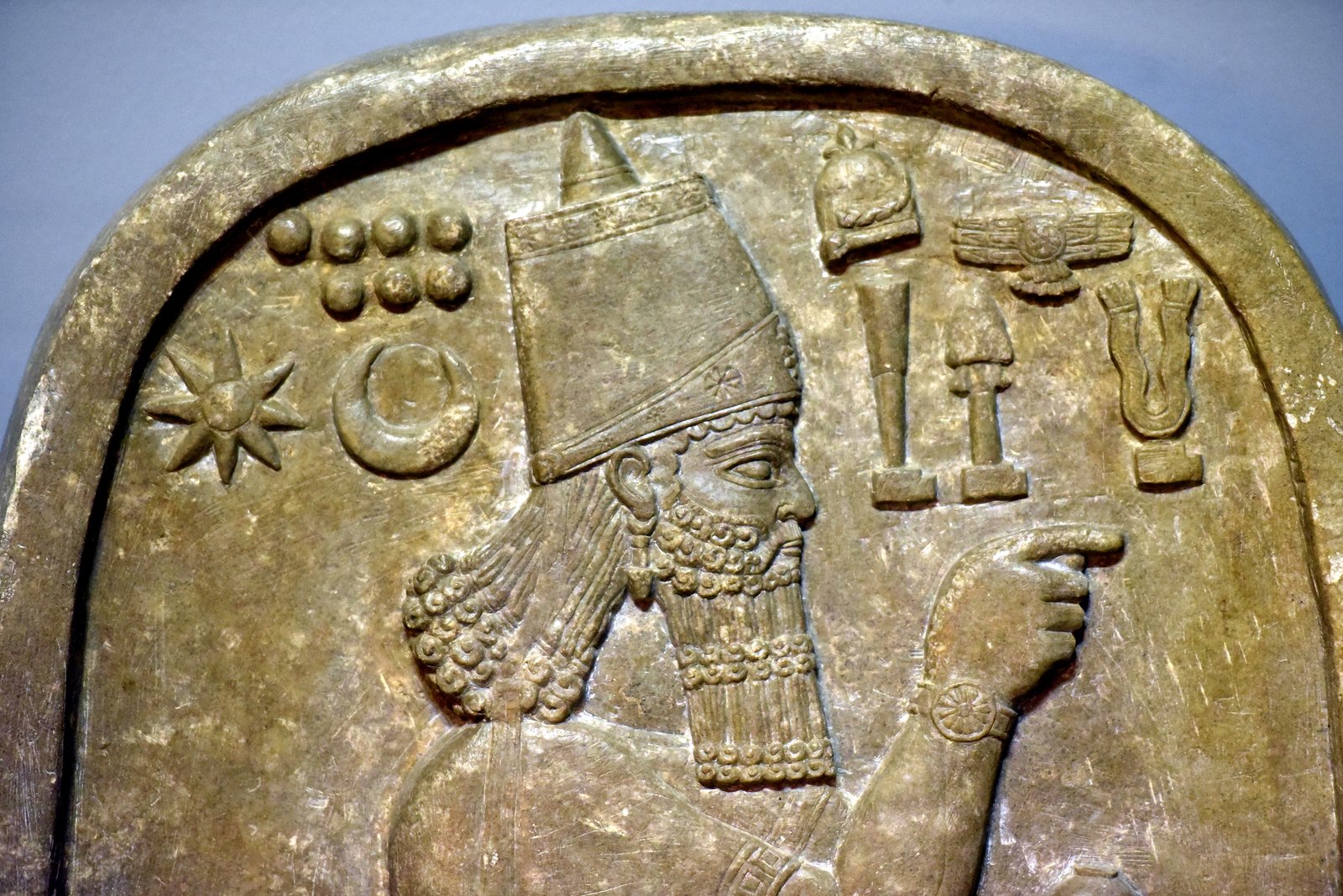
CuneiformCuneiformWriting with wedge-shaped signs, developed from Mesopotamian recording traditions and used for several languages from the third millennium BCE.Glossary · Click to read the explanation changed over many centuries. A modern explanatory image is not a record of a sign’s first appearance, nor is a resemblance to a present-day star proof that every written AN originated from a single unchanging religious emblem. Visible Language provides a framework for studying early writing, but this review checked only the book’s publisher catalogue and contents: Christopher Woods’s chapter and the object catalogue referenced in the original notes were not read in full.[1]
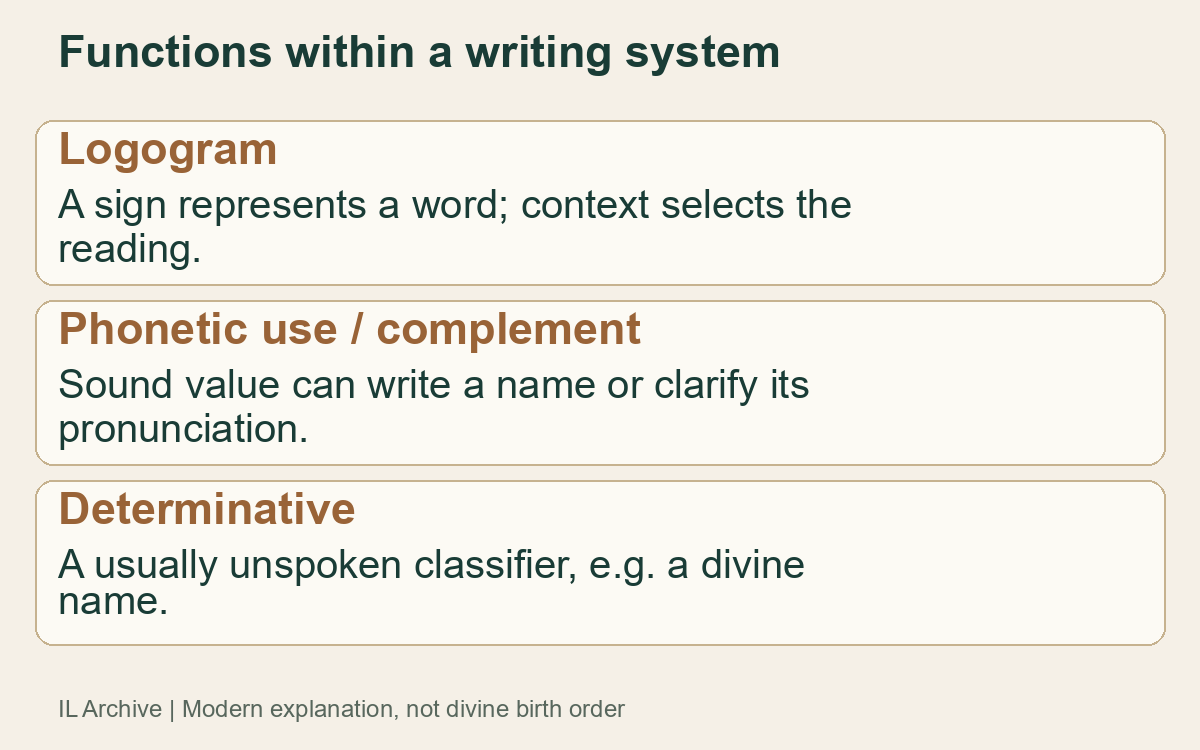
The retained archive diagram distinguishes logographic, phonetic and determinative functions. It is a modern teaching diagram, not a copy of an ancient inscription. The new cover is likewise a generated symbolic image; its radiant motif is neither a verified reproduction of AN/DINGIR nor an archaeological object.
A practical reading rule
Three questions belong together: which sign is actually written, where does it stand relative to a name, and is it functioning there as sound, word or classifier? Answers depend on the edited reading, language and surviving context, with due care for damage and editorial reconstruction in composite texts. A determinative is evidence about a scribe’s writing practice, not independent proof of a religion’s origin or a deity’s identity.[3][5]
References and notes (8)
- Christopher Woods (ed.), with Emily Teeter and Geoff Emberling, Visible Language: Inventions of Writing in the Ancient Middle East and Beyond, OIMP 32, Chicago, 2010; corrected reprint 2015. Publisher catalogue, table of contents, and edition data only; large PDF could not be opened. Pages 43/70 and the full chapter were not read in this review. Return to the text ↑
- Kathryn Stevens, “An/Anu (god)”, Ancient Mesopotamian Gods and Goddesses (ORACC), “Name and Spellings”. Search-index extract of “Name and Spellings” only; direct access timed out. Identifies Sumerian an and Akkadian {d}AN, {d}a-nu and {d}60. Return to the text ↑
- Oracc, “Akkadian Stylesheet”, “Determinatives” section, cuneiform classifiers and ATF encoding. Search-index excerpt of “Determinatives” only; full page fetch failed. Return to the text ↑
- DCCLT, “Introduction to Cuneiform Lexical Texts”, discussion of sign values and determinatives. Indexed paragraph on IB, UN and the divine name Uraš; the full page was inaccessible. Return to the text ↑
- Cuneiform Digital Library Initiative (CDLI), “CDLI search information”, ATF conventions for determinatives. Read “Lines of text”/“Determinatives”, examples 1–2, and “Searching for words”, not the entire guide. Return to the text ↑
- CDLI, RIME 1.14.15.01, composite edition P431223, edited by Robert K. Englund (2016). Published transliteration, lines 1–14 only, not individual artifact photographs; {d}en-lil at 1 and unu{ki} at 6 and 8. Return to the text ↑
- CDLI, RIME 4.03.07.07, Sumerian composite P448503, edited by Daniel A. Foxvog (2013). Lines 1–15 of the composite transliteration; damage and editorial additions present; no direct tablet reading. Return to the text ↑
- Eleanor Robson and Steve Tinney, “QPN: Oracc Linguistic Annotation for Proper Nouns”, “Transliteration” and “EPOS”. Indexed excerpts of “Transliteration” and “EPOS”; example of royal Šulgi marked divine. The rest of the guide was not read. Return to the text ↑
Suggest a correction · Suggest a source for this record
Cite this record
IL Archive, «The divine determinative in cuneiform», https://ilarchive.com/en/entities/divine-determinative
Continue reading