Entity · Concept
Divine determinative
A reference page linking a name, group, or concept to the materials that discuss it.
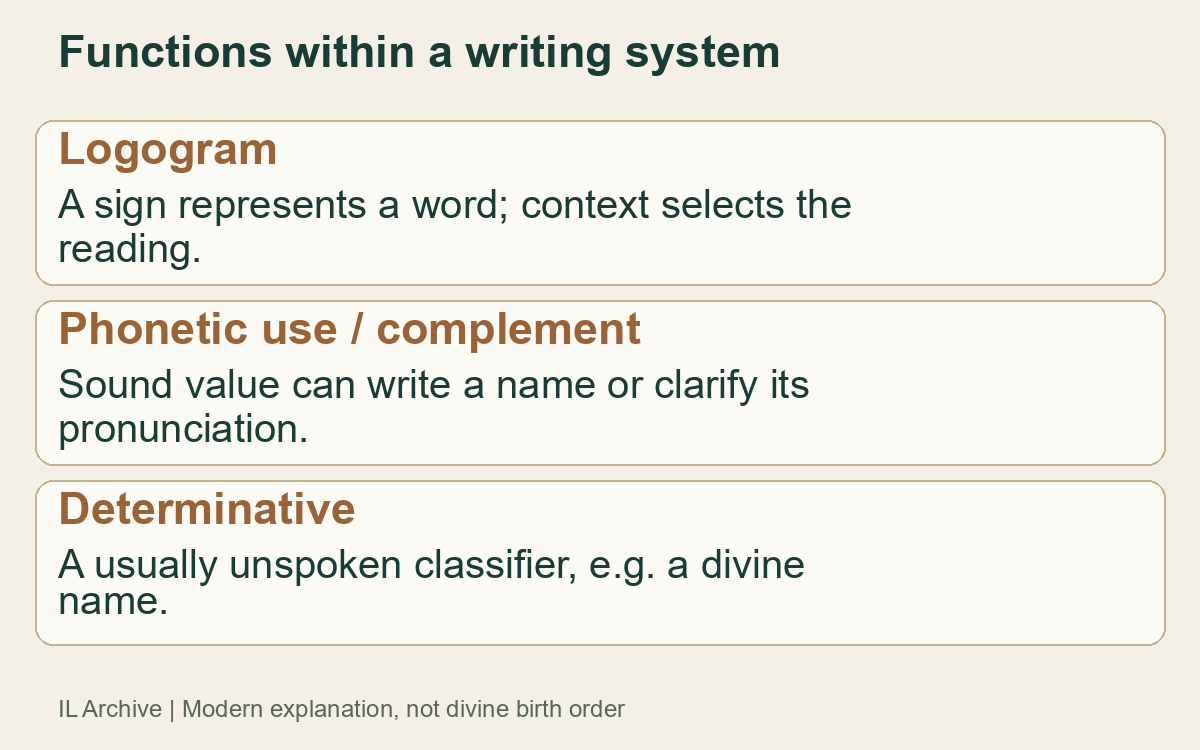
A usually unspoken sign classifying a name as divine; usage differs by language, period and name.
Text
A determinative guides a reader to a word’s category rather than necessarily adding sound. Mesopotamian writing uses AN/DINGIR as a divine classifier. Editors indicate it by raised d or {d}, modern transliteration conventions.[1]
Not every divine name bears it in every stage: Sumerian An is an example of absence. Context remains necessary. The diagram explains functions without inventing an ancient cuneiformCuneiformWriting with wedge-shaped signs, developed from Mesopotamian recording traditions and used for several languages from the third millennium BCE.Glossary · Click to read the explanation shape.[2]
References and notes
- Christopher Woods (2010), The Earliest Mesopotamian Writing; Joachim Marzahn, catalogue no. 39 (translated by Robert Wagner). In C. Woods, E. Teeter & G. Emberling, Visible Language. OIMP 32. Selected chronology/language passages; p. 43: URI3+NA and Nanna; p. 70, no. 39, VAT14540: clay Inanna emblem, page visually inspected. Not the whole book. Catalogue photograph not republished. Emblem origin balanced against van Dijk-Coombes. Return to the text ↑
- Kathryn Stevens. An/Anu (god). Ancient Mesopotamian Gods and Goddesses, ORACC. Indexed original-site sections: AN functions, Sumerian An without determinative, clearer Fara/Mesanepada evidence. Direct access failed; Frayne’s underlying publication was not read. Return to the text ↑
Research history
Substantive changes are retained here. Minor copy edits remain in the internal operational log.
-
Substantive record update
Suggest a correction · Suggest a source for this record
Cite this record
IL Archive, «Divine determinative», Edition 2, https://ilarchive.com/en/entities/divine-determinative