Artifact · Tablet
A Late Uruk Tablet Recording Food Rations (BM 140852)
An object record bringing together its image, metadata, rights, and context.
- Timeline
- From 3200 BCE to 3000 BCE
- Region
- Mesopotamia
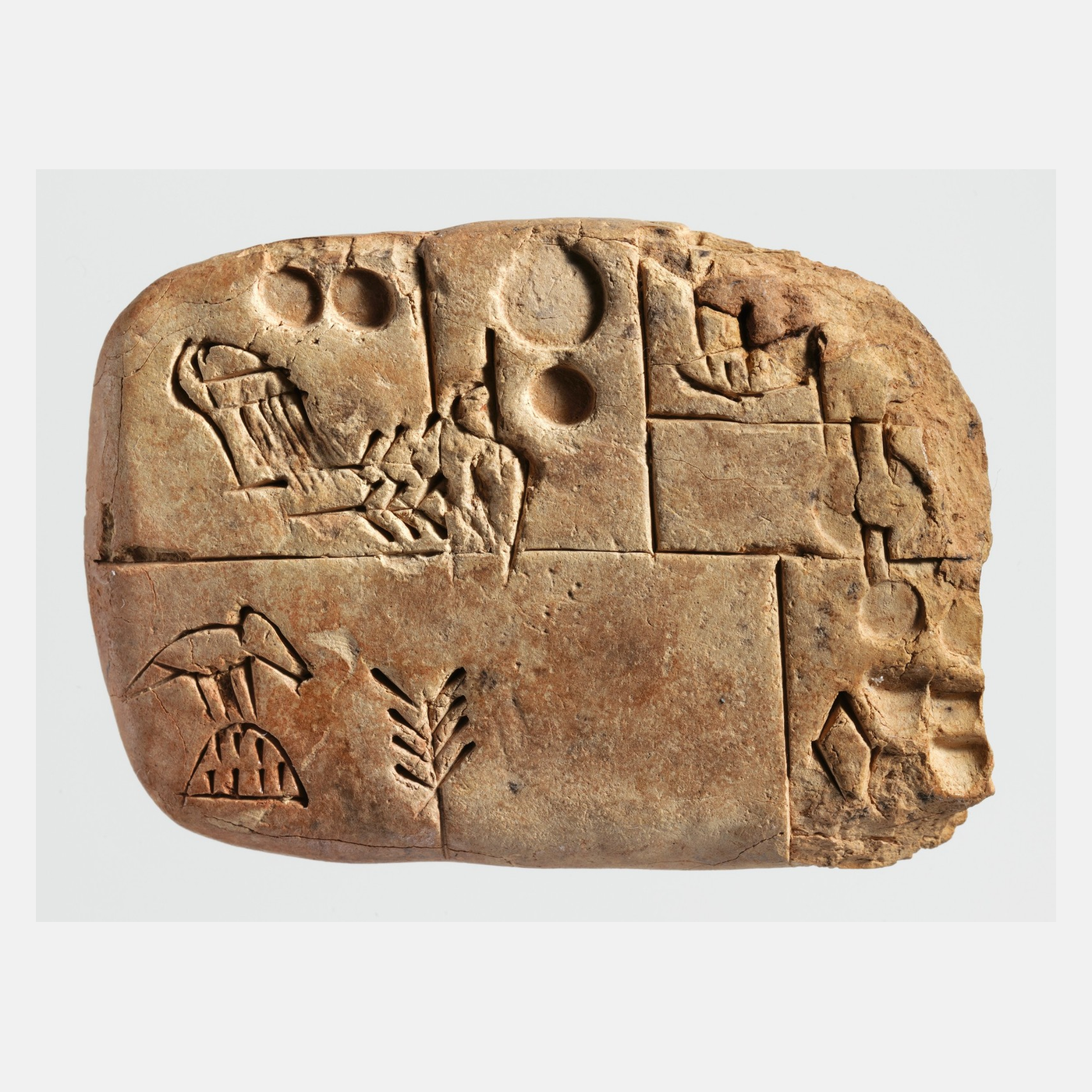
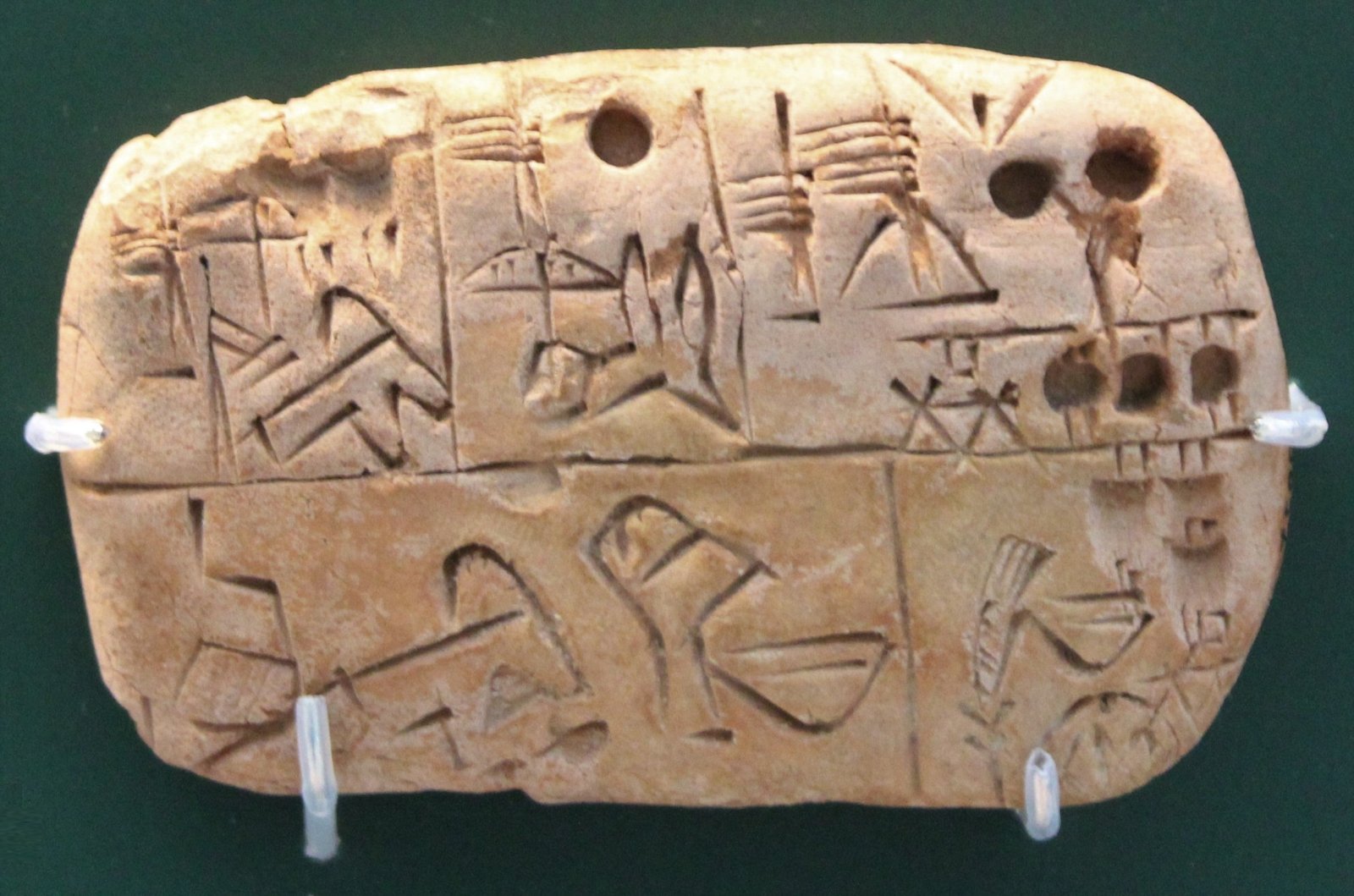
A clay tablet records allotments of barley and emmer wheat. On the front, a head and bowl mark the account as a record of provisions. The back keeps the two grains separate, so each total can be checked against the entries.
Estimated reading time: 4 min Published Last reviewed:
Share article
Photograph
Photograph by Zunkir, via Wikimedia Commons, CC BY-SA 4.0. Resized.
Obverse of British Museum tablet 140852. The head and bowl are near the lower centre, with round numerical impressions on the right
License · Image sourceObject details
- Title
- A Late Uruk Tablet Recording Food Rations (BM 140852)
- Timeline
- From 3200 BCE to 3000 BCE
- Region
- Mesopotamia
- Rights
- CC BY-SA
Text
Introduction
On the front of British Museum tablet 140852, a head faces a bowl. The sign belongs to an account of grain allotments. The two faces preserve individual entries and separate totals for barley and emmer, a kind of wheat. The CuneiformCuneiformWriting with wedge-shaped signs, developed from Mesopotamian recording traditions and used for several languages from the third millennium BCE.Glossary · Click to read the explanation Digital Library Initiative classifies the tablet as an administrative record in proto-cuneiformProto-cuneiformEarly southern Mesopotamian script (c. 3350–3000 BCE): clay tablets with counting systems and signs for commodities, people and offices, as well as lexical lists; not yet a full rendering of speech.Glossary · Click to read the explanation from the UrukUrukAncient city at Warka in southern Iraq, a major urban centre around 3200 BCE that preserved early writing and accounting tablets.Glossary · Click to read the explanation III phase, about 3200–3000 BCE. The catalogue gives Uruk, modern Warka in IraqIraqIraq is a modern country encompassing much of ancient MesopotamiaGlossary · Click to read the explanation, as a possible place of origin. [1][2][3]
A sign for provisions
The clay is divided into small fields by incised lines. Circular impressions on the right give quantities, and signs made with lines or combinations of marks give other information about the entries. The sign at the lower centre of the front combines a human head with a bowl near the mouth. In the modern edition it is called GU7. It occurs again on the back, beneath the totals. The British Museum explains the sign in relation to the later Sumerian word gu, meaning “to eat.” Here it helps identify the transaction as an allocation of provisions. The language of the tablet as a whole remains undetermined. [1][2][3]
The different uses of the clay bowls of the period help explain why the sign can be easy to recognize and still leave questions open. The British Museum associates the shape beside the head with a mass-produced bowl used for rations. The bowls associated with the Late Uruk period have thick sides and bevelled rims. In experiments with replicas, Jill Goulder found that their shape and thick sides made them suitable for baking bread. Her results support one possible use of these vessels. The entry on the tablet records allotted grain and leaves the eventual preparation of that food unspecified. [1][2][3][5]
The front and back of the account
The modern edition divides the front into two columns. In its first entry, two impressions of a numerical sign labelled N14 stand before the sign ŠE, which denotes barley. A separate entry in the same column begins with one more N14 sign. The first entry on the back gives three N14 signs with ŠE. The number of impressions for that sign matches the front entries, two plus one. N14 is the edition’s name for a particular numerical mark. Its value as a measure depends on the counting system in which it is used. [1][3][4]
The emmer has its own total in the next entry on the back. The edition records three impressions of N19 and five of N04 there. The front already has three N19 impressions, and counts of two and three N04 signs in separate places. The edition flags the group of two as damaged. Read this way, the reverse retains the three and combines the two smaller groups as five. Salvatore F. Monaco places this tablet among accounts that total barley and emmer separately using different systems of capacity signs. He identifies the group of signs GIŠ+TE, which occurs twice on this front, as a designation associated with an allocation of emmer. Its appearances help identify the grain in entries where the numbers and designations are abbreviated. [1][3][4]
Date and provenance
The British Museum’s online exhibition dates the piece to about 3300–3100 BCE and gives dimensions of 75 × 45 × 16 mm. The CDLI record gives 76 × 48 × 17 mm and assigns it to Uruk III, about 3200–3000 BCE. The CDLI entry identifies the proposed provenance as Uruk and gives no recorded findspot. The museum’s exhibition lists Iraq and records that the tablet came from the Erlenmeyer collection and was purchased through Christie’s. The original find context is unknown. [1][2][3]
Quick answers
What is British Museum 140852?
It is a Late Uruk clay tablet that records allocations of barley and emmer wheat. The reverse preserves a separate total for each grain. [1][2][3]
What does the head and bowl sign mean?
The sign, conventionally written GU7, helps identify the entry as a record of provisions. The British Museum links it to a sign used for “to eat” in later writing. [1][2][3]
Where was the tablet found?
Uruk in Iraq is its proposed provenance. The catalogue marks that attribution as uncertain and gives no specific findspot. [1]
Where is the tablet now?
It is in the British Museum in London, with museum number 140852. [1][2]
References and notes
- Cuneiform Digital Library Initiative, MSVO 3, 70 (P005381) Catalogue, explicit Provenance field, edition summary, obverse columns I–II and reverse columns I–II. Date, dimensions, uncertain origin, sign groups and grain totals. Return to the text ↑
- British Museum, “Record of food supplies”, Google Arts & Culture Object description and Details. Head and bowl, circular quantity marks, later Sumerian meaning, date, measurements and acquisition. Return to the text ↑
- Salvatore F. Monaco, “Unusual Accounting Practices in Archaic Mesopotamian Tablets”, Cuneiform Digital Library Journal 2005 (1) Sections 1.1–1.2 and notes 2–3. Section 8.1, note 21. Collection history, separate barley and emmer totals in no. 70 and GIŠ+TE as an emmer destination. Return to the text ↑
- Robert K. Englund, “Grain Accounting Practices in Archaic Mesopotamia”, in Jens Høyrup and Peter Damerow, eds., Changing Views on Ancient Near Eastern Mathematics, BBVO 19, 2001, pp. 1–35 Pp. 3–4, note 7 and figure 1. Modern sign labels and the numerical systems used in early grain accounts. Return to the text ↑
- Jill Goulder, “Administrators’ bread: an experiment-based re-assessment of the functional and cultural role of the Uruk bevel-rim bowl”, Antiquity 84 (324), 2010, pp. 351–362 Pp. 351, 355 and 357–358, including figure 2. Bevel-rim bowls, proposed uses and bread baked in replicas. Return to the text ↑
Archive records may be reviewed and refined as better evidence or sources become available. Suggest a correction
Suggest a correction · Suggest a source for this record
Cite this record
IL Archive, «A Late Uruk Tablet Recording Food Rations (BM 140852)», https://ilarchive.com/en/artifacts/late-uruk-ration-tablet-bm140852
Continue reading