Entity
Dumuzi / Tammuz
A reference page linking a name, group, or concept to the materials that discuss it.
Dumuzi is a deity of ancient Mesopotamian traditions associated with shepherding and Inanna; Tammuz appears as the name in later linguistic and textual traditions.
Last reviewed:
Video
Inanna’s Descent to the Netherworld: Seven gates, a rescue and a price
Seven gates, a rescue and a price. The whole story in two illustrated chapters, told from the ancient clay tablets; where the tablets are broken, the narration says so. Illustrations, narration voice and visual effects were created with AI tools by IL Archive; the text is a faithful retelling based on the ancient tablets.
The YouTube player loads only when you press play. Watch on YouTube
Text
Dumuzi is a deity of ancient Mesopotamian traditions associated with shepherding and InannaInanna / IshtarA prominent Mesopotamian goddess whose Sumerian name Inanna became associated with Akkadian Ishtar across diverse traditions. She was associated with desire, war, royal authority and Venus, while local forms and genealogies varied among texts.Glossary · Click to read the explanation; Tammuz appears as the name in later linguistic and textual traditions.
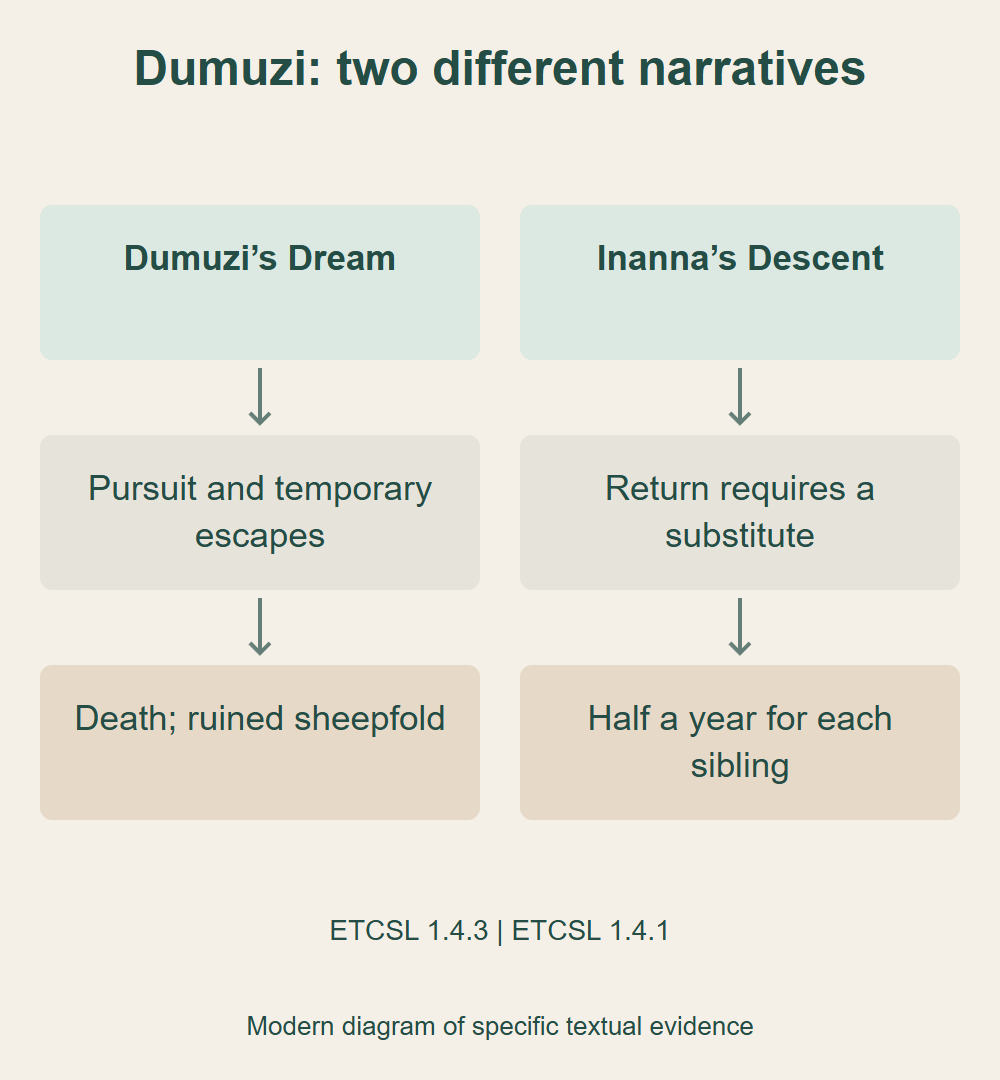
In Dumuzi’s Dream his sister tries to protect him, and the sun god helps him escape temporarily before the narrative ends with his death and ruined sheepfold. The ending of Inanna’s Descent divides residence below between him and his sister, half a year each. Death and return function differently in these two texts; laments and ritualsRitualAn organised or distinguished practice meaningful to a community; it may leave traces, but its form alone does not reveal an associated doctrine.Glossary · Click to read the explanation add further evidence. [1] [2] [3]
References and notes
Suggest a correction · Suggest a source for this record
Cite this record
IL Archive, «Dumuzi / Tammuz», https://ilarchive.com/en/entities/dumuzi-tammuz