Study
From a national god to the god of the universe
An extended study of a topic, with evidence and references.
Exclusive allegiance and denial of other gods: inscriptions, Assyrian/Babylonian crises and Second Isaiah, separating events from composition and disagreements over monotheism.
Share article
Text
Two questions inside one word
If we asked someone in Iron Age Israel or Judah whom they should worship, and then whether other gods existed, the questions would not be identical. They could pledge allegiance to YahwehYahwehThe divine proper name written YHWH in the Hebrew Bible.Glossary · Click to read the explanation alone while believing that other nations had their gods. Another text could go further and deny everyone else genuine divinity. Between exclusive worshipMonolatryWorship of one deity without necessarily denying others; variable analytical term, not one uniform doctrine of all Israelites.Glossary · Click to read the explanation and that denial lies a major problem in the history of Israelite religion. [1][4]
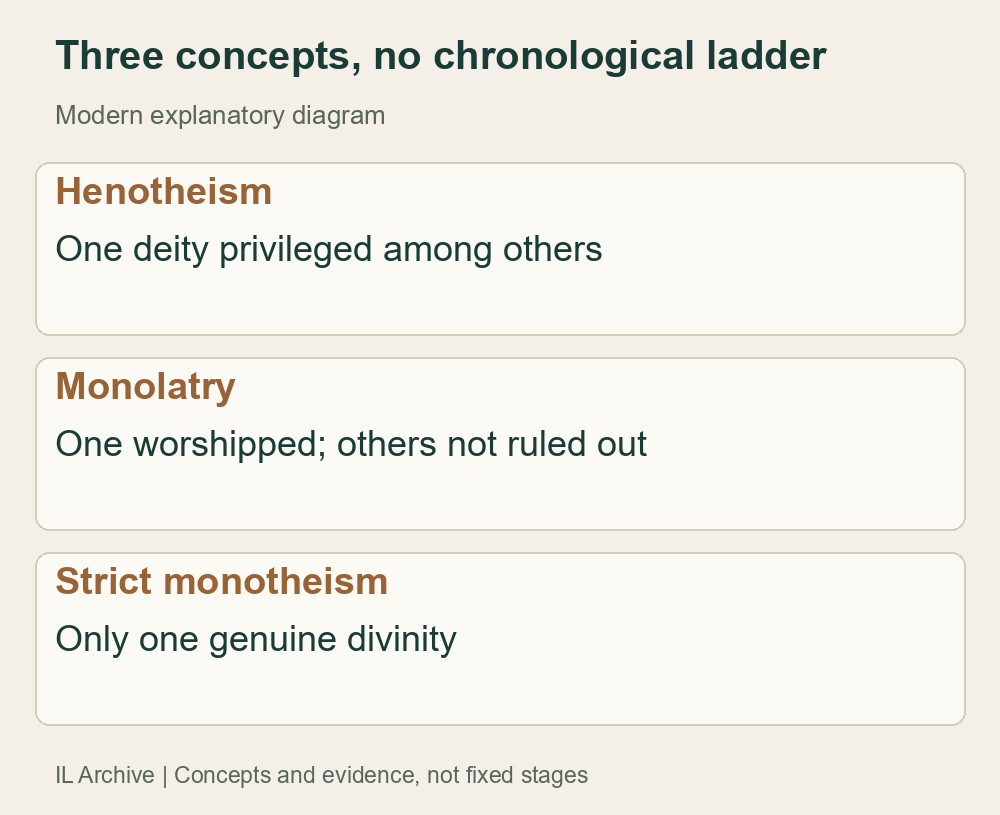
Here henotheismHenotheismPrivileging one god while acknowledging others in the working definition used here; not automatically monotheism or a fixed social phase.Glossary · Click to read the explanation means privileging one deity within a world acknowledging others; monolatryMonolatryWorship of one deity without necessarily denying others; variable analytical term, not one uniform doctrine of all Israelites.Glossary · Click to read the explanation means worshipping one deity without necessarily denying others. Strict monotheismMonotheismBelief in a single God as the only deity, rather than merely the highest among several gods.Glossary · Click to read the explanation recognizes only one genuine divinity. Scholars define these terms differently. They are not a staircase that every community climbed in the same order. [8][13]
Yahweh and the people
Yahweh had a special relationship with IsraelAncient IsraelA name for an ancient population and later historical traditions, attested on the Merneptah Stele.Glossary · Click to read the explanation and Judah. In an environment of national and royal deities, a god protected a community and legitimized its king; land and victories could be attributed to him. “National god” does not mean worship automatically stopped at the border, that the god had no power beyond it, or that everyone in the kingdom worshipped him alone. [1][2]
The relationship with the people was central to his religious identity. A kingdom’s defeat therefore raised a painful question: how could a people protected by its god be defeated? Answers could differ within the same society, from blaming the people to questioning protection or rethinking divine sovereignty.
National gods in the language of the text
In Judges 11:24, Jephthah’s speech compares land granted by ChemoshChemoshProminent Moabite deity whose anger and favor explain defeat and recovery in Mesha’s royal inscription.Glossary · Click to read the explanation with land granted by Yahweh. Yet it addresses the Ammonite king, whereas Chemosh is normally associated with Moab. It is not a straightforward chart matching every nation to its god, nor a census of popular belief. It attests this argument within the narrative. [2]
One reading of Deuteronomy 32:8 distributes nations according to divine sons; the next verse identifies Jacob as Yahweh’s portion. QumranDead Sea ScrollsJudaean Desert manuscripts, especially Qumran cave finds. Biblical copies and other works reveal textual diversity; a copy’s age is not the work’s initial date.Glossary · Click to read the explanation manuscripts support divine beings against the Masoretic “sons of Israel.” Reading ElEl at UgaritA deity prominent in West Semitic traditions, especially as head of the divine family in Ugaritic texts.Glossary · Click to read the explanation/Elyon and Yahweh as separate deities here is an influential, disputed reconstruction; the manuscript variant alone does not settle it. [3][1]
“Worship no other” and “no other exists”
The command in Exodus 20 prohibits other gods before Yahweh. Its immediate concern is human allegiance and worship. The prohibition alone establishes neither that its author denied all other gods nor that the author accepted their existence. It must be read alongside other texts. [4]
Saying Yahweh is greater than others, or deserves exclusive loyalty, differs logically from saying that others possess no divinity at all. A text may combine superiority and exclusivity. These distinctions let us ask more precise questions than a single question about when monotheism began.
Inscriptions complicate the picture
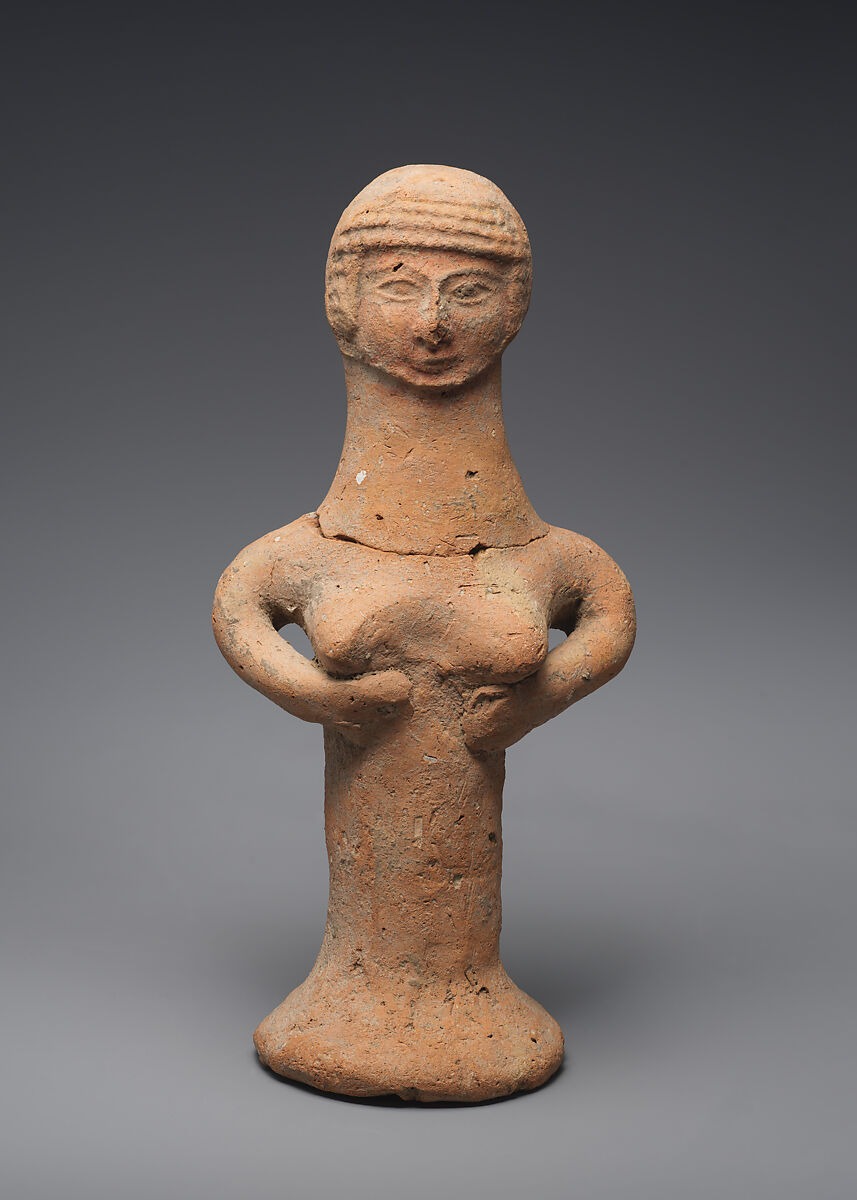
Blessings from Kuntillet ʿAjrudKuntillet ʿAjrudSinai site preserving blessings by Yahweh of Samaria/Teman and “his asherah” around 800 BCE; building function and wording disputed.Glossary · Click to read the explanation, around the late ninth and early eighth centuries BCE, mention Yahweh of Samaria, Yahweh of Teman and “his asherah.” An eighth-century Khirbet el-QomKhirbet el-QomSite west of Hebron known for an eighth-century BCE funerary inscription commonly associating Yahweh with “his asherah”; damaged text and readings disputed.Glossary · Click to read the explanation inscription is also commonly read as associating Yahweh with “his asherah.” Scholars discuss the goddess Asherah/AthiratAthiratA high-ranking goddess commonly understood as El’s consort in Ugaritic texts; associated with the progenitress epithet and the palace intercession.Glossary · Click to read the explanation, her cult symbol and other readings; the wording alone does not identify its referent. [5]
This material cannot automatically be equated with the Bible’s final religious picture. It reveals varied ritualRitualAn organised or distinguished practice meaningful to a community; it may leave traces, but its form alone does not reveal an associated doctrine.Glossary · Click to read the explanation language. It does not show that all Israelites believed Yahweh had a consort or that every female image depicted Asherah. Inscription and interpretation must remain distinct levels of evidence.
One society, several practices
Palace, temple, household and local shrine were not identical copies. Northern and southern traditions could differ, as could a family’s practices and the position of a writer condemning them. “The Israelites believed...” needs a specified source, setting and period. [1][5]
A religious command does not prove compliance. Polemic against BaalBaalStorm god and protagonist of Ugarit’s Baal Cycle; exercises active kingship while El retains importance and authorizes the palace.Glossary · Click to read the explanation or an asherah may reflect real competition, but it does not by itself measure the proportion of worshippers. Silence about a cult in an administrative document likewise does not establish its absence from everyday life.
Exclusive allegiance before exile
Deuteronomic and prophetic traditions strongly advocate worshipping Yahweh alone. Second Kings 23 depicts a reform attributed to Josiah, removing other cult equipment and binding the king to a covenant. The king’s late seventh-century setting, the narrative’s composition and editing, its programme and its actual implementation must be distinguished. [6]
Historical models place this movement within the late monarchy and disputes over identity and the centre of worship. Exclusivity need not have been one doctrine adopted by everyone, and each formulation need not deny others’ existence. Older traditions could persist within subsequently edited texts. [1]
Samaria’s fall: crisis before Babylon
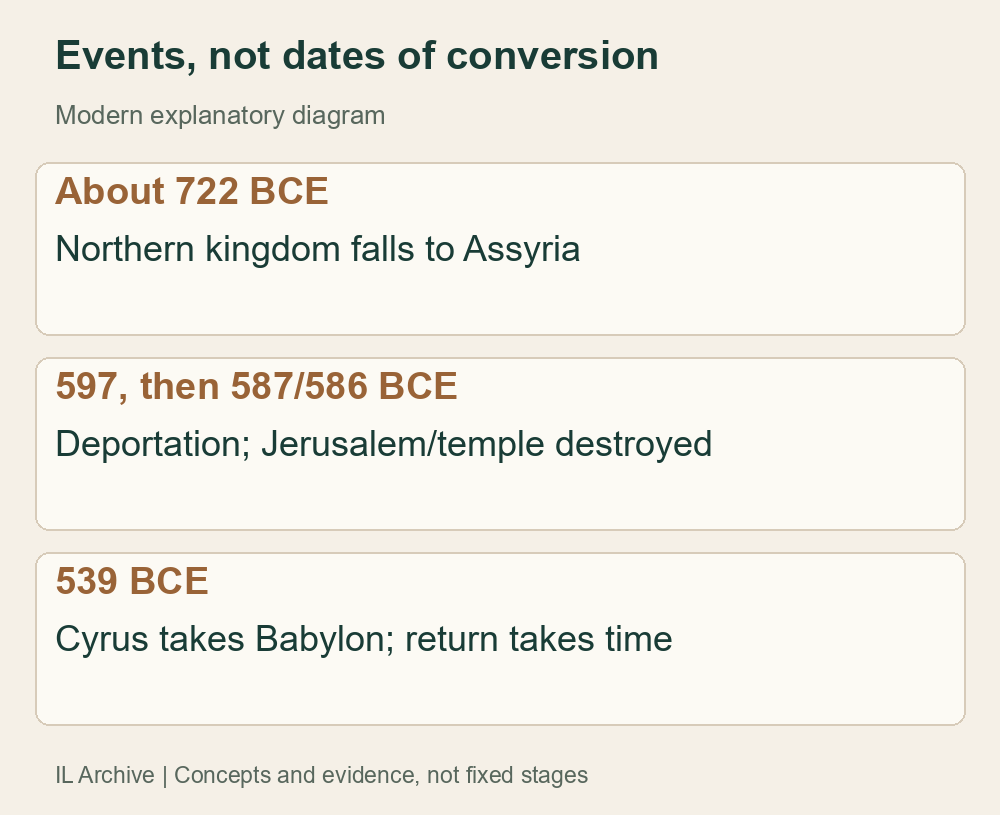
The northern kingdom of Israel fell to Assyria in the late eighth century BCE, with approximately 722 serving as a major chronological reference. People were deported, while Judah did not end at the same moment. Judah then faced Sennacherib’s campaign in 701, more than a century before the Babylonian catastrophe. [7]
This sequence prevents reducing the transformation to one exile. JerusalemJerusalemJerusalem is a city of religious importance in Judaism, Christianity and IslamGlossary · Click to read the explanation’s collapse followed prolonged engagement with a large empire and with rhetoric attributing victory and kingship to divine power. Questions about land, defeat and sovereignty existed before the sixth century.
Assyria as Yahweh’s instrument
Isaiah 10:5–15 depicts Assyria as an instrument of punishment and then condemns its king’s arrogance. Within the text’s logic, the seemingly dominant empire remains subject to Yahweh. This claims power beyond his people, without by itself settling the denial of every other god. [9]
Baruch Levine locates early roots of global monotheism in this prophetic horizon, from the late eighth and early seventh centuries. This is a proposed dating connecting thought with imperial challenges, not agreement that a complete doctrine had then spread throughout society. [8]
Jerusalem’s destruction and the Babylonian exile
BabylonBabylonBabylon is an ancient city in central present-day Iraq, south of BaghdadGlossary · Click to read the explanation’s campaigns against Judah unfolded in stages. A major deportation occurred in 597 BCE; Jerusalem and its temple were destroyed in 587/586. Babylonian exileBabylonian exileJudean deportations to Babylonia and the kingdom’s collapse in the early sixth century BCE; several phases, not everyone removed or returned at once.Glossary · Click to read the explanation covers events and communities over time. It does not mean that everyone was removed from the land or sent to Babylon at once. [7]
The kingdom and its previous royal institutions collapsed. Deportees lost their homeland and a principal centre of worship. Yet people remained in the land, and families settled abroad. The experience should not be reduced to the exiles’ voice, nor should catastrophe be assumed to produce one religious response.
Defeat is not divine defeat in every text
The catastrophe could be interpreted in several ways. Some surviving texts recast it as punishment initiated by Yahweh, making the conqueror an instrument of his decision. Jeremiah 25:9 calls Nebuchadnezzar Yahweh’s servant. This is a theological account of conquest, not independent historical proof of what caused it. [9]
Such a formulation lets the narrative retain divine sovereignty despite the people’s defeat. No historical law requires a defeated kingdom’s god to disappear, or makes monotheism the inevitable outcome. We study one preserved response among possible responses.
Presence outside the land
Deportation reopened questions about god, land and temple. Yet thinking about Yahweh’s authority beyond Judah did not begin from nothing in 586: earlier rhetoric already placed Assyria under his direction. Crisis could expand and reformulate existing conceptions rather than create every element for the first time. [8][9]
If Yahweh could govern empires and promise salvation abroad, his action need not stop at the kingdom’s borders. This follows from those texts’ logic; it does not tell us how every exile or every remaining inhabitant understood them.
Second Isaiah and the sixth-century setting
Scholars conventionally call Isaiah 40–55Second IsaiahScholarly label for Isaiah 40–55, substantially linked to exile and Cyrus; not proof of one author or one year for every verse.Glossary · Click to read the explanation Second IsaiahSecond IsaiahScholarly label for Isaiah 40–55, substantially linked to exile and Cyrus; not proof of one author or one year for every verse.Glossary · Click to read the explanation. The designation does not supply a secure biography of one person who wrote the whole collection. A substantial part relates to exile, the end of Babylonian rule and Cyrus’s rise in the sixth century BCE, with debate over layers and later editing. [12]
These texts combine hope of return, divine power over kings, creation and criticism of idols. A general sixth-century setting cannot date every verse or identify the day a particular idea was first formulated.
Statements beyond superiority
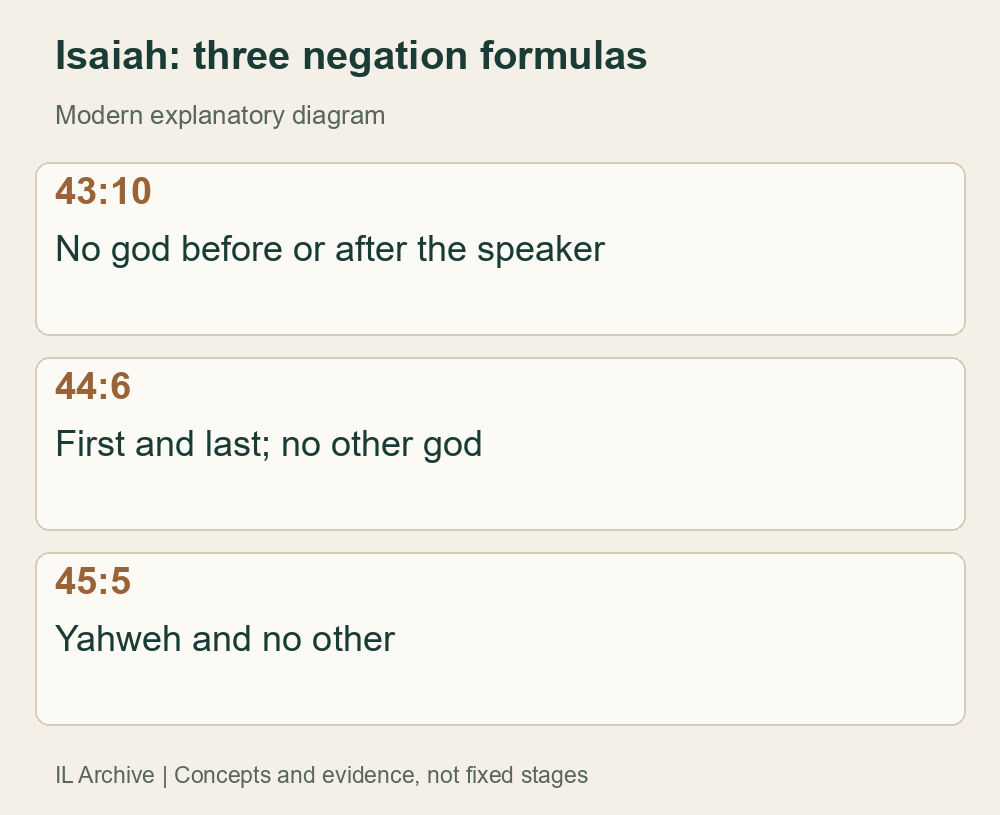
In Isaiah 43:10, the divine speaker denies a god before or after himself. In 44:6, being first and last accompanies denial of another god. Isaiah 45:5 explicitly identifies Yahweh as the only deity. These are clear references to the text’s statements, rather than merely comparisons of divine strength. [10]
Many scholars see them as some of the strongest evidence for explicit monotheism. Others debate the ancient rhetoric of negation: does it assert complete ontological uniqueness, or emphasize incomparable supremacy and rivals’ powerlessness? The dispute concerns interpretation, not whether the statements occur. [13][14]
Cyrus in two different discourses
Isaiah 45 portrays Cyrus as a conqueror chosen by Yahweh, although the king does not know him. This discourse can interpret a foreign ruler’s success as serving Israel’s god rather than escaping his authority. [10]
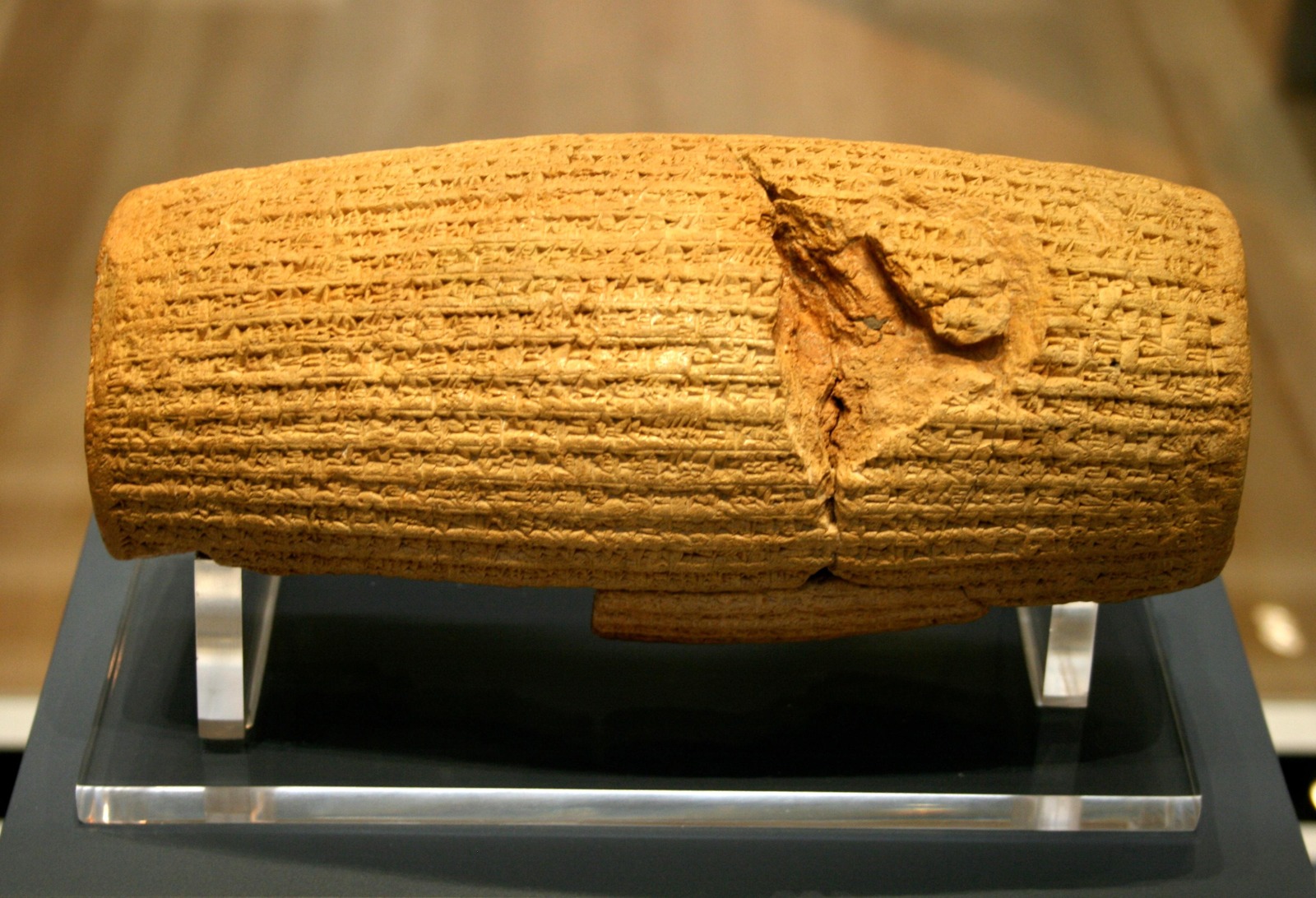
The Cyrus Cylinder, following Babylon’s conquest in 539 BCE, attributes his selection to MardukMardukBabylon’s god, elevated with the city’s history. Enuma Elish celebrates his rise and cosmic ordering; sources associate him with Nibiru and Jupiter. Earliest origins and functions remain uncertain.Glossary · Click to read the explanation. It names neither Yahweh nor Judah and is not the specific text of a Jewish return decree. Comparison reveals two claims of sovereignty, not one royal creed. [11]
Babylon and control of history
Matthias Albani discusses Isaiah’s claims within competition over the future and Cyrus’s rise. His interpretation connects Babylonian discourse about gods and destiny with religious conflicts near the kingdom’s end. This contextual hypothesis helps explain the polemic; it does not establish that monotheism as a whole was borrowed from Babylon. [12]
The text can place heavens, stars and history under one creator’s power. Conquest no longer testifies only to one nation’s fortunes but enters a broader claim about governing the world. The actual transmission and reception of ideas remain harder to establish than this literary contrast.
Creator of the world, still linked to Israel
Isaiah does not abandon Israel when speaking of the universe’s god. Chapter 45 itself identifies Jacob as servant and Israel as chosen, then speaks of creating earth, humanity and heavens. Election and universal sovereignty coexist within the text. [10]
The change does not remove the people from the relationship. It changes the claim’s scope: Israel’s god can also create everyone and govern other nations’ kings. Universal power does not imply that all nations had actually adopted one form of worship.
Exile as a turning point, not the whole beginning
The sixth century can be significant without being the birthplace of every root of monotheism. Several traditions of exclusivity precede it; assertions of power beyond Israel precede the catastrophe. Redefinitions of divinity and heavenly beings continued afterwards. [6][8][10]
Conversely, a strong statement in a text does not establish that ordinary people shared its meaning at one date. Four dates need separating: the event, the tradition, the text and its editing, and its social diffusion. Mixing them turns a prolonged transformation into an announcement made on one day.
Scholarly disagreement also concerns definitions
Benjamin Sommer argues for biblical monotheism with a preexilic presence and examines the term’s limitations. His position should be reported, rather than using only his account of other scholars who place monotheism’s emergence in the sixth century. [13]
Arnaud Sérandour dates monotheism much later under his strict definition, attaching importance to PhiloPhilo of AlexandriaFirst-century CE Alexandrian Jewish author. In Life of Moses he presents Greek translation as inspired; the passage does not explicitly assign a separate room to each translator.Glossary · Click to read the explanation in the Roman period. His article appeared in 2005, although Cambridge made it available online in 2024. This is a dissenting position, not a new consensus. Different criteria for “another god” yield different chronological answers. [14]
“Yahweh is one” requires interpretation
Deuteronomy 6:4, the Shema, becomes central to Jewish confession: Yahweh our God, Yahweh one. Scholarship discusses unity or uniqueness and the declaration that Yahweh alone is the community’s god. The HebrewHebrewA Northwest Semitic language in the Canaanite group, with ancient and modern forms.Glossary · Click to read the explanation sentence does not offer one uncontested modern translation. [6][15]
Later liturgical readings should not be dismissed, but they alone do not date the emergence of every meaning. The text’s place in a later religion and what its wording and ancient setting allow us to infer are separate matters.
A surviving council, changing status
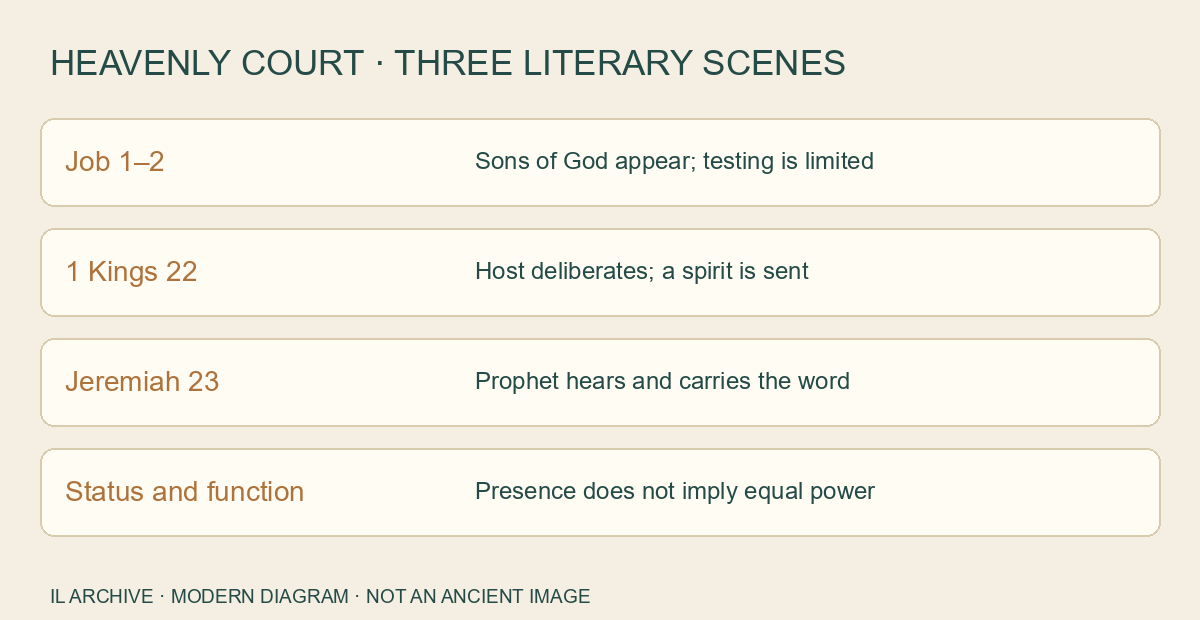
The heavenly councilDivine councilA representation of divine beings acting as an assembly with authority and differentiated roles.Glossary · Click to read the explanation survives in texts such as Job 1, where sons of GodSons of GodA Hebrew expression for heavenly beings in texts such as Job; context determines its meaning, rather than biological descent or a fixed angelic roster.Glossary · Click to read the explanation appear before Yahweh, and Psalm 82, with judgement among beings called elohimElohimA Hebrew word with plural morphology, used for “gods” or for a singular deity according to context.Glossary · Click to read the explanation. Whether the latter are heavenly or human is debated; a ready-made translation should not conceal that. [16]
Later traditions could retain messengers, spirits and the heavenly hostHeavenly HostA heavenly group whose meaning varies: celestial bodies in some texts, attendants around the throne deliberating in 1 Kings 22.Glossary · Click to read the explanation while denying their entitlement to independent worship. Monotheism therefore need not empty heaven. Continuity does not prove that each angelAngel / Divine MessengerHebrew malʾakh means messenger, human or celestial according to context; the word alone proves neither wings nor origin from a particular Canaanite god.Glossary · Click to read the explanation was a particular Canaanite deity renamed. It concerns classification and authority, not a list matching individuals.
The temple remains important
Understanding God as ruler of the world did not abolish land or temple. Projects of return and rebuilding themselves gave sacred space great weight. Dating exile’s end shows that Babylon’s conquest in 539, return and work on the temple were not one simultaneous event for everyone. [7]
Divine sovereignty and ways of maintaining identity could expand while particular places and rituals remained central. A simple route from temple religion to religion without place misrepresents a history retaining tension between universality and attachment to place.
Comparison does not mean copying
Other environments praised supreme gods in comprehensive terms. Yet exalting a god among gods, or attributing their functions to him, does not automatically equal denying all other divinity. Each text needs examination rather than being classified as monotheistic merely because it calls a god one or incomparable. [15]
Research on empires, defeat and circulating ideas explains contexts of religious expression. It neither decides God’s existence nor reduces belief to a single psychological device. Historians study what communities said and practised and how it changed, recognizing that many voices are lost.
What can be said at different levels
It is textually certain that some passages demand exclusive allegiance to Yahweh while others explicitly deny another god. It is historically certain that Samaria’s fall, Jerusalem’s destruction and deportation transformed communities. Treating those crises as monotheism’s sole cause goes beyond the evidence. [4][7][10]
The late monarchy, exile and subsequent periods probably mattered greatly in reshaping Yahweh’s image. Preexilic monotheism, some negation formulas and the term’s boundaries remain disputed. No single date establishes everyone’s conversion, and no single inventor followed by the whole society is demonstrated. [1][8][13][14]
From a people’s god to a claim over the world
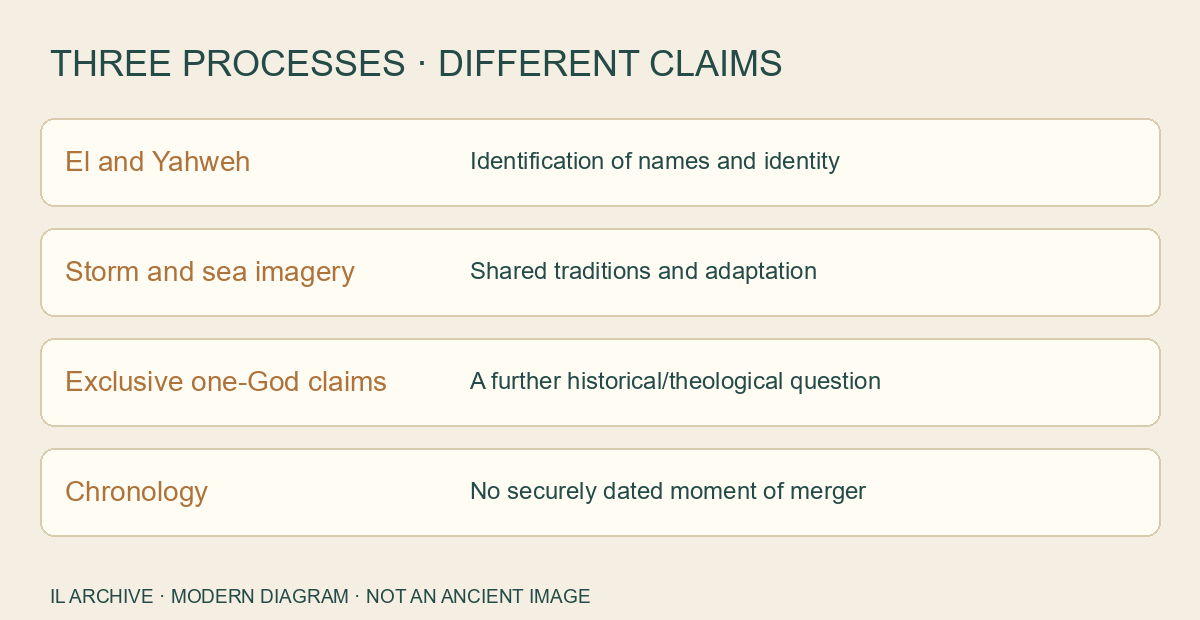
The story is not simply a local god growing when his people lost. Broader sovereignty traditions, demands for loyalty, varied worship and texts reinterpreting the past already existed. Empire and exile put new pressure on these questions. Some texts then articulated a powerful answer: Yahweh not only protects Israel but governs its conqueror and restorer and creates the whole world.
This process cannot be assigned to one year or made inevitable. Its changing claims can be traced through texts, inscriptions and chronology. In its clearest formulations, the question is no longer which god is stronger than the others, but who possesses genuine divinity at all. Israel’s relationship with its god remains, while the text asks that this god be understood as the world’s god.
References and notes
- Mark S. Smith. The Origins of Biblical Monotheism: Israel’s Polytheistic Background and the Ugaritic Texts. Author overview, Bible Interp, associated with the 2001 book. Author overview passages on varied worship, seventh/sixth centuries, El, council and Deuteronomy 32 read; full book not read. Reconstruction attributed; separation of El/Yahweh disputed, not manuscript fact. Return to the text ↑
- Hebrew Bible: Judges 11:12–27, especially 11:24. Mechon-Mamre, Hebrew text and displayed English translation. Jephthah addresses Ammon’s king but invokes Chemosh; comparison and Moab/Ammon context read. Character’s speech not a cult census or automatic composition date. Return to the text ↑
- Israel Antiquities Authority. Leon Levy Dead Sea Scrolls Digital Library, B-359054, Deuteronomy witness; compare Deuteronomy 32:8–9 and Smith’s reconstruction. Qumran witness/catalogue compared with textual scholarship previously checked; no complete independent decipherment claimed. Divine sons strongly supported; Elyon/Yahweh separation disputed. Manuscript does not date poem’s origin. Return to the text ↑
- Hebrew Bible: Exodus 20, prohibition of other gods and their worship. Mechon-Mamre. Hebrew prohibition read; commandment/verse numbering varies across traditions. Direct concern is allegiance; author’s complete ontology and popular belief not inferred from this alone. Return to the text ↑
- Judith M. Hadley. Evidence for Asherah. Bible Interp, December 2008. Inscription, Athirat, symbol and drawing passages read during related study review; source page rechecked. Consort/symbol and identity debated, not a verified couple or one belief for all Israel. Return to the text ↑
- Hebrew Bible: Deuteronomy 6:4–9; 2 Kings 23:1–7. Mechon-Mamre. Shema, covenant and reform passages compared in Hebrew and translation. Josiah’s narrative setting not composition date; prescription not evidence of universal implementation. Return to the text ↑
- Rainer Albertz. Israel in Exile: The History and Literature of the Sixth Century B.C.E. Translated by David Green. Society of Biblical Literature, 2003. Introduction, pp. 1–3. Introduction pp. 1–3 and 2003 copyright page read, not full book: sequence 722, 701, 597, 587/586, 539 and limits of exile’s end. Deportation not equated with empty land or immediate return of everyone. Return to the text ↑
- Baruch A. Levine. Global Monotheism: The Contribution of the Israelite Prophets. In Melammu: The Ancient World in an Age of Globalization, 2014. DOI: 10.34663/9783945561003-04. Introduction, proposed phases/dating and expanded prophetic horizon read. Late eighth/early seventh in Levine’s model; imperial explanation attributed, not consensus or universal adoption. Return to the text ↑
- Hebrew Bible: Isaiah 10:5–15; Jeremiah 25:8–12. Mechon-Mamre. Assyria as instrument; Nebuchadnezzar as servant in Jeremiah. Hebrew/specified contexts read: theological claims, not independent proof of conquest’s cause or dating of all layers. Return to the text ↑
- Hebrew Bible: Isaiah 43:10–12; 44:6–10; 45:1–7, 12–13. Mechon-Mamre. Negation formulas, Cyrus’s selection and creation passages read in Hebrew/translation. Short quotations or editorial paraphrases in all three languages; dating from scholarship, not text page. Return to the text ↑
- British Museum. The Cyrus Cylinder, museum number 90920; registration 1880,0617.1941. Collection record. Object identity, after-539 date, Babylon and Marduk’s choice of Cyrus verified in museum record. Not a specific Jewish return decree or a text naming Yahweh. Photograph rights from photographer’s page, not museum record. Return to the text ↑
- Matthias Albani. Monotheism in Isaiah. In The Oxford Handbook of Isaiah, edited by Lena-Sofia Tiemeyer. Published online 8 October 2020, pp. 219–248. DOI: 10.1093/oxfordhb/9780190669249.013.22. Official publisher abstract/metadata only, full chapter not read: Isaiah 40–48, late Babylon, destiny and Cyrus. Contextual proposal attributed to Albani. Direct fetch failed; official abstract retrieved by search. Return to the text ↑
- Benjamin D. Sommer. Appendix: Monotheism and Polytheism in Ancient Israel. The Bodies of God and the World of Ancient Israel. Cambridge University Press, 2009, pp. 145–174. DOI: 10.1017/CBO9780511596568.009. Cambridge summary only, not appendix text: reports debate then states own case for biblical monotheism not unusual before exile and limits of term. Others’ views not substituted for his own. Return to the text ↑
- Arnaud Sérandour. On the Appearance of a Monotheism in the Religion of Israel (3rd Century BC or Later?). Diogenes 52(1), February 2005, pp. 33–45. DOI: 10.1177/0392192105050601. Cambridge online availability: 28 February 2024. Abstract and issue metadata only: strict definition and Roman/Philo dating. Published 2005, not 2024; recent availability not a consensus. Complete article not read. Return to the text ↑
- Daniel M. Zucker. Shema Yisrael: In What Way Is “YHWH One”? TheTorah.com, 2017. Syntax, allegiance, uniqueness and comparative-formula sections read. Numerical Ashur proposal not adopted as fact; used for varied Shema readings and limits of “one.” Return to the text ↑
- Hebrew Bible: Job 1:6–12; Psalm 82. Mechon-Mamre. Divine sons present before Yahweh; Psalm 82 read in Hebrew, with translation/referent disagreements. Text alone not a chain turning each god into a named angel. Return to the text ↑
Suggest a correction · Suggest a source for this record
Cite this record
IL Archive, «From a national god to the god of the universe», Edition 1, https://ilarchive.com/en/studies/israelite-monotheism
Continue reading