Entity
Second Isaiah
A reference page linking a name, group, or concept to the materials that discuss it.
Scholarly label for Isaiah 40–55, associated substantially with exile and Cyrus; neither an identified biography nor proof of a single author or date.
Estimated reading time: 7 min Published Last reviewed:
Share article
Text
Introduction
“Second Isaiah” is a scholarly name for chapters 40–55 of the Book of IsaiahBook of IsaiahProphetic collection in the Hebrew Bible; its first chapter addresses justice and the cases of the fatherless and widow.Glossary · Click to read the explanation, a prophetic collection in the HebrewHebrewA Northwest Semitic language of the Canaanite group, encompassing Iron Age epigraphy, Biblical, Rabbinic, medieval and Modern Hebrew; its scripts and pronunciations changed over time.Glossary · Click to read the explanation Bible, and, sometimes, for the anonymous prophet or circle associated with its formation. It is not another person's name established by an ancient manuscript. These texts connect hope of release from the Babylonian exileBabylonian exileJudean deportations to Babylonia and the kingdom’s collapse in the early sixth century BCE; several phases, not everyone removed or returned at once.Glossary · Click to read the explanation, the deportation of groups from Judah to Babylonia, and hope of JerusalemJerusalemJerusalem is a city of religious importance in Judaism, Christianity and IslamGlossary · Click to read the explanation's restoration with a dispute about who governs history and deserves to be called God. Their importance emerges from the relationship between deliverance, creation, textual evidence and the history of transmission.
Why distinguish this collection?
Isaiah son of Amoz, after whom the book is named, belongs to the world of Judah and Assyria in the eighth century BCE. Isaiah 40–55 addresses a different crisis: Jerusalem's devastation, Babylonian domination and anticipated deliverance. It names the Persian king Cyrus IICyrus IIFounder of the Achaemenid Empire; conquered Babylon in 539 BCE and died in 530 BCE.Glossary · Click to read the explanation in 44:28 and 45:1. Differences of language, style and the presentation of hope reinforce this historical contrast. Critical scholarship therefore associates a substantial core with the sixth century, around the transition from Babylonian to Persian rule, rather than simply with the first Isaiah's biography. [3]
Yet dividing the book into three parts does not uncover three files written by three identifiable men. Communities reworked and interpreted the Isaianic tradition; later material also occurs within chapters 1–39. The unity, layers and precise boundaries of Isaiah 40–55 remain research questions. Attribution to one anonymous prophet is an explanatory model, not established biographical information. [3]
Three distinct chronological levels
- Political events: deportation in 597 BCE, Jerusalem's destruction in 587/586, and Cyrus's entry into BabylonBabylonBabylon is an ancient city in central present-day Iraq, south of BaghdadGlossary · Click to read the explanation in 539. These are historical reference points, not dates when particular verses were copied. [13]
- Composition and editing: the collection's core belongs to the late Babylonian and early Persian horizon. Determining what preceded the conquest and what was composed or revised afterwards requires an argument for each passage. Albani emphasizes the last Babylonian years for chapters 40–48, while Römer discusses the collection in an early Persian setting. Different scopes do not justify assigning every verse to one year. [1][4]
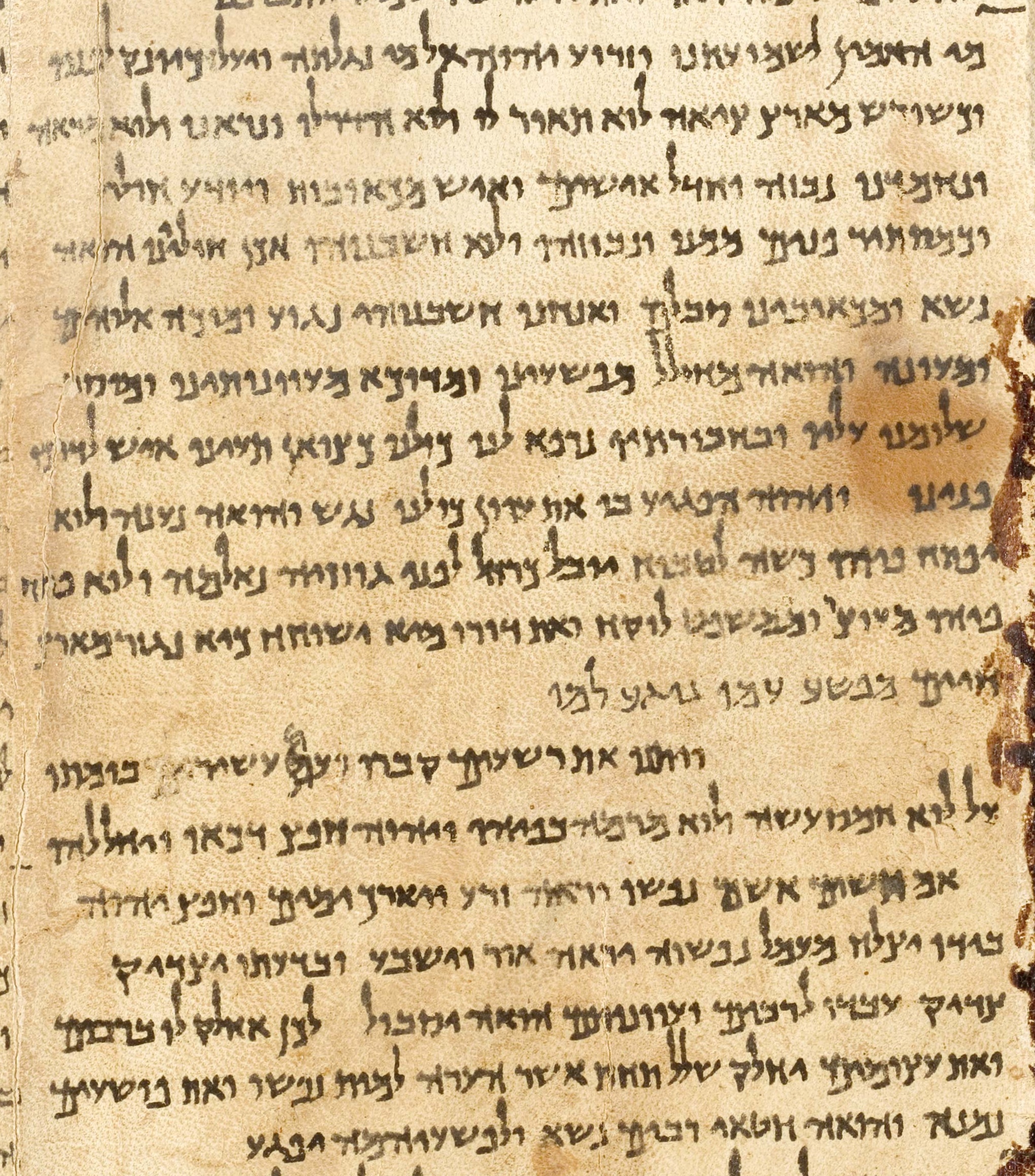
- Material transmission: the Israel Museum dates the Great Isaiah Scroll from QumranQumranArchaeological site northwest of the Dead Sea near manuscript caves; its settlement and the groups who deposited the scrolls are studied together but not assumed identical. It is not synonymous with all Dead Sea Scrolls.Glossary · Click to read the explanation, near the northwestern Dead SeaDead SeaThe Dead Sea is a salt lake in the Jordan Rift Valley, near sites where ancient manuscripts were foundGlossary · Click to read the explanation, 1QIsaa, to approximately 125 BCE. It is a copy made centuries later, not an authorial draft or the date when the ideas originated. The received Masoretic textMasoretic TextThe Hebrew Bible’s transmission tradition combining its consonantal text, transmitted vocalization and accentuation, and Masorah notes. The consonantal text has ancient roots; surviving codices that bring these layers together in their Masoretic form are medieval.Glossary · Click to read the explanation is likewise a textual tradition that must be distinguished from each scroll's wording. [5][12]
Deliverance and creation: one argument, several voices
The collection begins by comforting Jerusalem and preparing a wilderness road (40:1–11). It closes with joyful departure and a divine word that accomplishes its purpose like rain making the earth grow (55:10–13). Hope recalls the earlier exodus to envisage a new return. Promises, courtroom scenes, addresses to Zion and satire of idol-making coexist within this frame; this is not a philosophical treatise of uniform style. [6]
Creation answers a question of trust: the one who creates the heavens and calls their host by name can strengthen an exhausted people (40:26–31). In 44:9–20, the polemic reverses maker and product: a person uses wood for cooking and warmth, then worships what remains. This is a hostile representation of competing worship, not a neutral description of everything a statue's worshipper would say about the deity. [7]
Images of care and motherhood also appear: YahwehYahwehThe proper name of Israel’s deity, written יהוה (YHWH), the Tetragrammaton. Its exact ancient pronunciation is not directly preserved; texts and inscriptions witness its history.Glossary · Click to read the explanation, Israel’s god, is a shepherd in 40:11, a woman in labour in 42:14, and a mother who remembers her child in 49:15. Thomas RömerThomas RömerScholar of Hebrew Bible history and composition, holding the Biblical Milieux chair at the Collège de France.Glossary · Click to read the explanation, a scholar of the Hebrew Bible, interprets such variety as an incorporation of functions associated with several gods and goddesses. The maternal imagery is directly attested whether or not that historical explanation is accepted. [4]
Decisive witnesses: what does the text deny?
These excerpts follow the published Masoretic wording, without restoration of missing letters. The short editorial translations were compared with the Hebrew and the displayed translation. Isaiah 43:10 states: [2]
Isaiah 44:6 states: [2]
And Isaiah 45:5: [2]
These statements occur within an argument about knowledge demonstrated through action, prediction and deliverance, not an abstract census of beings. The courtroom of 43:9–12 demands witnesses from the nations and makes Israel witness to its god's action. Nevertheless, reducing the negation to “our god is stronger” also requires justification: the denial of predecessors and successors, joined to exclusive creation and salvation, claims more than preference for a local patron. [2]
Monotheism and incomparability: weighing the readings
Kenneth Seeskin reads the formulas as a genuine denial of the rivals' divinity. Saul Olyan instead stresses the heavenly hostHeavenly HostA heavenly group whose meaning varies: celestial bodies in some texts, attendants around the throne deliberating in 1 Kings 22.Glossary · Click to read the explanation in 40:25–26 and Rahab and the dragon in 51:9–11: the poetic world retains heavenly beings and cosmic conflict imagery. According to Olyan's abstract, the clearest innovation may be restricting the designation “god” to Yahweh while retaining his host. [8][9]
The objection prevents imposing a later metaphysics that excludes every heavenly agent other than God. But a commanded host is not automatically a group of rival gods, and its presence does not cancel the negations. Nor does recalling a defeated dragon present an independent creator. We therefore favour describing these passages as a strong discourse reserving divinity, creation and deliverance to Yahweh. This is more precise than denying any innovation or claiming that the passages already explain every issue in later philosophical monotheismMonotheismBelief that only one God possesses divinity in its fullest sense. Historically distinct from exclusively worshipping one deity without denying others; its theological forms vary.Glossary · Click to read the explanation. It is a judgement about the text's logic, not a survey of sixth-century beliefs. [2][7][9]
Cyrus and authority over welfare and calamity
Isaiah 45:1 calls Cyrus “his anointed”: a ruler selected for a royal task, not necessarily an eschatological messiah in the later sense. Verses 4–5 repeat that the king does not know Yahweh. His success serves Israel's god without implying that he adopted Yahweh's worship. Political deliverance becomes part of a claim to world sovereignty. [2]
Isaiah 45:7 places light and darkness, “peace/welfare” and “evil/calamity,” within Yahweh's activity. The word רע stands opposite שלום in a context of conflict and deliverance; the verse should not be reduced to moral evil alone. Stefan Beyerle reports טוב, “good,” instead of שלום in 1QIsaa, column XXXVIII, line 13. That is a particular manuscript reading, not a silent correction of the wording quoted above. [10]
The passage excludes a realm of harm independent of Yahweh's authority. Calling it a demonstrable direct reply to a fully developed Zoroastrian dualism goes further than the evidence: Beyerle discusses the dating of Iranian witnesses and the comparison's limitations. The comparison remains a question, not an established route of transmission. [10]
The servant, Zion and the widening horizon of hope
Cyrus is not the collection's only protagonist. Israel is Yahweh's servant in 41:8, and the servant is called “Israel” in 49:3, yet in 49:5–6 receives a mission to restore Jacob and reach the nations. This combines personification of a community with the possibility that a part of it, or an individual addressing it, represents that community. A name in one passage cannot settle every occurrence. [6][11]
The suffering servant appears most extensively in 52:13–53:12. Israel's explicit designation in the surrounding collection strongly supports a collective reading; a mission directed towards Israel and individual language leave an individual or representative group open to discussion. Jewish and Christian reception is important to the text's history but distinct from identifying its earliest horizon. The accompanying scroll photograph witnesses the transmission of Isaiah 53; it is not photographic proof of the servant's identity. [6][11]
Zion and Israel thus remain central while divine sovereignty and the horizon of deliverance expand. Second Isaiah matters because it rethinks defeat, creation and election through a multi-voiced literary discourse. This does not require monotheism to have been invented at one moment or adopted simultaneously by all communities.
References and notes (13)
- Matthias Albani. Monotheism in Isaiah. In The Oxford Handbook of Isaiah, edited by Lena-Sofia Tiemeyer. Published online 8 October 2020, pp. 219–248. DOI: 10.1093/oxfordhb/9780190669249.013.22. Publisher abstract only: Isaiah 40–48, final years of Babylonian rule, and control of the future. Full chapter not read. Return to the text ↑
- Hebrew Bible, Isaiah 43:10–12; 44:6–20, 28; 45:1–13. Mechon-Mamre, Hebrew text and English translation. Isaiah 43:10–12; 44:6–20, 28; 45:1–13. Hebrew and displayed translation consulted; excerpts receive short editorial translations, not a new critical edition. Return to the text ↑
- Yale Divinity School, Yale Bible Study, “Second Isaiah – Introduction.” Complete introduction, especially the division of the book and reassessment of successive-author models. Return to the text ↑
- Thomas C. Römer, “Yhwh, the Goddess and Evil: Is ‘monotheism’ an adequate concept to describe the Hebrew Bible’s discourses about the God of Israel?”, Verbum et Ecclesia 34/2 (2013). Introduction, sections on Yhwh commanding foreign nations, “Yhwh as a goddess in the book of Second Isaiah,” creating good and evil, and conclusion; these sections directly read, not all hypotheses adopted. Return to the text ↑
- Wikimedia Commons, “Great Isaiah Scroll Ch53.jpg”; photograph by Ardon Bar Hama, sourced to the Israel Museum. File description, version history and public-domain declaration; image witness to chapter 53, not the chapter 43–45 passages discussed in the text. Return to the text ↑
- Christine Hayes, Introduction to the Old Testament, Lecture 19, Yale University. Transcript sections 5–6: Second Isaiah, new exodus and suffering servant. Relevant passages checked against the biblical text; not the whole lecture. Return to the text ↑
- Hebrew Bible, Isaiah 40 and 44, Hebrew text published by Mechon-Mamre. 40:1–31; 44:9–20: comfort, creation and idol manufacture. Passages read; polemic is not treated as a neutral account of other worship. Return to the text ↑
- Kenneth Seeskin, “When Did the Bible Become Monotheistic?”, TheTorah, 2019. Sections on numerical and philosophical monotheism and Isaiah/incomparability; the scholar’s own exposition, not a reading of his complete book. Return to the text ↑
- Saul M. Olyan, “Is Isaiah 40–55 Really Monotheistic?”, Journal of Ancient Near Eastern Religions 12/2 (2012), pp. 190–201; DOI: 10.1163/15692124-12341237. Author’s abstract only: heavenly host, Rahab/dragon and restricting the designation god to Yahweh. Full article not read; biblical passages checked independently. Return to the text ↑
- Stefan Beyerle, “Monotheism, Angelology, and Dualism in Ancient Jewish Apocalyptic Writings,” in Nathan MacDonald and Ken Brown, eds., Monotheism in Late Prophetic and Early Apocalyptic Literature, Mohr Siebeck, 2014, pp. 219–246. Read pp. 219–224; p. 223 visually checked. טוב in 1QIsaa XXXVIII.13 follows Beyerle and his reference to DJD 32; DJD itself was not directly read. Return to the text ↑
- Hebrew Bible, Isaiah 41:8–10; 49:1–6, 14–15; 52:13–53:12. Israel named as servant, his mission and suffering; identity distinguishes textual evidence from subsequent religious reception. Return to the text ↑
- Israel Museum, Great Isaiah Scroll exhibition information. Introductory description: scroll dated approximately 125 BCE. This does not date the collection’s composition. Return to the text ↑
- Rainer Albertz, Israel in Exile: The History and Literature of the Sixth Century B.C.E., trans. David Green, SBL, 2003. Publisher excerpt p. 2, available indexed text: 597, 587/586 and 539, distinguishing Babylon’s conquest from exile’s end. Not the whole book. Return to the text ↑
Suggest a correction · Suggest a source for this record
Cite this record
IL Archive, «Second Isaiah», https://ilarchive.com/en/entities/second-isaiah
Continue reading