Study
Yahweh and Asherah
An extended study of a topic, with evidence and references.
Blessings at Kuntillet ʿAjrud and el-Qom, female figurines and reform narratives: separating evidence from interpretation while examining worship before Yahweh’s exclusivity.
Share article
Text
Between textual commands and lived practice
Many biblical texts, in their received form, present a clear religious boundary: YahwehYahwehThe divine proper name written YHWH in the Hebrew Bible.Glossary · Click to read the explanation is the god of ancient IsraelAncient IsraelA name for an ancient population and later historical traditions, attested on the Merneptah Stele.Glossary · Click to read the explanation, while worship of BaalBaalStorm god and protagonist of Ugarit’s Baal Cycle; exercises active kingship while El retains importance and authorizes the palace.Glossary · Click to read the explanation, Asherah and other gods is rejected. Inscriptions and material remains complicate that picture. Blessings associate Yahweh with “his asherah”; female figurinesFigurineSmall three-dimensional representations of people, animals or other beings. Size and appearance alone do not establish a toy, portrait, ritual object or deity; manufacture, discovery context and use require study.Glossary · Click to read the explanation occur in Judah; biblical narratives describe removing cult equipment from the temple itself. [1][2][13]
These witnesses do not give every inhabitant the same beliefs, or make Israel identical to UgaritUgaritAncient city and kingdom at Ras Shamra on the Syrian coast, flourishing between the fourteenth and early twelfth centuries BCE and preserving multilingual archives.Glossary · Click to read the explanation. They expose the difference between the religious programme an author promotes and practices material evidence can reveal. Historical inquiry concerns both: what people were told to worship, and what they did when blessing others, burying their dead or protecting their households.
Before Yahweh and Asherah: El and Athirat
In Late Bronze AgeLate Bronze AgeAn archaeological period conventionally around 1600–1200 BCE in much of the Near East, with regional variation.Glossary · Click to read the explanation UgaritUgaritAncient city and kingdom at Ras Shamra on the Syrian coast, flourishing between the fourteenth and early twelfth centuries BCE and preserving multilingual archives.Glossary · Click to read the explanation, Athirat / AsherahAthiratA high-ranking goddess commonly understood as El’s consort in Ugaritic texts; associated with the progenitress epithet and the palace intercession.Glossary · Click to read the explanation is a major goddess associated with ElEl at UgaritA deity prominent in West Semitic traditions, especially as head of the divine family in Ugaritic texts.Glossary · Click to read the explanation, father and head of the divine household. Her titles concern divine motherhood, and literary texts speak of her children. The name in eighth-century inscriptions therefore has an older West Semitic background. [1]
Comparison does not establish an unchanged personality surviving across the centuries. Languages, kingdoms and cult institutions changed between Ugarit and Israelite or Judahite inscriptions. The older tradition helps explain the name; it does not supply a complete chain showing how every attribute and ritualRitualAn organised or distinguished practice meaningful to a community; it may leave traces, but its form alone does not reveal an associated doctrine.Glossary · Click to read the explanation moved between communities.
Kuntillet ʿAjrud: a small site, large questions
Kuntillet ʿAjrudKuntillet ʿAjrudSinai site preserving blessings by Yahweh of Samaria/Teman and “his asherah” around 800 BCE; building function and wording disputed.Glossary · Click to read the explanation lies in the SinaiSinai: peninsula and biblical mountainSinai is a peninsula in eastern Egypt; in the Torah the name also denotes the mountain of revelation to MosesGlossary · Click to read the explanation interior, about fifty kilometres south of Kadesh Barnea. Nearby water and its position around the Red Sea–Gaza route mattered to its use. Excavations in 1975–1976 uncovered buildings, vessels, inscriptions and drawings, although the site was known earlier. The relevant material is usually dated to the late ninth and early eighth centuries BCE, around 800 BCE. [2]
Its function is disputed: way station, state establishment with scribes, or a place with ritual activity. A blessing on a wall or vessel does not make the whole building a temple. This matters because the site's interpretation affects how we understand the people responsible for its texts.
The blessings that made the site famous
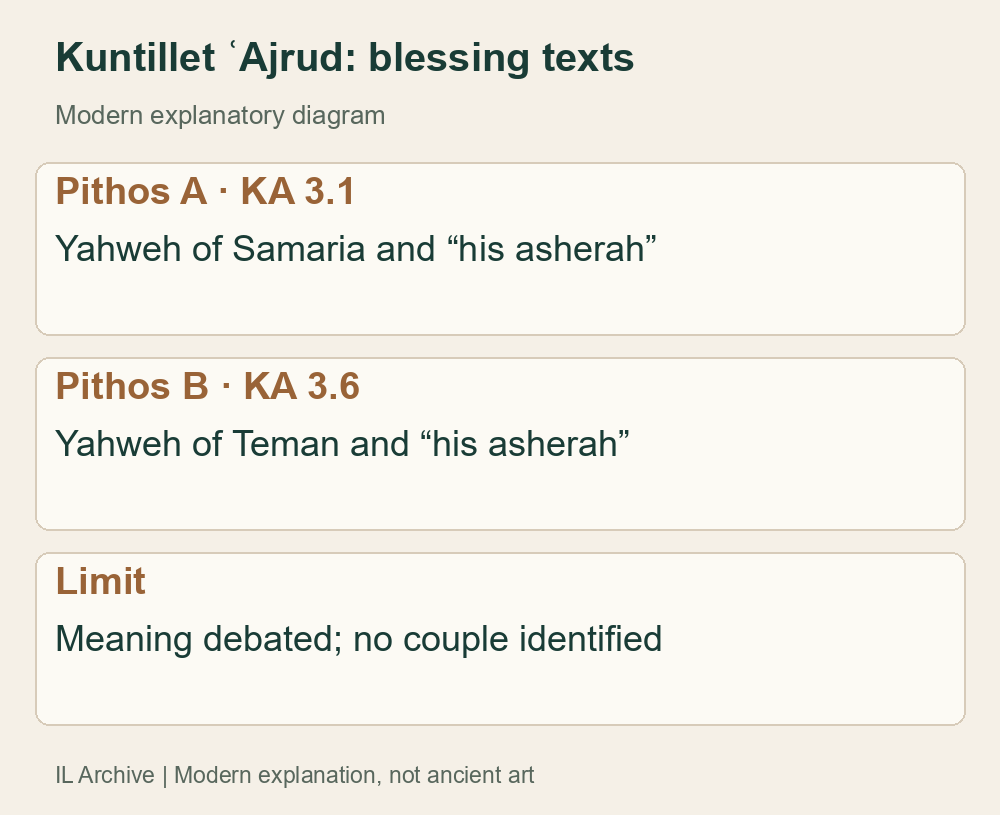
The best-known formulas occur on large storage jars, called pithoi. An inscription on Pithos A, KA 3.1, contains a blessing by Yahweh of Samaria and “his asherah.” On Pithos B, KA 3.6 invokes Yahweh of Teman and “his asherah,” followed by wishes for blessing and protection. This summarizes published readings rather than reproducing every damaged letter. [2]
The short formula has substantial historical value. It shows that Yahweh's name could be used with ʾšrth in a favourable blessing. It does not define the writer's entire theology or establish that every Israelite prayed this way.
Yahweh of Samaria and Yahweh of Teman
The regional descriptions deserve attention in their own right. Samaria connects the blessing with the northern kingdom's centre. Teman is associated with the southern world in several interpretations, although its exact identification here is disputed. The two formulas do not prove that their users believed in two separate gods named Yahweh. [1][2]
They may refer to a cult location or regional manifestation. Personal names and material culture underline northern connections, alongside wider cultural contacts. One Sinai site consequently cannot stand for a single uniform religion shared by Israel, Judah and Phoenicia.
What does “his asherah” mean?
The form ʾšrth contains a suffix usually understood as “his.” Identifying its referent is harder than identifying the suffix. Is it the goddess Asherah associated with Yahweh, or an asherah cult symbolAsherah cult symbolAsherah as a cult object or symbol, often wooden in biblical contexts; relation to the goddess and inscriptional ʾšrth remains debated.Glossary · Click to read the explanation, an object or installation belonging to his worship? [1][11][12]
The Arabic rendering used in this study is a convention for the ancient term, not a reference to a human clan. Translating the phrase in advance as “his wife” also builds an interpretation into the wording. Retaining the term and explaining the alternatives makes the evidential distinction easier to see.
The suffix argument and its limits
One objection to identifying a goddess is that proper names do not ordinarily take a possessive suffix as names of objects do. “His asherah” therefore looks more suitable for a religious symbol than a goddess's personal name. Treating this as an absolute linguistic prohibition, however, goes beyond the debate. [11][12]
Advocates of a goddess interpretation discuss flexible uses of names, titles and divine representations. Some propose the personification of a divine power associated with Yahweh. The available abstracts of Kang and Kim present contrasting approaches. Translating the word, or choosing an English capital letter, cannot settle that disagreement.
Hadley’s wooden-symbol interpretation
Scholars discussing Asherah should not all be assigned the same position. In her published 2008 account, Hadley favours a wooden cult object representing the goddess for the Kuntillet ʿAjrud inscription. This connects an object to the goddess's tradition; it does not make the phrase alone an explicit declaration that Yahweh had a wife. [1]
Asherah as Yahweh's consort remains an influential historical interpretation, including within Smith's model of changes to the divine family. It should be attributed to that reconstruction while keeping linguistic and archaeological objections visible. No preserved marriage text describes the relationship this model proposes. [10]
Goddess and symbol are not simple alternatives
An object interpretation need not deny all connection with the goddess's history. A symbol can bear the name of a deity it represents and subsequently be understood within another god's worship. Ritual functions may continue while explanations change. [1]
The reverse inference also requires care. A name resembling the goddess's does not make every tree motif her image, or prove that every user imagined Yahweh with a personal consort. Text, setting, imagery and use must be compared; the word cannot carry the entire argument.
The famous drawings are not a verified divine couple
A widely reproduced scene from Pithos A includes two standing figures and a seated musician. It is sometimes presented as a portrait of Yahweh and Asherah. That identification is unresolved. Influential readings compare the standing figures with motifs of the Egyptian god Bes and dispute the musician's identity, gender and status. [1][3]
An inscription next to a drawing need not caption it. Differences in execution and overlaps require examination of the sequence and different hands. The surviving material cannot automatically become an official portrait of Yahweh and his consort. This study therefore does not present an invented image of them as a discovered artifact.
The pictures and building also have competing interpretations
Ornan proposes that jar drawings may be sketches related to wall paintings, reading some elements in the context of kingship, protection and state buildings. Na’aman and Lissovsky's published abstract offers another proposal: activity around a sacred tree, with a building housing the goddess's possessions and receiving travellers. [3][4]
These are interpretations of the assemblage, not the discovery of an actual sacred tree or proof of one building function. Smoak and Schniedewind argue for everyday life and scribal education. The disagreement shows why religious language must be distinguished from proof that every text was a prayer performed in a local temple. [2]
Khirbet el-Qom: a blessing in a funerary setting
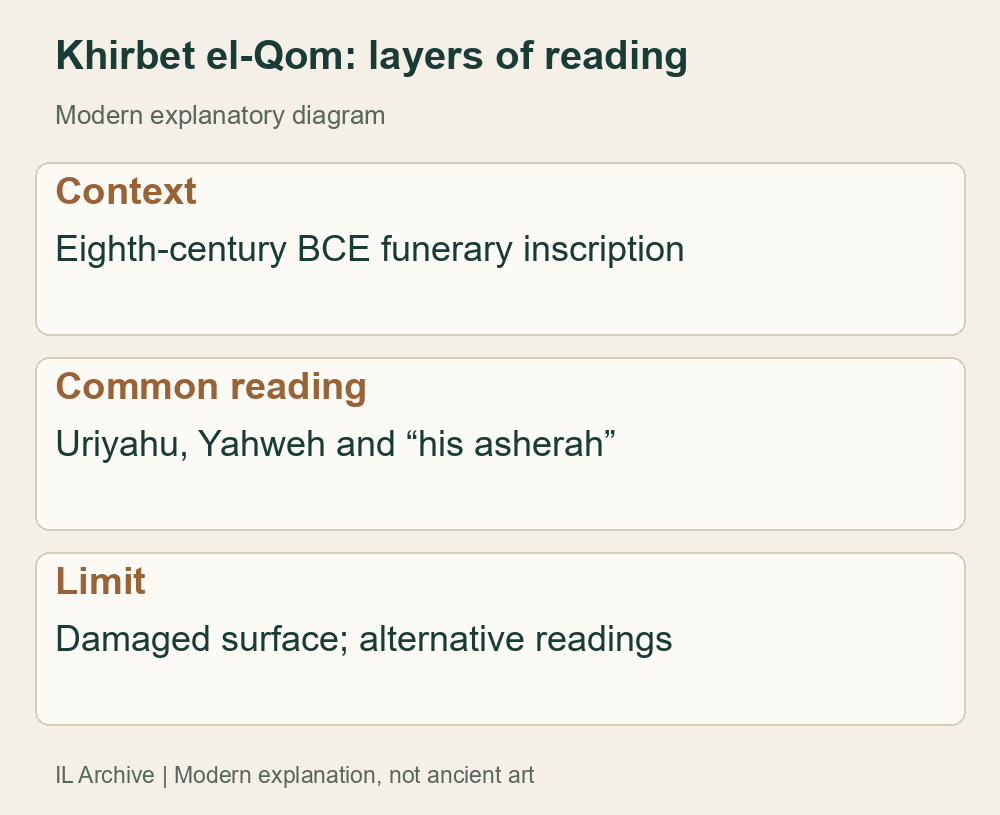
Another important witness comes from Khirbet el-QomKhirbet el-QomSite west of Hebron known for an eighth-century BCE funerary inscription commonly associating Yahweh with “his asherah”; damaged text and readings disputed.Glossary · Click to read the explanation, west of Hebron, in a funerary inscription generally dated to the eighth century BCE. A common reading associates a man named Uriyahu with Yahweh's blessing and with protection or rescue from enemies through “his asherah.” [1]
Its setting differs from the jars of Kuntillet ʿAjrud, making comparison valuable. General similarity does not make the two texts identical. The precise relations among words, verbs and names at el-Qom are debated; a short formula cannot supply a complete account of the tomb family's worship.
A difficult inscription and an alternative reading
Surface damage, intersecting marks and removal from its original location affect interpretation. Hadley discusses letters, cracks and alternative readings, warning against treating surface marks automatically as deliberate erasure or a drawing of a tree. A translation should keep these difficulties visible. [1]
According to its published abstract, Émile Puech's 2015 study proposes reading ʾšrh as “shrine.” This expands the debate beyond wife versus wooden pole. The abstract establishes that the proposal exists; it cannot substitute for reading the whole article when evaluating each step of the revised decipherment. [5]
Female figurines in Judah
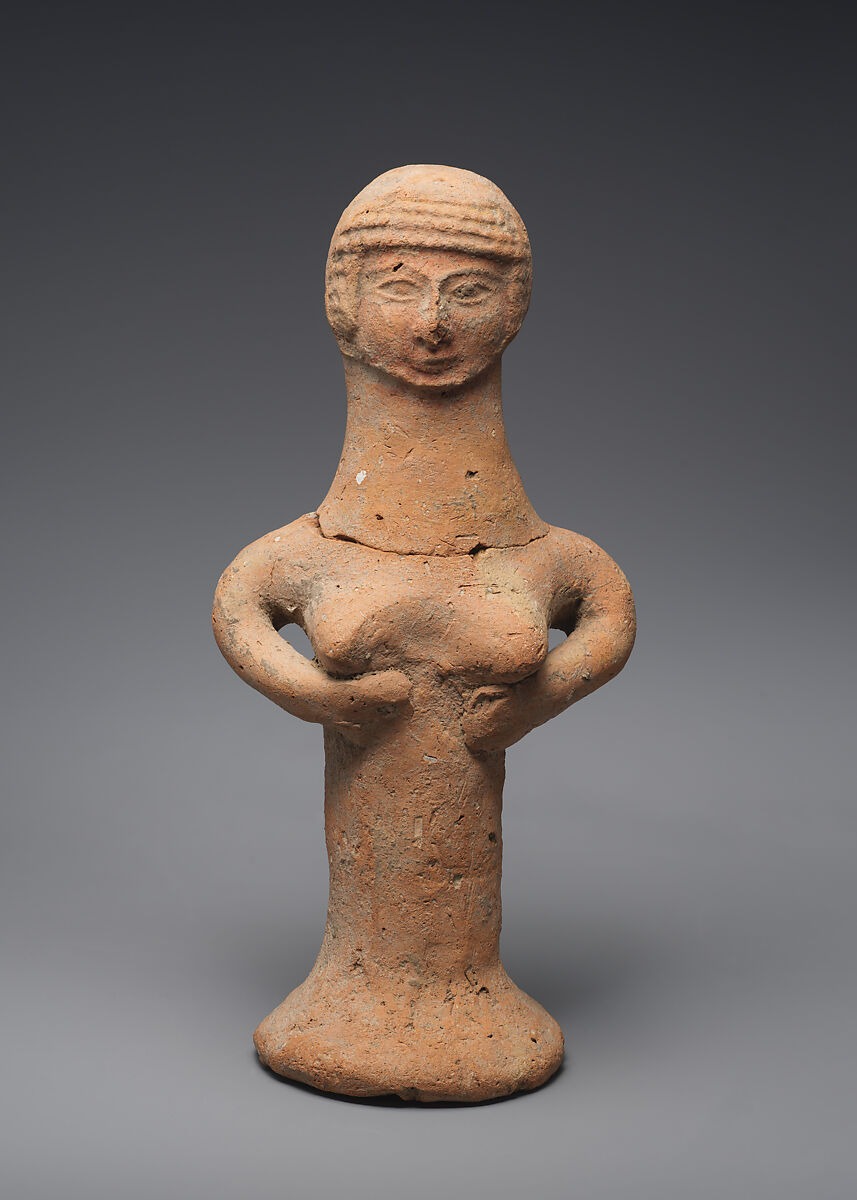
The archaeological record includes many Judean pillar figurinesJudean pillar figurinesClay female figurines with pillar bases in Judah, especially widespread in the eighth/seventh centuries BCE; identity and function not determined by form alone.Glossary · Click to read the explanation: small clay female images whose arms hold or support the breasts, above a pillar base. Some have separately moulded heads; others have heads shaped by hand and pinching. They were particularly widespread in the eighth and seventh centuries BCE. [6][7]
“Hundreds” is sufficient here: counts vary with the corpus and how fragments are counted. The cover shows an example from Lachish, dated by the Metropolitan Museum to approximately the eighth–seventh century BCE. Its existence, form and recorded provenance are documented; identifying the represented goddess or figure is a different question. [9]
Do all of them represent Asherah?
Asherah is a familiar attribution, but it is not a name inscribed on every object. These figurines generally do not carry inscriptions identifying the figure. Proposed readings include motherhood, fertility and nursing, healing and protection, or beings of lower divine rank. Breasts alone do not establish a fertility ritual. [6]
Darby tests such assumptions against context, material and comparative texts. She proposes protective and healing functions while leaving precise identity open. A Yahweh worshipper might use a protective object without treating it as a competing major god. A figurine's presence therefore does not always establish a shrine to an independent goddess.
The household as evidence for religious history
Houses help reveal activities missing from official offering lists. Illness, fear, birth and ordinary life can prompt ritual actions absent from royal narratives. Yet find context also requires analysis: original use differs from later deposition in fill, rubbish or reused construction. [6]
Household assemblages contain more than female images. Animal, horse-and-rider and incense-related objects appear, with protective, practical and religious roles potentially intersecting. Wilson's interpretation of the figurines as part of maintaining local identity during Assyrian expansion offers another perspective; it does not finally identify every figure. [7][8]
Five houses at Tell en-Naṣbeh
Aaron Brody's 2018 abstract presents five connected pillared houses at Tell en-Naṣbeh, inhabited by an extended family. Objects include female and animal figurines, horses and riders, incense stands and animal-shaped vessels. The case demonstrates the diversity of household equipment. [8]
Brody suggests that a concentration near two kitchens may relate to a female household head's role in its religious wellbeing. This is a contextual interpretation, not proof that only women used figurines or that every Judahite house resembled this compound. The abstract, rather than the complete report's detailed analysis, is available here.
A female image does not identify its user's gender
It is easy to construct a story in which men worshipped Yahweh while women worshipped Asherah. An object's form does not automatically reveal who made, carried or used it. Households contained men, women and children, and rituals could involve them together. [6][8]
Assigning particular use needs evidence from location, associated objects and texts; conclusions may differ between sites. Just as every clay rider is not a war god, every clay woman is not a named goddess. Recognizing these limits makes the figurines more reliable historical evidence.
Biblical texts are witnesses with a position
Texts reject BaalBaalStorm god and protagonist of Ugarit’s Baal Cycle; exercises active kingship while El retains importance and authorizes the palace.Glossary · Click to read the explanation, asherim, high places and other altars. Their disputes are important evidence for what their authors regarded as religious problems. Prohibitions, however, are not a census of practice: they do not alone establish the same activity in every village and period. [1][10]
Nor can references from different works be assembled into one contemporary scene. Composition, editing and transmission intervene. Historians must distinguish the narrated event's time from the time of the author's judgment and compare narratives with inscriptions and material contexts.
Asherah and the temple in Kings
Second Kings 21:3–7 says that Manasseh made an asherah and put its image in Yahweh's house. Narratives about Josiah describe removing equipment from the temple and taking out and burning the asherah. The term can concern a manufactured object and, in some contexts, the goddess herself. [1][13]
This makes a rigid division between pure official religion and deviant popular religion difficult: an author's condemned practices can be attributed to king and temple. Yet the existence of the passage does not independently establish every detail and date of the event. The narrative presents and judges the past through a religious programme.
A national god is not necessarily the only god
Yahweh could be Israel's central god while other powers, beings or religious objects remained present. Affiliation with his worship does not alone establish denial of every other deity or rejection of every related symbol. [2][10]
Worshipping Yahweh alone must therefore be distinguished from saying that no other god exists. Exclusive devotion can precede the strongest formulations of monotheismMonotheismBelief in a single God as the only deity, rather than merely the highest among several gods.Glossary · Click to read the explanation. Differences between blessings, names and texts show that divine identity and worship did not develop in a static, uniform society.
Did El's consort become associated with Yahweh?
Within a model of El–Yahweh convergence, the question is reasonable. If Yahweh occupied the highest divine position and absorbed El's titles, a goddess associated with El might also become associated with him. Smith includes this in his reconstruction of the divine family's history. [10]
Plausibility is not a verified sequence. No document identifies a community transferring El's consort to Yahweh in a specific year. “His asherah” could indicate a symbol related to that tradition in one setting and a different understanding in another. The model explains converging clues; missing direct links limit it.
Reform has a history of its own
Accounts of Hezekiah and Josiah describe removing high places and cult equipment and redirecting worship toward Yahweh. They matter for understanding how scribes narrated exclusivity. The actual extent and details of reform, and the narrative's relationship to Deuteronomy's editing, require separate investigation. [1]
Every broken object cannot be assigned to reform, or a practice's disappearance dated solely from a king's narrative. Temple rules might change before or after household practices. Religion changes through authorities, institutions, families and regions, not a single decision adopted by every inhabitant.
When exclusivity becomes explicit monotheistic language
Passages in Isaiah 40–55Second IsaiahScholarly label for Isaiah 40–55, substantially linked to exile and Cyrus; not proof of one author or one year for every verse.Glossary · Click to read the explanation, usually associated with the sixth-century Babylonian setting, explicitly deny other gods. The claim now reaches beyond preferring a national patron to neighbouring peoples' deities. [10][13]
Smith situates the transformation within social change, political trauma and expanding empires. This is a historical explanation, not a rule that every crisis produces monotheism. Layer dating and the definition of monotheism remain debated. These texts diminish others' legitimacy while extending Yahweh's rule over the world.
What does the evidence establish?
Secure: Athirat is a goddess in Ugarit; Kuntillet ʿAjrud preserves formulas associating Yahweh with ʾšrth; Judah has many female figurines; biblical texts condemn forms of worship and narrate removal of the asherah. These witnesses do not all belong to one period or society. [1][2][6][13]
Probable: religious practices varied and Yahweh's worship interacted with other traditions. Possible and influential: Asherah as his consort in some settings, or the survival of a symbol associated with her history. Unproven: the famous drawing as their portrait, every pillar figurine as Asherah, or all Israelites believing Yahweh had a wife.
Yahweh and Asherah within a changing history
The remains do not provide one answer to “What did Israelites actually worship?” They offer specific, sometimes partial answers for people, places and periods. A blessing writer at a desert station, a tomb family, household figurine users and an author narrating royal reform each open a different window.
Together they show that exclusive Yahweh worshipMonolatryWorship of one deity without necessarily denying others; variable analytical term, not one uniform doctrine of all Israelites.Glossary · Click to read the explanation was not the only picture from the outset. Asherah, whether understood in a particular case as goddess, symbol or another ritual term, matters to this history. Reading inscriptions, figurines and narratives together reveals the path toward exclusivity and monotheism while leaving genuine gaps open.
References and notes
- Judith M. Hadley. Evidence for Asherah. Bible Interp, 2008. Read sections on Athirat, Kuntillet ʿAjrud/el-Qom inscriptions, drawings, figurines, biblical terminology and reform. Hadley favours a wooden symbol representing the goddess; not attributed an exclusively wife-based interpretation. Reported disagreements not treated as consensus. Return to the text ↑
- Jeremy Smoak and William Schniedewind. Religion at Kuntillet ʿAjrud. Religions 10 (2019), 211. DOI: 10.3390/rel10030211. Introduction, site-function passages pp. 2–3, KA 3.1/3.6 blessings p. 5 and available scribal-context passages read. Selected pages, not the entire article. Scribal education is the authors’ interpretation, not an established exclusive site function. Return to the text ↑
- Tallay Ornan. Sketches and Final Works of Art: The Drawings and Wall Paintings of Kuntillet ʿAjrud Revisited. Tel Aviv 43 (2016), 3–26. DOI: 10.1080/03344355.2016.1161374. Institutional abstract only: sketches, royal/protective motifs, state building with cult space. No claim of full-article reading or secure identification of every drawing. Return to the text ↑
- Nadav Na’aman and Nurit Lissovsky. Kuntillet ʿAjrud, Sacred Trees and the Asherah. Tel Aviv 35 (2008), 186–208. DOI: 10.1179/tav.2008.2008.2.186. Abstract only: proposed sacred tree, activity around it and a goddess’s treasury. Proposal not converted into an excavated tree. Return to the text ↑
- Émile Puech. L’inscription 3 de Khirbet el-Qôm revisitée et l’Ashérah. Revue Biblique 122 (2015), 5–25. DOI: 10.2143/RBI.122.1.3149557. Publisher abstract only: ʾšrh as shrine. Full revised decipherment not evaluated or presented as consensus. Return to the text ↑
- Erin Darby. Fatal Attraction: Obsession, Aversion, and the Femme Fatale of Ancient Judah. Bible Interp, February 2015. Author’s main article read: head types, context/redeposition, critique of inferring deity identity or user gender from form, proposed protection/healing. Proposal not imposed as the sole function of all objects. Complete book not read. Return to the text ↑
- Ian Douglas Wilson. Judean Pillar Figurines and Ethnic Identity in the Shadow of Assyria. Journal for the Study of the Old Testament 36 (2012), 259–278. DOI: 10.1177/0309089212438002. Abstract only: eighth/seventh-century popularity and proposed maintenance of local identity under empire. Interpretation, not definitive figurine identification. Return to the text ↑
- Aaron Brody. Materiality of Religion in Judean Households: A Contextual Analysis of Ritual Objects from Iron II Tell en-Naṣbeh. Near Eastern Archaeology 81 (2018), 212–221. DOI: 10.5615/neareastarch.81.3.0212. Abstract only: five connected houses, object diversity, proposed female household-head role from distribution near kitchens. Not generalized to all families or all users’ genders. Return to the text ↑
- The Metropolitan Museum of Art. Nude female figure, object 34.126.53, collection record 323163. Ceramic, Lachish, about eighth–seventh century BCE, 18.4 cm; public-domain image. Artifact identity/image rights separated from proposed mother-goddess or Asherah attribution. Return to the text ↑
- Mark S. Smith. The Origins of Biblical Monotheism: Israel’s Polytheistic Background and the Ugaritic Texts. Author’s account, Bible Interp. Author’s account read, not entire book: exclusivity, El/Yahweh/Asherah model, social/political change. Dating debates retained and model distinguished from inscriptions. Return to the text ↑
- 강승일 (Kang). Yahweh’s Consort? Korean Journal of Old Testament Studies 17 (2011), 123–144. DOI: 10.24333/jkots.2011.17.2.123. English abstract only: challenge to absolute suffix objection and divine hypostasis discussion. Its drawing identification not adopted as fact; Korean main text not read. Return to the text ↑
- 김준 (Kim). Kuntillet Ajrud “Yahweh and His Asherah” and the Goddess Asherah, Who Had No Archeological Presence in Israel in the Eighth Century B.C.E. Korean Journal of Old Testament Studies 24 (2018), 354–368. DOI: 10.24333/jkots.2018.24.3.354. English abstract only: cult-object reading and critique of drawing/inscription association. Title’s absence claim belongs to the author, not this study’s finding for all Israel. Korean main text not read. Return to the text ↑
- Hebrew Bible: 2 Kings 21:3–7; 23:4–7; Isaiah 45:5–7, 18, 21–22. Mechon-Mamre. Selected Hebrew passages and displayed translation read: temple image, asherah removal, Isaiah’s exclusive claims. Text proves wording, not every event’s historicity; composition dating from scholarship. Return to the text ↑
Suggest a correction · Suggest a source for this record
Cite this record
IL Archive, «Yahweh and Asherah», Edition 1, https://ilarchive.com/en/studies/yahweh-and-asherah
Continue reading