Study
Ugarit
An extended study of a topic, with evidence and references.
From the 1929 excavations and alphabetic cuneiform to houses, scribes and the Baal Cycle: what does Ugarit reveal about Levantine gods, and where are the limits of comparison?
Share article
Text
The city that brought the gods of Canaan back into view
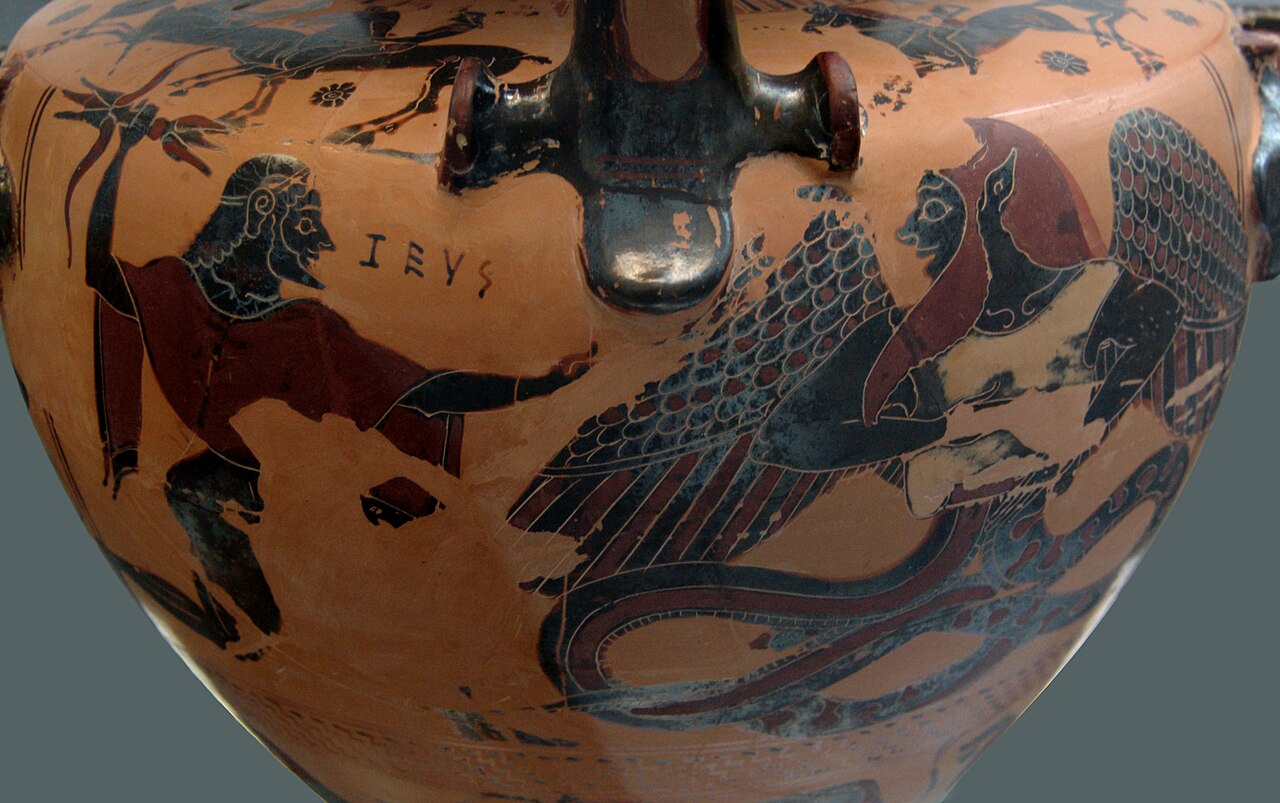
In spring 1929, archaeologists began work at Ras ShamraUgaritAncient city and kingdom at Ras Shamra on the Syrian coast, flourishing between the fourteenth and early twelfth centuries BCE and preserving multilingual archives.Glossary · Click to read the explanation on the Syrian coast. The first season produced tablets in a cuneiformCuneiformWriting with wedge-shaped signs, developed from Mesopotamian recording traditions and used for several languages from the third millennium BCE.Glossary · Click to read the explanation script previously unknown to scholars. Its decipherment opened a window onto a city whose scribes described their gods in their local language. El, BaalBaalStorm god and protagonist of Ugarit’s Baal Cycle; exercises active kingship while El retains importance and authorizes the palace.Glossary · Click to read the explanation and AnatAnatAn active and violent goddess in Ugaritic literature; pressures El over Baal’s palace and addresses him with paternal and wisdom language.Glossary · Click to read the explanation were no longer merely names encountered in other sources: readers could follow conversations, narratives and ritualsRitualAn organised or distinguished practice meaningful to a community; it may leave traces, but its form alone does not reveal an associated doctrine.Glossary · Click to read the explanation. [1][4]
This is the sense in which Ugarit brought the gods of Canaan back into view. Its discovery provided an exceptional body of direct evidence for a West Semitic religious tradition. The phrase nevertheless needs a qualification: these are the texts of a particular northern city, rather than a complete record of religion throughout the LevantThe LevantThe Levant is a regional name for lands along the eastern MediterraneanGlossary · Click to read the explanation. [8][15]
A harbor tomb before the city’s tablets
The modern discovery began with a tomb found accidentally in 1928 at Minet el-Beida, close to the coast. The following year, Claude Schaeffer directed excavations at the harbor and nearby Ras Shamra. The two sites proved to be the port and capital associated with the kingdom of Ugarit. [1]
Finding the tomb did not itself reveal the myths. It identified an archaeological setting; excavation then uncovered buildings and tablets that required new methods of reading. Discovery and understanding were separated by considerable work: identifying the script, comparing signs, reconstructing the language and translating the texts.
Where was Ugarit?
The mound of UgaritUgaritAncient city and kingdom at Ras Shamra on the Syrian coast, flourishing between the fourteenth and early twelfth centuries BCE and preserving multilingual archives.Glossary · Click to read the explanation lies about ten kilometers north of LatakiaLatakiaA coastal city in Syria, south of ancient Ugarit at Ras Shamra.Glossary · Click to read the explanation and approximately 800 meters inland. It covers roughly 28 hectares. The nearby bay of Minet el-Beida connected the capital with maritime trade. The city belonged to networks linking the Syrian coast, Cyprus, Egypt, AnatoliaAnatoliaAnatolia is the region occupying the Asian part of present-day TurkeyGlossary · Click to read the explanation and MesopotamiaMesopotamiaA historical region associated with the Tigris and Euphrates, home to many societies and civilisations.Glossary · Click to read the explanation. [1]
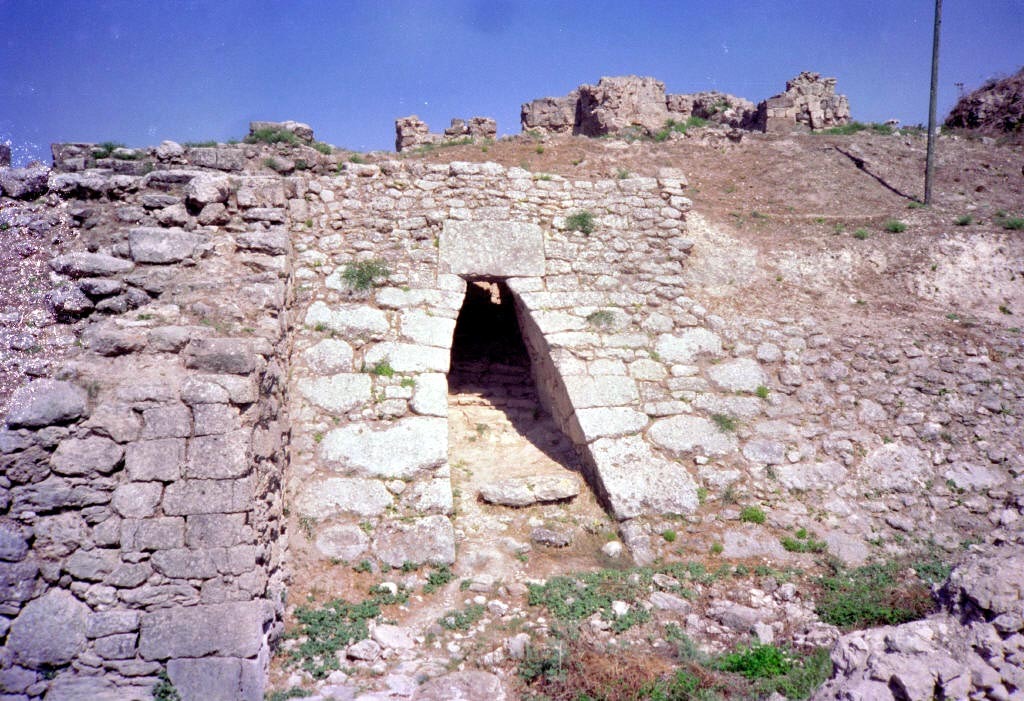
Excavations revealed residential neighborhoods, palatial areas and an acropolis with two large temples. The texts can therefore be connected with urban life: houses, streets, temples, palaces and a harbor. The tablets are documents from an inhabited city, with material contexts that help explain their use.
The age of the site and the age of its archives
Settlement at Ras Shamra began long before the famous tablets, in the Neolithic. The documents that provide the fullest picture of the kingdom belong principally to the Late Bronze AgeLate Bronze AgeAn archaeological period conventionally around 1600–1200 BCE in much of the Near East, with regional variation.Glossary · Click to read the explanation. AkkadianAkkadianAn ancient East Semitic language written in cuneiform in Mesopotamia.Glossary · Click to read the explanation material extends from the mid-fourteenth to the early twelfth century BCE. Mnamon’s language entry gives a conservative range of about 1300–1190 BCE for the Ugaritic linguistic evidence. [1][2][7]
Reference works differ over the earliest alphabetic evidence; all the texts should not be assigned a single date. More fundamentally, the age of a clay copy does not establish when the story or religious practice it records began. Some traditions may be older, but determining how much older requires independent evidence.
The kingdom’s end and the survival of part of its memory
The city was destroyed around 1180 BCE, during the upheavals ending the Late Bronze Age in the eastern Mediterranean. This marks the end of the kingdom represented in the archives. It does not mean that the site was never used again: the excavation mission records smaller later occupations. [1]
Tablets and fragments remained beneath ruined buildings. Some preserve substantial texts; others have lost lines or large portions. The excavated archive is consequently an incomplete sample of the city’s written material. What we can read depends on preservation, destruction, excavation and reconstruction, as well as on what scribes originally chose to write. [16]
A city with several languages
Ugarit used its local language, Babylonian AkkadianAkkadianAn ancient East Semitic language written in cuneiform in Mesopotamia.Glossary · Click to read the explanation with its important international role, and other documented languages including Hurrian, Sumerian and Hittite. Several writing systems were present. This diversity cannot be converted directly into a census of languages spoken daily: a written language might serve education or diplomacy. [6]
International correspondence and treaties were written in Akkadian, as were local contracts. Ugaritic was used for literature, rituals and many administrative documents. These patterns reveal overlapping scribal traditions within the same society, rather than two entirely separate cultural worlds.
An alphabet with a cuneiform appearance
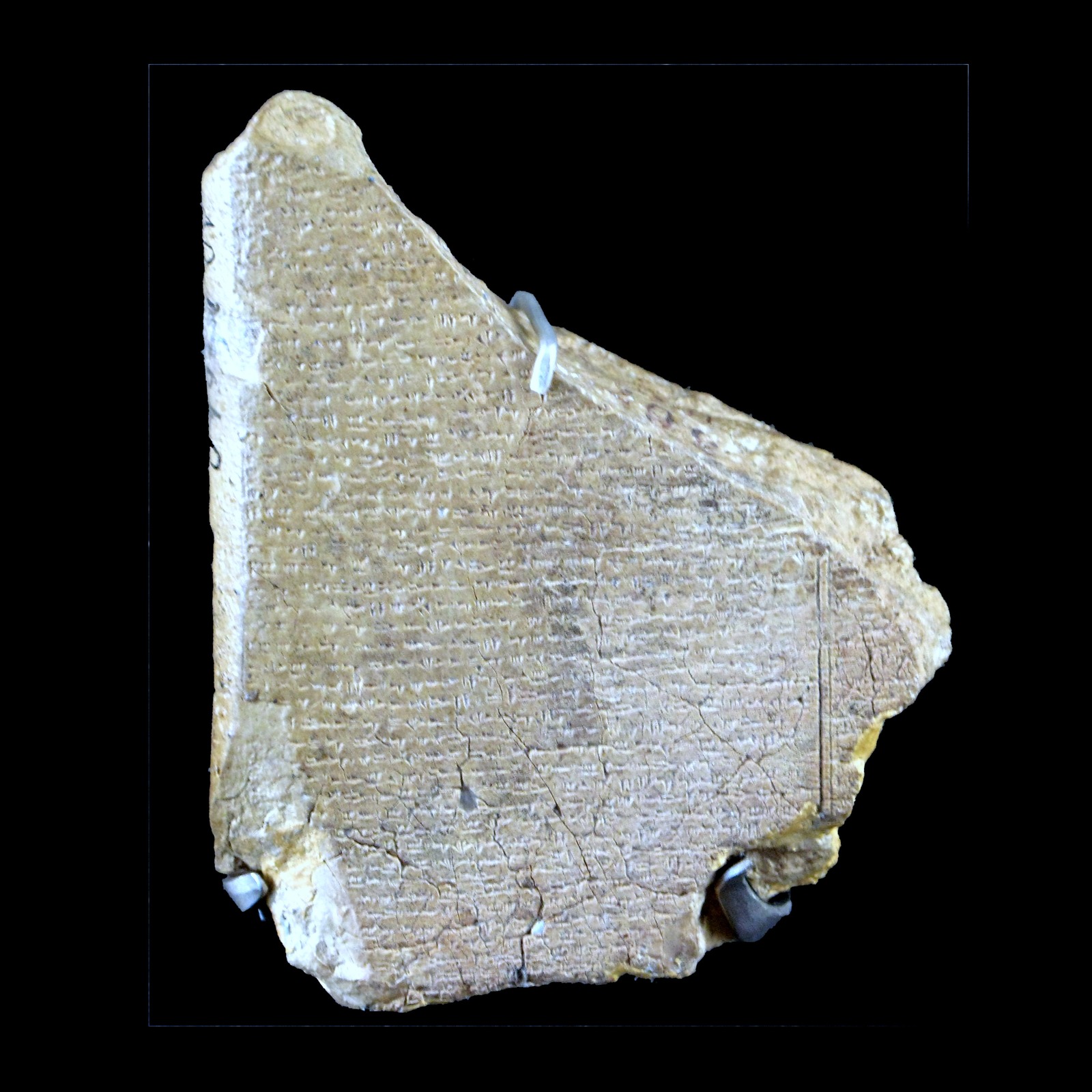
The long Ugaritic alphabetUgaritic alphabetLong cuneiform alphabet of 30 signs, chiefly consonantal. Its wedge shapes do not imply Akkadian syllabic principles or priority as the first alphabet.Glossary · Click to read the explanation contains thirty signs. Their shapes are wedge-like, but their principle differs from the Akkadian system combining syllabic signs and word signs. In Ugaritic, a sign generally represents a single consonant; the system can therefore be described as a consonantal alphabet or abjad. [3][4]
It does not record vowels in the manner of many modern alphabets. Nevertheless, three signs for the glottal stop are associated with accompanying vowels. Ordinary texts run from left to right. Similar tools and wedge impressions do not imply identical methods of representing language.
Did Ugarit invent the first alphabet?
The evidence does not support that claim. Mnamon favors a local adaptation of an existing alphabetic system to cuneiform technique. The French Ministry of Culture also explains that no secure direct successor is apparent comparable to the continuity of the linear Phoenician alphabet. [3][4]
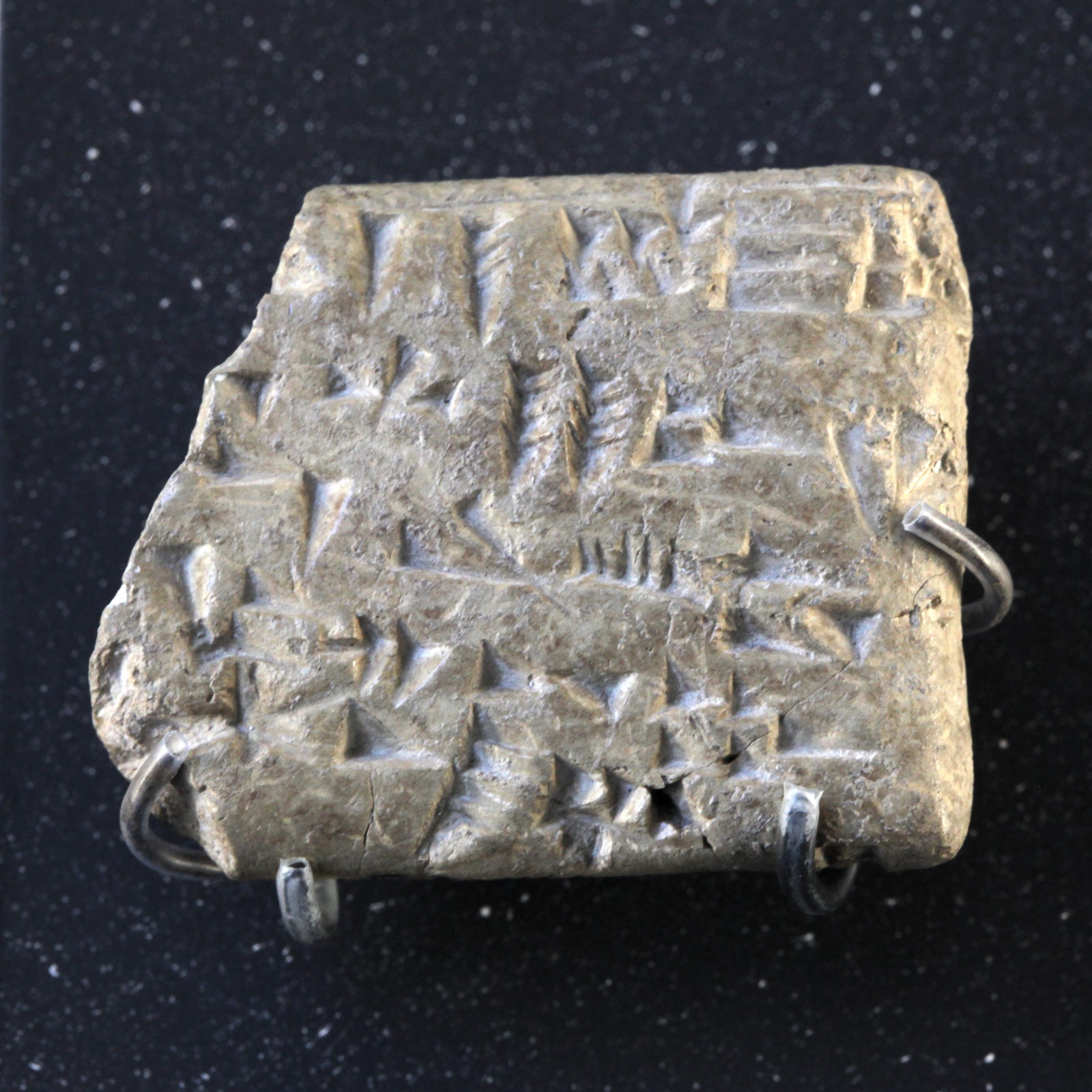
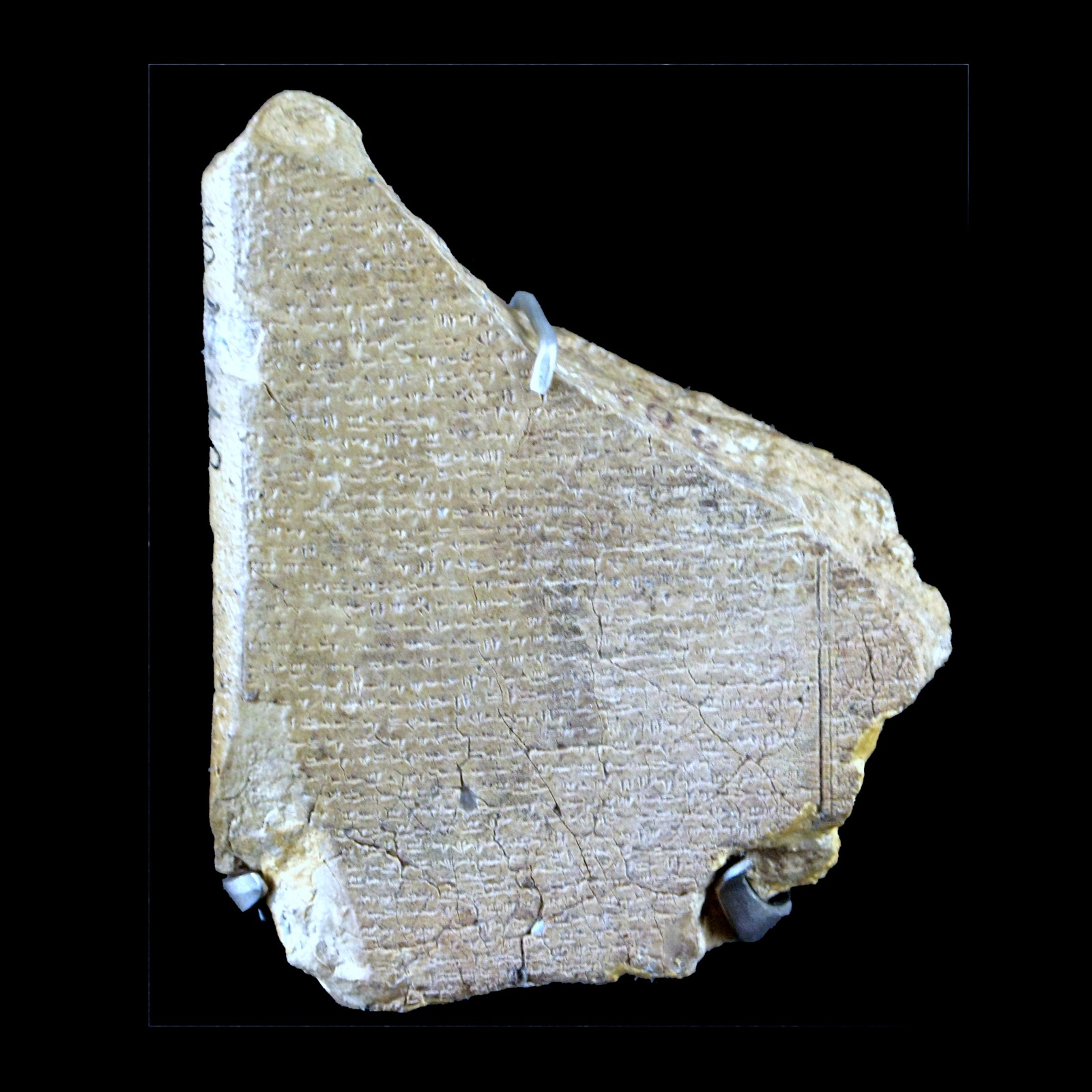
Ugarit’s importance does not depend on being awarded the title of first alphabet. It supplies clear evidence of alphabetic literary, administrative and religious writing, and of teaching the order of signs. The complete tablet RS 12.033, discovered in 1948, is an important witness. The photographed tablet here, AO 19992 / RS 10.087, is a different, incomplete object. [5][17]
The archive was not a single library
Texts were distributed among palaces, houses and buildings with religious connections. Research on fragments shows that calling a collection an archive does not remove the need to study its formation, retention and the possible movement of its parts. [16]
A house could hold letters, contracts, exercises and literary works. Administrative, cultural and ritual activities could overlap. A building’s modern label consequently cannot determine the genre of every text found there, nor establish that all the tablets formed one collection accessible to the whole city.
Urtenu’s house: commerce, writing and ritual
Discoveries in the south-central sector, particularly from 1973 onward, produced an important collection later associated with the house of UrtenuUrtenu and his houseUgaritic figure close to court and commerce, associated with a south-central archive; family and personal texts helped identify its owner.Glossary · Click to read the explanation. Its owner had commercial connections and was close to the court. Bordreuil and Malbran-Labat explain how family letters and a personal protective text helped identify him. [9]
Administrative lists, royal letters and lexical texts occurred alongside a document concerning a royal funeral. The collection reminds us that religion, commerce, family and palace affairs were not always separate subjects in scribal work. It does not give every document the same function or make every wealthy householder an author of myths.
Small fragments still change readings
The mission describes a project studying unpublished alphabetic materials, chiefly small fragments from several sectors. Tasks include finding joins and examining clay, handwriting, line arrangement and context. [16]
A fragment only a few centimeters wide can alter a name’s reading or connect two lines. Translating an ancient text is thus an ongoing activity. A number quoted on a project page should not be treated as an updated census of all unpublished material. The project itself shows how knowledge depends on continuing reconstruction and investigation.
The two temples and Dagan’s name
The acropolis preserves remains of Baal’s temple and the building traditionally called the temple of DaganDaganDeity known in Syria and Mesopotamia, attested in Ugaritic lists, offerings and names; Baal is called his son. Temple attribution remains debated.Glossary · Click to read the explanation. The publisher’s summary of Olivier Callot’s study describes their Middle Bronze Age construction, collapse in a mid-thirteenth-century BCE earthquake, and rebuilding of Baal’s temple before the final destruction. [10]
The second attribution is disputed. ORACC’s Dagan entry presents a reinterpretation identifying it as a temple of El. We therefore retain the traditional name while indicating the debate. Identifying a building’s cult requires comparison of finds, inscriptions and context, rather than reliance on its modern designation. [11]
Ilimilku: the scribe’s hand and the story’s age
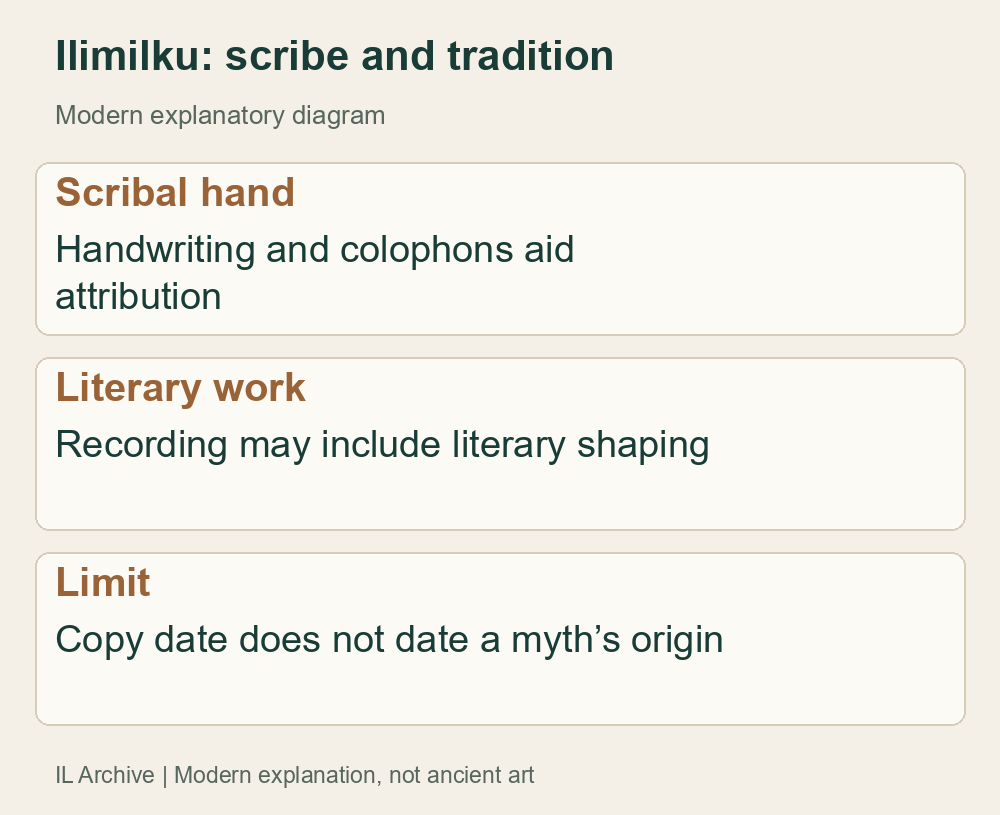
The name IlimilkuIlimilkuUgaritic scribe associated with the Baal Cycle, Kirta and Aqhat; handwriting and colophons aid attribution. His work alone does not date the traditions’ origins.Glossary · Click to read the explanation is associated with several major literary works. Handwriting and scribal colophons help attribute tablets of the Baal CycleBaal CycleA group of Late Bronze Age Ugaritic religious texts recounting Baal’s conflicts, relationships with the gods and the building of his palace.Glossary · Click to read the explanation and the Kirta and Aqhat narratives to his activity. Modern scholarly presentations place this writing in the late thirteenth century BCE, against a history of chronological debate. [7][8]
This establishes a role in recording literature; scholars may also discuss his contribution to composition or literary shaping. It does not prove that he invented every myth he transmitted. The date of the hand producing a copy must be distinguished from the history of a tradition that may have circulated orally or in writing before it. A colophon documents a scribe’s work, rather than the birth of an entire religion.
Six tablets and a world of conflict
The Baal CycleBaal CycleA group of Late Bronze Age Ugaritic religious texts recounting Baal’s conflicts, relationships with the gods and the building of his palace.Glossary · Click to read the explanation is known from six tablets numbered KTUKTU: Ugaritic Text ReferencesAbbreviation for a modern scholarly corpus of alphabetic cuneiform texts; its numbers are references, not dates.Glossary · Click to read the explanation 1.1–1.6 in modern cataloguing. BaalBaalStorm god and protagonist of Ugarit’s Baal Cycle; exercises active kingship while El retains importance and authorizes the palace.Glossary · Click to read the explanation fights YamYam / NaharSea god and Baal’s opponent for kingship, also associated with Nahar, River.Glossary · Click to read the explanation, the Sea, aided by two weapons made by the craftsman Kothar-wa-HasisKothar-wa-HasisCraftsman god in the Baal Cycle, supplying weapons and building the palace.Glossary · Click to read the explanation. The palace-building issue follows, then conflict with MotMotGod of death in the Baal Cycle; an adversary who returns even after a violent attack.Glossary · Click to read the explanation, Baal’s absence and renewed struggle. [8][12][14]
This summarizes the surviving course of events, rather than every missing episode. Damage can interrupt the causal link between events. Gaps should not automatically be filled with a smooth modern narrative or the whole cycle converted into a fixed agricultural calendar. Seasonal interpretations can be useful comparisons, but remain interpretations of the text. [14]
El: the father who remained at the head
ElEl at UgaritA deity prominent in West Semitic traditions, especially as head of the divine family in Ugaritic texts.Glossary · Click to read the explanation appears as father, king and head of the divine household. Texts reveal roles involving offspring, family and governance. Joel Burnett explains the divine councilDivine councilA representation of divine beings acting as an assembly with authority and differentiated roles.Glossary · Click to read the explanation through the household model: senior El heads it, while prominent warrior Baal exercises kingship within that framework. [13]
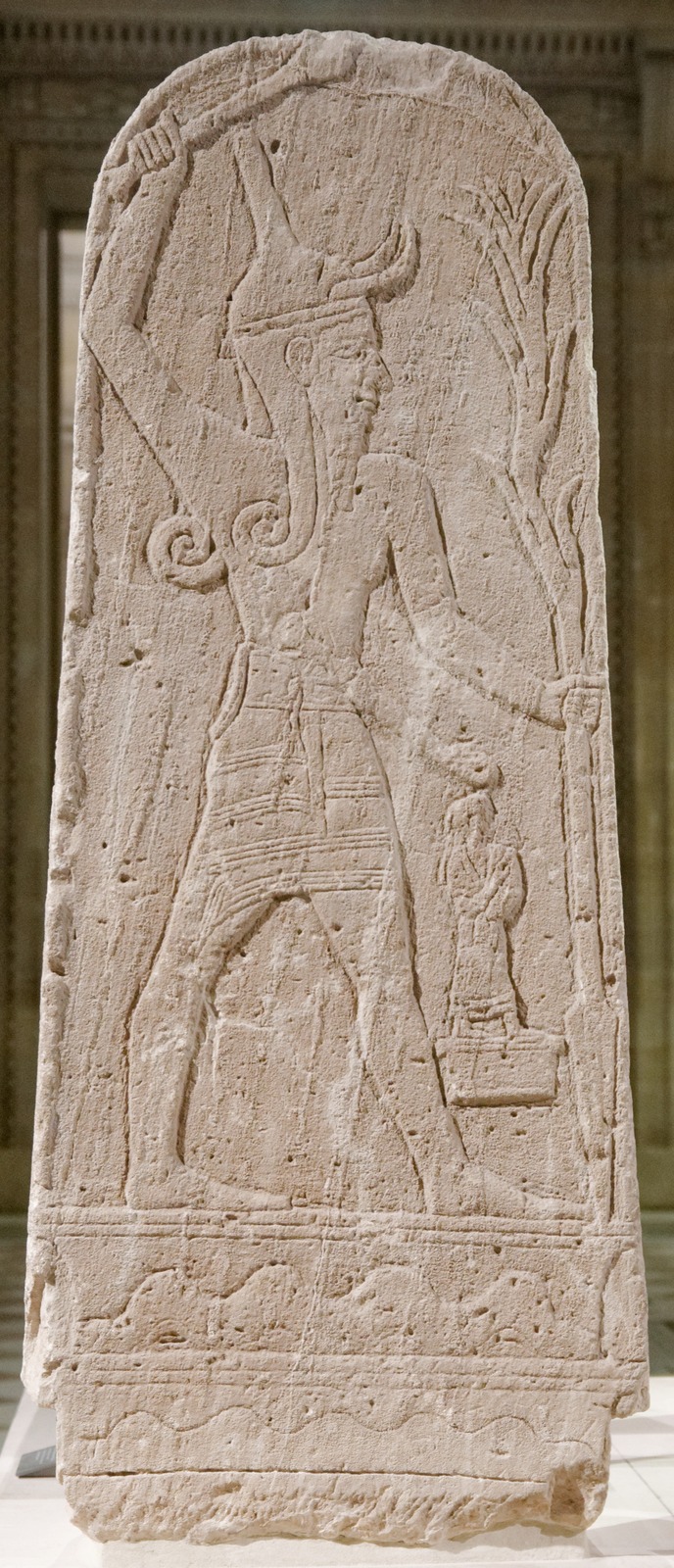
Baal’s dramatic centrality does not deprive El of authority. In the palace story his approval matters, and other figures seek it or press for it. The father granting recognition and the fighting hero combine tension with complementary roles. The cycle preserves no story in which Baal kills El and takes his place.
Athirat alongside El
AthiratAthiratA high-ranking goddess commonly understood as El’s consort in Ugaritic texts; associated with the progenitress epithet and the palace intercession.Glossary · Click to read the explanation is commonly understood as El’s consort and the divine community’s great mother. Her title associates her with bearing gods, and the texts speak of her sons. In the palace story she mediates with El and helps Baal obtain approval. [13][14]
The texts do not thereby supply a complete birth register of the gods. Family language organizes the celestial community and can express membership, rank and descent together. Shared divine names or titles across sites also do not guarantee an unchanging personality or identical worship practices everywhere.
Anat, Yam and Mot: personalities beyond their names
AnatAnatAn active and violent goddess in Ugaritic literature; pressures El over Baal’s palace and addresses him with paternal and wisdom language.Glossary · Click to read the explanation acts violently in the cycle and participates in the palace affair and the crisis of Baal’s death. Yam and Mot combine the familiar domains of sea and death with individual personalities who speak, struggle and seek authority. [12][14]
Calling them abstract symbols alone is inadequate, as is treating Anat as an exact equivalent of every warlike goddess. Local texts give figures particular relationships and actions. Comparison is useful when it preserves these distinctions instead of dissolving them into a general function.
Religious literature does not encompass all worship
Alongside myths are offering texts, rituals, incantations and documents involving the dead and kingship. Religious activity thus involved actions, materials, people and occasions in addition to stories of Baal’s victory. [6][8][9]
A deity can be prominent in cultic lists yet less visible in literature. Dagan, for example, appears in lists, offerings and personal names more strongly than in the surviving mythological narratives. Narrative prominence alone does not measure the extent of worship, and literary silence does not prove the absence of temples or devotees. [11]
Why speak of the gods of Canaan?
Ugarit preserves a tradition sharing divine names, images and religious language with a wider West Semitic world. These links make the phrase gods of Canaan understandable in a general presentation. Yet Ugarit was a city and kingdom, while Canaan designated a broader region rather than a unified state with one doctrinal book. [15]
Peter Craigie’s study identifies both the value and the risks of equating the two. An Ugaritic text may illuminate a parallel known farther south. It cannot establish that every Canaanite settlement narrated the same stories or assigned the gods identical ranks.
A Syrian kingdom and a West Semitic language
Calling Ugarit an ancient Syrian kingdom locates its historical setting; calling its language Northwest Semitic identifies linguistic relationships. Mnamon notes that Ugaritic’s precise position within the Semitic family is debated. The classification Canaanite dialect should therefore not be presented as settled. [2]
These categories should not be converted into modern national identities or treated as mutually exclusive. The kingdom had connections with Hittite power and Mediterranean and Mesopotamian settings. Those connections are part of its history and coexist with its clear location on the Syrian coast. [1][6]
Why did Ugarit change the reading of Hebrew texts?
The tablets supplied independent comparative material: El and the divine household, councils and messengers, and storm-god Baal, called rider of the clouds, fighting the Sea. They made religious and literary images visible outside the polemical settings in which some HebrewHebrewA Northwest Semitic language in the Canaanite group, with ancient and modern forms.Glossary · Click to read the explanation texts describe rival worship. [12][13]
Finding a parallel nevertheless does not prove that a Hebrew writer read a particular tablet at Ugarit. Geography, chronology and differing contexts matter. Craigie discusses how historical links and common traditions support comparison, while rejecting treatment of the corpora as one literature exempt from critical controls. [15]
How should a similarity be tested?
Comparison begins with wording, context and the date of the witness. Is the parallel an identical title, a general image or a narrative structure? It then asks how a tradition might pass between regions and periods, and considers alternatives such as shared older traditions or independent reuse. [15]
Two similar words do not establish direct copying. Later religious differences do not erase every continuity either. Ugarit’s strength is that it supplies one inspectable side of a comparison. Each claim of transmission still requires its own supporting evidence.
Texts within a material landscape
The tablets belong to a site containing architecture, objects, routes, houses and tombs. Reconstructing an archive involves findspots, clay, shape, handwriting and possible movement or breakage. The mission explains how imprecise early excavation records and objects dispersed among museums complicate that work. [16]
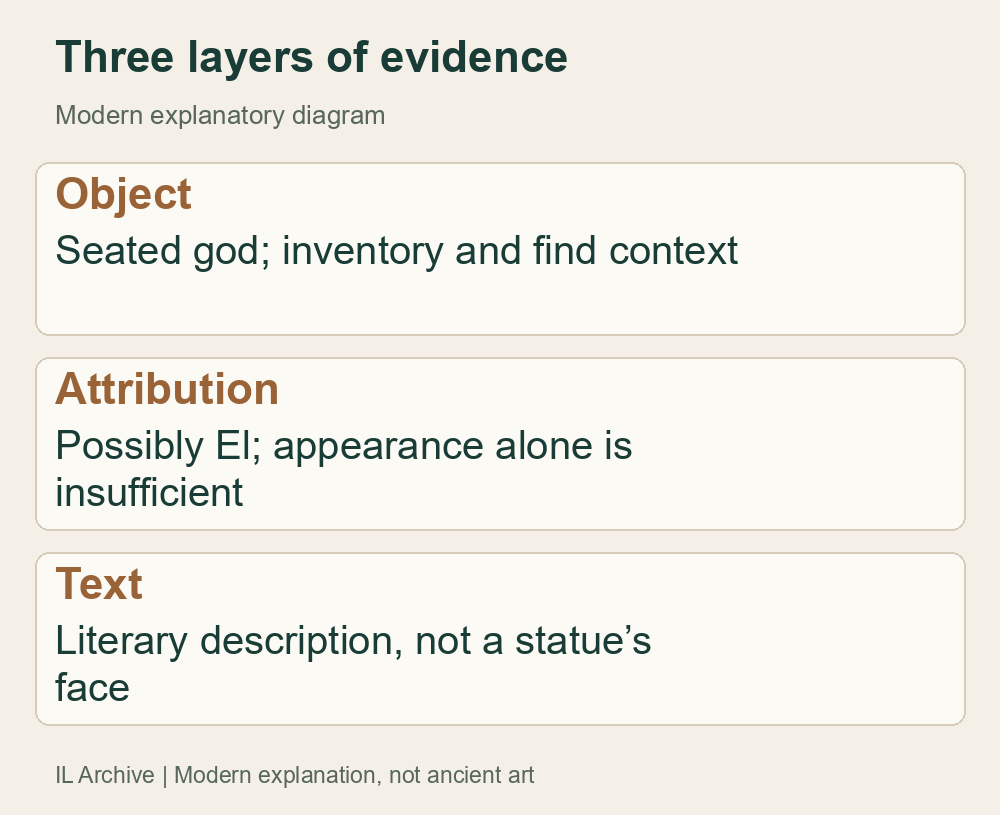
These clues do not identify every statuette with a named god in a poem or every building with that deity’s temple. They do help connect texts with the society producing them. The city contextualizes words, and words illuminate some finds. Where the evidence fails to converge, an identification should remain tentative.
One city opened a broad window
Some divine names were known through other traditions before Ras Shamra’s discovery. The novelty was the expanded context: speaking gods, named scribes and collections revealing literature, worship and administration. Researchers gained a setting in which to test accounts of West Semitic religion against its own documents. [8][13][15]
Ugarit did not provide all Canaanite religion or the origin of every later idea. It provided a more specific resource: a city with partly known streets, houses and scribes, together with significant portions of its imagined divine world. Its value follows from that specificity. We encounter El, Baal, Athirat and Anat in a tradition with a time and place, then compare its surviving evidence with other cities and periods.
References and notes
- Valérie Matoïan. Historique de la Mission archéologique syro-française de Ras Shamra–Ougarit. Main historical account: site, excavations from 1929, settlement, destruction around 1180 BCE and Mediterranean networks. Destruction date does not establish one cause or the absence of later use. Also read: Valérie Matoïan’s account of the 1928 tomb discovery and spring 1929 excavations. Return to the text ↑
- Paolo Merlo. Ugaritic: language. Mnamon, Scuola Normale Superiore. Visible introduction: linguistic evidence about 1300–1190 BCE; precise Semitic classification debated. Range not imposed on all tablets in every language. Return to the text ↑
- Paolo Merlo. Ugaritic: writing. Mnamon. DOI: 10.25429/sns.it/lettere/mnamon019. Complete main entry: 30 signs, cuneiform technique/alphabetic principle, three glottal-stop signs, direction, rarer systems and probable adaptation of an older alphabet. General 14th–12th-century range broader than language entry. Return to the text ↑
- Anne-Sophie Dalix. Les alphabets à Ougarit. Ministère de la Culture. Decipherment from 1929, uses, 30 signs, limited spread and no clear direct successor. Page’s later termination wording not used to override the mission’s destruction chronology. Return to the text ↑
- Anne-Sophie Dalix. Un abécédaire : la tablette RS 12.033. Ministère de la Culture. Complete tablet found 1948, 30-sign order and teaching. Study photograph shows another incomplete tablet AO 19992/RS 10.087. Return to the text ↑
- Carole Roche-Hawley. Corpus et langue / La documentation textuelle d’Ougarit. Ministère de la Culture. Languages/scripts, Babylonian diplomacy/contracts, Ugaritic rituals and much administration, scribal curricula. Written languages not treated as a census of speakers. Return to the text ↑
- Carole Roche-Hawley. Les scribes à Ougarit. Ministère de la Culture. Akkadian mid 14th–early 12th centuries, training/Babylonian culture, proposed 13th-century alphabetic beginnings and Ilimilku’s activity. Chronological proposal not promoted to consensus. Return to the text ↑
- Arnaud Sérandour. La première littérature levantine connue. Ministère de la Culture. Six Baal tablets, three each for Kirta/Aqhat, handwriting/colophons and Ilimilku/late dating, literature/ritual/Syrian context. Author label not proof that every tradition originated with him. Return to the text ↑
- Pierre Bordreuil and Florence Malbran-Labat (1995). Les archives de la maison d’Ourtenou. CRAI 139(2), 443–451. DOI: 10.3406/crai.1995.15480. Pp. 443–444 only: 1973 discoveries, lists/letters/lexical/funerary texts and 1992 identification evidence. Pp. 445–451 not claimed read. Return to the text ↑
- Olivier Callot (2011). Les sanctuaires de l’acropole d’Ougarit. Les temples de Baal et de Dagan. RSO XIX, MOM Éditions. Publisher summary, metadata and contents only: Middle Bronze construction, mid 13th-century earthquake and Baal-temple rebuilding. 238-page volume not read in full; restricted illustrations not reproduced. Return to the text ↑
- Adam Stone (2019). Dagan (god). Ancient Mesopotamian Gods and Goddesses, ORACC. Cult/genealogy/attestations: lists/offerings/names, limited literary presence, Dagan/El paternal language and temple reinterpretation as El’s. Interpretation reported, not a new attribution consensus. Return to the text ↑
- Robert Hawley. Le cycle de Baal. With translation by P. Bordreuil and D. Pardee (Manuel d’Ougaritique, 2004). Ministère de la Culture. Introduction and KTU 1.2 IV translation: storm Baal/cloud rider, Yam/two weapons/Kothar. No extended quotation; scene not generalized to the entire broken cycle. Return to the text ↑
- Joel S. Burnett (2022). The Persistence of El in Iron Age Israel and Ammon. In Biblical and Ancient Near Eastern Studies in Honor of P. Kyle McCarter Jr. Pp. 301–303 including notes: household/KTU 1.65, El’s sons/Athirat/Baal son of Dagan, and senior El/warrior Baal reading. Selected pages read, not whole chapter or volume. Return to the text ↑
- Jeffery B. Lloyd (1994). The Goddess Anat: An Examination of the Textual and Iconographic Evidence from the Second Millennium B.C. University of Edinburgh doctoral thesis. Selected pp. 181–184, 191–192, 197–198, 203–208 read for El and Baal: palace/mediation/mourning/Mot, revival gap and seasonal-reading limits. Scoped reuse, not whole thesis reading. Return to the text ↑
- Peter C. Craigie (1983). Ugarit, Canaan, and Israel. Tyndale Bulletin 34, 145–167. DOI: 10.53751/001c.30586. Pp. 145–146, 165–167 only; PDF 1–2, 21–23. City/kingdom/region distinctions, comparative benefits/limits. P. 166 rendered and visually inspected. Whole article not read; 1983 argument not equated with all current scholarship. Return to the text ↑
- Anne-Sophie Dalix. Édition et exploitation des documents inédits rédigés en cunéiformes alphabétiques. Mission de Ras Shamra–Ougarit. Fragments/joins/clay/handwriting/contexts/dispersed holdings; about 300 describes the project group, not an updated census of all unpublished material. Return to the text ↑
- Musée du Louvre. Tablette: abécédaire incomplet. AO 19992 / RS 10.087, KTU 5.4. Incomplete abecedary, 7 missing letters, museum date 1400–1200 BCE, found 1938. Different fromRS 12.033. Licensed Rama photo separate from protected museum photographs. Return to the text ↑
Suggest a correction · Suggest a source for this record
Cite this record
IL Archive, «Ugarit», Edition 1, https://ilarchive.com/en/studies/ugarit-city-and-gods
Continue reading