Study
From El’s Council to Yahweh’s Court
An extended study of a topic, with evidence and references.
How did heavenly council structures persist as sovereignty and membership changed? Ugarit, Deuteronomy 32 and Job through messengers and angels, separating evidence from a presumed single evolutionary path.
Share article
Dates
Dates have distinct roles. The timeline uses creation, composition or historical coverage, rather than publication or discovery dates.
- Historical coverage
- Approximately From 1400 BCE to 100 BCE
Text
At UgaritUgaritAncient city and kingdom at Ras Shamra on the Syrian coast, flourishing between the fourteenth and early twelfth centuries BCE and preserving multilingual archives.Glossary · Click to read the explanation, El was not alone in heaven. A divine family, a council, messengers and figures of differing rank surrounded him. Centuries later, HebrewHebrewA Northwest Semitic language in the Canaanite group, with ancient and modern forms.Glossary · Click to read the explanation texts describe YahwehYahwehThe divine proper name written YHWH in the Hebrew Bible.Glossary · Click to read the explanation on his throne, sons of GodSons of GodA Hebrew expression for heavenly beings in texts such as Job; context determines its meaning, rather than biological descent or a fixed angelic roster.Glossary · Click to read the explanation presenting themselves before him, and the heavenly hostHeavenly HostA heavenly group whose meaning varies: celestial bodies in some texts, attendants around the throne deliberating in 1 Kings 22.Glossary · Click to read the explanation deliberating and receiving orders.
Did El’s council survive within Yahweh’s? Comparison supports substantial continuity in structure and language. But the path toward a heavenly court and angels involved more than changing its president’s name, and it did not turn every ancient god into a recognizable angel. The central question is how the texts redefined sovereignty and membership in the heavenly world.
Ugaritic heaven: household and council
At UgaritUgaritAncient city and kingdom at Ras Shamra on the Syrian coast, flourishing between the fourteenth and early twelfth centuries BCE and preserving multilingual archives.Glossary · Click to read the explanation in the fourteenth and thirteenth centuries BCE, ElEl at UgaritA deity prominent in West Semitic traditions, especially as head of the divine family in Ugaritic texts.Glossary · Click to read the explanation appears as father and king, with AthiratAthiratA high-ranking goddess commonly understood as El’s consort in Ugaritic texts; associated with the progenitress epithet and the palace intercession.Glossary · Click to read the explanation occupying the position of the great mother. The opening lines of KTUKTU: Ugaritic Text ReferencesAbbreviation for a modern scholarly corpus of alphabetic cuneiform texts; its numbers are references, not dates.Glossary · Click to read the explanation 1.65 bring together El, the sons of El, their circle and their assembly. Joel Burnett reads this list alongside the divine family depicted in the myths.[1]
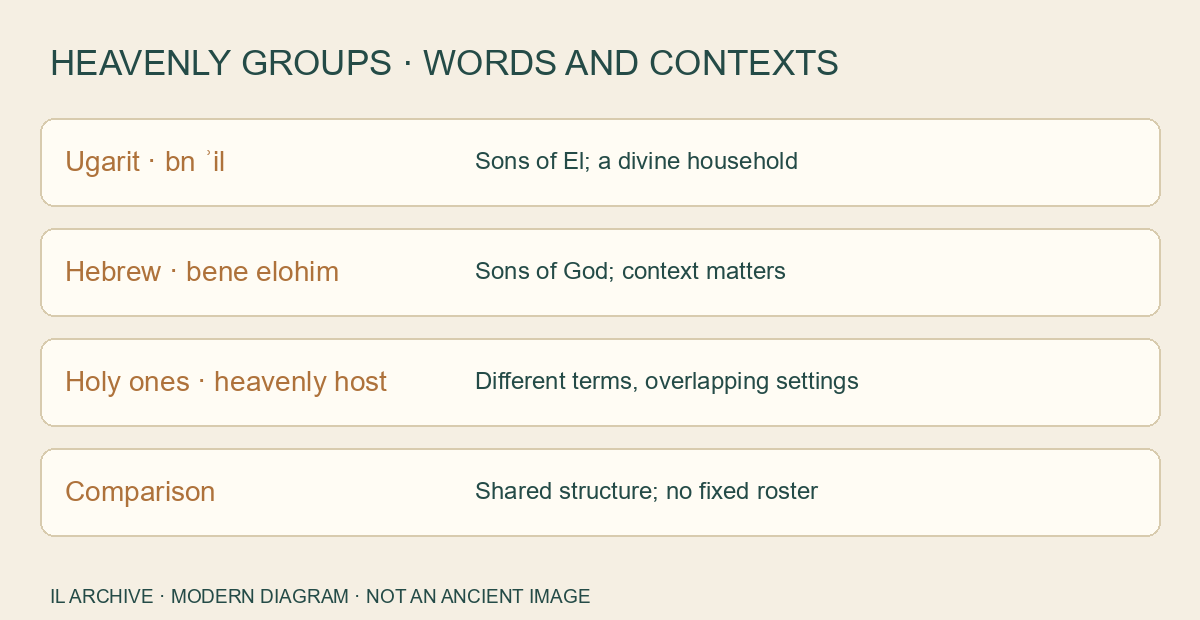
Other texts preserve expressions such as pḫr ʾilm, “assembly of the godsDivine councilA representation of divine beings acting as an assembly with authority and differentiated roles.Glossary · Click to read the explanation,” and pḫr bn ʾilm, “assembly of the divine sons.” The formulas bn ʾil and dr bn ʾil refer to El’s sons and their circle. Wording and contexts vary; these need not be interchangeable names for one group with fixed membership.[2]
Hierarchy preceded monotheism
The Ugaritic divine councilDivine councilA representation of divine beings acting as an assembly with authority and differentiated roles.Glossary · Click to read the explanation was not an assembly of equal powers. El held supreme rank, BaalBaalStorm god and protagonist of Ugarit’s Baal Cycle; exercises active kingship while El retains importance and authorizes the palace.Glossary · Click to read the explanation was a major storm god, and messengers and servants occupied lower positions. The order in KTU 1.65 places Baal within a world headed by El: active power did not erase seniority and paternal authority.[1]
The divine court also extended beyond Ugarit. A sudden transition from a council of equals to a royal court is therefore misleading. The comparison concerns a shared regional inheritance within which the ruler’s standing and the legitimacy of other powers changed, rather than a meeting room invented by one society and copied by another.[3]
Children of the divine household
The language of sons can express descent, but also membership in a family or heavenly group. The texts provide no surviving birth story for every figure included under these terms. Nevertheless, fatherhood and kinship are central to El’s divine community, rather than decorative metaphors.[1]
When similar formulas appear in Hebrew, their new contexts matter. Resemblance is evidence for comparison, but it does not establish that every Hebrew celestial figure is a former Ugaritic individual under another name.
Sons of God: surviving words, changing meanings
Hebrew uses bene elohim, bene elim, holy ones and the heavenly hostHeavenly HostA heavenly group whose meaning varies: celestial bodies in some texts, attendants around the throne deliberating in 1 Kings 22.Glossary · Click to read the explanation for celestial groups. Psalm 89 brings together bene elim and the council of holy ones, placing Yahweh above those around him. Collective language remained while the ruler’s position was clear.[4]
The terms are not identical in every occurrence. “Heavenly host” can mean celestial bodies, as in Deuteronomy 4:19, or the heavenly attendants in 1 Kings 22. Nor is fatherhood toward Yahweh linguistically prohibited: Deuteronomy 14:1 addresses Israelites as Yahweh’s children. The point concerns particular formulas for council members, not the absence of fatherhood from Israelite religion.[4]
Deuteronomy 32: three witnesses
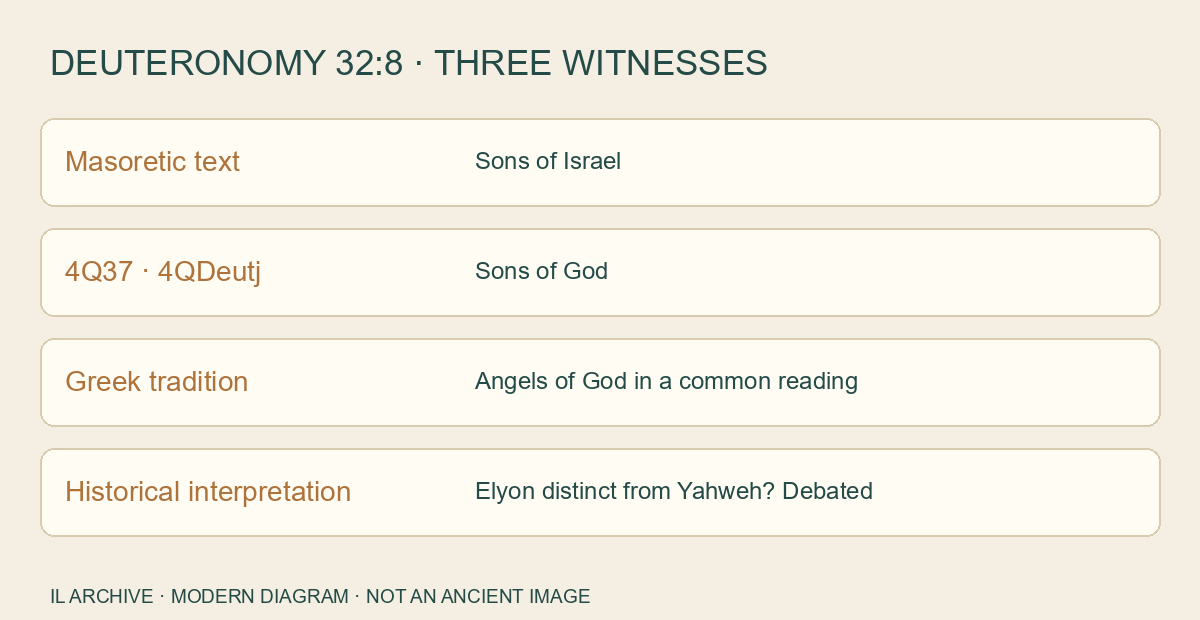
The Masoretic TextMasoretic TextA Hebrew textual transmission and reading tradition, compared in textual criticism with ancient manuscripts and translations.Glossary · Click to read the explanation of Deuteronomy 32:8 says that the Most High established peoples according to the number of the sons of Israel. By contrast, 4Q37, also known as 4QDeutʲ, preserves bene elohim. The Dead Sea ScrollsDead Sea ScrollsJudaean Desert manuscripts, especially Qumran cave finds. Biblical copies and other works reveal textual diversity; a copy’s age is not the work’s initial date.Glossary · Click to read the explanation Digital Library identifies image B-359054 as the recto of plate 172, fragment 10; the fragment’s photograph is available there for inspection.[5]
Eibert Tigchelaar’s discussion confirms this reading in 4QDeutʲ.[6] A common SeptuagintSeptuagintTraditional designation for ancient Greek translations of Jewish scriptures, whose readings sometimes differ from the Hebrew Masoretic Text.Glossary · Click to read the explanation reading gives “angels of God.” Textual comparison strongly favors divine beings behind these witnesses. The variation alone, however, establishes neither when the wording changed nor that a particular scribe intended to alter doctrine.[7]
Was Yahweh one of the Most High’s sons?
The following verse identifies Yahweh’s people as his portion. Daniel McClellan reads the distribution as a scene in which the Most High gives nations to his offspring and Yahweh receives Israel. In this model, the Most High and Yahweh differ within the layer preserved by the passage.[8]
MichaelMichael / MīkālTheophoric name asking who is like God; borne by humans and a heavenly figure in Daniel. It establishes no former Canaanite deity.Glossary · Click to read the explanation Heiser objects, treating Elyon as Yahweh’s own title and appealing to the verses’ syntax and the song’s context. On that reading, Yahweh distributes the nations and reserves Israel for himself.[9] The strong manuscript case for “sons of God” does not make the separation of El and Yahweh a consensus conclusion. The fragment itself does not state, “Yahweh is El’s son.”
Psalm 82: judgment within the council
Psalm 82 opens with elohimElohimA Hebrew word with plural morphology, used for “gods” or for a singular deity according to context.Glossary · Click to read the explanation standing in the assembly of El and judging among elohim. The first is the subject of a singular verb; the second is read as plural within the judgment scene. The addressees are charged with failing the vulnerable, described as gods and sons of the Most High, and sentenced to die like mortals.[10]
A celestial reading is compelling in comparison with ancient Near Eastern councils. Another interpretive tradition understands the addressees as human judges or rulers. Their nature should therefore remain an interpretive question, with the reasons for the divine-being reading made explicit.[3]
What can Psalm 82 establish?
Yahweh’s four-letter name does not appear explicitly in this psalm; its terms are elohim, El and Elyon. In the Psalter’s final context, the judging deity is understood as Israel’s God. Reconstructing the passage’s origin and date requires an additional argument.[10]
McClellan interprets the death sentence as withdrawing the council members’ privileged status and responsibilities. This is a historical and literary reading, not a document giving the year their worship ended. Nor does the psalm tell us that they became angels under new names.[8]
Job: appearing before Yahweh
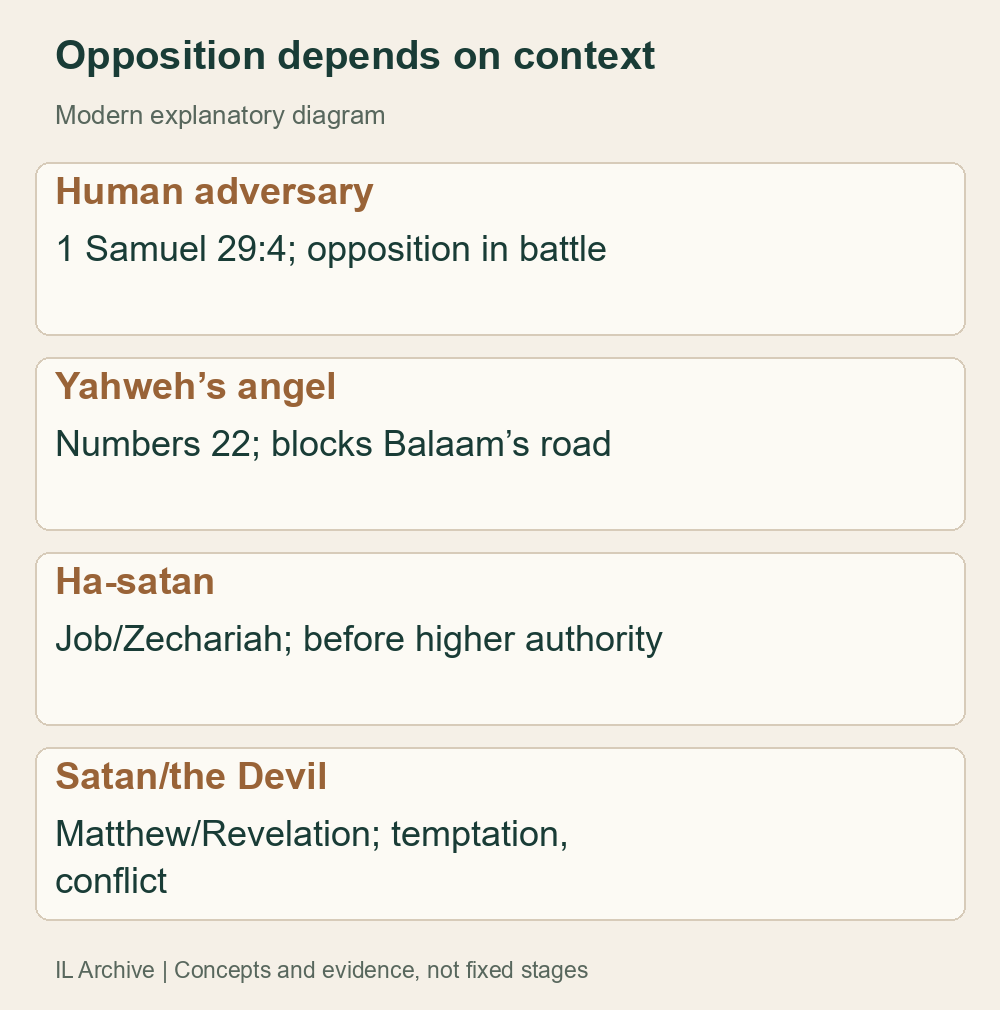
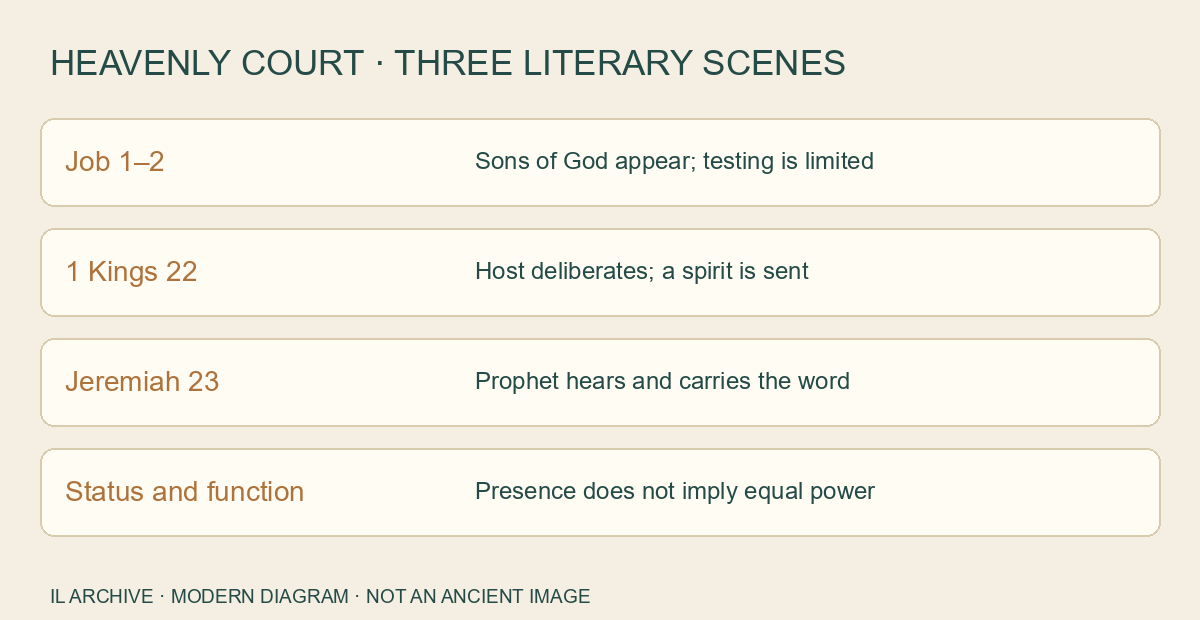
In Job 1, the sons of GodSons of GodA Hebrew expression for heavenly beings in texts such as Job; context determines its meaning, rather than biological descent or a fixed angelic roster.Glossary · Click to read the explanation present themselves before YahwehYahwehThe divine proper name written YHWH in the Hebrew Bible.Glossary · Click to read the explanation, with ha-satanHa-satan in JobThe adversary or accuser in Job, with the Hebrew definite article; among the sons of God, acting within permission and limits rather than carrying every later Satanic trait.Glossary · Click to read the explanation among them. Yahweh addresses him and permits him to test Job within limits: Job’s possessions are accessible, but he may not touch Job himself during that round.[11]
The gathering recurs in Job 2. Permission changes, while Job’s life remains excluded. The narrative presents a heavenly group and an authority determining what one of its participants may do.[12] This court belongs to a literary narrative; it need not be dated as a stage following every text that uses different council language.
Ha-satan: a role within the scene
Ha-satanHa-satan in JobThe adversary or accuser in Job, with the Hebrew definite article; among the sons of God, acting within permission and limits rather than carrying every later Satanic trait.Glossary · Click to read the explanation carries the Hebrew definite article: the adversary or accuser, a figure who challenges or makes an accusation. Warren Zev Harvey describes Job’s character as a celestial being among the sons of God, with a special role.[13]
The scene should not inherit every characteristic assigned to Satan in later traditions. Testing requires permission here, and Job’s life lies beyond its limits. At the same time, the character’s role is harsh and ethically troubling; subordination does not make the action harmless. The role establishes no direct connection to a particular Canaanite deity.
Morning stars and sons of God
Job 38:7 pairs singing morning stars with sons of God shouting at the earth’s foundation.[14] It depicts a heavenly celebration without providing a roster or a full explanation of the participants’ relationship to the stars.
Mark Smith compares this language with Ugaritic expressions in KTU 1.10 for El’s sons, the assembly of stars and the circle of heavenly beings. The Ugaritic context is damaged, and parts of its parallelism remain uncertain.[2] The resemblance merits study while keeping surviving wording separate from reconstruction of missing passages.
Micaiah ben Imlah: audible deliberations
In 1 Kings 22:19–22, Micaiah sees Yahweh enthroned with the heavenly host to his right and left. The ruler asks who will entice Ahab into a fatal military expedition. Different proposals arise; a spirit then offers to become a lying spirit in the prophets’ mouths and receives an order to act.[15]
This is a session with a question, proposals, dialogue and a commission, not silent attendance around a throne. But the text calls the speaker a “spirit”; we should not automatically turn it into a named angel. The vision also belongs to a narrative dispute over true prophecy, rather than archaeological minutes of a historical meeting.
The prophet who stood in the council
Jeremiah 23:18 asks who has stood in Yahweh’s sod and heard his word. Verse 22 connects standing in the council with carrying that word to the people and changing their conduct.[16] Bryan Spinks places this within a tradition of prophetic vision of a celestial assembly headed by Yahweh.[3]
Sod encompasses council, counsel and intimate or secret deliberation. Context determines the sense; not every occurrence describes a heavenly chamber. Within this tradition, prophetic authority comes from hearing the divine decision. It is one model of prophecy, rather than its only definition.
What remained of El’s council?
Comparable elements survived: a ruler, a heavenly group, sons, ranks, missions and deliberations. McClellan identifies a strong relationship between some Israelite council representations and Ugaritic and broader Southwest Asian traditions.[8]
Such continuity does not establish the transfer of one religious institution with all its members. Ugarit offers a window onto West Semitic traditions, rather than necessarily being the library Hebrew authors consulted. Hierarchy and messengers already existed within polytheistic worlds. The changes requiring explanation concern independence, sovereignty and worship.
An angel began as a messenger
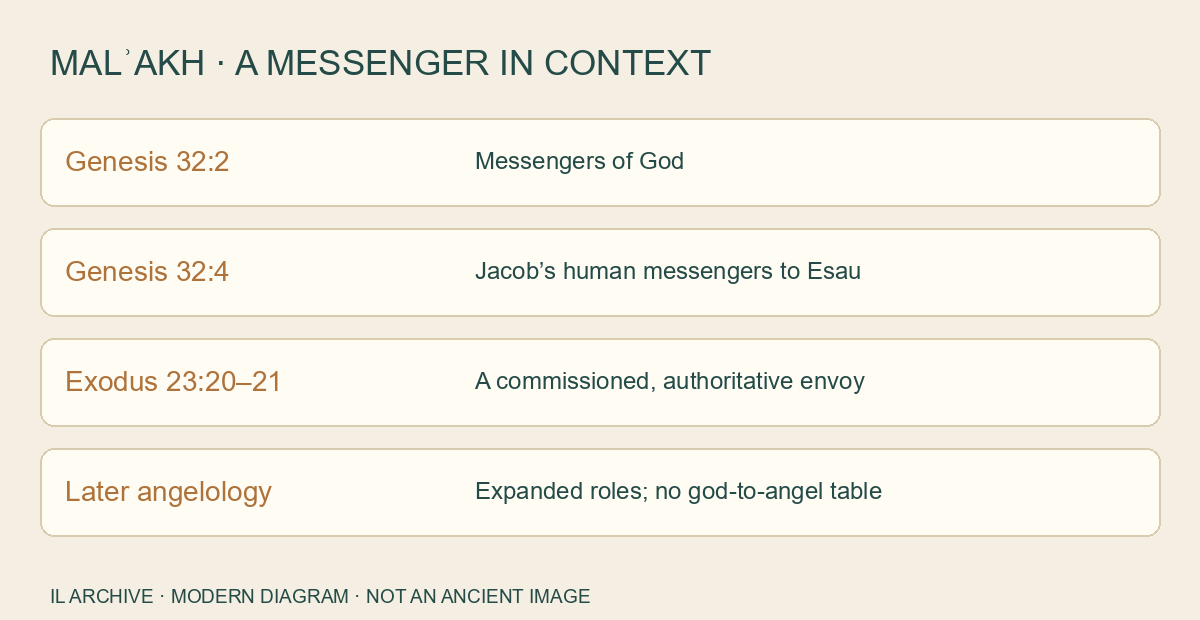
MalʾakhAngel / Divine MessengerHebrew malʾakh means messenger, human or celestial according to context; the word alone proves neither wings nor origin from a particular Canaanite god.Glossary · Click to read the explanation means messenger or envoy. Genesis 32 depicts angels of God, then Jacob sends malʾakhim to Esau: human messengers. The same word takes its meaning from the sender and the context.[17]
Exodus 23:20–21 describes an envoy sent to guard and guide, carrying powerful authority associated with the divine name.[18] The word therefore does not simply identify one fixed class of winged creatures. MonotheismMonotheismBelief in a single God as the only deity, rather than merely the highest among several gods.Glossary · Click to read the explanation did not invent the heavenly messenger’s function; Ugarit and other societies knew it, with differing rank and classification.[2]
Worshipping one god and asserting that only one exists
An injunction to worship Yahweh alone does not automatically deny every other divine being’s existence. Isaiah 44:6 and 45:5–6 use more exclusive language: the speaker declares that no other god exists beside him.[19]
The core conventionally called Second IsaiahSecond IsaiahScholarly label for Isaiah 40–55, substantially linked to exile and Cyrus; not proof of one author or one year for every verse.Glossary · Click to read the explanation is usually associated with the sixth-century BCE exilic context. Robert Gordon discusses disagreement over whether this period began monotheismMonotheismBelief in a single God as the only deity, rather than merely the highest among several gods.Glossary · Click to read the explanation or expressed it most clearly; definitions affect its dating.[20] Not all communities need have adopted identical claims simultaneously, and a heavenly court need not contradict a single god in every conceptual framework.
Second Temple writings: organizing a vast heavenly world
Some Jewish writings of the Second Temple periodSecond Temple JudaismDiverse Jewish traditions under Persian, Hellenistic and Roman rule, not one creed.Glossary · Click to read the explanation elaborate celestial names, functions and knowledge. Annette Yoshiko Reed proposes locating an important beginning of written Jewish angelologyAngelologyStudy and organization of angels and heavenly beings: names, ranks and roles within particular traditions, without assuming one fixed system.Glossary · Click to read the explanation and demonologyDemonologyStudy or organization of harmful powers, names, origins and roles within specific traditions; no single doctrine or claim about existence beyond the text is assumed.Glossary · Click to read the explanation in the third century BCE, drawing on AramaicAramaicA group of Northwest Semitic language varieties with a long history across the Near East.Glossary · Click to read the explanation Dead SeaDead SeaThe Dead Sea is a salt lake in the Jordan Rift Valley, near sites where ancient manuscripts were foundGlossary · Click to read the explanation texts and Hellenistic scribal knowledge.[21]
This dates a literary and organizational phenomenon, not the first belief in any angel. Different writings preserved diverse conceptions of mediators and heavenly authority. More detail can coexist with exclusive worshipMonolatryWorship of one deity without necessarily denying others; variable analytical term, not one uniform doctrine of all Israelites.Glossary · Click to read the explanation of the highest deity, but no historical rule makes increasing monotheism automatically produce more angels.
Michael, Gabriel and the limits of comparison
GabrielGabriel / JibrīlName joining El with an element involving man or strength; interpreter in Daniel, messenger in Luke, named Jibrīl in the Qurʾan.Glossary · Click to read the explanation interprets a vision in Daniel 8. Michael appears among the princes in Daniel 10, alongside princes associated with Persia and Greece.[22] This is a later representation of celestial agency connected with peoples. It can be compared with the council without equating it with every earlier depiction.
The names contain El, and Michael is commonly understood as the question “Who is like God?” But a theophoric nameTheophoric nameA personal name containing the name of a deity or a divine element.Glossary · Click to read the explanation expresses a relationship to the deity; it does not establish that Michael was an independent god at Ugarit. We have no table equating particular Canaanite gods with Gabriel or Michael after a demotion.
What do we know, and with what confidence?
- Established: council terminology and sons of El occur at Ugarit; heavenly assemblies occur in Hebrew texts.
- Established: Deuteronomy 32:8 varies between sons of Israel and sons of God, with angels of God in the Greek tradition.
- Probable: West Semitic council structures and language continued within representations of Yahweh’s council.
- Contested: whether Deuteronomy 32:8–9 distinguishes the Most High from Yahweh, and whether all Psalm 82’s addressees are celestial beings.
- Probable: traditions of Yahweh’s exclusivity reinterpreted the status and subordination of many heavenly beings.
- Unproven: every later angel was an ancient god under another name, or one date marks the polytheistic council’s end.
These grades apply to specific claims. The different texts cannot be assembled as securely dated chapters in one inevitable sequence.
Heaven remained; membership changed its meaning
Belief in one god did not require an empty heaven. A throne, host, messengers and holy beings could carry divine commands and participate in the celestial world without deserving independent worship.
This is what comparison between El’s and Yahweh’s councils most securely reveals: continuity in language and structure, alongside redefinition of sovereignty and members’ legitimacy. The council remained viable within different conceptions, and Jewish traditions could read it as a court serving the one God. The older structure did not disappear entirely; belonging to it came to mean something different.
References and notes
- Joel S. Burnett (2022). The Persistence of El in Iron Age Israel and Ammon. In Biblical and Ancient Near Eastern Studies in Honor of P. Kyle McCarter Jr., selected pp. 300–301. Selected pp. 300–301, especially KTU 1.65.1–18, sons of El, household and Baal’s position. Selected passages read, not the whole volume; list translation follows the published discussion, not a new tablet examination. Return to the text ↑
- Mark S. Smith (2006). The Rituals and Myths of the Feast of the Goodly Gods of KTU/CAT 1.23. Resources for Biblical Studies 51. Selected pp. 101–102, 105. Pp. 101–102, 105: group formulas, KTU 1.10 i.3–5 and astral comparison, envoys. P. 102 visually checked; parallelism in the damaged context remains provisional. Not the full book. Return to the text ↑
- Bryan D. Spinks (1991). The Old Testament Background and Setting. The Sanctus in the Eucharistic Prayer, chapter 1, pp. 11–24. doi:10.1017/CBO9780511520242.003. Accessible Summary excerpt on Yahweh’s council, Psalm 82 and prophecy; not the full chapter. The excerpt prints Jeremiah 22:18; the passage checked here is 23:18,22. Return to the text ↑
- Hebrew Bible / Bible hébraïque — Psalm 89:6–9 (Hebrew numbering); Deuteronomy 4:19; 14:1. Mechon-Mamre, Hebrew text and JPS 1917 English translation. Hebrew Psalm 89:6–9 (5–8 in other translations): bene elim and holy council. Heavenly host checked at https://mechon-mamre.org/p/pt/pt0504.htm v.19, human children at https://mechon-mamre.org/p/pt/pt0514.htm v.1. Context prevents treating all terms as identical. Return to the text ↑
- Israel Antiquities Authority. Leon Levy Dead Sea Scrolls Digital Library: B-359054, 4Q37 / 4QDeutj, plate 172, fragment 10, recto. Photograph: Shai Halevi, April 2013. Record metadata and fragment photograph inspected in the browser. Reading also follows Tigchelaar [6]; no full DJD edition review or El–Yahweh inference from letter forms claimed. The photograph is linked, not republished as media; accompanying diagram is modern. Return to the text ↑
- Eibert Tigchelaar (2012). Editing the Hebrew Bible: An Overview of Some Problems. In Editing the Bible: Assessing the Task Past and Present, ed. John S. Kloppenborg and Judith H. Newman, pp. 41–66, especially p. 46 n. 22. Selected pp. 41–46, especially p. 46 n. 22 identifying 4QDeutj for Deuteronomy 32:8. Page visually checked; not the whole volume. Witness identification does not prove El–Yahweh separation. Return to the text ↑
- NET Bible. Deuteronomy 32, textual note 14 on verse 8. Textual note 14: Qumran sons of God and common Greek angels of God against sons of Israel. Greek wording in the note read; not an independent collation of all Septuagint manuscripts. Identity interpretation is separate from textual preference. Return to the text ↑
- Daniel O. McClellan (2022). YHWH’s Divine Images: A Cognitive Approach. Ancient Near East Monographs 29. Selected pp. 88, 98, 102, 125–126. Selected passages read on Deuteronomy 32, Psalm 82, envoys, Yahweh’s council and prophetic vision. Distinct Elyon/Yahweh interpretation attributed, not consensus. Neither named angels as former Ugaritic gods nor a full-book reading claimed. Return to the text ↑
- Michael S. Heiser (2006). Are Yahweh and El Distinct Deities in Deut. 32:8–9 and Psalm 82? Hiphil 3, pp. 1–9; selected pp. 6–7. Repository metadata and pp. 6–7 read in the open reprint: https://www.dburnett.com/wp-content/uploads/2011/07/Heiser-on-Deut-32-Ps-82.pdf . Context and Elyon-title objections to necessary separation. Not presented as consensus. Return to the text ↑
- Hebrew Bible / Bible hébraïque — Psalm 82:1–8. Mechon-Mamre, Hebrew text and JPS 1917 English translation. Whole Hebrew psalm: assembly of El, elohim, sons of Elyon, death sentence and absence of YHWH. Displayed JPS translation uses judges in some places; article retains celestial/human interpretive disagreement. Return to the text ↑
- Hebrew Bible / Bible hébraïque — Job 1:6–12. Mechon-Mamre, Hebrew text and JPS 1917 English translation. Verses 6–12: sons of God, ha-satan and limited permission. Scene in the surviving narrative, not a fixed date for a religious stage. Return to the text ↑
- Hebrew Bible / Bible hébraïque — Job 2:1–7. Mechon-Mamre, Hebrew text and JPS 1917 English translation. Verses 1–7: renewed audience and permission excluding Job’s life. Later conceptions of Satan are not projected onto this character. Return to the text ↑
- Warren Zev Harvey (2022 online; 2023 issue). Questions on the Book of Job. Religious Studies 59, S1, S7–S16. doi:10.1017/S0034412521000585. Open passage in The Framework Story read on satan as adversary/accuser and a celestial being with a special role, and permission. Other philosophical interpretations are not adopted; full-article reading not claimed. Return to the text ↑
- Hebrew Bible / Bible hébraïque — Job 38:4–7. Mechon-Mamre, Hebrew text and JPS 1917 English translation. Verses 4–7, especially morning stars and sons of God in v.7. Ugaritic comparison follows [2], retaining the damaged context. Return to the text ↑
- Hebrew Bible / Bible hébraïque — 1 Kings 22:19–23. Mechon-Mamre, Hebrew text and JPS 1917 English translation. Verses 19–23: throne, host, proposals, spirit and dispatch. Text says spirit, not a particular named angel; reading concerns the literary vision’s structure. Return to the text ↑
- Hebrew Bible / Bible hébraïque — Jeremiah 23:18,22. Mechon-Mamre, Hebrew text and JPS 1917 English translation. Verses 18,22: Yahweh’s sod, hearing and delivering the word. Council interpretation not generalized to every sod occurrence or form of prophecy. Return to the text ↑
- Hebrew Bible / Bible hébraïque — Genesis 32:2–4 (Hebrew numbering). Mechon-Mamre, Hebrew text and JPS 1917 English translation. Hebrew vv.2–4 (1–3 in other translations): God’s envoys, then Jacob’s messengers. Both use malʾakh/malʾakhim according to context; bodily form not inferred from the word. Return to the text ↑
- Hebrew Bible / Bible hébraïque — Exodus 23:20–21. Mechon-Mamre, Hebrew text and JPS 1917 English translation. Verses 20–21: protective, guiding envoy with authority tied to the divine name. Neither a powerless messenger nor evidence for obligatory wings. Return to the text ↑
- Hebrew Bible / Bible hébraïque — Isaiah 44:6; 45:5–6. Mechon-Mamre, Hebrew text and JPS 1917 English translation. 44:6 and 45:5–6 checked at https://mechon-mamre.org/p/pt/pt1045.htm . Exclusive formulations preserved; core dating and monotheism definition are further questions in [20]. Return to the text ↑
- Robert P. Gordon (2007). Introduction. The God of Israel. Cambridge University Press, publisher excerpt. Indexed paragraph on Second Isaiah, the sixth century and differing definitions of monotheism. Full excerpt did not open in this review; no full-book reading claimed. Used only for this limited discussion. Return to the text ↑
- Annette Yoshiko Reed (2020). Rethinking Scribalism and Change in Second Temple Judaism. Demons, Angels, and Writing in Ancient Judaism, chapter 2, pp. 87–131. doi:10.1017/9781139030847.004. Publisher abstract only: third-century BCE proposal for beginnings of angelology/demonology in Aramaic literature, writing and knowledge. Full chapter not read; not a date for the first belief in an angel. Return to the text ↑
- Hebrew Bible / Bible hébraïque — Daniel 8:15–17; 10:13,20–21. Mechon-Mamre, Hebrew text and JPS 1917 English translation. Daniel 10:13,20–21 and 8:15–17 at https://mechon-mamre.org/p/pt/pt3408.htm . Michael/Gabriel roles attested; linguistic comment on El establishes no former Canaanite divine identity. Return to the text ↑
Media
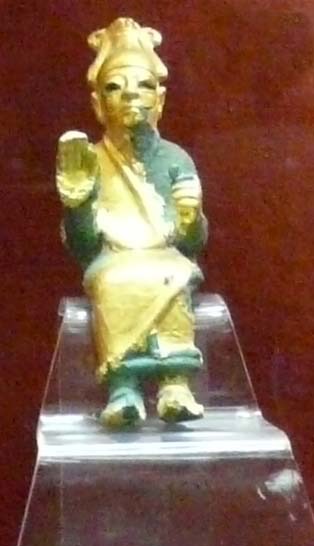
Original photograph
Seated god from Ugarit, bronze and gold, about 1400–1300 BCE; Damascus Museum S 3573 / RS 23.394. Possibly El. Context for Ugarit, not a picture of the full council, Yahweh, or gods becoming angels.
Public domain · ywpark2003 · CC0 1.0 · CC0 1.0 · https://creativecommons.org/publicdomain/zero/1.0/ · display resized only; original preserved
Suggest a correction · Suggest a source for this record
Cite this record
IL Archive, «From El’s Council to Yahweh’s Court», Edition 1, https://ilarchive.com/en/studies/divine-council
Continue reading