Entity · Theological concept
Negative theology
A reference page linking a name, group, or concept to the materials that discuss it.
Negative theology rules out limitations and misleading predicates of God; some accounts go beyond affirmation and negation alike. A comparison of Pseudo-Dionysius, Maimonides, Islamic traditions and Aquinas.
Estimated reading time: 6 min Published Last reviewed:
Share article

Text
Introduction
How can people speak of God if their vocabulary comes from limited things? Negative, or apophatic, theology approaches this question by denying what is thought inappropriate to God or inaccessible to human understanding. This entry compares philosophical, Jewish, Christian and Islamic sources. Their ways of negating do not all reach the same conclusion: negation may correct a misleading description, safeguard divine unity, or mark the limits of speech itself. The aim is to trace the sources and their differences, not to decide the truth of a particular faith.
Contents
- The limits of words and the work of negation.
- The One in philosophy and Gregory of Nyssa's account of unknowing.
- Pseudo-Dionysius and MaimonidesMoses MaimonidesJewish jurist, philosopher, and physician (c. 1138–1204). Wrote the Commentary on the Mishnah and Guide in Judeo-Arabic, and the Mishneh Torah in Hebrew; practiced in Egypt.Glossary · Click to read the explanation.
- Transcendence in Islamic schools.
- Analogy in Thomas AquinasThomas AquinasThomas Aquinas (c. 1225–1274): Dominican philosopher and theologian whose unfinished Summa theologiae examines divine being and simplicity, immutability, and the relationship of reasoning to revelation.Glossary · Click to read the explanation.
- Four approaches compared, with a methodological conclusion.
What does negative theology negate?
Saying that God is “not a body” often excludes size, location and constituent parts; it does not supply a new sensory description of the divine essence. Denying ignorance or weakness need not turn God into a larger and more capable human being. In Part I of the Guide for the Perplexed, Moses MaimonidesMoses MaimonidesJewish jurist, philosopher, and physician (c. 1138–1204). Wrote the Commentary on the Mishnah and Guide in Judeo-Arabic, and the Mishneh Torah in Hebrew; practiced in Egypt.Glossary · Click to read the explanation formulates a strict version of this caution: statements about the divine essence must not add independent properties such as those possessed by creatures. [1]
Negation is not necessarily a claim that God does not exist, nor an abolition of worship or scriptural names. The more precise question is what knowledge a negative statement provides. One thinker may hold that it rules out error without disclosing essence; another may argue that thinking must move beyond negation too.
The One beyond philosophical description
The third-century philosopher PlotinusPlotinusThird-century CE philosopher central to Neoplatonism, whose treatises were collected as the Enneads.Glossary · Click to read the explanation investigates “the One” as the first principle, whose unity is prior to all multiplicity. In the Enneads, especially V.3 and VI.9, this principle exceeds the classes of beings to which names and definitions apply. This is part of the history of NeoplatonismNeoplatonismModern name for Platonic currents flourishing from the third century CE, including Plotinus, Porphyry, Iamblichus and Proclus. They examined the first principle, Intellect, Soul and the world, while disagreeing over interpretation and practice.Glossary · Click to read the explanation, but it is not simply identical with later doctrines of a creator God or the TrinityTrinityChristian formulation of divine unity and Father/Son/Spirit distinction, with a history of debate.Glossary · Click to read the explanation. [2]
Here negation tests whether conceptual categories can reach the first principle. Such a philosophical background may explain shared vocabulary; by itself, however, it cannot establish that every religious text about transcendence borrowed directly from Plotinus.
Divine darkness and Gregory of Nyssa
In Exodus 20:21, MosesMosesCentral figure in Exodus, Torah traditions and the Qur’an; childhood accounts differ in detail.Glossary · Click to read the explanation approaches the thick darkness associated with God's presence. The fourth-century Christian theologian Gregory of NyssaGregory of NyssaFourth-century bishop of Nyssa and theologian, one of the Cappadocian Fathers.Glossary · Click to read the explanation develops this image in his reflections on Moses' ascent and the limits of knowing. Darkness here is not mere ignorance: it figures an encounter with what exceeds ordinary understanding.
Where Gregory locates the climax of the ascent remains a scholarly question. In the abstract of a peer-reviewed study, Nathan Eubank argues that the encounter with the heavenly tabernacle and Christ, rather than the darkness alone, may be the culminating scene in the Life of Moses. Gregory's account should therefore not be reduced to the slogan that darkness is its final destination. [3]
Pseudo-Dionysius: beyond even negation
An unidentified Christian writer of the late fifth or early sixth century composed works under the name of Dionysius the Areopagite, the figure mentioned in Acts 17:34. Modern scholarship calls the author Pseudo-Dionysius: attribution to Paul's first-century contemporary cannot be treated as the actual date of composition. [4]
In The Mystical Theology, especially chapters 1, 2, 4 and 5, this author proceeds from affirmative names for God to the denial of sensory and intellectual predicates. At the close of chapter 5, in C. E. Rolt's English translation, the transcendent cause exceeds both affirmation and negation. This is not the proposition “God is nothing”; it is an attempt to explain why both sides of an ordinary conceptual opposition fall short. Silence and “luminous darkness” belong to a contemplative vocabulary, not to a historically verifiable account of every reader's experience. [5]
Maimonides: negative attributes and attributes of action
Moses MaimonidesMoses MaimonidesJewish jurist, philosopher, and physician (c. 1138–1204). Wrote the Commentary on the Mishnah and Guide in Judeo-Arabic, and the Mishneh Torah in Hebrew; practiced in Egypt.Glossary · Click to read the explanation (d. 1204) composed the Guide for the Perplexed in Judeo-Arabic in the late twelfth century. Part I, chapter 58, goes beyond a rejection of bodily images: a positive property treated as an addition to God's essence would introduce composition incompatible with absolute unity. Terms referring to the effects of divine action in the world can be legitimate without defining the divine essence. [6]
Chapters 59 and 60 describe how negations supported by proof may progressively exclude false conceptions; chapter 60 illustrates this with people identifying a ship by eliminating inappropriate descriptions. The example concerns knowing by exclusion, not an eventual grasp of God's essence in the way one might grasp a ship. Our comparison uses Michael Friedländer's published 1904 English translation, not a direct collation with the Judeo-Arabic manuscript. [7]
Transcendence across Islamic schools
The QuranThe QuranThe central scripture of Islam, consisting of 114 Arabic surahs; its study distinguishes Quranic discourse from manuscript history, reading traditions, and historical inference.Glossary · Click to read the explanation combines the denial of likeness in 42:11 (“There is nothing like unto Him”) with an affirmation of hearing and seeing; 112:4 denies any equal or comparable being. The verses support divine transcendence, but do not, on their own, stipulate one philosophical method for handling every attribute. [8] [9]
Theological schools approached this problem differently. Muʿtazilites, Ashʿarites, Maturidites and scholars using traditionalist approaches debated essence and attributes, the affirmation or interpretation of scriptural wording, and what it means to refrain from asking “how.” Affirming an attribute without specifying its modality is not always another name for negating that attribute; nor is tanzīh automatically Maimonides' doctrine. [10]
Aydogan Kars examines more radically negative approaches in medieval Ismāʿīlī thought, including a denial of predicates followed by a move beyond negation itself. This point rests on the published chapter abstract only, not a reading of its full pages. It indicates a line of inquiry rather than a uniform doctrine of all Ismāʿīlīs or all Muslims. [11]
Thomas Aquinas: negation alongside analogy
The thirteenth-century Christian thinker Thomas AquinasThomas AquinasThomas Aquinas (c. 1225–1274): Dominican philosopher and theologian whose unfinished Summa theologiae examines divine being and simplicity, immutability, and the relationship of reasoning to revelation.Glossary · Click to read the explanation distinguishes knowledge that God exists through effects in the world from comprehension of the divine essence. In the Summa Theologiae I, question 12, article 12, natural knowledge moves from created effects toward their cause without knowing the essence as it is in itself. [12]
Question 13, articles 2, 3 and 5, considers names such as “good” and “wise.” For Aquinas, some such names are more than metaphors, but they are not applied to God and creatures in one identical sense. They work analogically: a meaningful relation remains alongside a real difference in being and signification. His position cannot therefore be compressed into negation alone. [13]
Four approaches that should not be collapsed
- Interpretation: assigning a non-bodily sense to an expression that might otherwise suggest likeness, with contextual justification.
- Negation: excluding limitation, deficiency or an unsuitable predicate; in some accounts, this goes on to question conceptual predication itself.
- Analogy: using a related term while preserving a substantive difference between God and creatures.
- Affirmation without modality: accepting an attribute's wording without defining how it obtains, an approach applied differently across schools.
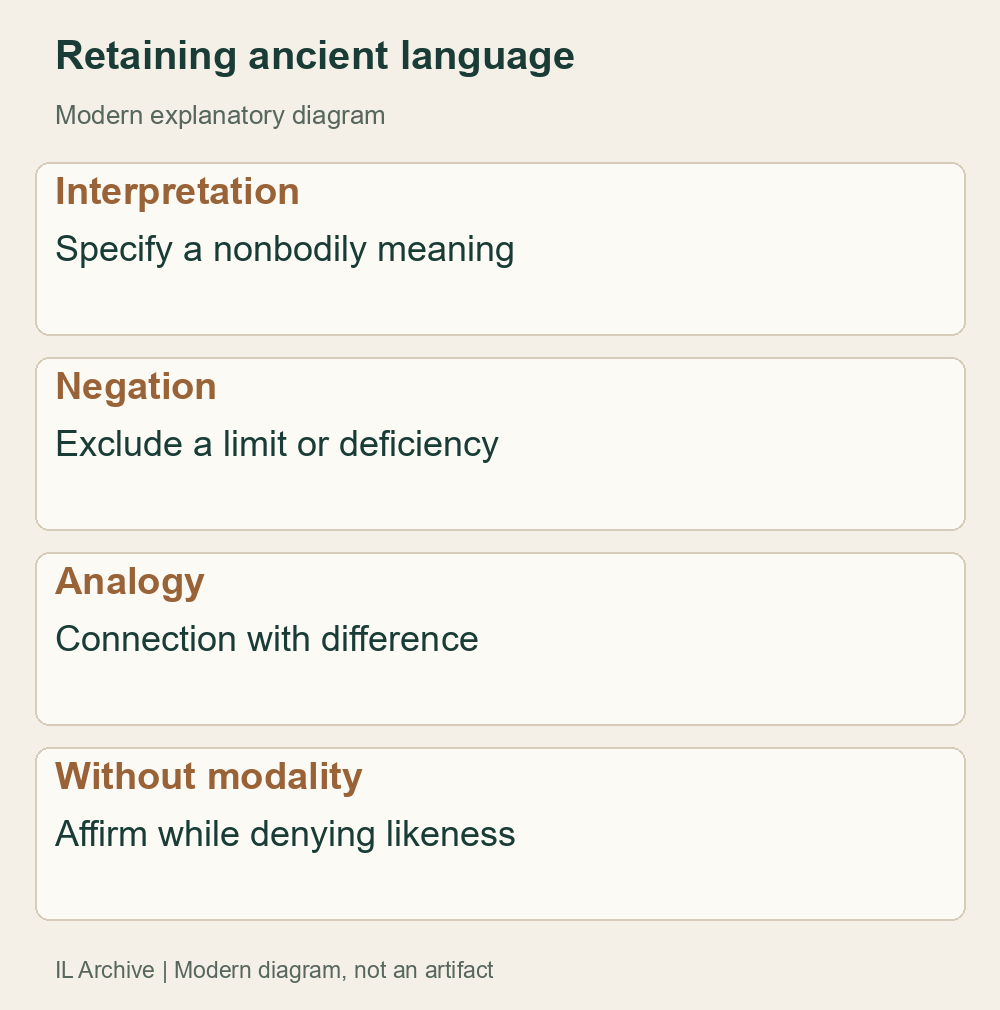
The accompanying diagram is a modern editorial comparison of methods for handling religious language, not an ancient source or proof that their proponents agreed. More than one approach can occur in a single writer, but interpreting figuratively is not identical with negating a predicate, and analogical naming is not the same as suspending the question of its modality.
Limits of the evidence and conclusion
Negative theology probes both what language can communicate and what it cannot. The sources differ in religious commitments, the status of revelation, the role of demonstration, and the aims of prayer and contemplation. Shared words such as “transcendence” and “negation” do not in themselves establish a route of borrowing without further textual and historical evidence.
Readers can ask three questions of each witness: what exactly is being negated? Does the author correct a particular description or seek to go beyond every description? How is that limit reconciled with divine names, actions and worship? Distinguishing their answers gives a more reliable history than treating all these positions as a single school.
References and notes (13)
- Moses Maimonides, Guide for the Perplexed, Part I, ch. 58; Michael Friedländer’s revised English translation (1904), CCEL. Part I, chapter 58, read in the 1904 English translation; Judeo-Arabic manuscript not collated. Return to the text ↑
- “Plotinus,” Stanford Encyclopedia of Philosophy, discussion of the One and the first principle. Sections 1 and 7, including the cited Enneads references; no claim to reading the complete Enneads. Return to the text ↑
- Nathan Eubank, “Ineffably effable: the pinnacle of mystical ascent in Gregory of Nyssa’s De vita Moysis” (2014), Oxford University Research Archive. Abstract only; neither the full article nor a critical Greek text of the Life of Moses was read. Return to the text ↑
- “Pseudo-Dionysius the Areopagite,” Stanford Encyclopedia of Philosophy, revised 2023. Authorship and dating section, and §3.4 on mystical theology; not the entire encyclopedia entry. Return to the text ↑
- Pseudo-Dionysius, The Mystical Theology, chapters 1, 2, 4 and 5, in C. E. Rolt’s English translation, CCEL; Greek not collated. Specified chapters of the English translation; “beyond affirmation and negation” is from the end of chapter 5. Return to the text ↑
- Kenneth Seeskin, “Maimonides,” Stanford Encyclopedia of Philosophy, updated 18 November 2024. Introduction and discussion of negative attributes and attributes of action; not the whole entry. Return to the text ↑
- Moses Maimonides, Guide for the Perplexed, Part I, chapters 59–60, Friedländer English translation (1904), CCEL. Chapters 59–60 read; ship example in ch. 60. No manuscript examined. Return to the text ↑
- Quran 42:11, checked in the University of Leeds Quranic Arabic Corpus parallel translation page. Verse 42:11 only; negation of likeness alongside hearing and seeing. Return to the text ↑
- Quran 112:4, University of Leeds Quranic Arabic Corpus. Verse 112:4 and displayed translations only; no claim to reading full commentaries. Return to the text ↑
- “Arabic and Islamic Philosophy of Religion,” Stanford Encyclopedia of Philosophy (2023), §§6.1–6.2 on theological language and attributes. §§6.1–6.2 read from the live entry; no general claim about all schools or eras. Return to the text ↑
- Aydogan Kars, “Double Negation: Ismāʿīlī Apophaticism,” in Unsaying God: Negative Theology in Medieval Islam (Oxford, 2019), pp. 23–72. Chapter abstract and bibliographic metadata only; pp. 23–72 are the chapter range, not pages read. Return to the text ↑
- Thomas Aquinas, Summa Theologiae I, question 12, article 12, English text on New Advent. Question 12, article 12 on knowing the cause from effects; not the entire question. Return to the text ↑
- Thomas Aquinas, Summa Theologiae I, question 13, articles 2, 3 and 5, English text on New Advent. Articles 2, 3 and 5 on predication, metaphor and analogy; not the entire question. Return to the text ↑
Suggest a correction · Suggest a source for this record
Cite this record
IL Archive, «Negative theology», https://ilarchive.com/en/entities/negative-theology
Continue reading