Person · philosopher_and_jewish_scholar
Moses Maimonides
Medieval Jewish thinker; wrote the Guide in Judeo-Arabic and examined incorporeality and attributes.
Metadata
These are descriptive fields, not conclusions.
- Edition
- 2
Text
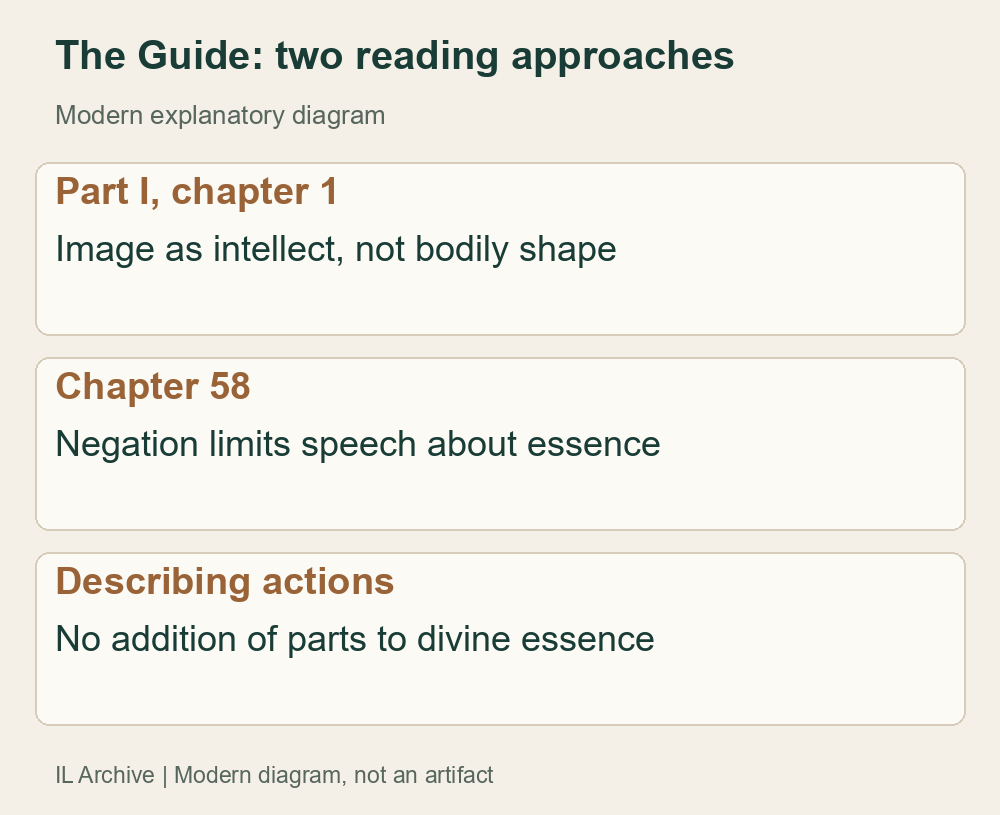
The twelfth-century Guide, Part I, chapter 1 interprets divine image through intellect rather than bodily shape. Chapter 58 explains how denying deficiencies and describing actions permit language about God without making attributes additional components of his essenceOusia — essenceGreek term for essence or nature, with meanings changing between authors.Glossary · Click to read the explanation. [1]
The work belongs to an Arabic-writing Jewish and Islamic philosophical context whose connections can be investigated. Similarity to PhiloPhilo of AlexandriaFirst-century CE Alexandrian Jewish author. In Life of Moses he presents Greek translation as inspired; the passage does not explicitly assign a separate room to each translator.Glossary · Click to read the explanation’s questions does not establish direct discipleship or an uninterrupted reception chain. The diagram covers particular passages rather than portraying the philosopher or summarizing all his religious rulings. [2]
References and notes
- Moses Maimonides, The Guide for the Perplexed, translated by M. Friedländer, 1904 Part I, chapter 1, chapter 58 and opening of 60; intellectual image and negative attributes. Return to the text ↑
- The Influence of Islamic Thought on Maimonides, Stanford Encyclopedia of Philosophy, Spring 2026 archive Selected section 1 passages; Maimonides’ Islamic philosophical context. Return to the text ↑
Research history
Substantive changes are retained here. Minor copy edits remain in the internal operational log.
-
Substantive record update
Suggest a correction · Suggest a source for this record
Cite this record
IL Archive, «Moses Maimonides», Edition 2, https://ilarchive.com/en/people/maimonides