Artifact
Elephantine Ahiqar Papyrus
An object record bringing together its image, metadata, rights, and context.
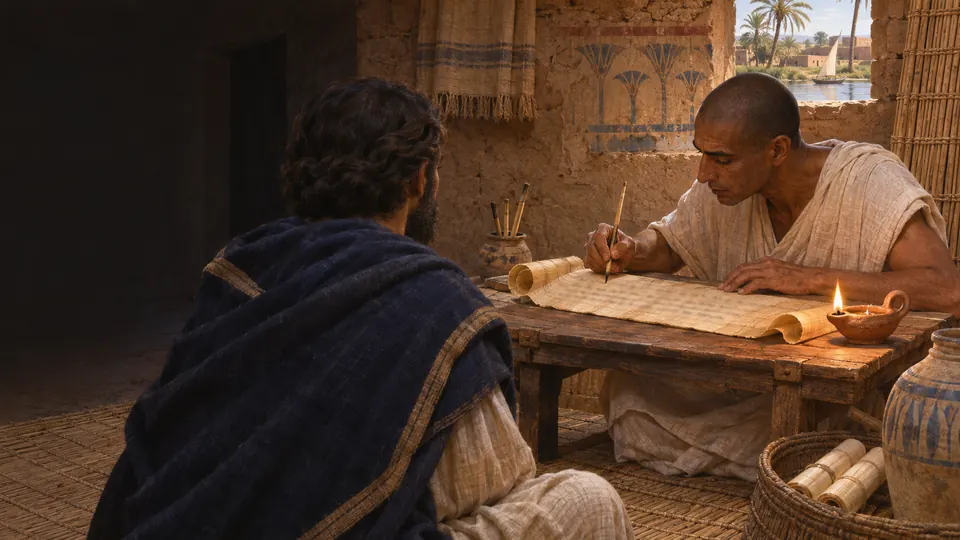
A fragmentary Aramaic witness from Elephantine, copied in the fifth century BCE on a scroll reused after a customs account of about 475 BCE; it preserves parts of Ahiqar’s narrative, Nadin’s betrayal and wisdom sayings.
Estimated reading time: 8 min Published Last reviewed:
Share article
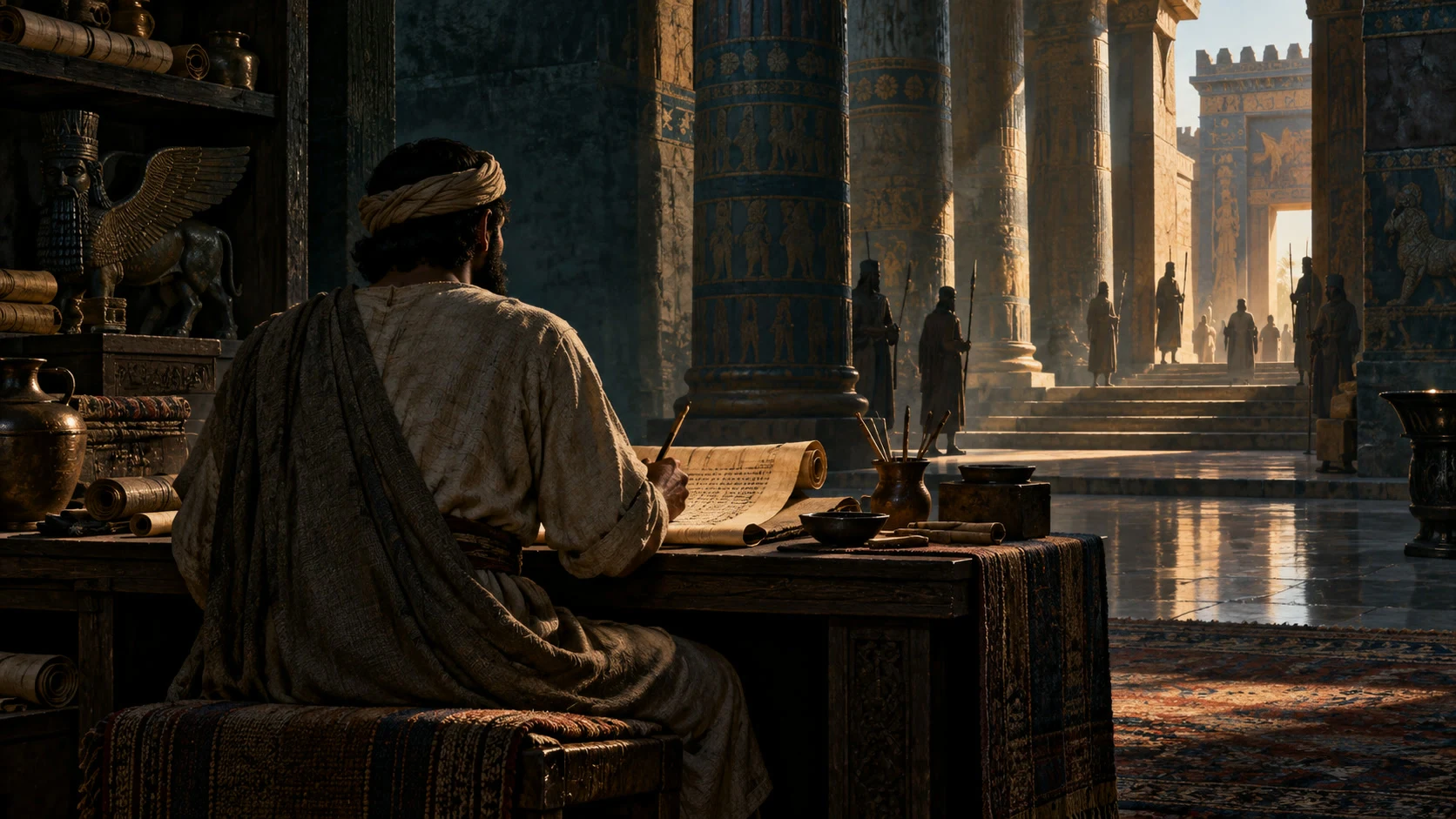
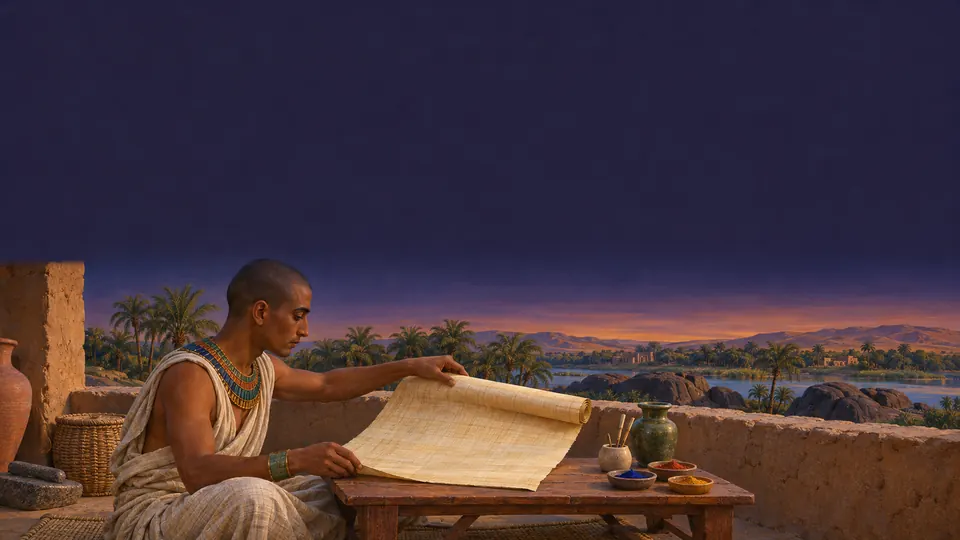
Illustration — not a photograph of the original object
Modern editorial illustration: IL Archive / CC0
Modern editorial illustration of a sage writing at an ancient court. Generated explanatory image, not a photograph of P.13446 or a documented reconstruction of Daniel or Ahiqar. © IL Archive, CC0
Object details
- Title
- Elephantine Ahiqar Papyrus
- Rights
- CC0
Text
Introduction
This papyrus is material evidence for a story about AhiqarAhiqar the wise figureAhiqar is a wise figure in ancient Aramaic traditions.Glossary · Click to read the explanation, a wise scribe portrayed as serving Assyrian kings. It is not a complete copy of every Ahiqar tradition, but remains of an AramaicAramaicNorthwest Semitic language varieties documented since the early first millennium BCE, including Old and Imperial Aramaic, Syriac, Jewish dialects, and living Neo-Aramaic forms.Glossary · Click to read the explanation text preserved in Persian-period Egypt. Comparing the surviving ink with editorial restorations, and then comparing this witness with later recensions, allows us to trace the story and its sayings more responsibly. It also explains why the reigns of the kings in the plot cannot date either the surviving manuscript or the composition of all its components.
The artifact, its location and its language
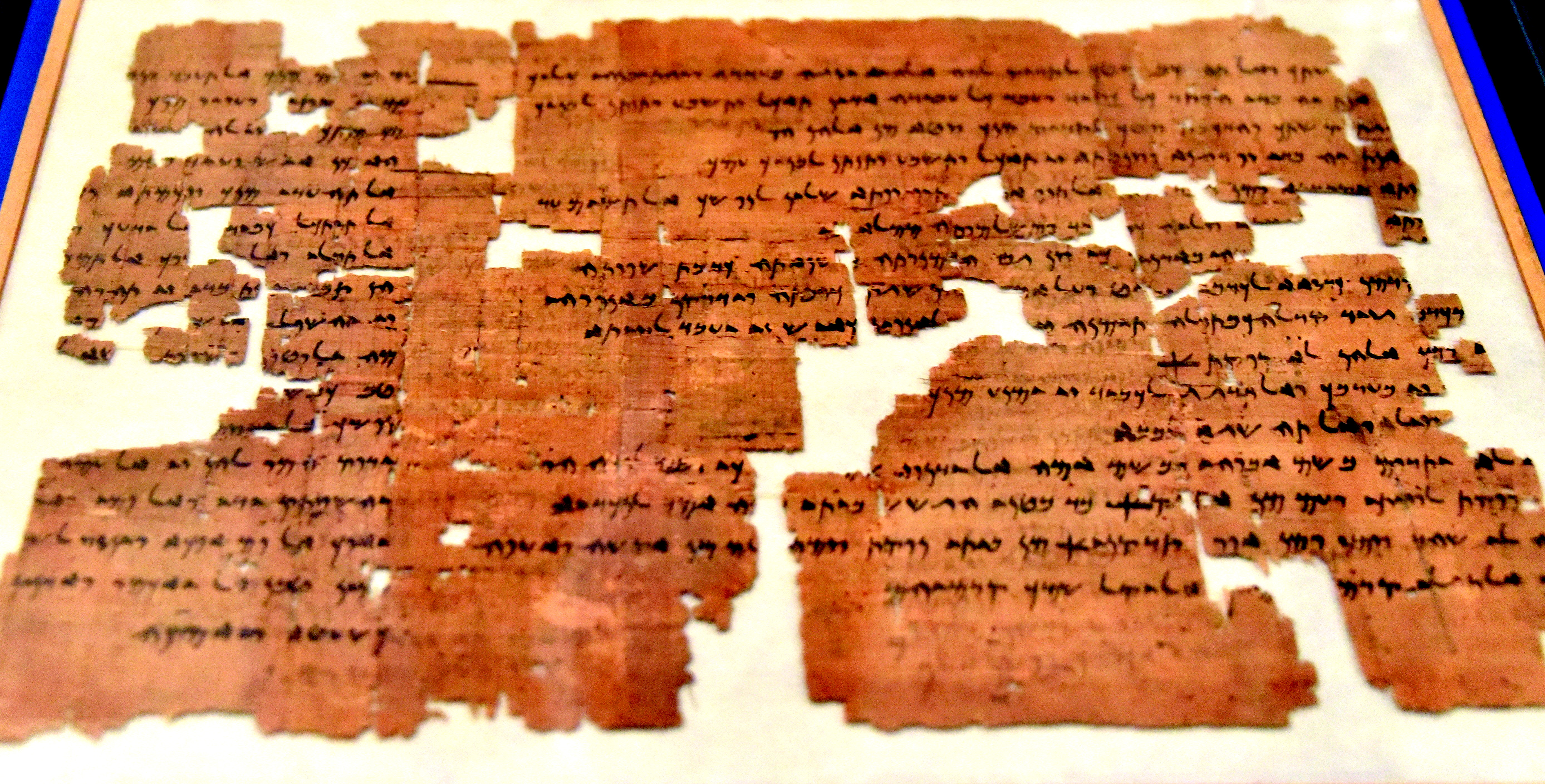
The text fragments were found at Elephantine, or YebElephantine / YebElephantine / Yeb, near Aswan at the Nile’s First Cataract, preserves a long-lived Egyptian town, temples of Khnum and Satet, and Persian-period garrisons. Aramaic papyri document several communities, including Judeans and Yaho’s temple, whose rebuilding was sought in 407 BCE; claims and archaeological interpretations must be distinguished.Glossary · Click to read the explanation, an island in the Nile at Aswan in southern Egypt, among materials from an Aramaic-speaking community and the administrative and family records of Achaemenid rule. Most pieces are held by the Egyptian Museum and Papyrus Collection of the Staatliche Museen zu Berlin under P.13446, with catalogued sheets A–H, K–L. Related material includes a fragment associated with Cairo and smaller pieces whose placement remains unsettled. These sheet letters do not constitute an original sequence of chapters: the arrangement of fragments and writing surfaces remains a matter of editorial debate. The catalogue for sheet A also describes writing on the versos of H and L that may represent another recension or a model used in copying the more elaborate version, rather than a secure continuation of it. [7] Found in excavations of 1906–1907, the fragmentary papyrus is catalogued as black-ink writing in the script and language of Imperial Aramaic. The surviving copy does not identify its scribe. [1][6]
There is more than one textual layer on the roll. Beneath the literary writing researchers recovered part of an older customs account concerning ships, imports and revenues collected for the royal treasury, dated to approximately 475 BCE. The erased account has helped establish physical relations among some fragments. It cannot, however, give the date of composition of the Ahiqar tale: the literary scribe reused an earlier writing surface. Calling the scroll the “Ahiqar Papyrus” does not mean every text on both sides belongs to the story. [1][5]
Three distinct chronological levels
- The story's setting: the courts of SennacheribSennacherib, king of AssyriaAssyrian king, 704–681 BCE; part of Ahiqar’s story is set at his court.Glossary · Click to read the explanation and his son EsarhaddonEsarhaddon, king of AssyriaSennacherib’s son and successor, Assyrian king in 680–669 BCE, named in Ahiqar and Tobit.Glossary · Click to read the explanation in the late eighth and early seventh centuries BCE. This is the narrative setting, not the date of the surviving papyrus.
- The literary tradition: the scribe's story and didactic sayings may have developed in different circles and stages before being combined. Scholars have proposed Assyrian, northern Aramaic and later Egyptian settings, but there is no complete seventh-century copy that fixes the composition date of the Elephantine text or of each saying. [2][9]
- The surviving witness: the customs ledger of about 475 BCE predates reuse of the scroll, while the literary manuscript is normally assigned to the fifth century BCE, often its later part. Estimates vary within this period; surviving SyriacSyriacAn Aramaic literary language rooted in Edessa, first attested in non-Christian inscriptions and later prominent in Christian writing, scholarship, translation and liturgy.Glossary · Click to read the explanation and Arabic recensions represent later stages, not automatic dates for the original work. [1][5][7]
The reused material, script and state of the papyrus support a Persian-period date for the physical witness, not a single year of literary composition. James D. Moore examines the narrative's detailed familiarity with Assyrian scribal work as literary knowledge transmitted or reshaped over time. Seth A. Bledsoe reads its simultaneous service to, and fear of, the king against the experience of transmitting the story under Persian imperial rule. These are arguments about the narrative and its circulation, not proof that the events occurred as told or that a court commissioned the copy. [2][9]
What the Aramaic narrative actually preserves
The beginning introduces the speaker as a wise and experienced scribe. The following short excerpt is from A i.1 in the institutional digital transcription. It follows the edition's modern letter forms, not a photograph of the ancient script; raised corner marks indicate letters whose reading is not wholly secure. [1]
Our rendering is “The words of the one called Ahiqar, a wise and skilled scribe.” It is a selection from a longer damaged and reconstructed line, not by itself evidence for the title of a complete book containing every subsequent recension.
Ahiqar appears as an important official under Sennacherib and an adviser under Esarhaddon. Seeking a successor, he puts forward NadinNadin in AhiqarThe young man Ahiqar raises and prepares as successor, then portrayed as betraying the sage.Glossary · Click to read the explanation, his sister's son, whom he had brought up and trained as a scribe. The young man becomes his adversary, and allegations against Ahiqar lead to an order for his death. The surviving portions of column B i establish the outline of the betrayal, but the precise wording of the purported letter and accusations is not fully preserved. Important details are printed in square editorial brackets: the manuscript does not supply an intact forged letter. [1][9]
In C i–D i, a courtier generally named Nabû-šuma-iškun in modern scholarship is sent to dispose of Ahiqar. The sage recalls that he once saved the courtier from execution and appeals for reciprocal protection. In D i.4 he says: [1]
That is, “Do not kill me.” The appeal is directly attested, while several steps in the concealment or substitution scheme remain damaged or editorially reconstructed. The surviving narrative breaks off before a complete resolution. The Egyptian pharaoh's riddle and the final sentence on Nadin belong to later tellings; they are not extant scenes in these Aramaic columns. [1][7][9]
The wisdom sayings as they survive
The narrative is followed by instructions on speech, royal authority, conduct and interpersonal obligations. They are not a single uniform voice: direct exhortations stand alongside animal images, warnings and reflections on the perils of power. At E i.2 we read: [1]
Our translation is “My son, do not curse the day until you have seen the night.” Square brackets indicate restored missing letters, and the raised marks distinguish less secure reading; the sense is intelligible without pretending that every letter is preserved. A brief image in E i.4 reads: [1]
“For a word is a bird.” In context, the image is connected with guarding one's mouth and the consequences of released speech. Alternative readings occur earlier in the same line, so the entire maxim should not be reproduced as if all its wording were certain. Sayings about addressing the king combine a favorable depiction of royal authority with warnings about its destructive potential. This tension informs Bledsoe's political interpretation; it does not, by itself, prove either unconditional royal propaganda or opposition to a particular regime. [1][2]
Some maxims refer to “gods” and to ShamashShamashMesopotamian god of the sun and justice, shown before Hammurabi on an eighteenth-century BCE stele preserved in the Louvre.Glossary · Click to read the explanation. It would be misleading to rewrite them automatically as monotheistic statements drawn from later Jewish literature. The presence of the manuscript in Elephantine, with its Judean and Aramaic-speaking residents, attests to circulation there rather than proving the religious identity of the composer of every textual layer. A comparative study with the Book of JobBook of JobHebrew wisdom text exploring suffering, justice and the limits of human knowledge through dialogue and poetry.Glossary · Click to read the explanation explores suffering and human limits within a broader intellectual milieu, while acknowledging the marked difference between Job's dialogue and Ahiqar's father-to-son instruction. [1][10]
Later reception and literary parallels
The Book of TobitBook of TobitJewish story of a family in Assyria, combining adversity, prayer, journey and almsgiving, and naming Ahiqar.Glossary · Click to read the explanation explicitly names Ahiqar, makes him Tobit's relative and an influential court officer who helps his family in hardship (1:21–22). It places him at a family celebration (11:18) and uses his fate with Nadin as a moral example in Tobit's final advice (14:10–11). The names and the pattern of betrayal and escape provide strong evidence of literary reception, but Tobit adapts the figure to a Jewish story about righteousness and almsgiving rather than transmitting the Elephantine text sentence by sentence. [8]
Later Syriac and Arabic Ahiqar stories enlarge the peril and deliverance, sometimes including a challenge sent by the Egyptian king and a fuller account of Nadin's punishment. The Göttingen project's synopsis of Syriac maxims shows that manuscript witnesses differ in their number and sequence, and that correspondences may be classified by sense instead of identical wording. A later recital must therefore not be inserted silently into a damaged Elephantine line; restoration and surviving letters have different evidential weight. [4][7][9]
There are thematic affinities with the Book of ProverbsBook of ProverbsThe Book of Proverbs collects wisdom texts in the Hebrew Bible on learning, conduct and social relationships.Glossary · Click to read the explanation, the Book of JobBook of JobHebrew wisdom text exploring suffering, justice and the limits of human knowledge through dialogue and poetry.Glossary · Click to read the explanation, and stories about a sage in jeopardy at the royal court in the Book of DanielBook of DanielA book combining court tales of wisdom and deliverance with visions of kingdoms and the future, formed in stages.Glossary · Click to read the explanation. Such parallels illuminate shared wisdom practices and cultural contact; common advice on prudent speech or a falsely accused courtier alone cannot establish that one author consulted another particular manuscript. Here, the explicit name Ahiqar in Tobit is the firmer link, whereas the direction of possible literary borrowingLiterary borrowingUse of verbal or narrative material from an earlier text or tradition in a later work, distinguishing evidence of transfer from mere resemblance.Glossary · Click to read the explanation and the dating of pre-Elephantine stages remain open questions. [8][10]
The image and the limits of the evidence
The retained cover is a modern generated editorial illustration of a sage writing in an imagined court. It is not a photograph of the Berlin papyrus, nor a historical likeness of Ahiqar. The museum separately identifies an authentic image of the particular piece P.13446/F, with its own photographer credit and licence. That photograph is not the cover file included here. The original illustration has therefore been retained with its explanatory label and inherited attribution, without presenting it as an artifact. [3]
The secure achievement of this witness is to show an Aramaic court-scribe story and collected wisdom circulating in Persian Egypt. Preserved phrases identify Ahiqar, outline Nadin's betrayal, voice the plea for protection and counsel guarded speech. The missing ending, substantial editorial expansions and the earliest place and time of composition must remain questions of reconstruction and comparison, not statements about ink that survives on the papyrus.
References and notes (10)
- Texts and Scripts from Elephantine (Staatliche Museen zu Berlin), institutional catalogue of the Ahiqar papyrus with Aramaic transcription and English rendering; narrative and maxims use different editorial bases and contain restorations. Pap. Berlin P.13446 A–H, K–L; TAD C.1.1 / C.3.7; Ai01–Dii15, Ei01–Ei16, Ji14–Ji16, palimpsest; institutional metadata Return to the text ↑
- Seth A. Bledsoe, “Conflicting Loyalties: King and Context in the Aramaic Book of Ahiqar,” in Political Memory in and after the Persian Empire (SBL Press, 2015). Selected passages consulted; not a complete reading of the volume. Printed pages 239–243, 245–246, 253–255 and 263–265 Return to the text ↑
- Staatliche Museen zu Berlin catalogue record for actual papyrus sheet P.13446/F; photograph credited to Sandra Steiß under CC BY-SA 4.0. That photograph is not reproduced here. Object obj:1388863; P.13446/F; photographic credit and licence in object catalogue Return to the text ↑
- Simon Birol, “Proverbs in the Syriac Version of the Story of Ahiqar,” Göttingen digital project; introduction, manuscript-order notes and an initial sample of comparisons read, not all Syriac manuscripts. Introductory remarks; Table 1 description and sample proverbs 1–3, Cambridge Add.2020 and related Syriac sigla Return to the text ↑
- Ada Yardeni, “Maritime Trade and Royal Accountancy in an Erased Customs Account from 475 B.C.E. on the Aḥiqar Scroll from Elephantine,” BASOR 293 (1994), 67–78. Abstract and bibliographic record only; full paper not read. Abstract and metadata only; BASOR 293, pp. 67–78 Return to the text ↑
- DEAPS, Digital Editions of Aramaic and Phoenician Sources, Ohio State University, Ahiqar entry; editorial overview and fragment inventory consulted and checked against the Berlin institutional edition. Ahiqar text object 12283; manuscript and recension overview, June 2026 editorial update Return to the text ↑
- Texts and Scripts from Elephantine, James D. Moore’s institutional record for sheet A of the Ahiqar papyrus: the A–D narrative, variant material on the versos of H and L, and distinctions from the Syriac recensions. Pap. Berlin P.13446/A, object 308239: comments on text and history, R1–15, H.v / L.v; editorial summary of later Syriac witnesses Return to the text ↑
- Book of Tobit, USCCB/NABRE English edition, chapters 1, 11 and 14; specific references to Ahiqar and Nadin read directly; summaries in the article are newly phrased. Tobit 1:21–22; 11:18; 14:10–11 (other passages at /bible/tobit/11 and /bible/tobit/14) Return to the text ↑
- James D. Moore, Literary Depictions of the Scribal Profession in the Story of Ahiqar and Jeremiah 36 (De Gruyter, 2021); preview preface and introduction pp. 1–6 read, not the whole monograph. Preview PDF: Preface pp. vii–viii, Introduction printed pp. 1–6 (PDF pages 11–16, depending on viewer) Return to the text ↑
- JiSeong James Kwon, “The Aramaic Ahiqar and the Book of Job: Wisdom Texts in the Persian Period,” Usuteaduslik Ajakiri 1(77) (2020); pp. 94–98 checked for comparative method and religious differences; full article not read. Printed pp. 94–98 (PDF pages 1–5 of 35) Return to the text ↑
Archive records may be reviewed and refined as better evidence or sources become available. Suggest a correction
Suggest a correction · Suggest a source for this record
Cite this record
IL Archive, «Elephantine Ahiqar Papyrus», https://ilarchive.com/en/artifacts/ahiqar-elephantine-papyrus
Continue reading
Related readings