Entity · Book
Samaritan Pentateuch
A reference page linking a name, group, or concept to the materials that discuss it.
- Names
- Samaritan Torah
A Samaritan Hebrew tradition of the five books, compared with the Masoretic text and Qumran scrolls, especially over Mount Gerizim. A critical account of textual witnesses, a disputed fragment, and archaeological dating.
Estimated reading time: 5 min Published Last reviewed:
Share article

Text
Introduction
The Samaritan Pentateuch is a HebrewHebrewA Northwest Semitic language of the Canaanite group, encompassing Iron Age epigraphy, Biblical, Rabbinic, medieval and Modern Hebrew; its scripts and pronunciations changed over time.Glossary · Click to read the explanation form of the PentateuchTorah / PentateuchThe first five books of the Jewish and Christian Bible: Genesis, Exodus, Leviticus, Numbers and Deuteronomy. They combine narrative and law from creation to Moses’ death; in Jewish usage, “Torah” can also encompass a wider body of authoritative teaching.Glossary · Click to read the explanation preserved by the Samaritan community as its central scripture. It is neither a sixth biblical book nor an Arabic translation of the Torah: it is a distinct manuscript and textual tradition. Its five books share the broad narrative structure of the Jewish Torah but differ at particular readings, literary arrangements and cultic passages. These differences are especially valuable for studying the transmission of scripture in and after the Persian and Hellenistic periods.[1]
The books, language and script
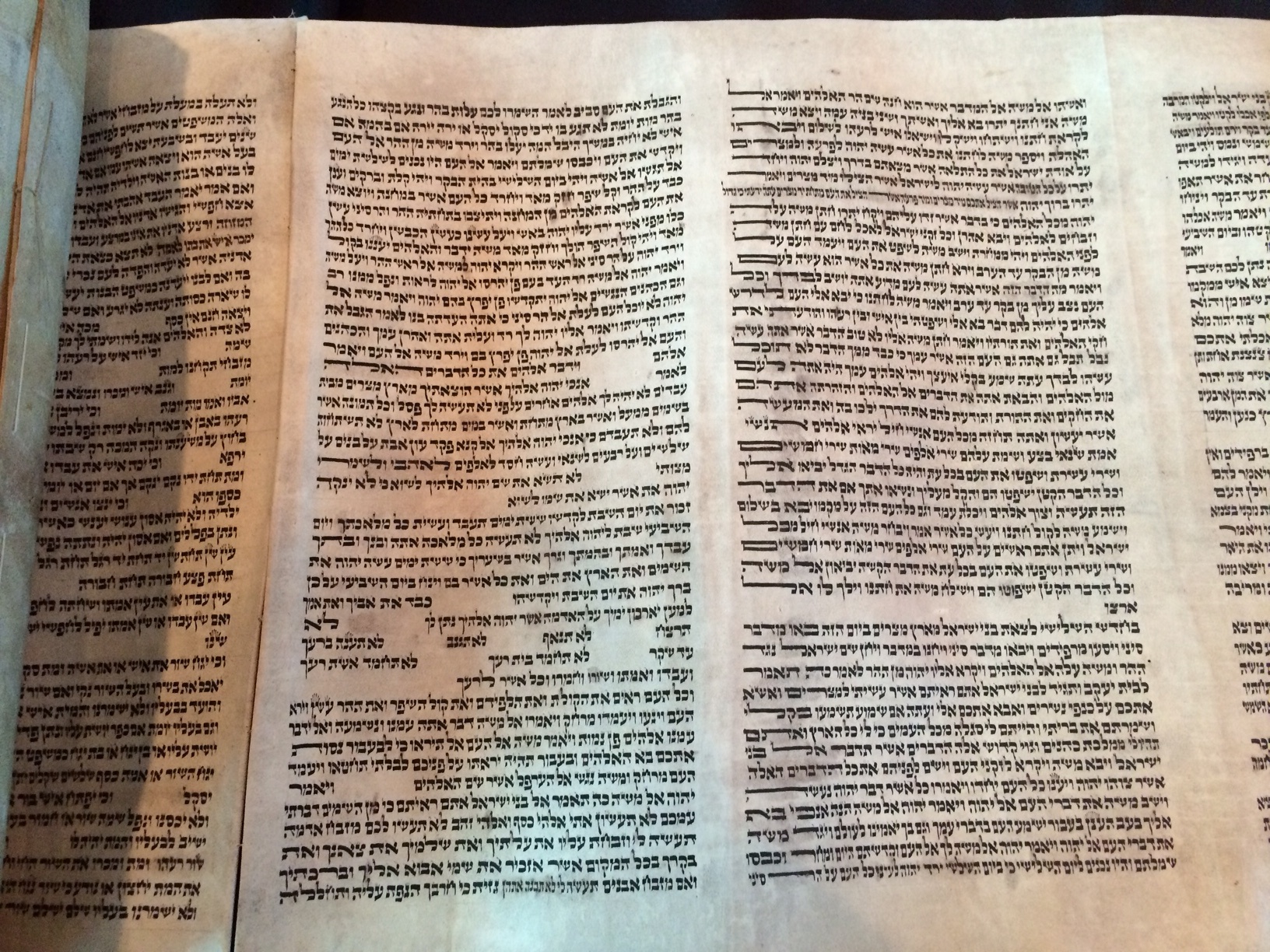
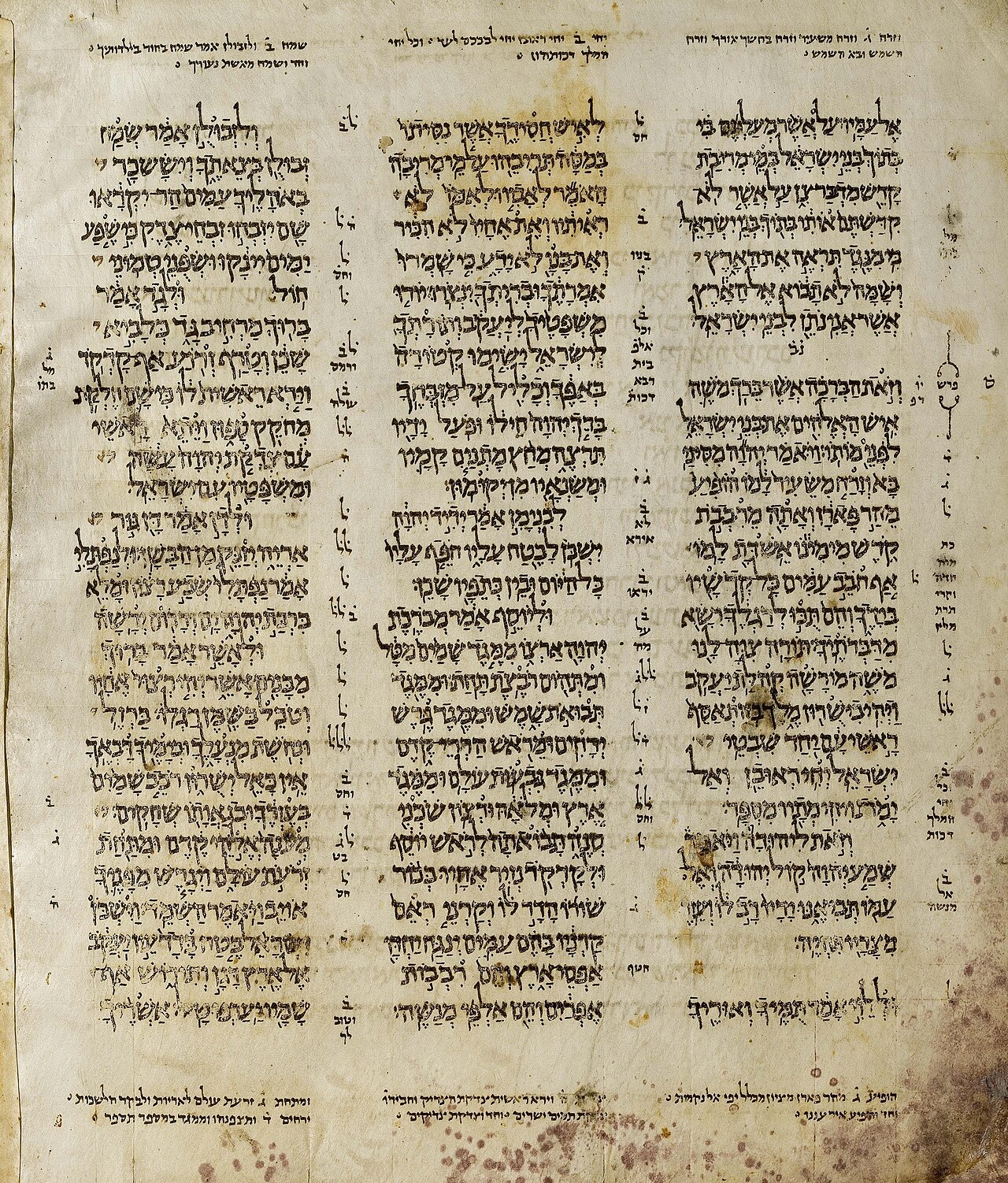
The Samaritan Pentateuch comprises Genesis, Exodus, Leviticus, Numbers and Deuteronomy. For Samaritans, these books alone constitute their scriptural canon; this does not mean that Samaritan communities lack other religious literature, prayers or interpretations. Scholars commonly compare their Hebrew text with the Jewish Masoretic TextMasoretic TextThe Hebrew Bible’s transmission tradition combining its consonantal text, transmitted vocalization and accentuation, and Masorah notes. The consonantal text has ancient roots; surviving codices that bring these layers together in their Masoretic form are medieval.Glossary · Click to read the explanation and other witnesses, including the SeptuagintSeptuagintA name for the varied ancient Greek translations and writings associated with Jewish scripture; beginning with the Torah, the texts differ across books and manuscripts.Glossary · Click to read the explanation. None of these labels names a single ancient manuscript or guarantees that its reading is earliest at every passage.[1][2]
The language of the Samaritan Pentateuch is a form of HebrewHebrewA Northwest Semitic language of the Canaanite group, encompassing Iron Age epigraphy, Biblical, Rabbinic, medieval and Modern Hebrew; its scripts and pronunciations changed over time.Glossary · Click to read the explanation, written in a distinct Samaritan script developed from palaeo-Hebrew. Language, script and textual tradition must therefore be distinguished. A Samaritan oral reading tradition and translations into Samaritan Aramaic and Arabic have also been transmitted. A change in letter shapes is not, in itself, a change in a verse's meaning.[1]
Shared readings and the desert manuscripts
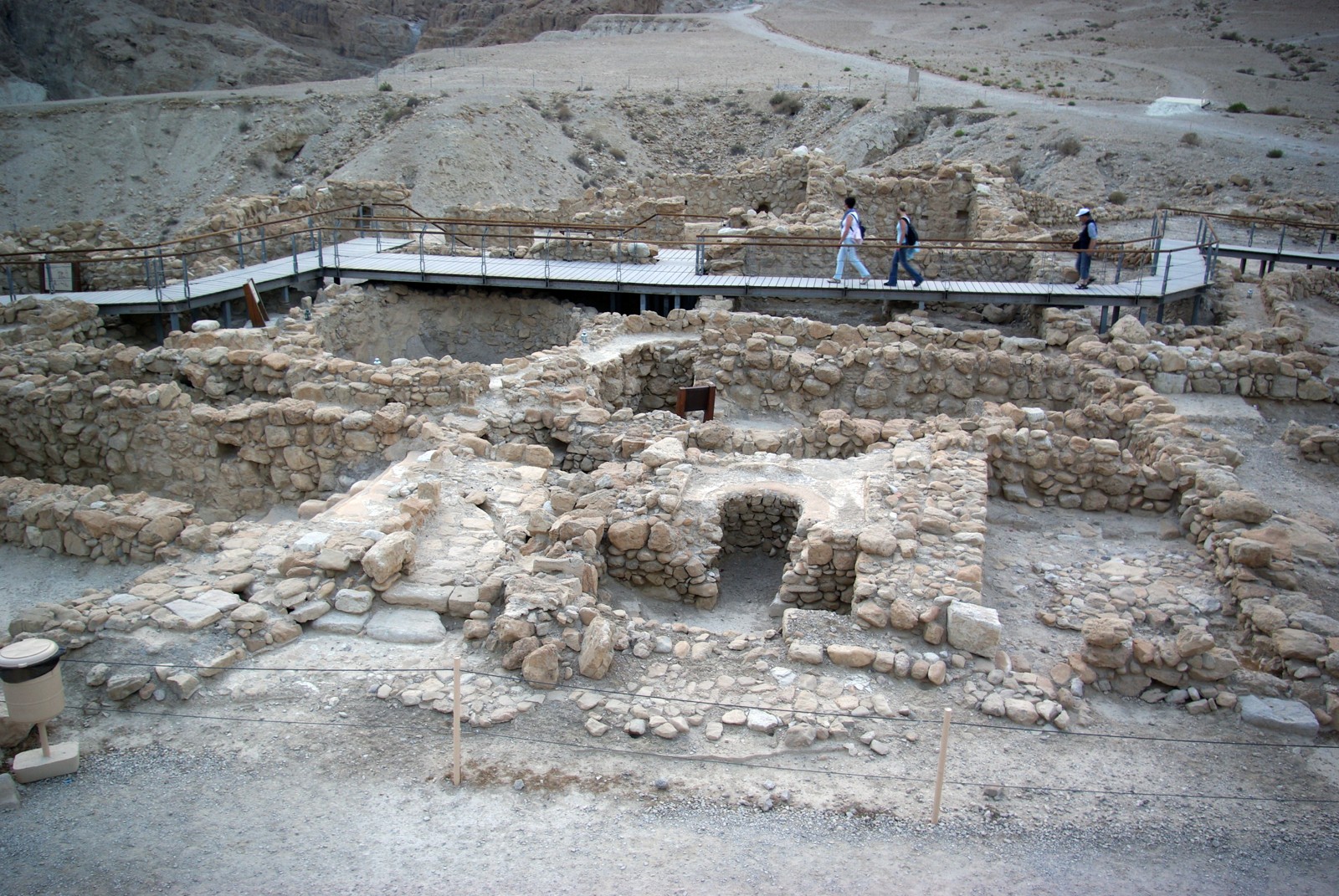
The Dead Sea ScrollsDead Sea ScrollsManuscript collections from the Judaean Desert, best known through Qumran: diverse works, languages and textual forms, with copying distinguished from composition.Glossary · Click to read the explanation document the coexistence of multiple Pentateuchal textual forms before later standardization. Secure manuscripts from QumranQumranArchaeological site northwest of the Dead Sea near manuscript caves; its settlement and the groups who deposited the scrolls are studied together but not assumed identical. It is not synonymous with all Dead Sea Scrolls.Glossary · Click to read the explanation, notably 4QpaleoExodᵐ (4Q22) and 4QNumᵇ (4Q27), share with the Samaritan Pentateuch a tendency to incorporate parallel passages and harmonize narratives. Scholars have described them as “pre-Samaritan” or “Samaritan-like”. These terms do not establish that they were copies of the later Samaritan Pentateuch, or that their copyists belonged to the Samaritan community.[1]
An older view held that the Gerizim passage was absent from 4QpaleoExodᵐ. In 2022, Hila Dayfani proposed a physical and textual reconstruction of the scroll's damaged columns, arguing that the Gerizim composition was included. This is an important revision, but its crucial evidence involves reconstructing material no longer extant, not reading a wholly preserved passage on the leather. Only the published academic abstract, not the entire paper, was checked for this review.[3]
What varies between the texts?
Most differences concern spelling, grammatical forms or phrasing; a smaller group reshapes narrative transitions or religious instructions. In the Exodus plague narratives, the Samaritan form more frequently reports MosesMosesCentral figure in Exodus, Torah traditions and the Qur’an; childhood accounts differ in detail.Glossary · Click to read the explanation speaking to Pharaoh in accordance with instructions just narrated. Comparable expansions occur in certain Qumran witnesses. Such harmonization can be interpreted as editorial coordination of parallel passages, but greater narrative coherence does not by itself prove greater antiquity.[1]
In the Samaritan arrangement of the Decalogue, a passage commanding stones and an altar on Mount Gerizim is assembled largely from Deuteronomy and placed after the familiar Exodus commandments. Commandment numbering and division differ between traditions: calling this an “additional commandment” describes a difference in arrangement, not a Samaritan belief in eleven commandments.[1][3]
Gerizim and the chosen place
Mount Gerizim near Nablus, in the region of SamariaSamaria: city and regionAncient city and administrative region; the city’s site is at Sebastia, northwest of Nablus in the West Bank.Glossary · Click to read the explanation, is a sacred centre for Samaritans. At Deuteronomy 27:4 the Samaritan wording names Gerizim as the location for setting up stones; the Masoretic wording names Ebal. The latter can be verified in the Hebrew text of Deuteronomy displayed by Sefaria. A related variation in Deuteronomy 12 concerns the place the deity “has chosen” versus “will choose.” The past reading permits a Samaritan identification of the chosen site with Gerizim, while the future permits another construal. The textual contrast does not establish a particular scribe's motives.[1][4][5]
Scholars have discussed witnesses for “Gerizim” outside Samaritan manuscripts, including ancient Greek and Latin traditions. Such evidence resists the automatic dismissal of Gerizim as an unquestionably late sectarian alteration. It does not, however, demonstrate that Gerizim stood in every earlier form of Deuteronomy. Jonathan Ben-Dov discusses both directions of change and even a possible earlier formulation that named neither mountain. These are historical interpretations, not equally attested surviving texts.[5]
A fragment with uncertain provenance
It is essential to distinguish securely excavated Qumran scrolls from a small Deuteronomy 27:4–6 fragment, known as APU 4, bearing “Gerizim.” The fragment surfaced through the antiquities market; an origin in Qumran Cave 4 is not secured by archaeological context. In 2025 Jonathan Klawans set out substantial reasons to doubt its authenticity and described it as a likely forgery. This review has not located a conclusive independent material test of APU 4 itself. Accordingly, it must not be treated as securely provenanced Qumran evidence; doubts about it do not erase the other textual witnesses relevant to the debate.[5][6]
Archaeology and the limits of dating
Excavations on Mount Gerizim exposed a sacred precinct, architecture and objects consistent with ritualRitualAn organised or distinguished practice meaningful to a community; it may leave traces, but its form alone does not reveal an associated doctrine.Glossary · Click to read the explanation activity, but the foundation date of its earliest phase is disputed. Yitzhak Magen placed it in the fifth century BCE. Eran Arie's 2021 study reviews that dating and associated problems, while Jodi Magness argued in 2025 that the published stratified evidence does not substantiate a foundation in the mid-fifth century BCE. This archaeological debate neither dates the composition of the Samaritan Pentateuch nor proves a particular reading of Deuteronomy.[7][8]
Gerizim remains a place of Samaritan observance. The site's UNESCO description belongs to the State of Palestine's 2012 Tentative List: that is not the same as inscription on the World Heritage List.[9]
Manuscripts and modern editions
Most Samaritan manuscripts used for editions are medieval copies, even though the textual forms they transmit have older antecedents. Samaritan tradition attributes the Abisha Scroll to Abisha, a descendant of Aaron, but this is a traditional attribution, not a material date placing the parchment in Moses's time. Scholars have proposed medieval dates and identified later repairs. Samaritan copies entered European scholarly circulation in the seventeenth century, including one acquired by Pietro della Valle in 1616 and used in polyglot printing. Several modern comparative and critical editions now exist; they should not be assumed identical in their choice of manuscripts or readings.[1]
What the evidence can establish
The Samaritan Pentateuch is an authentic witness to a diverse history of Pentateuchal transmission and a continuing religious community. Neither “corrupt text” on confessional grounds nor “the original” because one reading may be early is a defensible overall label. Comparison requires a specific verse, manuscript and date: the extant words are evidence, their relationship is an argument in textual criticismTextual criticismComparison of written witnesses and ancient translations to explain variant readings and textual transmission, distinguishing attested text from restorations and inferred ancestors.Glossary · Click to read the explanation, and reconstructions of lost columns remain revisable hypotheses. This witness is valuable to history, linguistics and religious studies without adjudicating anyone's faith.[1][2]
References and notes (9)
- Ingrid Hjelm, “The Samaritan and Jewish Versions of the Pentateuch: A Survey,” Religions 11, no. 2 (2020), article 85, sections 1–6, pp. 1–9; PDF article text examined, bibliography on pp. 10–12 consulted selectively. pp. 1–9 (sections 1–6); references pp. 10–12 Return to the text ↑
- Magnar Kartveit, “The Pentateuch and the Samaritans,” in The Oxford Handbook of the Pentateuch, ed. Joel S. Baden and Jeffrey Stackert (2021), pp. 95–110. Only the public abstract and bibliographic record were consulted; the chapter text was not accessed. abstract only; chapter pagination 95–110 not read Return to the text ↑
- Hila Dayfani, “4QpaleoExodᵐ and the Gerizim Composition,” Journal of Biblical Literature 141, no. 4 (2022): 673–698, DOI: 10.15699/jbl.1414.2022.5. University-hosted abstract only; the reconstruction was not independently checked against the article or photographs. abstract only; pp. 673–698 not read Return to the text ↑
- Sefaria, Deuteronomy 27:2–8, displayed Masoretic Hebrew and accompanying translation, particularly 27:4 (“Mount Ebal”). Direct inspection of the published Masoretic passage, not of a Samaritan manuscript. Deut. 27:2–8, especially 27:4 Return to the text ↑
- Jonathan Ben-Dov, “An Altar on Mt Ebal or Mt Gerizim? – The Torah in the Sectarian Debate,” TheTorah.com (2016), sections “A Hidden Biblical Jewish Response” and “Evaluating the Versions,” notes 12–15. Those sections and their textual argument were read; the piece notes authenticity doubts concerning a recently marketed fragment. sections on Deut. 27 and versions; notes 12–15 Return to the text ↑
- Jonathan Klawans, “The Case for Retraction of Academic Authentications of Forged Fragments,” Ancient Jew Review (29 May 2025), section 5, “The Azusa Fragment Published by James Charlesworth.” Context and the APU 4 discussion examined. This is a scholarly call for reassessment, not an independent laboratory finding for that fragment. section 5 on APU 4 (and contextual sections 1–2) Return to the text ↑
- Eran Arie, “Revisiting Mount Gerizim: The Foundation of the Sacred Precinct and the Proto-Ionic Capitals,” New Studies in the Archaeology of Jerusalem and Its Region 14 (2021): 39–64. Abstract and university bibliographic description only, not the article. abstract only; pp. 39–64 not read Return to the text ↑
- Jodi Magness, “When Was the First Samaritan Temple on Mount Gerizim Built?” Journal of Ancient Judaism 16, no. 3 (2025): 340–349. Only the abstract in the Hebrew University Orion Center bibliography was read; the dating critique is attributed to the author. abstract only; pp. 340–349 not read Return to the text ↑
- UNESCO World Heritage Centre, “Mount Gerizim and the Samaritans,” State of Palestine Tentative List, ref. 5706, submitted 2 April 2012. The descriptive nomination page was read; it is neither final World Heritage inscription nor an independent excavation report. Tentative List 5706, full description Return to the text ↑
Suggest a correction · Suggest a source for this record
Cite this record
IL Archive, «Samaritan Pentateuch», https://ilarchive.com/en/entities/samaritan-pentateuch
Continue reading