Artifact · Inscription
Ketef Hinnom amulets
An object record bringing together its image, metadata, rights, and context.
- Names
- Ketef Hinnom silver scrolls
- Timeline
- From 650 BCE to 550 BCE
- Region
- Ketef Hinnom, Jerusalem, ancient Judah (ancient Levant)
Two silver amulets from a burial at Ketef Hinnom, usually dated to the late seventh or early sixth century BCE. Their blessing parallels Numbers 6:24–26, attesting a formula in use, not the writing of Numbers as a whole.
Estimated reading time: 6 min Published Last reviewed:
Share article
Photograph
Photograph Bachrach44 · Wikimedia Commons; square-cover layout: package editor, 2026 · CC BY-SA 3.0
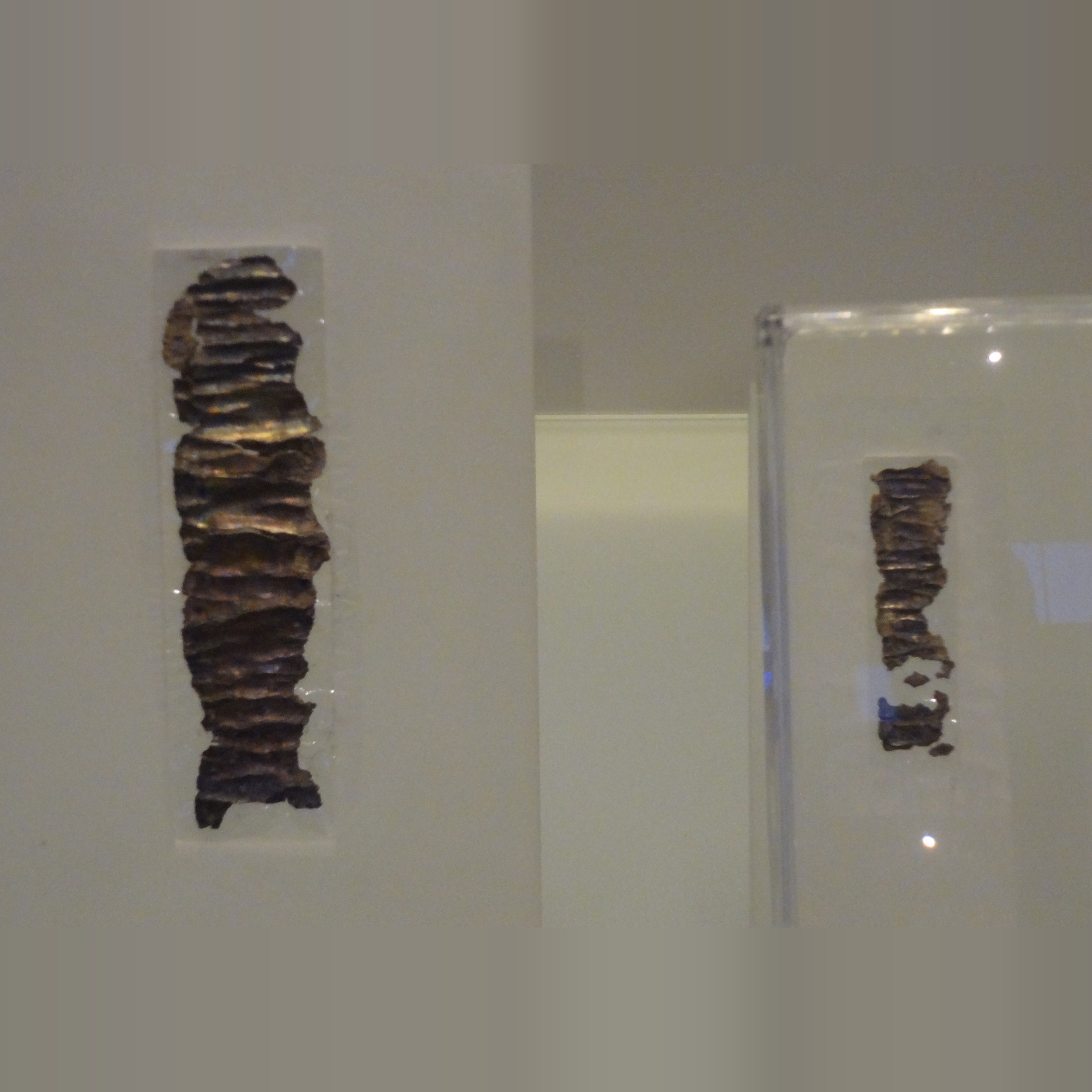
The unrolled Ketef Hinnom silver amulets displayed at the Israel Museum, Jerusalem, with the larger at left and the smaller at right. Modern square presentation of Bachrach44’s 2012 photograph: extended borders above and below, with neither artifact cropped
License · Image source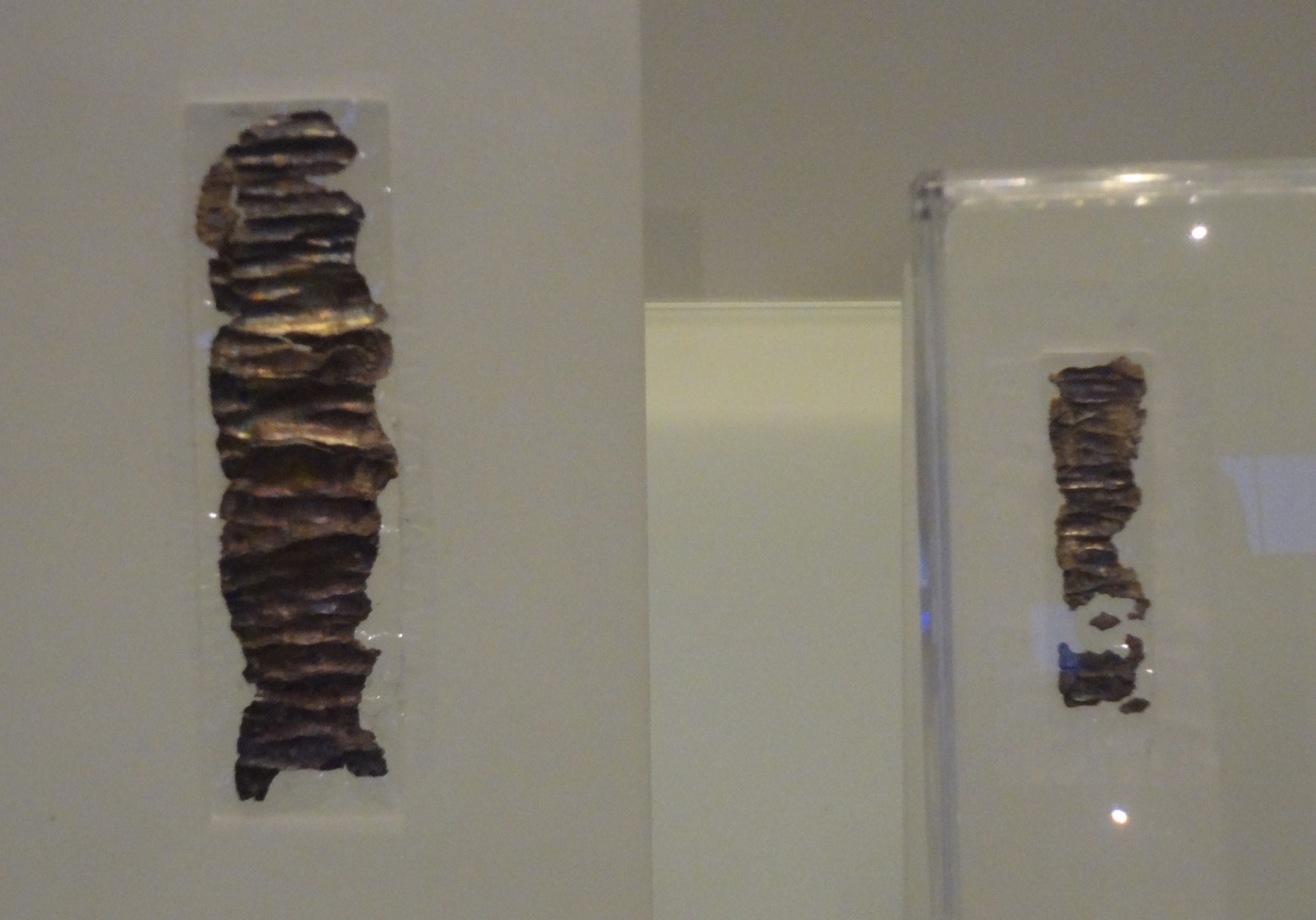
Photograph
Bachrach44 · Wikimedia Commons · CC BY-SA 3.0
Ketef Hinnom silver amulets displayed at the Israel Museum, Jerusalem; photograph, 2012. Usually dated to the late seventh or early sixth century BCE. A blessing related to Numbers 6, not evidence for the entire book. Display copy resized without cropping
License · Image sourceObject details
- Title
- Ketef Hinnom amulets
- Timeline
- From 650 BCE to 550 BCE
- Region
- Ketef Hinnom, Jerusalem, ancient Judah (ancient Levant)
- Rights
- CC BY-SA
Dates
Dates have distinct roles. The timeline uses creation, composition or historical coverage, rather than publication or discovery dates.
- Historical coverage
- Approximately From 650 BCE to 550 BCE
Text
Introduction
Why do two tiny silver rolls from a burial site near JerusalemJerusalemJerusalem is a city of religious importance in Judaism, Christianity and IslamGlossary · Click to read the explanation matter for the history of religious writing? This entry examines the Ketef Hinnom amulets: their archaeological context, manufacture, legible wording, relationship to the blessing in the Book of NumbersBook of NumbersTorah book addressing daughters’ inheritance and tribal retention of land.Glossary · Click to read the explanation, and the evidence and uncertainty surrounding their date.
Their importance is as physical witnesses to the circulation of words of blessing and protection in ancient JudahKingdom of JudahJudah was an ancient southern Levantine kingdom centered on Jerusalem in the Iron AgeGlossary · Click to read the explanation, not as surviving copies of an entire biblical book. Reading them requires distinguishing extant marks on silver, scholars’ reconstructions, and the biblical version of the blessing transmitted to us.
Discovery and archaeological context
Ketef Hinnom lies on the western shoulder of the Hinnom Valley, southwest of Jerusalem’s Old City. In 1979, archaeologist Gabriel Barkay discovered two tightly rolled silver objects in a burial repository associated with a complex of rock-cut tombs. The repository contained jewelry and other burial goods. Their documented setting is therefore funerary, not a temple where the blessing was performed. The tombs remained in use over a long span, so the date of the tomb architecture, the deposition of objects, and the engraving of each object should not be conflated.[3]
The objects seen in today’s display are two separate amulets, not fragments of a single manuscript. They were found rolled up, whereas the museum photograph shows them unrolled after conservation: their current appearance is different from their form when used.[2][9]
Silver, script, and decipherment
Each amulet was made from a thin silver sheet bearing minute incisions, then rolled into an object that could be worn close to the body. According to the Israel Museum record, the larger sheet measures approximately 9.7 by 2.7 cm when unrolled, and the smaller 3.9 by 1.1 cm. The inscriptions employ HebrewHebrewA Northwest Semitic language of the Canaanite group, encompassing Iron Age epigraphy, Biblical, Rabbinic, medieval and Modern Hebrew; its scripts and pronunciations changed over time.Glossary · Click to read the explanation in the early paleo-Hebrew script; corrosion, creasing, and breakage have damaged the writing.[2]
A display photograph cannot be treated as a legible transcript of every character. Gabriel Barkay, Marilyn J. Lundberg, Andrew G. Vaughn, and Bruce Zuckerman reexamined detailed high-resolution images and published a revised reading in 2004, detecting traces of previously unrecognized letters and clarifying others. Portions nevertheless remain uncertain. A scholarly reconstruction of lettering is not the same thing as seeing a complete word directly on the object.[1] The research team also published an earlier account of the imaging techniques used.[10]
What is the connection to the blessing?
Both amulets contain language of prayer and blessing naming YahwehYahwehThe proper name of Israel’s deity, written יהוה (YHWH), the Tetragrammaton. Its exact ancient pronunciation is not directly preserved; texts and inscriptions witness its history.Glossary · Click to read the explanation. Parts of their wording—especially their concluding sections—closely parallel the Priestly Blessing in Numbers 6:24–26. Within the biblical book, the blessing is placed in instructions to AaronAaron, priest in the biblical narrativeMoses’s brother and a priest in biblical narrative; Leviticus 16 assigns him sanctuary purification and confession over the living goat.Glossary · Click to read the explanation and his sons to bless the Israelites (Numbers 6:22–27). In the biblical wording, the prayer asks Yahweh to bless and guard the recipient, shine his face upon that person and be gracious, and grant peace. That is a synopsis of the biblical verses, not a complete verbatim transcription of either silver inscription.[5]
The parallels are substantial, but neither inscription preserves the chapter in full or serves exactly the same purpose. The first amulet includes language of protection beyond the material corresponding to Numbers, and damaged lines permit different suggested restorations. Other wording on the first amulet has parallels with formulae also found in Deuteronomy 7:9, Nehemiah 1:5, and Daniel 9:4. Those are textual and interpretive comparisons; they do not independently establish that all three books existed in their familiar forms when the silver was inscribed.[1][3][4]
Why call them amulets?
Here amulet is an archaeological designation for a small inscribed object believed to attract favor and avert harm. The precious metal, miniature size, rolled form, probable bodily use, language of guarding, and burial setting support this reading. The 2004 research team described the objects’ likely function as apotropaic: intended to ward off a perceived danger or evil.[1]
Jeremy D. Smoak draws attention to their materiality: for their users, the act of wearing written divine words may have mattered alongside the content of the blessing, and the objects ultimately became part of a burial assemblage. This is a scholarly interpretation of their social and ritualRitualAn organised or distinguished practice meaningful to a community; it may leave traces, but its form alone does not reveal an associated doctrine.Glossary · Click to read the explanation use, not certain knowledge of an individual owner’s identity, beliefs, or specific fears.[8] Nor does the later designation “priestly” mean the wearer was necessarily a priest.
Dating and scholarly disagreement
On the basis of the script, the inscriptions, and their setting, Barkay and colleagues argued for a late preexilic date—around the end of the seventh or the start of the sixth century BCE. The Israel Museum catalogue gives the broader label Iron Age II / sixth century BCE. These different levels of chronological precision need not represent contradictory dates.[1][2][10]
The discussion is not closed. In 2011, historian Nadav Na’aman proposed an early Second Temple date after the exile, drawing on a different reconstruction and historical interpretation of part of the first amulet. In 2012 Shmuel Aḥituv challenged that later dating and the proposed allusion to the Temple, arguing instead for reading the amulets as modest personal documents.[6][7]
The late seventh–early sixth-century date remains the influential epigraphic assessment, but the later proposal should be acknowledged. These dates are not direct measurements of the year of engraving; they are scholarly inferences from script and context at a burial complex reused over time.[1][3][6]
What do they establish about the Book of Numbers?
The strongest conclusion is that a blessing closely related to the form now preserved in Numbers 6 circulated in a written, personal context in Judah before the exile, on the prevailing dating. The objects illuminate the history of a religious formula and show the name Yahweh and the language of blessing and protection in material religious practice.[1][5]
The setting differs markedly between the two witnesses. On silver, the formula was inscribed on something probably worn by an individual for protection. In Numbers, it belongs to directions for a spoken blessing administered by priests. Smoak proposes that the biblical setting reworked memories of written blessings and ritual space. That is a model of textual development, not proof of a direct line of copying from either particular amulet to a specific manuscript of Numbers.[4]
Dating an object containing parallel wording does not date the compilation of every other part of Numbers, establish a single author, or prove direct quotation from an already complete book. Blessing formulae may have circulated through spoken and written practice before being embedded in a larger literary composition. The crucial distinction is between the age of a material witness to certain words and the date of an entire book.[4]
Present location and the cover photograph
The two amulets are held by the Israel Museum in Jerusalem. The cover shows them unrolled in a display photographed by Bachrach44 in August 2012, with the larger object at left and the smaller at right. The specific photograph is documented on Wikimedia Commons under CC BY-SA 3.0. The square cover is a modern layout of that photograph with the surrounding background extended above and below; neither artifact has been cropped or altered. The age of the artifacts and rights to this photograph are separate from the date and permissions of other museum images.[2][9]
The Ketef Hinnom amulets thus join a small physical witness to a larger textual question. The silver preserves a blessing closely related to biblical tradition, while the precise readings, exact date, and route by which the formula came to occupy its position in Numbers remain matters to be tested against evidence.
References and notes (10)
- Gabriel Barkay, Marilyn J. Lundberg, Andrew G. Vaughn and Bruce Zuckerman, “The Amulets from Ketef Hinnom: A New Edition and Evaluation,” Bulletin of the American Schools of Oriental Research 334 (2004): 41–71. DOI: 10.2307/4150106. Publisher’s abstract and metadata only; 41–71 is the published page range, not pages read. Full article required subscription. Used for rereading, date and apotropaic interpretation, not unverified letter-by-letter claims. Return to the text ↑
- The Israel Museum, Jerusalem, “‘Priestly Benediction’ on amulets,” collection record on Google Arts & Culture, Iron Age II, sixth century BCE, silver, from Ketef Hinnom. Full collection record viewed: material, findspot, dating, Numbers 6:24–26 parallel, listed dimensions (height 3.9–9.7 cm; width 1.1–2.7 cm). Museum image rights attributed to Israel Antiquities Authority are separate from the Commons photo. Return to the text ↑
- Jeremy D. Smoak, “Tombs at Ketef Hinnom,” The Database of Religious History (2024), Zenodo record. DOI: 10.5281/zenodo.12574330. Read the Zenodo Description (tombs, reuse, repository, artifacts) and bibliography; PDF download failed, so the complete attached report was not read. The page’s “2002” bibliography date for the 2004 BASOR paper is erroneous; publisher metadata used instead. Return to the text ↑
- Jeremy D. Smoak, “From Temple to Text: Text as Ritual Space and the Composition of Numbers 6:24–26,” Journal of Hebrew Scriptures 17, article 2 (2017). DOI: 10.5508/jhs.2017.v17.a2. Actually consulted printed pp. 1–4 (opening argument), 14–15 (mortuary/materiality), and 21–26 (discussion/conclusion) in a 27-page PDF whose first page is unnumbered cover; intervening pages were not read in full. Return to the text ↑
- Numbers 6:22–27, especially vv. 24–26; Hebrew text with accompanying English translation, Mechon-Mamre, “Numbers Chapter 6.” Hebrew and parallel English verses 22–27 consulted in full; the article’s prose summarizes their sense, not a transcription of the engraved silver. Return to the text ↑
- Nadav Na’aman, “A New Appraisal of the Silver Amulets from Ketef Hinnom,” Israel Exploration Journal 61, no. 2 (2011): 184–195. Tel Aviv University abstract and bibliographic metadata only. It proposes an early Second Temple date using an alternative interpretation of amulet I; the page numbers are publication pagination, not pages read. Return to the text ↑
- Shmuel Aḥituv, “A Rejoinder to Nadav Na’aman’s ‘A New Appraisal of the Silver Amulets from Ketef Hinnom’,” Israel Exploration Journal 62, no. 2 (2012): 223–232. Abstract on ResearchGate only: challenges the late date and interpretation of the Temple as the people’s “redeemer,” regarding the amulets as personal documents. Full article not consulted. Return to the text ↑
- Jeremy D. Smoak, “Wearing Divine Words: In Life and Death,” Material Religion 15, no. 4 (2019): 433–455. DOI: 10.1080/17432200.2019.1631695. Publisher’s abstract only, on silver, miniature scroll design, bodily action, and deposition; published pagination is not evidence of full-text reading. Return to the text ↑
- Bachrach44, “Ketef hinom scrolls.JPG,” Wikimedia Commons; photograph of the displayed Ketef Hinnom amulets, taken 14 August 2012; Creative Commons Attribution–ShareAlike 3.0 Unported. Commons file page reviewed (subject, author, date, license and share-alike); the displayed original was checked for identity and checksum, with full and 340 px visual inspections of the horizontal and square images; only the margins were extended. License: https://creativecommons.org/licenses/by-sa/3.0/ Return to the text ↑
- Gabriel Barkay, Marilyn J. Lundberg, Andrew G. Vaughn, Bruce Zuckerman and Kenneth Zuckerman, “The Challenges of Ketef Hinnom: Using Advanced Technologies to Reclaim the Earliest Biblical Texts and Their Context,” Near Eastern Archaeology 66, no. 4 (2003): 162–171. DOI: 10.2307/3557916. Publisher’s abstract only on imaging, amulet function, and late seventh/early sixth-century dating; pp. 162–171 are publication pages, not pages read. Return to the text ↑
Archive records may be reviewed and refined as better evidence or sources become available. Suggest a correction
Suggest a correction · Suggest a source for this record
Cite this record
IL Archive, «Ketef Hinnom amulets», https://ilarchive.com/en/artifacts/ketef-hinnom-amulets
Continue reading