Study
When Was the Torah Written?
An extended study of a topic, with evidence and references.
Between Moses’ time, inherited traditions and the surviving book: distinguishing composition and editing from translation, manuscripts and textual stabilization.
Share article
Dates
Dates have distinct roles. The timeline uses creation, composition or historical coverage, rather than publication or discovery dates.
- Historical coverage
- Approximately From 900 BCE to 1100 CE
Text
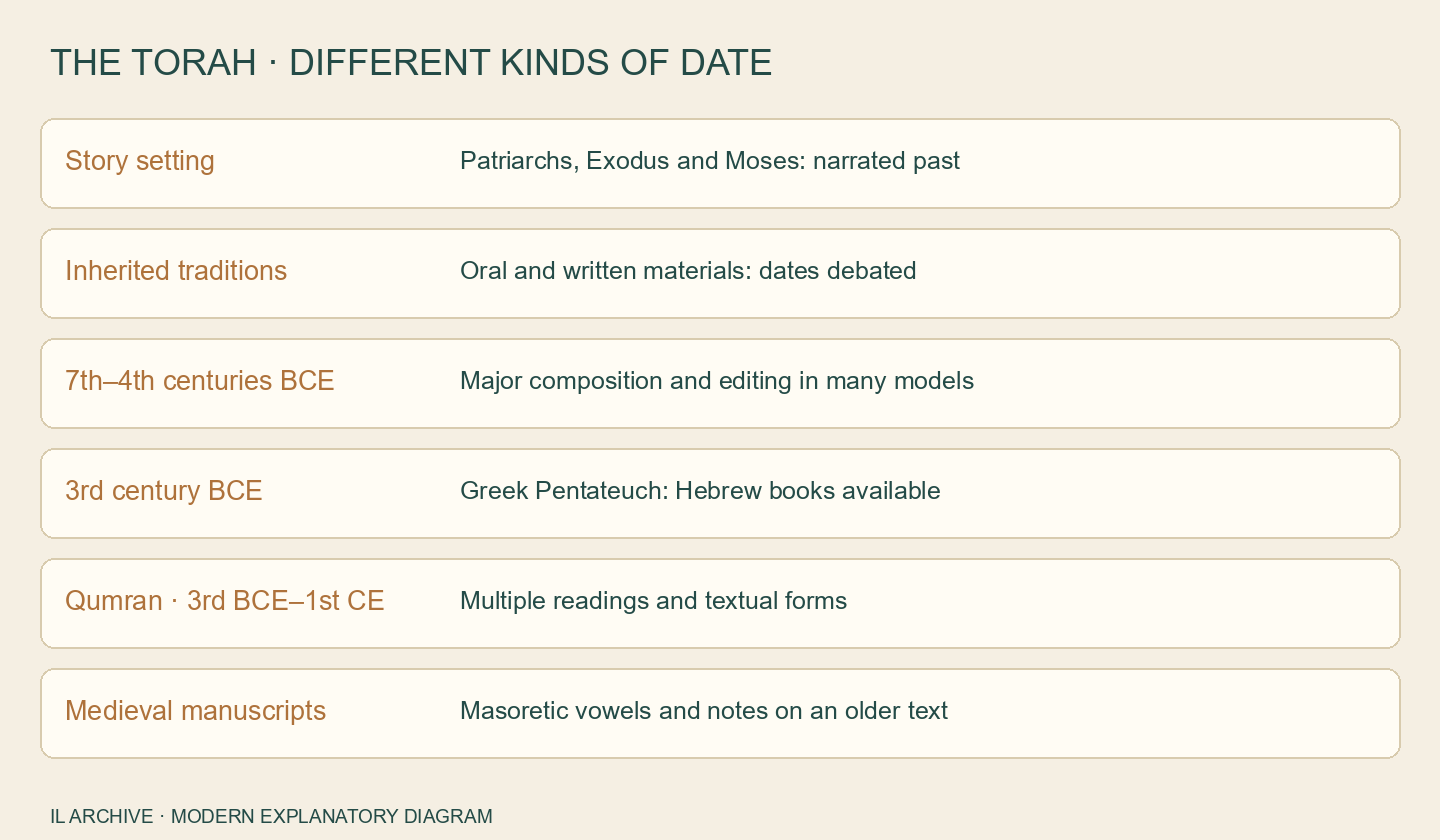
Asking when the TorahTorah / PentateuchGenesis, Exodus, Leviticus, Numbers and Deuteronomy: Mosaic corpus with a compositional history. Torah can also mean teaching or law beyond these five books.Glossary · Click to read the explanation was written seems to invite a single date, one author and a moment when the text began and ended. But the question contains several different questions. When did its narrated events take place? When did stories, laws and traditions circulate? When were individual materials first written, combined into larger works and arranged as the five books we know? When did the wording transmitted by later HebrewHebrewA Northwest Semitic language in the Canaanite group, with ancient and modern forms.Glossary · Click to read the explanation, Samaritan and Greek witnesses become established?
These were not necessarily the same moments. Modern critical scholarship treats the Torah as a composite work with a long history of composition, editing and transmission. Scholars nevertheless disagree about the division and dating of its layers. A history of formation is more widely accepted than any single detailed reconstruction.[1]
What does “Torah” mean?
In later Jewish and Christian usage, Torah can designate Genesis, Exodus, Leviticus, Numbers and Deuteronomy: the PentateuchTorah / PentateuchGenesis, Exodus, Leviticus, Numbers and Deuteronomy: Mosaic corpus with a compositional history. Torah can also mean teaching or law beyond these five books.Glossary · Click to read the explanation, or five books of Moses. Hebrew torah also means instruction, guidance or law. It was not always a technical title for exactly the present five-book collection. Even in Second Temple JudaismSecond Temple JudaismDiverse Jewish traditions under Persian, Hellenistic and Roman rule, not one creed.Glossary · Click to read the explanation its uses could extend beyond that corpus.[2]
Consequently, an ancient reference to a book of MosesMosesCentral figure in Exodus, Torah traditions and the Qur’an; childhood accounts differ in detail.Glossary · Click to read the explanation’ law does not automatically identify a copy identical to today’s Pentateuch. It might designate that collection, an earlier form or a smaller body of legislation. The evidence must decide.
Moses in the story, and the date of the writing
Moses is the central human figure in four of the five books. From Exodus to Deuteronomy he receives laws, speaks with YahwehYahwehThe divine proper name written YHWH in the Hebrew Bible.Glossary · Click to read the explanation, transmits instruction and writes particular things. Deuteronomy presents his final speeches and describes his writing of this Torah.[3] Such claims underlie ancient Jewish and Christian attribution of the Torah to Moses.
Historical inquiry asks a different question: when did the surviving work take shape, according to its language, literary structure, historical context and manuscripts? Attribution of authority and date of composition need not coincide. A law associated with a founding figure may be expanded and edited by later generations. Conversely, later writing does not establish that every tradition was invented then. The time of a story is not the time of writing that story.
No surviving Mosaic manuscript to date
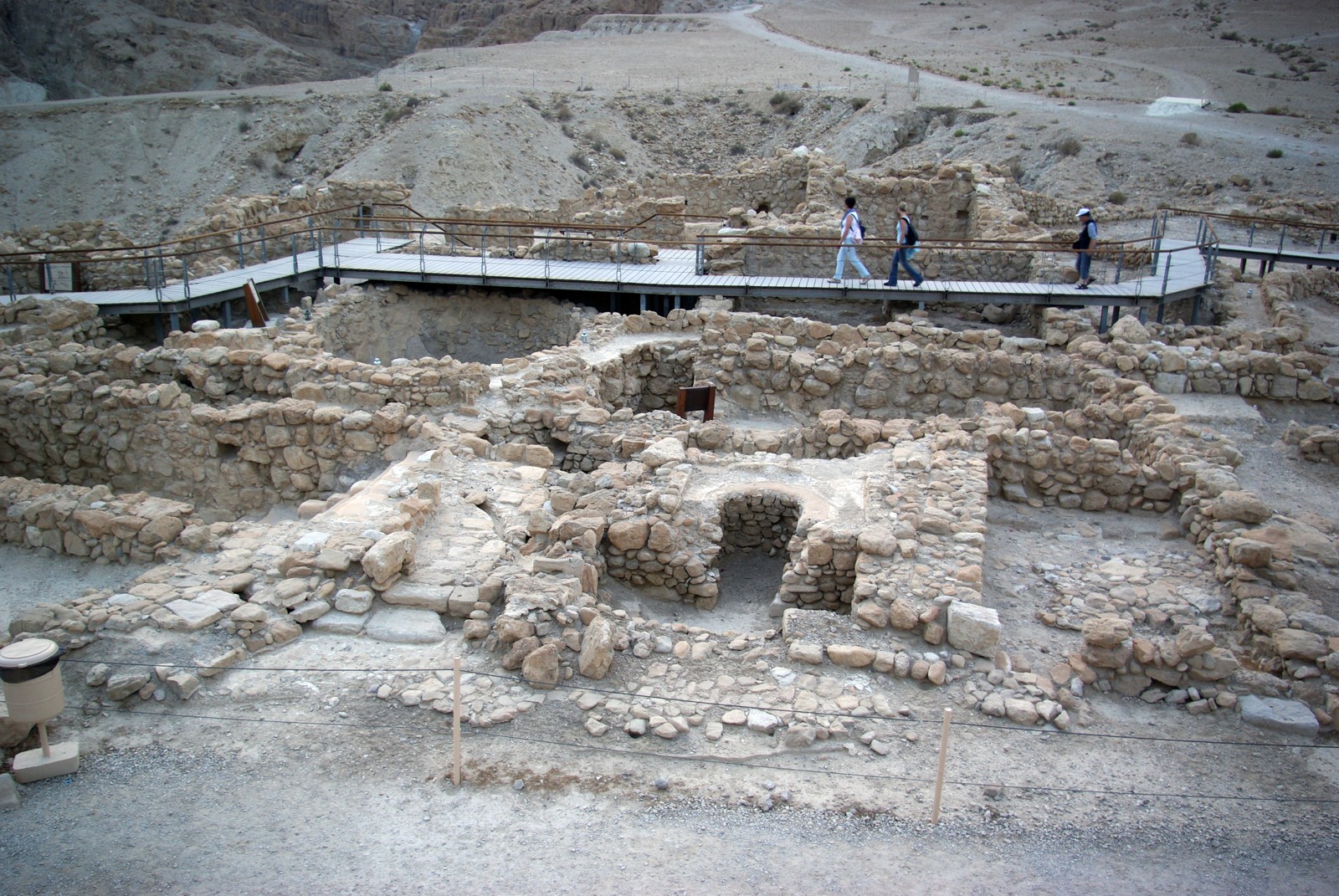
An Exodus manuscript securely dated to the Late Bronze AgeLate Bronze AgeAn archaeological period conventionally around 1600–1200 BCE in much of the Near East, with regional variation.Glossary · Click to read the explanation would change the discussion. We have no such witness, nor a surviving Pentateuch manuscript from the thirteenth, twelfth or tenth century BCE. The substantial ancient manuscript evidence comes much later, especially the QumranDead Sea ScrollsJudaean Desert manuscripts, especially Qumran cave finds. Biblical copies and other works reveal textual diversity; a copy’s age is not the work’s initial date.Glossary · Click to read the explanation biblical copies, generally dated from the mid-third century BCE to the first century CE.[4]
Dating earlier composition therefore depends on indirect evidence: language, institutions, laws, relationships between passages, repetitions, differences and editorial work; parallels with Assyrian, Babylonian and other texts; inscriptions; and later manuscripts and translations. The result is a historical reconstruction, not a radiocarbon date for an original author’s copy.
The text bears traces of more than one period
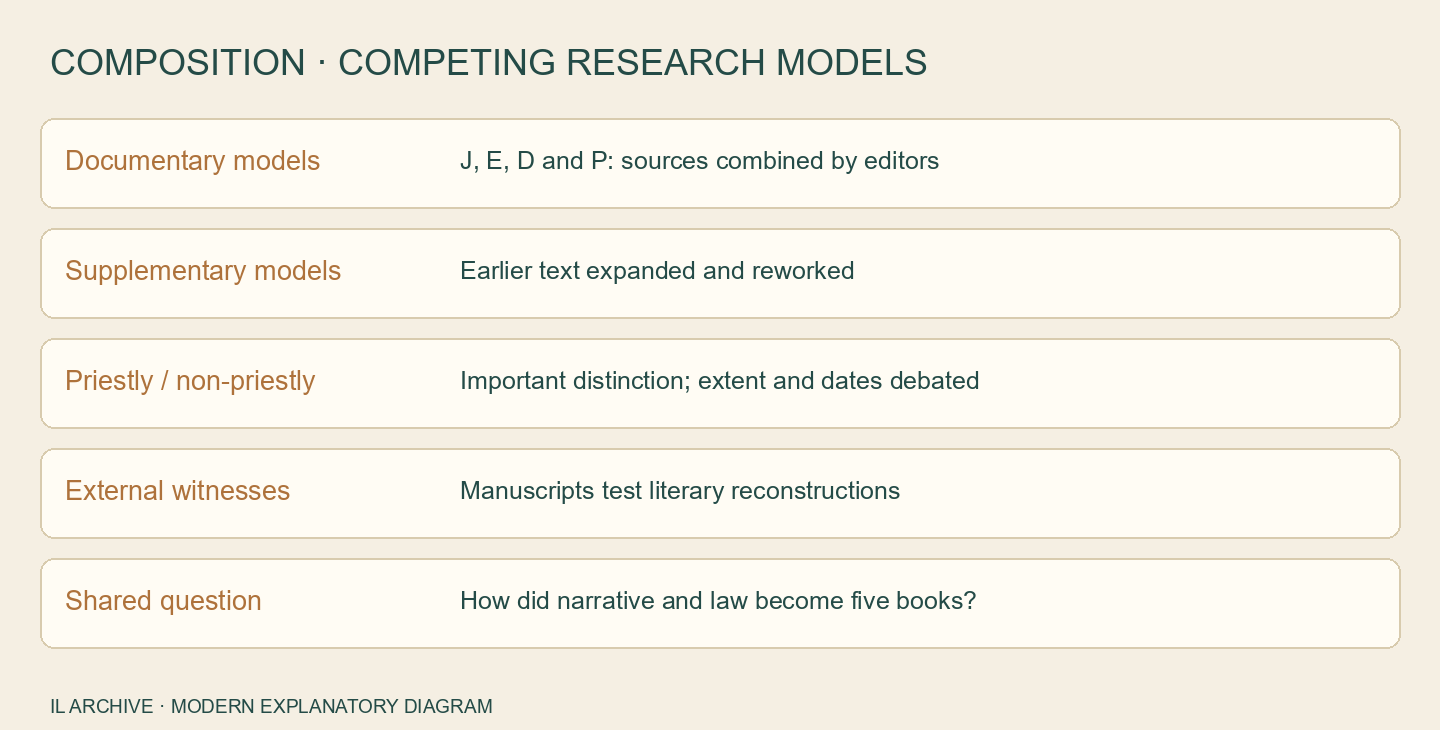
The Torah does not present a single simple literary voice. Events can be narrated differently; language and divine names vary; related laws contain different provisions. Priesthood, sacrifice, sacred space and leadership receive differing treatment. Such observations prompted nineteenth-century theories of sources and layers.
The best-known is the documentary hypothesisDocumentary hypothesisModel explaining the Torah through combined sources such as J, E, D and P. Boundaries, dating and editing are debated alongside supplementary models.Glossary · Click to read the explanation, with sources conventionally called J, E, D and P. Some scholars retain revised documentary models; others describe basic texts expanded through successive supplements and redactions. The general case for a compositional history does not require agreement with the classical model in every detail.[5][23]
Can some materials really be older?
Yes. A comparatively late collected form need not make every tradition equally late. Scholars identify possible preexilic narrative, poetic and legal materials, sometimes with an earlier oral background.
Frank Polak, for example, correlates linguistic features and social context and proposes an oral/written narrative stage in the ninth or early eighth century BCE. That is his reconstruction, not an agreed date for every passage.[6] Dating a final collection to the fifth century would not by itself date all its stories to that century.
A small silver witness
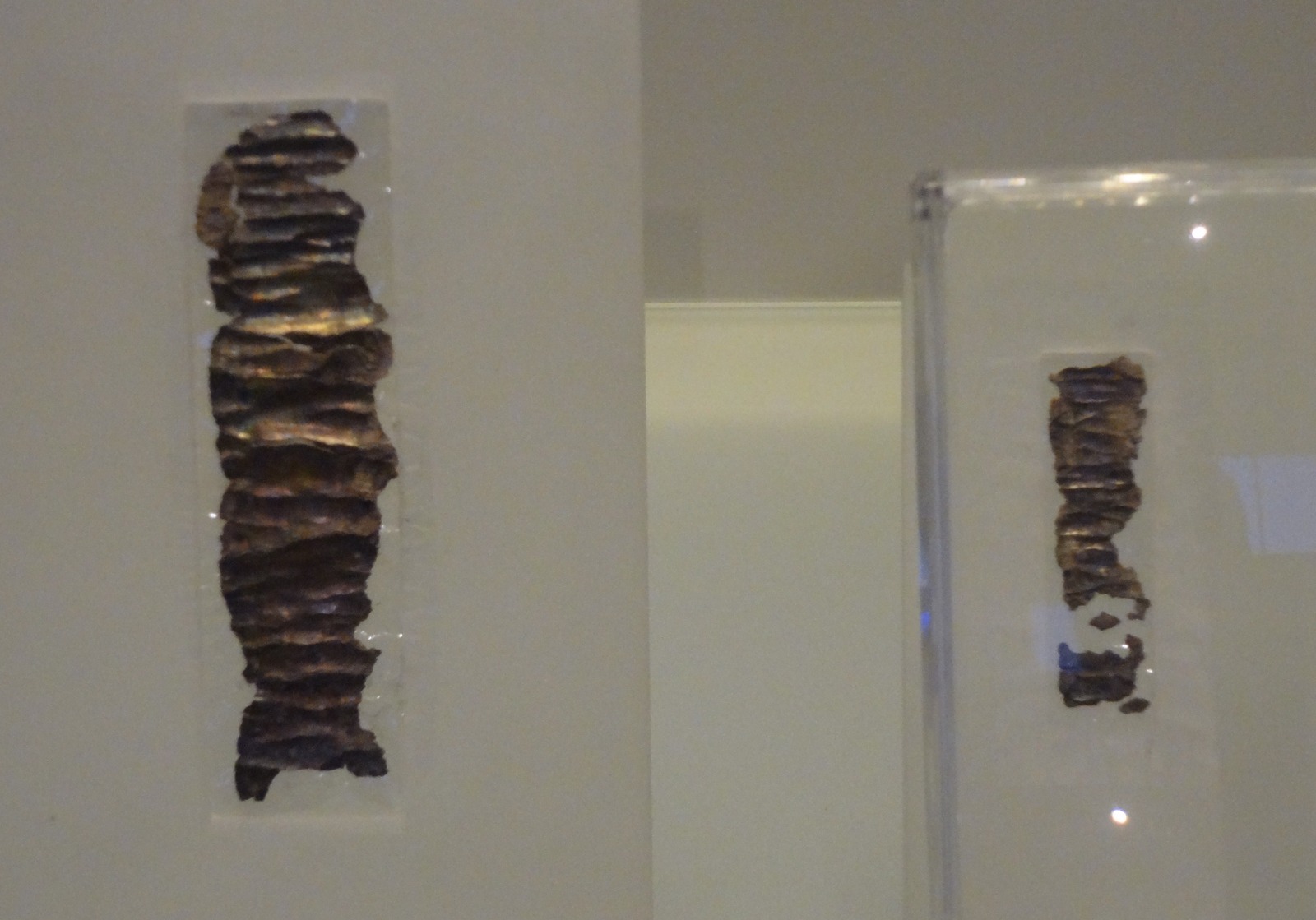
The Ketef Hinnom amuletsKetef Hinnom amuletsTwo silver scroll amulets found in Jerusalem in1979, with wording related to Numbers6. Usually late seventh/early sixth century BCE; they do not date the whole book.Glossary · Click to read the explanation make the distinction concrete. Two small silver scrolls discovered in JerusalemJerusalemJerusalem is a city of religious importance in Judaism, Christianity and IslamGlossary · Click to read the explanation contain wording closely related to the priestly blessing in Numbers 6. They are usually placed in the late seventh or early sixth century BCE; the 2004 reevaluation supports a late preexilic context, while the museum catalogue uses a broader sixth-century dating.[7][24]
They attest an old blessing or a related tradition. They do not establish that all of Numbers, in its current sequence, already existed. An ancient component within a book is not evidence that the entire book had reached its present form.
Deuteronomy and the seventh-century monarchy
Second Kings describes a book of law discovered in Jerusalem’s temple under Josiah, in the later seventh century BCE, prompting reforms. A longstanding scholarly interpretation identifies it with an early form of Deuteronomy rather than the whole Pentateuch. Centralized worship is a major point of comparison.
This remains influential, but the dating and precise relationship are contested. Sweeney’s discussion compares a Josianic setting with earlier northern reconstructions.[8] Other models give greater weight to exilic or later editing. An earlier nucleus and later layers are different questions.
Around 586 BCE: catastrophe and the writing of the past
BabylonBabylonBabylon is an ancient city in central present-day Iraq, south of BaghdadGlossary · Click to read the explanation’s destruction of Jerusalem and its temple, the end of the Judahite monarchy and deportations of part of the elite created a profound crisis. How could the community survive without its kingdom? How should defeat be understood in relation to Yahweh, covenant and land?
Scholars often connect substantial literary and theological work with exile and its aftermath. Deuteronomistic traditions interpret catastrophe through disobedience rather than Yahweh’s defeat. Priestly materials are frequently related to exilic or postexilic settings, although their dates, scope and formation remain debated.[9][10] Writing could preserve older stories while redefining communal identity, membership and law.
The Persian period and a larger collected Torah
Babylon fell to Persia in 539 BCE. Persian rule in the region continued until Alexander’s conquests in the later fourth century. This period is central to many reconstructions of pentateuchal formation: combining priestly and non-priestly traditions and connecting Genesis with the Mosaic story.
The model does not require an author to have invented five books from nothing in 450 BCE. Scribes and editors could combine materials of different ages into a narrative extending from creation to Moses’ death. Persian-period origins are an important research framework, but no single final closure date commands universal agreement.[12]
Did the Persians impose the Torah?
A strong version of the imperial authorization theory proposes that Persian authorities required or approved a unified local law. The evidence does not securely establish that the empire ordered the production of the Pentateuch.
Brett’s analysis favors more indirect imperial pressures and compromises among local traditions and institutions over official authorization.[11] Persian governance, rebuilding Judah and negotiations among priestly and other groups could matter without a documented decree to write five books.
Ezra and the book of Moses’ law
Nehemiah 8 depicts Ezra bringing a written law to a gathered community, reading and explaining it, followed by communal observance.[13] Its narrative setting is Persian. The scene portrays the authority of a Mosaic Torah; it is not an independently dated transcript of the event or an inventory of every passage in the book.
Lim points to differences between Ezra-Nehemiah’s regulations and the present Pentateuch, including temple contributions and festival observance.[14] Proposals range from a collection close to the five books to another arrangement of Mosaic materials. The story’s setting, its date of writing and the precise contents of Ezra’s book must remain distinct.
Did Ezra write the Torah?
Neither the narrative nor the available evidence warrants saying that Ezra composed the entire Torah. He is presented as a scribe learned in an already existing Mosaic law. Later traditions gave him a major restorative role after exile.
His period may have been important for collecting, editing, disseminating, interpreting or establishing the authority of Torah. These possibilities do not establish authorship of all five books by one person.
A crucial third-century BCE witness
The Greek Pentateuch was translated in Ptolemaic Egypt, probably in or around Alexandria, generally dated to the middle or later third century BCE.[15][16] Translation presupposes available Hebrew source texts. By this period it is therefore difficult to speak of the Pentateuch as a collection that had not yet taken shape.
This is a substantial chronological limit for the existence of the Hebrew books, not evidence that every reading was permanently fixed. Nor does translation alone reveal how old its source texts were before the translators used them.
“Final form” can mean two different things
Completion can mean recognition of the five-book literary collection. It can also mean that every word was identical across copies. Those processes need not coincide.
An authoritative corpus can circulate in different copies with variant readings, expansions and arrangements. That is what the next group of witnesses makes visible.
Qumran: an existing Torah with different textual forms
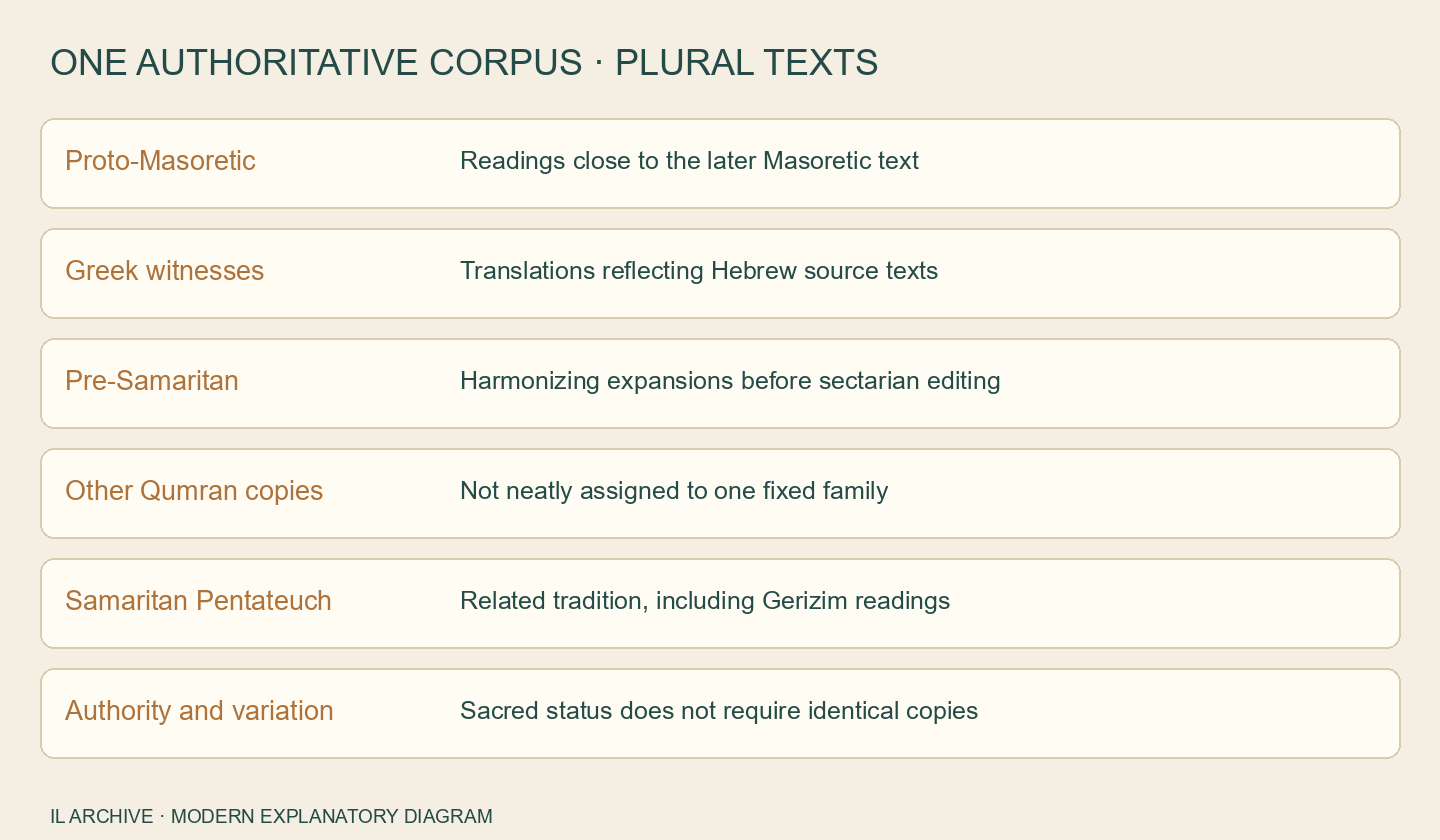
The Dead Sea ScrollsDead Sea ScrollsJudaean Desert manuscripts, especially Qumran cave finds. Biblical copies and other works reveal textual diversity; a copy’s age is not the work’s initial date.Glossary · Click to read the explanation, discovered from 1947, preserve biblical manuscripts from the last centuries BCE and the first century CE, alongside many other works.[25] Some resemble the later Masoretic textMasoretic TextA Hebrew textual transmission and reading tradition, compared in textual criticism with ancient manuscripts and translations.Glossary · Click to read the explanation; others have readings related to Hebrew sources behind Greek translations or to harmonizing, pre-Samaritan traditions. Other copies resist a neat classification.
The manuscripts changed textual criticismTextual criticismComparing witnesses to explain variation and infer earlier readings or editions, distinguishing preserved from reconstructed text.Glossary · Click to read the explanation by exposing diversity within works already treated as authoritative.[19] These affinities are not three perfectly sealed textual families. They show why asking when writing ended requires specifying what kind of completion is meant.
The Samaritans and another textual history
The Samaritan PentateuchSamaritan PentateuchSamaritan Hebrew five-book tradition sharing an older textual history, with linguistic and theological variants, including readings involving Mount Gerizim.Glossary · Click to read the explanation is the Samaritans’ scriptural corpus. It differs from the Jewish Masoretic tradition in many details, often involving spelling or language, with fewer larger literary and theological differences, notably readings concerning Mount Gerizim.
Qumran’s harmonizing witnesses complicate a picture in which all distinctive Samaritan features were invented by changing an already fixed Jewish text. The traditions share an older textual history alongside subsequent communal developments.[17][18] That does not mean every Samaritan reading has the same origin or date.
Does variation mean a text lacked sacred authority?
No. A modern expectation of identical printed copies can distort manuscript culture. Scribes copied, corrected, clarified and sometimes harmonized texts; parallel literary forms could develop.
Such plurality need not imply absence of religious authority. Qumran shows that highly valued writings could exist in different textual forms at the same time. Their status and their exact wording are related but distinct questions.
When did the Masoretic text become established?
This belongs to transmission history, not the initial composition of the Torah. The Masoretic tradition underlies many modern editions of the Hebrew Bible. Its medieval codices preserve a much older consonantal text, with close relatives among ancient manuscripts.
Vowels, accents, reading marks and Masoretic notes were added and cultivated by medieval specialists.[20] Dating a surviving codex to the Middle Ages does not date the Torah’s composition to that period. Nor was one textual form ever imposed on all Jewish, Samaritan and Christian communities alike.
An old tradition inside a later book
Imagine a song beginning in the tenth century BCE, circulating orally, then being written, incorporated into a larger work and later given an introduction or conclusion. The eventual fifth-century book could contain a much older song.
This is an illustration of possible accumulation, not the history of a specific verse. A statement that a book took shape after exile is different from saying that everything in it was invented after exile. Conversely, an old tradition does not guarantee that its later wording preserves an event unchanged.
How do researchers recognize older material?
There is no clock inside a verse. Researchers compare institutions, political settings, language, independently dated inscriptions, reuse in other works and apparent editorial relationships. Sometimes the evidence establishes a relative sequence more readily than an absolute date.
Each method has limits. Later writers can imitate older styles; traditions can preserve old details while undergoing revision; a story’s historical setting can be a literary reconstruction. Dates are usually proposed as periods, centuries or contextual possibilities, not an exact year for each line.
Five books were not simply written separately and bundled
A model in which one author wrote all of Genesis, another all of Exodus and a later collector merely bound them together is too simple. Literary materials cross current book boundaries. Priestly passages, for example, extend across several books; laws and revisions connect different portions.
Researchers also investigate the division into five unequal scrolls and its relation to earlier narrative units.[21] The question is both when parts were written and how a five-book corpus emerged.
Persian completion or Hellenistic completion?
Many reconstructions place decisive collection and editing in the Persian period, especially the fifth and fourth centuries BCE. Others allow substantial work to continue in Hellenistic times. The dating of the corpus and of particular additions need not be identical.
The third-century Greek Pentateuch provides a strong limit for the existence of Hebrew source books. It does not settle every proposed stage before translation or every textual development after it. Authority, collection and textual stabilization require separate histories.
The seventy translators and the Ptolemaic king
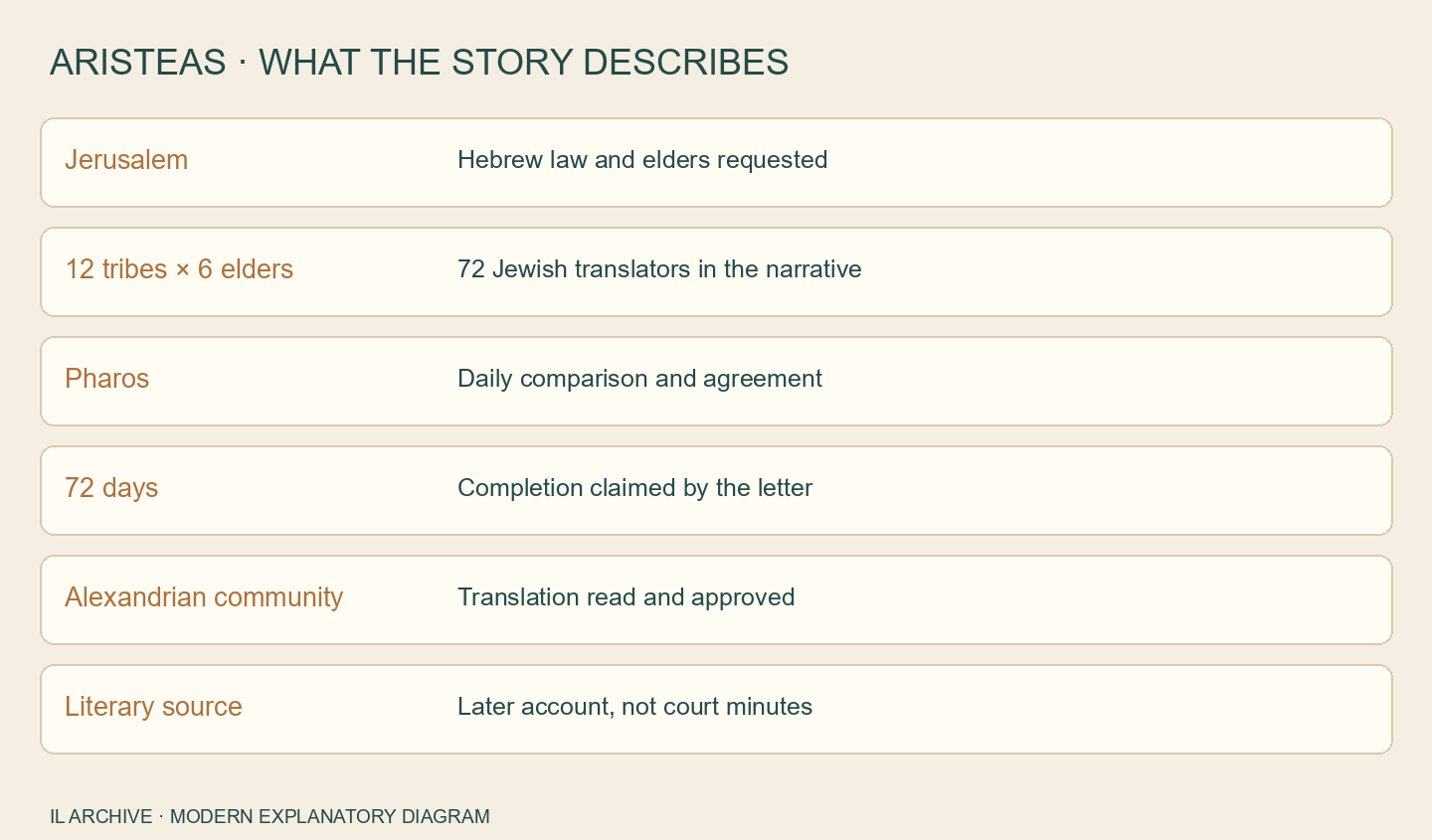
The Letter of AristeasLetter of AristeasHellenistic Jewish account, commonly dated to the second century BCE, of 72 elders translating Hebrew law in Egypt. Not contemporary minutes or a Torah-composition account.Glossary · Click to read the explanation narrates a royal initiative involving seventy-two Jewish elders translating law into Greek. Most scholars place the letter itself in the second century BCE, later than its purported setting, and treat it as a literary foundation story rather than a contemporary administrative record.[22]
It describes translation of an existing law, not its first composition. It cannot by itself establish when all Hebrew materials were written. Independent study of the Greek texts supports their character as translations; translating them in the third century does not measure their previous age.
A shared Torah and rival sanctuaries
Samaritan adoption of the Pentateuch complicates a model of a finished Jerusalem-only text simply sent elsewhere. Deuteronomy’s law speaks of a place chosen by Yahweh without explicitly naming Jerusalem. Different communities could read that language in relation to different sanctuaries.
Some scholars consider negotiations or shared traditions between Judah and Samaria important to formation. This remains a reconstruction, not evidence for a documented political meeting that drafted the Torah by agreement. It reminds us that the relevant religious world was diverse.
What is the short historical answer?
We have no material or manuscript evidence that Moses wrote all five books in their present form in the Bronze Age. They can contain traditions substantially older than their collected form. Some scholars identify written monarchic materials and earlier oral backgrounds, with disagreement over particular layers.
Much modern research gives major weight to late monarchic, exilic and Persian-period writing and editing. By the third century BCE Greek translation attests Hebrew pentateuchal books. Qumran and the Samaritan and Greek witnesses show that the history of individual readings continued afterward. These are different answers to different questions.
Four dates that must remain distinct
The time of events is the world in which the narrative places Abraham, Moses and the Exodus. The time of traditions is their circulation orally or in smaller written units. Composition and redaction describe the assembling and reworking of materials. Textual stabilization concerns copying traditions and the predominance of particular forms.
Ketef Hinnom attests an old blessing, not all of Numbers. Ezra’s scene portrays written Mosaic law, not an inventory identical to a modern Torah. Greek translation attests Hebrew source books; Qumran shows that authoritative texts still differed across copies. No witness should be made to prove a different kind of date.
Which came first: story or law?
The Torah includes beginnings, ancestral stories, Moses’ career, laws, poems, genealogies, priestly instructions, purity rules, itineraries and festivals. There is no reason to assume that all these genres began together.
A law may precede its narrative frame; a story may precede its present theological explanation; an editor may incorporate an old poem or adapt a law to another institution. The more productive question is how these materials became the text called Torah.
From communal memory to a book
The collected narrative links creation to Abraham, a family to a people in Egypt, departure to Moses, and law to a foundational story, ending at the border of the land. That sequence is a major literary achievement, not a self-evident arrangement of unrelated traditions.
Written narrative and law could travel with a community after the loss of political institutions. Their capacity to preserve and reinterpret communal identity helps explain the Torah’s enduring role beyond the lifetime of any particular kingdom or temple.
Is a later text necessarily less historically useful?
No. A fifth-century text can preserve an older name, poem or local memory as well as an editor’s newer interpretation. Composition date is not automatically the invention date of every element.
The reverse inference is equally unsafe: later writing does not necessarily reproduce an older event exactly. Each case requires evidence. Historical criticism tries to distinguish memory, editing and event without assuming that they are identical.
When was the Torah written, then?
The evidence does not yield one date. Many critical models describe old traditions entering writing, important seventh- and sixth-century activity, exilic reinterpretation and Persian-period collection into an authoritative Mosaic corpus. Details and possible Hellenistic continuation remain contested.
By the third century BCE the Hebrew books were available for Greek translation. Manuscripts nevertheless show ongoing variation, with proto-MasoreticProto-Masoretic textAncient witness close to later Masoretic consonants, without necessarily its vowels, accents and notes.Glossary · Click to read the explanation, pre-Samaritan, Greek-related and other readings. The book’s literary formation could precede stabilization within a particular copying tradition.
Moses is the figure through whom the Torah presents its law and authority. The surviving five books, according to historical, literary and manuscript study, have a longer history of writing, collecting, editing and transmission. Keeping those questions distinct is the central historical answer.
References and notes
- Joel S. Baden & Jeffrey Stackert (2021). Introduction: Convergences and Divergences in Contemporary Pentateuchal Research. The Oxford Handbook of the Pentateuch, pp. 1–19. Diverse approaches and scholarly agreement/disagreement. Publisher abstract only; full chapter not read. Return to the text ↑
- Molly M. Zahn (2021). The Relevance of Moses Traditions in the Second Temple Period. The Oxford Handbook of the Pentateuch, pp. 79–94. Torah not always coterminous with the Pentateuch; textual plurality and authority. Publisher abstract only; full chapter not read. Return to the text ↑
- Hebrew Bible, Deuteronomy 31:9,24–26; Mechon-Mamre. Moses writes this Torah within the narrative; not an independent manuscript date. Return to the text ↑
- Ronald S. Hendel (2011). Assessing the Text-Critical Theories of the Hebrew Bible after Qumran. The Oxford Handbook of the Dead Sea Scrolls, pp. 281–302. General mid-third-century BCE to first-century CE dating and relationships among Exodus witnesses. Publisher abstract only; full chapter not read. Return to the text ↑
- Reinhard Müller (2021). Positions on Redaction. The Oxford Handbook of the Pentateuch, pp. 237–254. Redactional theories, compositional models and Persian/Hellenistic witnesses. Publisher abstract only; full chapter not read. Return to the text ↑
- Frank Polak (2021). The Identification of Preexilic Material in the Pentateuch. The Oxford Handbook of the Pentateuch, pp. 315–344. Language/context model beginning in the ninth/early eighth century. Author’s reconstruction, not consensus. Publisher abstract only; full chapter not read. Return to the text ↑
- Gabriel Barkay, Marilyn J. Lundberg, Andrew G. Vaughn & Bruce Zuckerman (2004). The Amulets from Ketef Hinnom: A New Edition and Evaluation. BASOR 334, pp. 41–71. doi:10.2307/4150106. Abstract: image rereading, late preexilic dating and protective amulet function. Does not date the entire book of Numbers. Return to the text ↑
- Marvin A. Sweeney (2020). Deuteronomy and the Reigns of Kings Hezekiah and Josiah of Judah. The Oxford Handbook of Deuteronomy, pp. 252–266. History of debate, Josianic model versus earlier northern models, centralization. Publisher abstract only; full chapter not read. Return to the text ↑
- Jakob Wöhrle (2021). The Priestly Writing(s): Scope and Nature. The Oxford Handbook of the Pentateuch, pp. 255–275. Date, scope and ending of priestly writing are debated. Publisher abstract only; full chapter not read. Return to the text ↑
- Rainer Albertz (2021). The Identification of Postexilic Material in the Pentateuch. The Oxford Handbook of the Pentateuch, pp. 345–360. Historical, linguistic and literary dating methods; author’s case for postexilic material. Publisher abstract only; full chapter not read. Return to the text ↑
- Mark G. Brett (2021). The Imperial Context of the Pentateuch. The Oxford Handbook of the Pentateuch, pp. 443–462. Critique of Persian imperial authorization and model of local compromises. Publisher abstract only; full chapter not read. Return to the text ↑
- John J. Collins (2021). The Pentateuch in Second Temple Judaism. The Oxford Handbook of the Pentateuch, pp. 61–78. Persian-period origins and Hellenistic/Roman reception. Publisher abstract only; full chapter not read. Return to the text ↑
- Hebrew Bible, Nehemiah 8:1–8,13–18; Mechon-Mamre. Ezra’s reading, interpretation and booths festival. Persian setting is narrative time, not independent dating of the book’s composition. Return to the text ↑
- Timothy H. Lim (2022). How was the Canon Formed? The Expository Times. doi:10.1177/00145246221088365. Selected sections on canon terminology, Persian-period Torah and Greek translation: Ezra-Nehemiah differences and limits of Aristeas. Return to the text ↑
- Oxford Bibliographies in Biblical Studies. Septuagint, Introduction. Open introduction: Pentateuch translated in Ptolemaic Egypt, likely Alexandria, mid/late third century BCE. Full entry not read. Return to the text ↑
- Cécile Dogniez (2021). The Greek Translation of the Pentateuch. The Oxford Handbook of the Pentateuch, pp. 111–132. Early translation and interpretation; differences between Greek books and Hebrew texts. Publisher abstract only; full chapter not read. Return to the text ↑
- Ingrid Hjelm (2020). The Samaritan and Jewish Versions of the Pentateuch: A Survey. Religions 11(2), 85. doi:10.3390/rel11020085. University abstract: Samaritan five-book Bible, shared tradition, textual/theological variants and cult place. Full article not read. Return to the text ↑
- Magnar Kartveit (2021). The Pentateuch and the Samaritans. The Oxford Handbook of the Pentateuch, pp. 95–110. Witnesses, variants and reconstruction of origins across Persian/Hellenistic periods. Publisher abstract only; full chapter not read. Return to the text ↑
- Eugene Ulrich & Sidnie White Crawford (2025). The History of Textual Criticism of the Hebrew Bible from Antiquity to the Twentieth Century. The Oxford Handbook of Textual Criticism of the Bible, pp. 131–146. Qumran diversity and revised textual models. No three closed families inferred. Publisher abstract only; full chapter not read. Return to the text ↑
- James C. VanderKam (2016). Texts, Titles, and Translations. The Cambridge Companion to the Hebrew Bible/Old Testament, pp. 9–27. doi:10.1017/CBO9780511843365.002. Summary and available opening: older consonants, medieval vowels, accents and Masorah. Copy date is not Torah composition date. Return to the text ↑
- Olivier Artus (2021). The Pentateuch: Five Books, One Canon. The Oxford Handbook of the Pentateuch, pp. 22–40. Division into five unequal scrolls and relation to literary formation. Publisher abstract only; full chapter not read. Return to the text ↑
- Oxford Classical Dictionary. Aristeas, Letter of. Open summary: literary origin story of the Septuagint; most date the letter to the second century BCE within a broader proposed range. Return to the text ↑
- Christine Hayes (2006). Critical Approaches to the Bible: Introduction to Genesis 12–50, lecture 5, Introduction to the Old Testament. Open Yale Courses. Selected transcript on J/E/D/P, criticism and limits of reconstructing sources. Historical teaching model, not current consensus on each date. Return to the text ↑
- Israel Museum, Jerusalem. “Priestly Benediction” on amulets. Google Arts & Culture collection record. Catalogue: Ketef Hinnom, silver, Iron Age II/sixth century BCE, Numbers 6 connection. Display dating broader than 2004 study. Museum image rights do not license the separate Commons photo. Return to the text ↑
- Israel Antiquities Authority. The Dead Sea Scrolls: Introduction. Leon Levy Dead Sea Scrolls Digital Library. Qumran Caves Scrolls and Biblical Manuscripts: discovery, languages, date range, variation and authority. Other collections have other dates; Qumran’s range is not universal. Return to the text ↑
Suggest a correction · Suggest a source for this record
Cite this record
IL Archive, «When Was the Torah Written?», Edition 1, https://ilarchive.com/en/studies/torah-composition
Continue reading