Entity · Book
Letter of Aristeas
A reference page linking a name, group, or concept to the materials that discuss it.
- Timeline
- From 200 BCE to 100 BCE
Hellenistic Jewish account, commonly dated to the second century BCE, of 72 elders translating Hebrew law in Egypt. Not contemporary minutes or a Torah-composition account.
Text
What it says
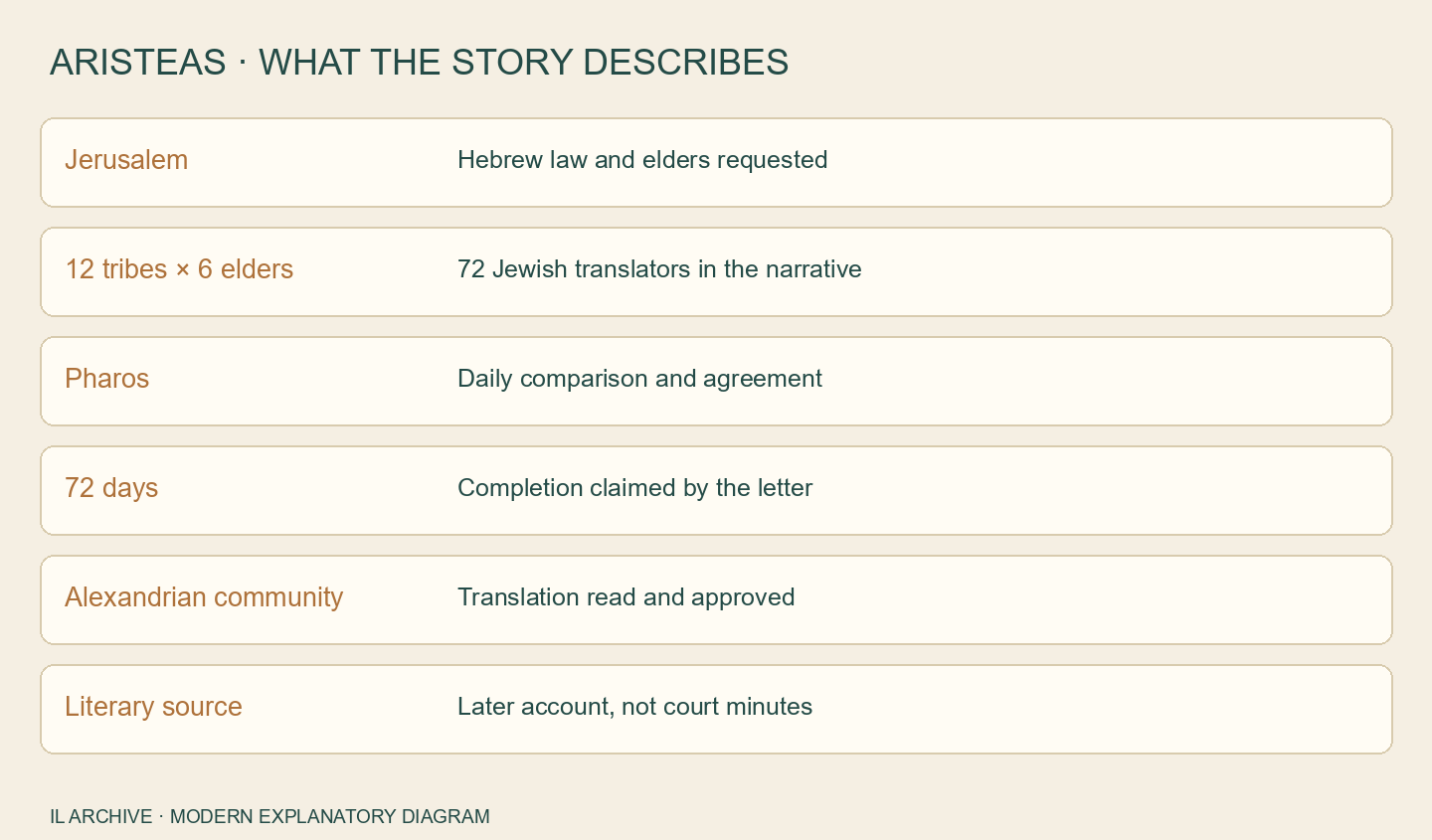
The narrative requests HebrewHebrewA Northwest Semitic language in the Canaanite group, with ancient and modern forms.Glossary · Click to read the explanation law from JerusalemJerusalemJerusalem is a city of religious importance in Judaism, Christianity and IslamGlossary · Click to read the explanation and six elders per tribe; on Pharos translators compare their work and agree on a text.[1]
Dating and interpretation
The narrator poses as a non-Jewish official, but a modern study identifies an Alexandrian Jewish author and late-second-century BCE composition.[2] Narrative setting and writing date differ. Translation is not composition, and narrative details are not all historically verified. Image: a modern diagram of the story.
References and notes
- Letter of Aristeas, §§9–11,35–50; English translation in R. H. Charles, ed., The Apocrypha and Pseudepigrapha of the Old Testament (1913). Selected sections on Hebrew law requested from Jerusalem, translation and six elders per tribe. The narrative is not contemporary court minutes. Return to the text ↑
- Max Leventhal (2022). Envisioning the Art of Empire in the Letter of Aristeas. The Cambridge Classical Journal 68, pp.164–180. doi:10.1017/S175027052200001X. Introduction and note 4: literary narrator, Alexandrian Jewish author and second-century BCE dating. Other sections not used to establish translation history. Return to the text ↑
Research history
Substantive changes are retained here. Minor copy edits remain in the internal operational log.
-
Substantive record update
Suggest a correction · Suggest a source for this record
Cite this record
IL Archive, «Letter of Aristeas», Edition 2, https://ilarchive.com/en/entities/letter-of-aristeas