Entity · Concept
Proto-Masoretic text
A reference page linking a name, group, or concept to the materials that discuss it.
Ancient witness close to later Masoretic consonants, without necessarily its vowels, accents and notes.
Text
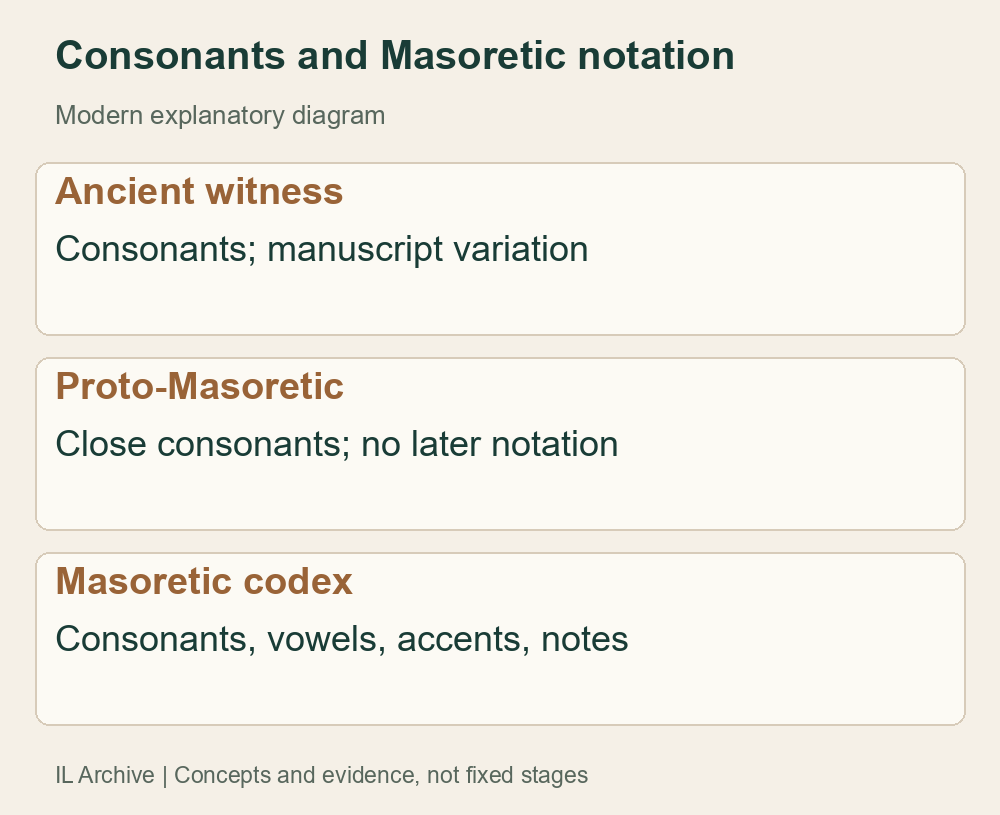
The label compares ancient consonantal readings with a tradition preserved in later manuscripts. It does not mean every letter agrees in every witness, or full Masoretic notation existed at QumranDead Sea ScrollsJudaean Desert manuscripts, especially Qumran cave finds. Biblical copies and other works reveal textual diversity; a copy’s age is not the work’s initial date.Glossary · Click to read the explanation. [1]
Masada/refuge-cave witnesses help trace continuity and stabilization. They are samples from particular groups and periods, not proof of one universal standardization date. The diagram distinguishes layers, not every scroll’s genealogy. [2]
References and notes
- James C. VanderKam (2016). “Texts, titles, and translations.” In The Cambridge Companion to the Hebrew Bible/Old Testament, pp. 9–27. DOI: 10.1017/CBO9780511843365.002. Pp. 9–12, 17–21: Masoretic layers, Aleppo c.925 and Leningrad 1009, witnesses, translations and variation. Counts depend on classification; no uniform percentage for all books. Return to the text ↑
- Israel Antiquities Authority. “Discovery Sites.” Qumran caves and Masada: fragments of seven biblical scrolls, close to the proto-Masoretic tradition. Does not establish universal standardization on one date. Return to the text ↑
Research history
Substantive changes are retained here. Minor copy edits remain in the internal operational log.
-
Substantive record update
Suggest a correction · Suggest a source for this record
Cite this record
IL Archive, «Proto-Masoretic text», Edition 2, https://ilarchive.com/en/entities/proto-masoretic