Study
El in Human and Angelic Names
An extended study of a topic, with evidence and references.
How does El survive in Israel, Ishmael, Daniel and angelic names? Seven formations, human and heavenly witnesses, selective Qurʾanic continuity, and the limits of inferring belief or identity from etymology.
Share article
Dates
Dates have distinct roles. The timeline uses creation, composition or historical coverage, rather than publication or discovery dates.
- Historical coverage
- Approximately From 1400 BCE to 700 CE
Text
Words preserved in names
Beliefs and languages can change while personal names endure. Israel, Ishmael, Daniel, MichaelMichael / MīkālTheophoric name asking who is like God; borne by humans and a heavenly figure in Daniel. It establishes no former Canaanite deity.Glossary · Click to read the explanation, GabrielGabriel / JibrīlName joining El with an element involving man or strength; interpreter in Daniel, messenger in Luke, named Jibrīl in the Qurʾan.Glossary · Click to read the explanation, RaphaelRaphael / RephaelTheophoric name from healing and El; human Rephael in Chronicles and angel Raphael in Tobit. Distinct from Israfil, whose etymology is a separate question.Glossary · Click to read the explanation and UrielUrielName joining El to an element interpreted as light or fire; human in Chronicles, heavenly figure in Enoch. No Ugaritic divine origin established.Glossary · Click to read the explanation contain a recurring element in their Semitic forms: ElSemitic ilAn ancient Semitic word for a deity; its linguistic use does not alone identify a particular divine figure.Glossary · Click to read the explanation, ʾEl. Its survival does not establish that everyone bearing these names worshipped the deity known from UgaritUgaritAncient city and kingdom at Ras Shamra on the Syrian coast, flourishing between the fourteenth and early twelfth centuries BCE and preserving multilingual archives.Glossary · Click to read the explanation.
El could mean a god and could designate a particular deity. No simple sequence establishes that the proper nameProper nameA name identifying a particular individual, place or other entity.Glossary · Click to read the explanation necessarily preceded the common nounCommon nounA word naming a class of things, such as “god”, rather than one particular individual.Glossary · Click to read the explanation. In HebrewHebrewA Northwest Semitic language in the Canaanite group, with ancient and modern forms.Glossary · Click to read the explanation texts it can refer to Israel’s God. Names first preserve linguistic material; identifying its divine referent requires context.[1]
A name bearing a divine element
A theophoric nameTheophoric nameA personal name containing the name of a deity or a divine element.Glossary · Click to read the explanation contains a divine element. It may be a nominal construction or a short sentence about divine hearing, healing or judgment, sometimes expressing a wish. Such formations belonged to many ancient Near Eastern communities, not only Israel or the naming of angels.
Hebrew names use El initially or finally, alongside Yahwistic elements such as Yeho-, -yahu and -yah. These patterns help researchers study naming traditions without automatically identifying a person’s community or beliefs. Families could use names in different languages, and inherited names could survive a changed setting.[2]
Which El does a name mean?
Ugaritic ElEl at UgaritA deity prominent in West Semitic traditions, especially as head of the divine family in Ugaritic texts.Glossary · Click to read the explanation, the father and head of the divine household, must be distinguished from El as a generic word. Once El and YahwehYahwehThe divine proper name written YHWH in the Hebrew Bible.Glossary · Click to read the explanation were identified in Israelite tradition, a bearer could understand the old element simply as God without invoking Ugarit’s character.
This is no rule that all later names are Yahwistic or all early names invoke a particular El. It is a problem of reference: the same word in different languages, periods and communities. The convergence model explains part of the continuity; every name is not an independent document of that convergence.[1]
Israel: a clear element, a debated interpretation
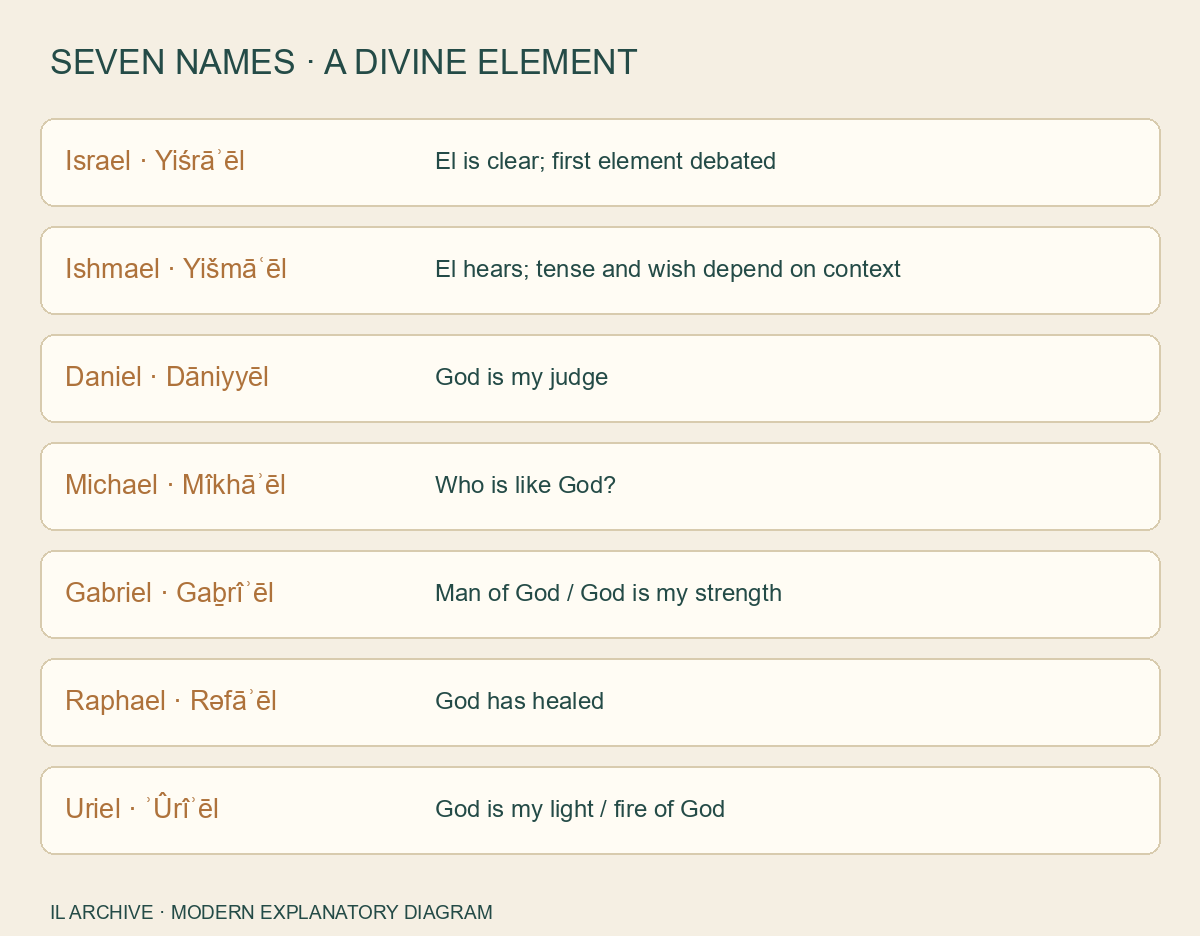
Yiśrāʾēl unmistakably contains El. Analyses of the first element vary. Genesis 32 associates it with Jacob’s wrestling; lexical interpretations include persistence, struggle or rule. The narrative explanation should not be equated with a single settled historical etymology.[4]
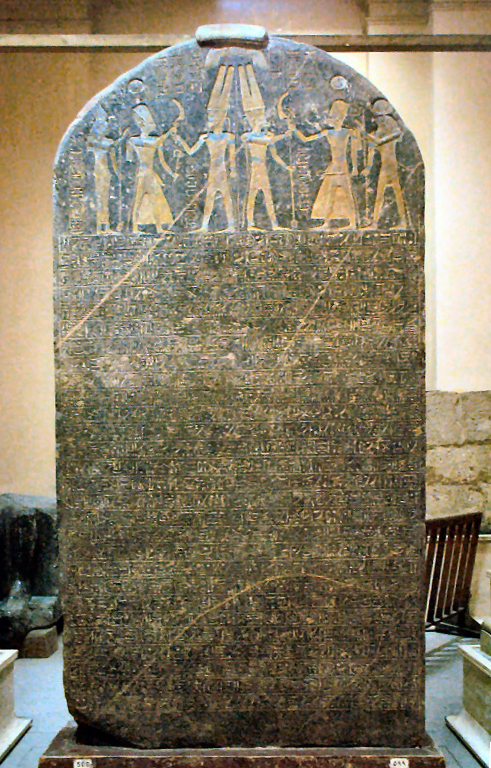
The name of ancient IsraelAncient IsraelA name for an ancient population and later historical traditions, attested on the Merneptah Stele.Glossary · Click to read the explanation is attested outside the Bible on the Merneptah SteleMerneptah SteleAn Egyptian royal inscription containing an early external attestation of the name Israel.Glossary · Click to read the explanation, around 1208 BCE, before the known Israelite kingdoms. This attests the collective name’s antiquity without by itself revealing how members understood its divine element or practised worship.[3]
Ishmael: God hears
יִשְׁמָעֵאל — Yišmāʿēl combines the root š-m-ʿ, hearing, with El. God hears is an approximate rendering. The name sentence can convey a statement or a wish; temporal and modal interpretations include hears, will hear, has heard and may hear, depending on grammar and context.[5]
Genesis 16:11 explains the child’s name through Yahweh hearing Hagar’s affliction. El in the name and the action attributed to Yahweh coexist naturally in the surviving narrative. The writer does not present a change of deity. This shows the text’s identification without independently dating its beginning.[6]
Daniel: God is my judge
דָּנִיֵּאל — Dāniyyēl relates to judgment and is normally understood as God is my judge. It states something about God, not that its bearer is divine. The University of Iowa entry explains the construction through my judge and El.[7]
This pattern illuminates the other names. A divine element in a human name does not classify its bearer as a god; the same element in a heavenly figure’s name does not establish independent divinity. The whole sentence must be understood before drawing conclusions about its bearer.
Michael: who is like God?
MichaelMichael / MīkālTheophoric name asking who is like God; borne by humans and a heavenly figure in Daniel. It establishes no former Canaanite deity.Glossary · Click to read the explanation, מִיכָאֵל — Mîkhāʾēl, asks who is like El or God. Usually understood rhetorically, it asserts divine uniqueness rather than claiming equality for its bearer.[8]
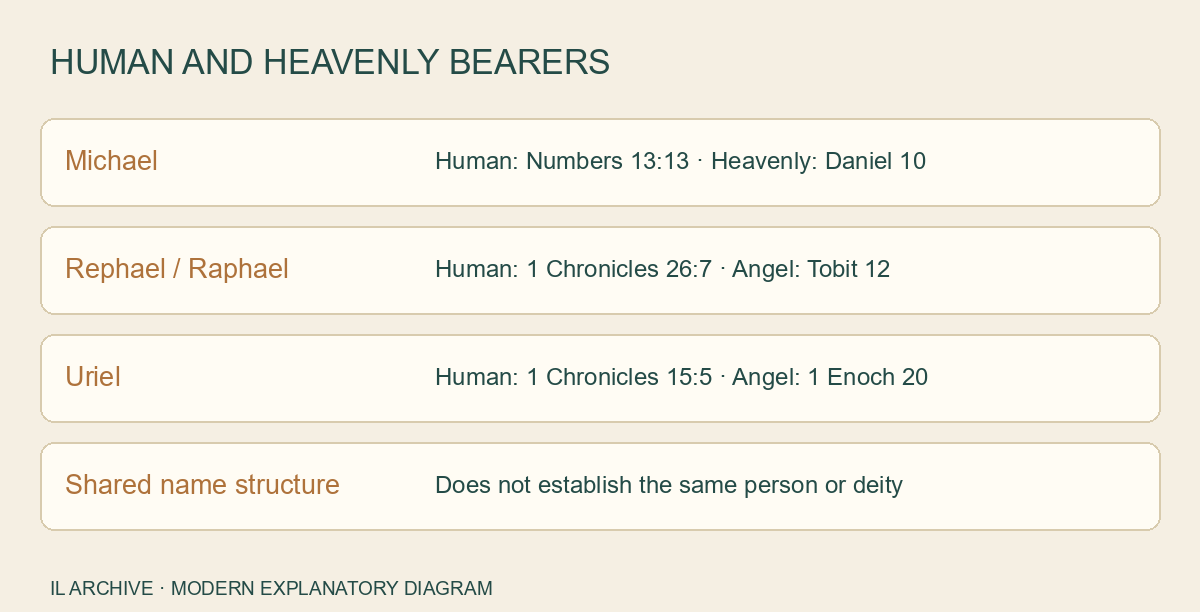
Humans also bear the name: Numbers 13:13 names Sethur’s father Michael.[9] Daniel 10:13,21 presents a heavenly Michael, one of the chief princes and the community’s prince.[10] Both usages are attested. The ordering of books and dates within their stories do not establish which usage historically arose first.
Gabriel: man and strength
GabrielGabriel / JibrīlName joining El with an element involving man or strength; interpreter in Daniel, messenger in Luke, named Jibrīl in the Qurʾan.Glossary · Click to read the explanation, גַּבְרִיאֵל — Gaḇrîʾēl, combines El with an element related to g-b-r, the semantic field of man and strength. Renderings include man of God and God is my strength. Iowa presents both analyses; neither should be treated as the sole possible interpretation.[11]
Daniel 8:16 commissions Gabriel to explain a vision. His identity and role come from the narrative, while etymology explains the name’s formation.[12] Man of God alone supplies neither an earlier human biography for the angel nor an origin as a Canaanite deity.
Raphael: healing in a name
RaphaelRaphael / RephaelTheophoric name from healing and El; human Rephael in Chronicles and angel Raphael in Tobit. Distinct from Israfil, whose etymology is a separate question.Glossary · Click to read the explanation, Rəfāʾēl, combines the healing root r-p-ʾ and El, conveying divine healing, commonly God has healed. Its theophoric structure remains recognizable despite different transmitted forms.[13]
In Tobit 12:14–15, Raphael explains his healing commission and membership among seven angels before God.[14] A human Rephael appears in 1 Chronicles 26:7. Shared consonants and formation do not erase differences in vocalization, transliteration or personal identity.[15]
Uriel: light or fire?
UrielUrielName joining El to an element interpreted as light or fire; human in Chronicles, heavenly figure in Enoch. No Ugaritic divine origin established.Glossary · Click to read the explanation, אוּרִיאֵל — ʾÛrîʾēl, has renderings involving God as my light or divine fire. NET’s collected dictionaries preserve both analyses. They are presented as alternatives, without deciding the issue from a sound resemblance or one role attributed to the figure.[16]
A human Uriel leads Levites in 1 Chronicles 15:5,11.[17] First EnochFirst EnochLayered collection of Jewish writings about heaven, evil and judgment.Glossary · Click to read the explanation 20 lists a heavenly Uriel.[18] The texts attest the name in two settings without making the human leader and angel the same person.
One naming language, different bearers
Michael, Raphael and Uriel demonstrate theophoric formations used for humans and heavenly beings. Israel, Ishmael and Daniel likewise prevent treating -el as an exclusively angelic ending.
The figure’s position in its text distinguishes an angel from a human. Matching names require further evidence before their bearers can be identified. The same applies to a proposed former deity: etymology is not a record of transferred religious identity.
When were angels given names?
Many Hebrew texts present unnamed heavenly messengers. Daniel gives Michael and Gabriel clear names and roles. But an observation about the Hebrew biblical collection cannot establish that angelic naming historically began with Daniel.
Annette Reed situates the formation of written angelologyAngelologyStudy and organization of angels and heavenly beings: names, ranks and roles within particular traditions, without assuming one fixed system.Glossary · Click to read the explanation in the third-century BCE context and Second Temple AramaicAramaicA group of Northwest Semitic language varieties with a long history across the Near East.Glossary · Click to read the explanation literature.[19] Daniel’s final form is commonly dated to the second century BCE, incorporating earlier material.[20] Tobit and Enoch have complex compositional and transmission histories. Story setting, composition and surviving manuscript date are separate questions.
Former sons of El?
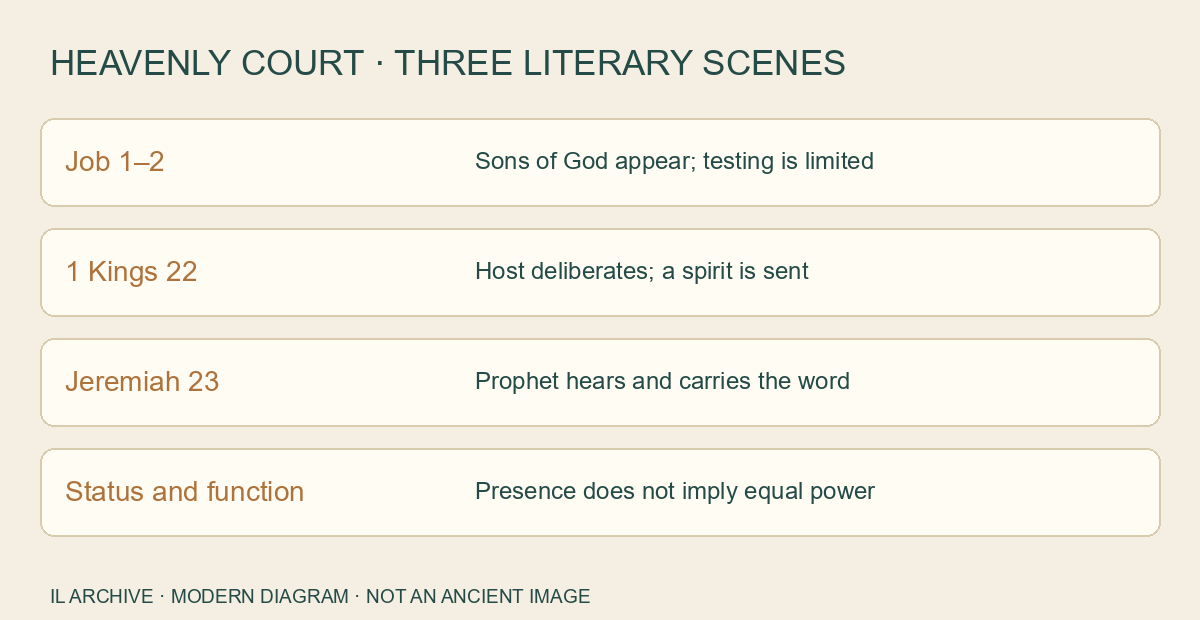
Ugarit knew a divine councilDivine councilA representation of divine beings acting as an assembly with authority and differentiated roles.Glossary · Click to read the explanation; Hebrew texts preserve heavenly groups; named angelic worlds subsequently expanded. Comparing these structures is useful without yielding a table identifying a particular Ugaritic deity with Michael or Gabriel.
The persistence of theophoric language and some court or messenger functions does not establish each character’s survival under another identity. El within an angel’s name is insufficient to demonstrate former membership in El’s council. The earlier study From El’s Council to Yahweh’s Court separates structural continuity from proposed individual transfers.
Names and family religion
A name may preserve a healing memory, an answered prayer or a hope for a child. It may also be an inherited relative’s name or a familiar choice whose etymology is not actively recalled. Every name referring to divine healing is not a report of a historical cure.
OnomasticsOnomasticsThe study of names, their origins, forms and contexts: evidence for language and religion, not a substitute for mythological or ritual texts.Glossary · Click to read the explanation compares names with family documents, archives and social relationships. Kathleen Abraham explains that Hebrew or Yahwistic names in Babylonian records need contextual corroboration when identifying their bearers. Language and religious naming do not mechanically establish identity.[2]
Judaism: named heavenly characters
Daniel distinguishes Michael as a heavenly prince and Gabriel as an interpreter. Tobit presents Raphael in a journey and healing narrative; First Enoch 20 lists several angels and their functions.[10][12][14][18] These are different witnesses, not a universally fixed Jewish roster.
More named subordinate beings need not contradict divine supremacy. Their names make statements about God: who is like God, God has healed. Names alone do not establish angelic rank, numbers or universal agreement about their functions.
Christianity: transmission through different texts
Luke 1:19,26 presents Gabriel in birth announcements.[21] Other names continue through Jewish writings and traditions received by Christians. Michael, Gabriel, Raphael and Uriel in European languages illustrate continuity alongside changing pronunciation.
Churches differ over the standing of particular writings. Tobit, Enoch and Fourth Ezra should not be treated as a single canon shared by every church. An angel’s position in Christian worship or tradition requires evidence for that community, not Hebrew etymology alone.
The Qurʾan: selective continuity
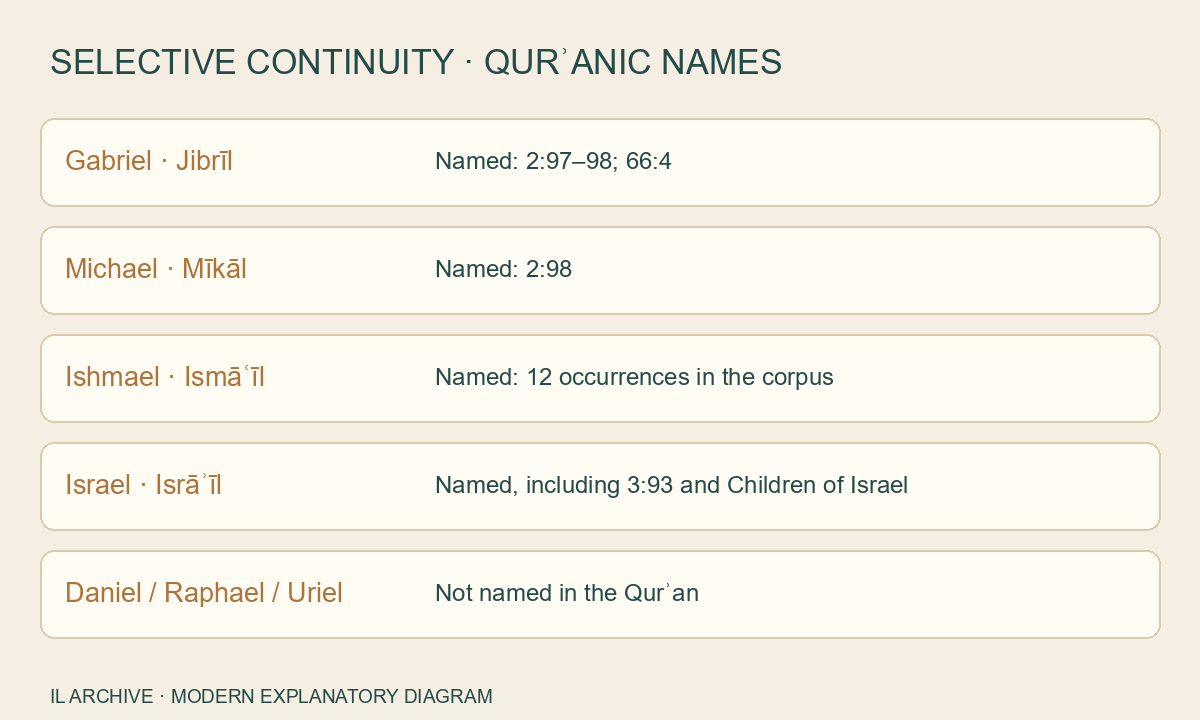
Of the seven names, the Qurʾan names Gabriel, Michael, Ishmael and Israel. Gabriel and Michael occur together at 2:98; Gabriel also occurs at 2:97 and 66:4.[22] The Quranic Arabic Corpus indexes twelve occurrences of Ishmael and identifies Israel at 3:93 and within the Children of Israel tradition.[23]
Daniel, Raphael and Uriel are not named in the Qurʾan. This is not a claim that all are absent from every Islamic tradition, nor permission to equate figures with Jewish counterparts without investigation. Linguistic continuity is real and selective.
A borrowed name becomes a whole
An Arabic speaker can say Ismāʿīl or Jibrīl without separating a Hebrew root and El. Borrowed names can become complete lexical units in their new language. Their survival does not establish Ugaritic El as an independent divine name in Islamic doctrine.
TDV explains Michael through Hebrew who is like God and discusses transfer into Arabic through Hebrew or SyriacSyriacA literary form of Aramaic, with an extensive Christian heritage and earlier non-Christian attestations.Glossary · Click to read the explanation.[24] Some earlier scholars’ knowledge of a name’s components differs from independent use of the word in the language. Not every name must have followed the same route.
Raphael and Israfil: distinction without overclaiming
Raphael in Tobit is associated with healing; Israfil in Islamic tradition with sounding the trumpet, although the Qurʾan does not name him. Similar endings and sounds do not justify simply equating the figures.
An unproven equation, however, does not prove the impossibility of every etymological connection. TDV describes Israfil’s origin as uncertain and reports proposed links with Hebrew vocabulary associated with seraphimSeraphimSix-winged beings in Isaiah 6’s throne vision, associated with praise and purification; not automatically identical to cherubim or every angel.Glossary · Click to read the explanation.[25] Distinguish the characters while treating Israfil’s etymology as a separate evidentiary question.
What survives, and what can be established?
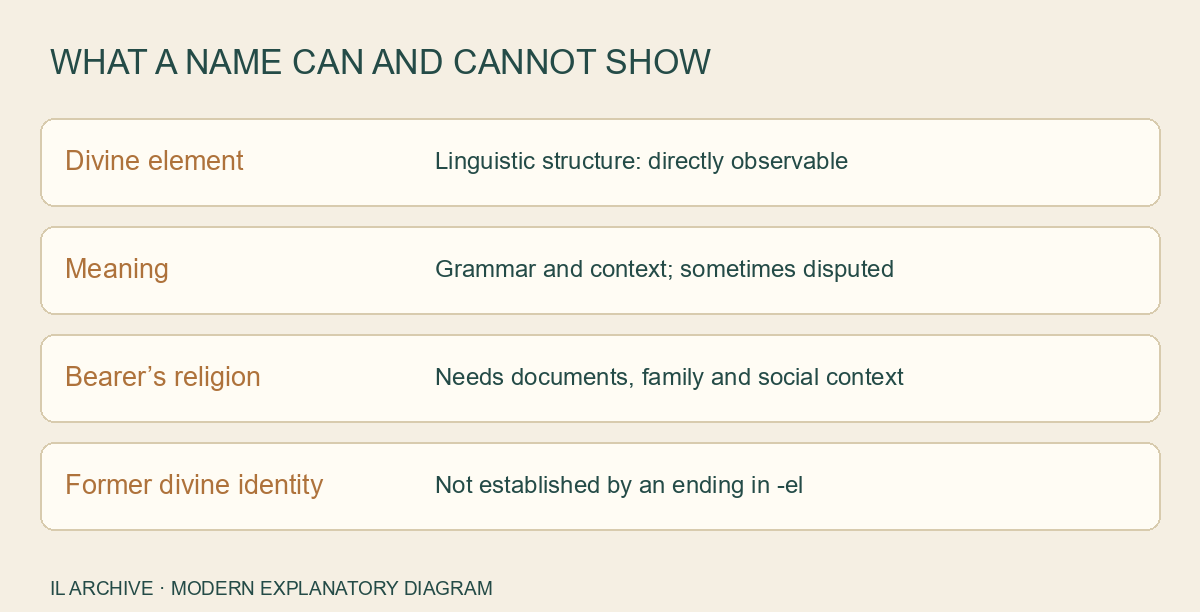
These names preserve an old Semitic divine element, and their formation is used for humans and angels. Some meanings are clearer than others: Michael’s question and Daniel’s judgment statement are less disputed than the precise analysis of Israel or Uriel.
The bearer’s beliefs or an angel’s proposed former identity as a god cannot be proved from -el alone. Names must be compared with texts, inscriptions, period and setting. When a name survives changed beliefs, linguistic memory can outlast the meaning its users consciously recall.[2]
Languages and heavenly worlds changed as names travelled between communities. This does not make Judaism, Christianity and Islam concealed worship of Ugaritic El. It shows how religious vocabulary can enter human and heavenly names and preserve history older than their users’ awareness.
References and notes
- Heath D. Dewrell & Andrew M. Garbarino (2023). Names of God in the Hebrew Bible. Oxford Bibliographies. doi:10.1093/obo/9780195393361-0318. Open introductory extract: El as common noun or divine name, compounds and convergence model. Full article not read; no chronological precedence of common noun or proper name inferred. Return to the text ↑
- Kathleen Abraham (2024). Hebrew Names. In C. Waerzeggers & M. Groß (eds.), Personal Names in Cuneiform Texts from Babylonia (c. 750–100 BCE), chapter 9, pp. 139–165. doi:10.1017/9781009291071.011. Selected HTML introduction and Historical and Ethno-Linguistic Background: contextual identification, overlapping languages/names and cuneiform ambiguity. Not the whole chapter or a review of every tabulated name. Return to the text ↑
- National Museum of Egyptian Civilization. Merenptah (Baenre Merinetjeru). Merneptah paragraph only: Israel Stela and earliest recorded mention. Approximate 1208 BCE dating also retained in the existing archive entry. JE 31408 image and rights are documented in media metadata; mummy page is not a detailed object record. Return to the text ↑
- Hebrew Bible, Genesis 32:29 (28 in many translations), Mechon-Mamre; Brown–Driver–Briggs, Israel, s.v. יִשְׂרָאֵל. Hebrew v.29, v.28 in many translations: narrative explanation. BDB entry inspected at https://biblehub.com/hebrew/3478.htm: persistence/struggle and alternatives. Added devotional commentary excluded; no single gloss settles the etymology. Return to the text ↑
- Encyclopedia of the Bible, “Ishmael,” §1 Name, hosted by Bible Gateway. Name paragraph only: El as subject, hearing predicate and tense/wish alternatives. Remaining narrative, patriarchal dating and social judgments are not historical evidence here. Return to the text ↑
- Hebrew Bible, Genesis 16:11. Mechon-Mamre, Hebrew and JPS 1917. Verse 11: Ishmael and Yahweh hearing Hagar’s affliction. Evidence for the surviving wording, not a contemporary document of the story’s setting. Return to the text ↑
- Robert R. Cargill (2023). Daniel. Bible & Archaeology, University of Iowa, 1 March. Short etymological paragraph: my judge + El. Its claim that the divine name later became the generic Semitic word is not adopted; that sequence is not established here. Return to the text ↑
- Joseph Jacobs, M. Seligsohn & Mary W. Montgomery. Michael. Jewish Encyclopedia (1901–1906), opening “Israel’s Advocate” paragraph. Etymology and Daniel context in opening paragraph. Historical reference work, not adopted as authority for every later legend or date of the name’s origin. Return to the text ↑
- Hebrew Bible, Numbers 13:13. Mechon-Mamre, Hebrew and JPS 1917. V.13: Sethur son of Michael, a human bearer. Narrative setting does not date the name’s earliest formation. Return to the text ↑
- Hebrew Bible, Daniel 10:13,21. Mechon-Mamre, Hebrew and JPS 1917. Vv.13,21: Michael among chief princes and as the community’s prince. Heavenly identity in the text, not evidence of Ugaritic divine origin. Return to the text ↑
- Bible & Archaeology, University of Iowa (2022). Gabriel, 24 February. Etymological paragraphs: man/strength semantic field and Man of God / God is my strength analyses. No single analysis is imposed. Return to the text ↑
- Hebrew Bible, Daniel 8:16. Mechon-Mamre; Brown–Driver–Briggs, Gabriel, s.v. גַּבְרִיאֵל. V.16, commission to interpret the vision. BDB at https://biblehub.com/hebrew/1403.htm also inspected: man of El and Daniel 8:16;9:21. Added devotional material is not used. Return to the text ↑
- Brown–Driver–Briggs and Strong, Rephael, Hebrew entry 7501, reproduced on Bible Hub. Original lexical sections: healing root + El and human name in 1 Chronicles 26:7. Added religious commentary is not used to date the figure. Return to the text ↑
- Tobit 12:14–15,18. King James Version, transcribed on Wikisource. Vv.14–15,18: healing, seven angels and divine commission; also 3:17 inspected. Historical translation, not an original manuscript; no identical wording assumed across all Tobit recensions. Return to the text ↑
- Hebrew Bible, 1 Chronicles 26:7. Mechon-Mamre, Hebrew and JPS 1917. V.7: וּרְפָאֵל, a human, rendered Rephael in JPS. Different transliteration from Raphael made explicit; no identity with the angel inferred. Return to the text ↑
- NET Bible Study Dictionary, Uriel: reproduced Strong, Easton, Smith and ISBE entries. Lexical sections preserving light/fire alternatives, human attestations and Enoch 20. Collected historical dictionaries, not a modern lexical consensus; old narrative dates are not used to date name formation. Return to the text ↑
- Hebrew Bible, 1 Chronicles 15:5,11. Mechon-Mamre, Hebrew and JPS 1917. Vv.5,11: Uriel as a Levitical leader. Book ordering does not establish precedence of human over heavenly naming. Return to the text ↑
- R. H. Charles (1912), The Book of Enoch, chapter 20, translation hosted by Internet Sacred Text Archive. Chapter 20: named angels including Uriel, Raphael, Michael and Gabriel. Published translation read, not Enoch manuscripts or a modern critical edition; roles and lists vary across passages and traditions. Return to the text ↑
- Annette Yoshiko Reed (2020). Rethinking Scribalism and Change in Second Temple Judaism. Demons, Angels, and Writing in Ancient Judaism, chapter 2. doi:10.1017/9781139030847.004. Publisher summary only: written angelology/demonology and third-century BCE Aramaic context. Full chapter not read; proposal does not date the first belief in a heavenly messenger. Return to the text ↑
- USCCB, New American Bible Revised Edition, Introduction to Daniel. Introduction: composition in 167–164 BCE context and traditional stories. Date applies to final form without assuming every component or tradition began then. Return to the text ↑
- New Testament, Luke 1:19,26. USCCB, NABRE. Vv.19,26: Gabriel identifies his commission and appears in Mary’s annunciation. Does not establish a universal canon or one angelic tradition for all churches. Return to the text ↑
- Qurʾan 2:98; 66:4. Quranic Arabic Corpus, text and translation pages. 2:98 names Gabriel and Michael; 66:4 read at https://corpus.quran.com/translation.jsp?chapter=66&verse=4. Word-by-word 2:97–98 entries also inspected, including lijib’rīla and wamīkāla. Qurʾanic names distinguished from all Islamic tradition. Return to the text ↑
- Quranic Arabic Corpus, Ishmael and Israel concept entries and occurrence indexes. Ishmael entry/index: 12 occurrences; Israel at https://corpus.quran.com/concept.jsp?id=israel and 3:93. Count refers to the name Ishmael, not stories; Israel’s index does not enumerate all references to Jacob. Return to the text ↑
- Lütfullah Cebeci. Mîkâil. TDV İslâm Ansiklopedisi, electronic entry. Origin paragraph: Hebrew mikaʾel and possible Hebrew or Syriac transmission. Alternatives are not proof of one route for every name. Return to the text ↑
- Lütfullah Cebeci (2001). İsrâfil. TDV İslâm Ansiklopedisi 23, pp. 180–181, electronic entry. Opening paragraphs: uncertain origin, seraphim proposals and absence of the name from Qurʾan. Used to delimit certainty, neither prove derivation from Raphael nor rule out every possible relationship. Return to the text ↑
Suggest a correction · Suggest a source for this record
Cite this record
IL Archive, «El in Human and Angelic Names», Edition 1, https://ilarchive.com/en/studies/el-in-names
Continue reading

![Quran manuscript folio, Met 1979.201, late eighth–early ninth century, Central Islamic Lands; ink, colours and gold on parchment. Later codex transmission, not a seventh-century copy or an image of the verses cited here. [28]](/media/1332)