Entity · Concept
Tetragrammaton
A reference page linking a name, group, or concept to the materials that discuss it.
The Tetragrammaton (יהוה, YHWH) names Israel and Judah’s deity in the Hebrew Bible. The entry separates spelling, reconstructed pronunciation and the complex link to El, claiming no sure etymology or old pronunciation.
Estimated reading time: 6 min Published Last reviewed:
Share article

Text
Introduction
The Tetragrammaton is the four-letter writing of the name of Israel and Judah’s deity, not a name for four gods or a four-word phrase. What do the texts and inscriptions actually preserve, and what can be inferred about pronunciation, meaning and history? This entry distinguishes the written consonants, interpretations within religious texts and historical-linguistic proposals whose conclusions remain debated.
The written name and the term itself
The HebrewHebrewA Northwest Semitic language of the Canaanite group, encompassing Iron Age epigraphy, Biblical, Rabbinic, medieval and Modern Hebrew; its scripts and pronunciations changed over time.Glossary · Click to read the explanation name is יהוה, written from right to left as yod (י), he (ה), waw (ו), he (ה). YHWHYahwehThe proper name of Israel’s deity, written יהוה (YHWH), the Tetragrammaton. Its exact ancient pronunciation is not directly preserved; texts and inscriptions witness its history.Glossary · Click to read the explanation transliterates the consonants; it does not supply the name’s spoken vowels. The term Tetragrammaton derives from Greek for “four letters” and designates a written form, not an etymology of YahwehYahwehThe proper name of Israel’s deity, written יהוה (YHWH), the Tetragrammaton. Its exact ancient pronunciation is not directly preserved; texts and inscriptions witness its history.Glossary · Click to read the explanation. This proper divine name must be distinguished from general terms and titles such as elohimElohimA Hebrew word with plural morphology, used for “gods” or for a singular deity according to context.Glossary · Click to read the explanation, which can mean “god” or “gods” depending on context. [1][4]
The gap between spelling and pronunciation
Ancient Hebrew writing is primarily consonantal, and these four letters alone do not record a full sequence of vowels. Yahweh is the conventional or reconstructed pronunciation commonly used in scholarship, not a direct recording of how a ninth-century BCE speaker sounded the name. In Jewish liturgical reading the written name has commonly been replaced by Adonai (“Lord”), and outside liturgy it may be referred to as HaShem (“the Name”). The vowel signs in pointed Hebrew manuscripts reflect such reading conventions, so they cannot automatically be treated as independent evidence for the original pronunciation. Jehovah has a later history of formation and use; it is a living religious designation, but not direct Iron Age phonetic testimony. [5]
Many translations render YHWH as LORD or “the Lord”. This is a translational and devotional convention, not the spelling of the Hebrew source. How the Greek Kyrios (“Lord”) and Hebrew-letter renderings were distributed among early Greek witnesses remains a question of textual history; a single rule should not be imposed on every manuscript. [5]
Exodus and the interpretation of the name
In the Book of ExodusBook of ExodusTorah book recounting Israel’s departure from Egypt and containing different formulations of seventh-day rest.Glossary · Click to read the explanation 3:13–15, MosesMosesCentral figure in Exodus, Torah traditions and the Qur’an; childhood accounts differ in detail.Glossary · Click to read the explanation asks which name he should give to the Israelites. The answer includes אהיה אשר אהיה (ehyeh asher ehyeh), which the Hebrew verbal form allows to be presented, depending on context, as “I am what I am” or “I will be what I will be”; the next verse gives יהוה. The narrative links the name with language of being or presence, but an explanation within the story does not by itself establish the earliest historical etymology. [3]
Exodus 6:2–3 says the deity appeared to the patriarchs as El ShaddaiEl ShaddaiA compound El name or title associated with ancestral narratives and identified with Yahweh in Exodus 6; Shaddai’s meaning and etymology remain uncertain.Glossary · Click to read the explanation but was not known to them by the name YHWH, whereas Genesis 4:26 reports people beginning to invoke YHWH well before Moses in the narrative’s chronology. These passages offer differing textual presentations of the name. The time depicted in a story should not be mistaken for the date of its composition; neither passage ought to be suppressed to force a preconceived reconstruction. [6][7]
Proposals about etymology
Proposals have connected the name with Semitic verbs of being or causing, while other proposals locate its linguistic environment farther south. Heath Dewrell treats its derivation as a live problem: his chapter title Yahweh the Destroyer does not establish a scholarly consensus on that meaning. Israel Knohl has argued for a southern origin and a link with an Arabic root associated with affection or passionate desire; this is a named scholar’s hypothesis, not an attested definition. Similar sounds or an origin story alone are insufficient to establish a derivation without converging linguistic and historical evidence. [2][8]
Shorter forms, including Yah and the elements found in personal names, occur alongside consonantal renderings such as YHW and YHW(H). Their presence does not settle the precise phonetic relation among all forms, nor does it restore the earliest missing vowels. [2]
An external inscription: the Mesha Stele
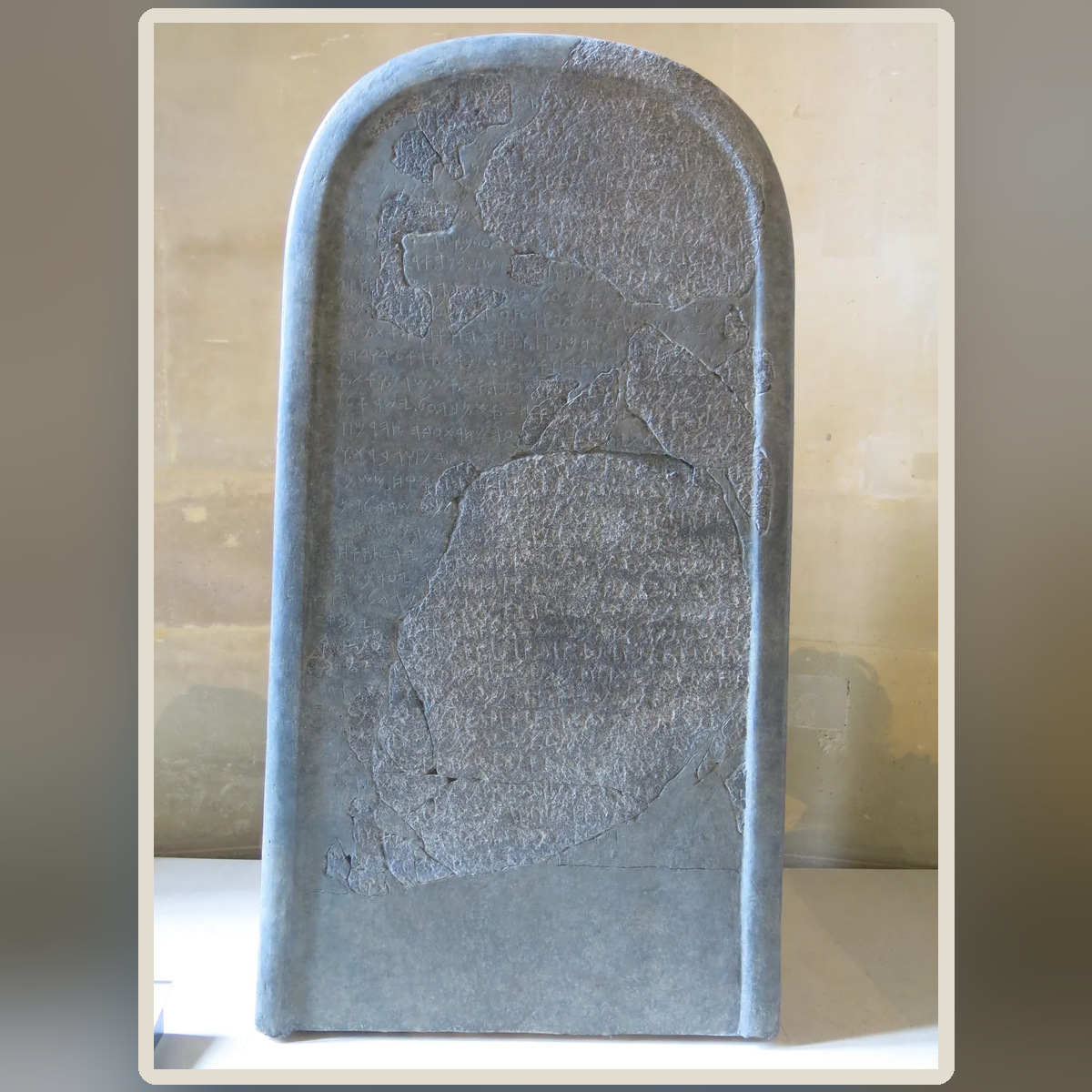
The Mesha SteleMesha SteleA ninth-century BCE Moabite royal basalt stele at the Louvre (AO 5066; KAI 181). Its inscription names Chemosh, Omri, Israel and YHWH (line 18). A proposed “House of David” reading in damaged line 31 is disputed.Glossary · Click to read the explanation is a material witness from ninth-century BCE Moab, independent of the biblical narrative. The surviving monument in the Louvre is catalogued as AO 5066 and KAI 181; it is broken, repaired and partly restored. The museum dates it to approximately 830–805 BCE and describes a Moabite inscription of thirty-four lines. That is a date for an object, not for the composition of Exodus. [9]
In a published reading of line 18, King Mesha says he removed “vessels/implements of YHWH” from Nebo and brought them before ChemoshChemoshMajor Moabite deity in the ninth-century BCE Mesha Stele, credited with restoring territory and receiving war booty; also named in Hebrew texts from another perspective.Glossary · Click to read the explanation, Moab’s deity. This attests to the name in a Moabite royal account of Israelite worship; it does not supply the original vowels or settle the theology’s origins. Because the monument is damaged and partly reconstructed, even good photographs must be read alongside a critical transcription. [10]
YHWH and El: religious identification is not word derivation
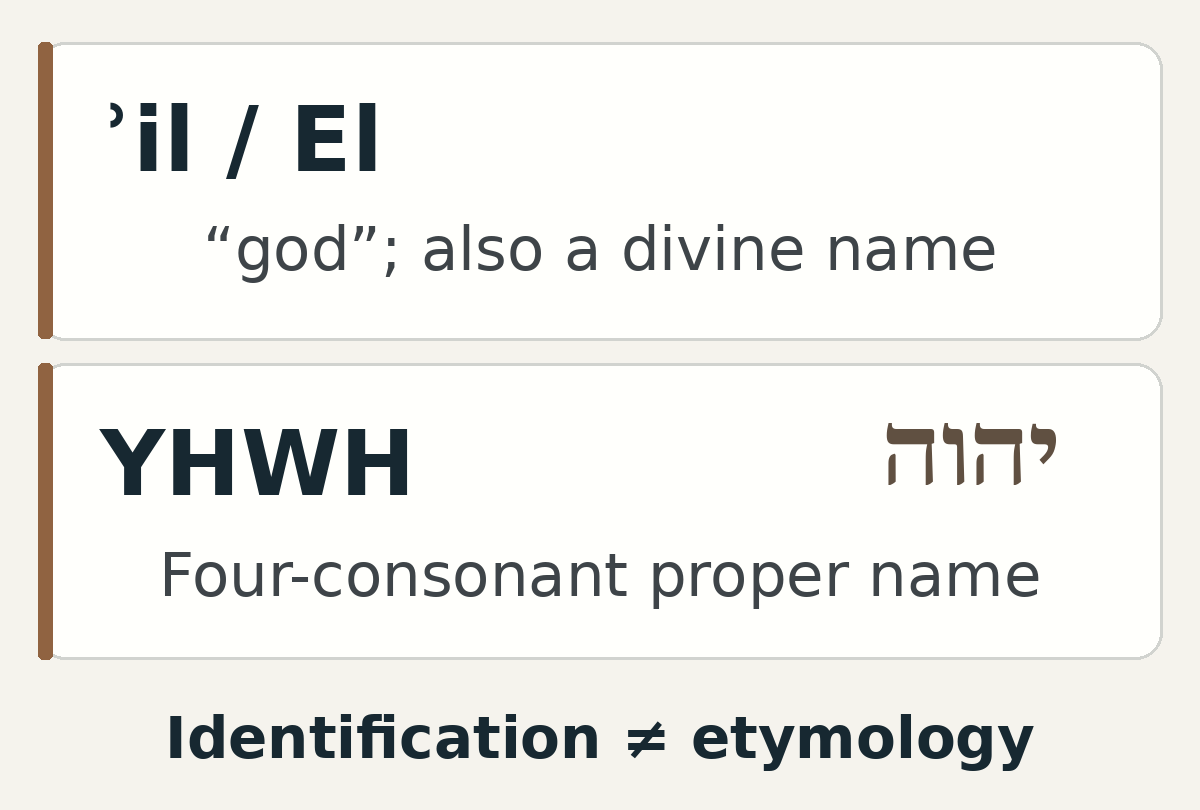
The Semitic word ʾil (“god”)Semitic ilAn ancient Semitic word meaning “god,” with cognates across several languages. It may function as a common noun or a proper name according to context; it is not always Ugaritic El.Glossary · Click to read the explanation belongs to the wider family of divine designations; El is also a particular deity known in Ugaritic texts. YHWH is a differently formed proper nameProper nameA name that identifies a particular person, place, group, or entity in context, unlike a common noun denoting a class. Spelling alone may not settle the distinction.Glossary · Click to read the explanation, although biblical writings attach El-related epithets, including El Shaddai, to Yahweh. Scholars discuss religious convergence, the transfer of attributes and the possibility of differing origins. Identification in religious tradition does not prove that YHWH is linguistically derived from El. [1]
Textual differences are themselves evidence. At Deuteronomy 32:8, a Qumran witness reads “sons of God” where the Masoretic Hebrew has “sons of Israel”; the following verse gives Jacob as YHWH’s own portion. These readings matter for reconstructing divine-council imagery, but this passage alone cannot determine the name’s pronunciation, etymology or the date when El and Yahweh were identified. [11]
Manuscripts and the distinct writing of the name
The script, as well as the ways in which the name was read, changed over time. In some Dead Sea ScrollsDead Sea ScrollsManuscript collections from the Judaean Desert, best known through Qumran: diverse works, languages and textual forms, with copying distinguished from composition.Glossary · Click to read the explanation the divine name is written in Old Hebrew letters inside texts mostly penned in the Aramaic-derived square script. Aaron Koller discusses the phenomenon as a meaningful scribal choice rather than a different deity. The Israel Antiquities Authority’s presentation of the Qumran Psalms manuscript 11Q5 similarly notes that its divine names appear in Paleo-Hebrew while the surrounding writing does not. The practice is not universal to every scroll and it does not reveal the spoken vowels. [12][13]
Evidence, interpretation, uncertainty
Direct evidence: the consonants transmitted in textual traditions, the name attested in Iron Age inscriptions, and changing written and reading practices in later manuscripts. Interpretation: Exodus’s play on the name, the use of other divine epithets, and translations such as “Lord”. Hypotheses: the exact earliest pronunciation, a definitive etymology, and the historical route by which Yahweh worship emerged and related to El. These distinctions allow historical inquiry without demanding either assent to or rejection of a faith.
References and notes (13)
- Heath D. Dewrell & Andrew M. Garbarino (2023), Oxford Bibliographies, “Names of God in the Hebrew Bible,” DOI: 10.1093/obo/9780195393361-0318. Read only the open introduction on El, common nouns and convergence/origin models; main bibliography and full article not accessed. Return to the text ↑
- Heath D. Dewrell (2022), SBL Press, “Yahweh the Destroyer: On the Meaning of יהוה,” chapter in Biblical and Ancient Near Eastern Studies in Honor of P. Kyle McCarter Jr., open-access edition. Only an indexed opening extract was accessible here, discussing competing etymologies; PDF/full chapter and pp. 5–10 were not personally inspected in this review. Return to the text ↑
- الكتاب العبري / Hebrew Bible / Bible hébraïque، Mechon-Mamre, Exodus 3:13–15, Hebrew text and facing English translation. Read Hebrew and English of 3:13–15; Arabic and French phrasings are editorial paraphrases, not claimed site translations. Return to the text ↑
- Collin Cornell (2019), Oxford Research Encyclopedia of Religion, “Names of God in the Hebrew Bible,” DOI: 10.1093/acrefore/9780199340378.013.144. Published abstract only: definition of Tetragrammaton and distinction among divine names and titles; full article not accessed. Return to the text ↑
- Martin Rösel (2007), Journal for the Study of the Old Testament 31(4), “The Reading and Translation of the Divine Name in the Masoretic Tradition and the Greek Pentateuch,” DOI: 10.1177/0309089207080558. Abstract only: Masoretic vocalization and Greek representations; its argument about early Greek practice is scholarly interpretation, not manuscript-wide certainty. Full text unavailable. Return to the text ↑
- الكتاب العبري / Hebrew Bible / Bible hébraïque، Mechon-Mamre, Exodus 6:2–3, Hebrew text with English translation. Read 6:2–3 only for El Shaddai and disclosure of the name. Return to the text ↑
- الكتاب العبري / Hebrew Bible / Bible hébraïque، Mechon-Mamre, Genesis 4:26, Hebrew text with English translation. Read verse 4:26 for the narrated chronology versus text-composition distinction. Return to the text ↑
- Israel Knohl (2019), TheTorah.com, “YHWH: The Original Arabic Meaning of the Name,” open-access research essay. Read sections “YHWH as Being,” “The Shaswe-Land YHWA,” “An Arabic Name,” and “The Jealous God”; the thesis is attributed to Knohl, not presented as consensus. Return to the text ↑
- Musée du Louvre، Département des Antiquités orientales, “Stèle de Mesha,” Louvre collection notice AO 5066 / KAI 181. Read catalog entry for identity, Diban, thirty-four Moabite lines, 830–805 BCE date, damage and restoration; no autopsy of the monument. Return to the text ↑
- David Ben-Gad HaCohen (2015), TheTorah.com, “The Unknown Yet Known Place of Moses’ Burial,” discussion of Mesha lines 14–18. Read the “On a Mountain: Ibn Ezra” passage and lines 14–18 including “vessels of Yhwh”; author’s Moses-burial hypothesis is not adopted as evidence here. Return to the text ↑
- Emanuel Tov (2023; updated 2026), TheTorah.com, “The Sons of Israel or God? — Deuteronomy 32:8,” textual-critical essay. Read the textual-witness comparison and first interpretive discussion of MT, 4QDeut-j and LXX; no definite historical convergence date inferred. Return to the text ↑
- Aaron Koller (2025), TheTorah.com, “The Transformation of Hebrew Script: From Paleo-Hebrew to Aramaic,” section “Old Hebrew for the Tetragrammaton.” Read the section on the name in Old Hebrew script and the relevant script-change context, not the complete apparatus of notes. Return to the text ↑
- Israel Antiquities Authority, Leon Levy Dead Sea Scrolls Digital Library, Image catalog B-314640 for Psalms scroll 11Q5, including the IAA’s script clarification. Read image metadata (2011, Shai Halevi, 11Q5) and the IAA comment on Paleo-Hebrew divine names; no direct palaeographic transcription or reuse of its image. Return to the text ↑
Suggest a correction · Suggest a source for this record
Cite this record
IL Archive, «Tetragrammaton», https://ilarchive.com/en/entities/tetragrammaton
Continue reading