Entity · deity
Athtar
A reference page linking a name, group, or concept to the materials that discuss it.
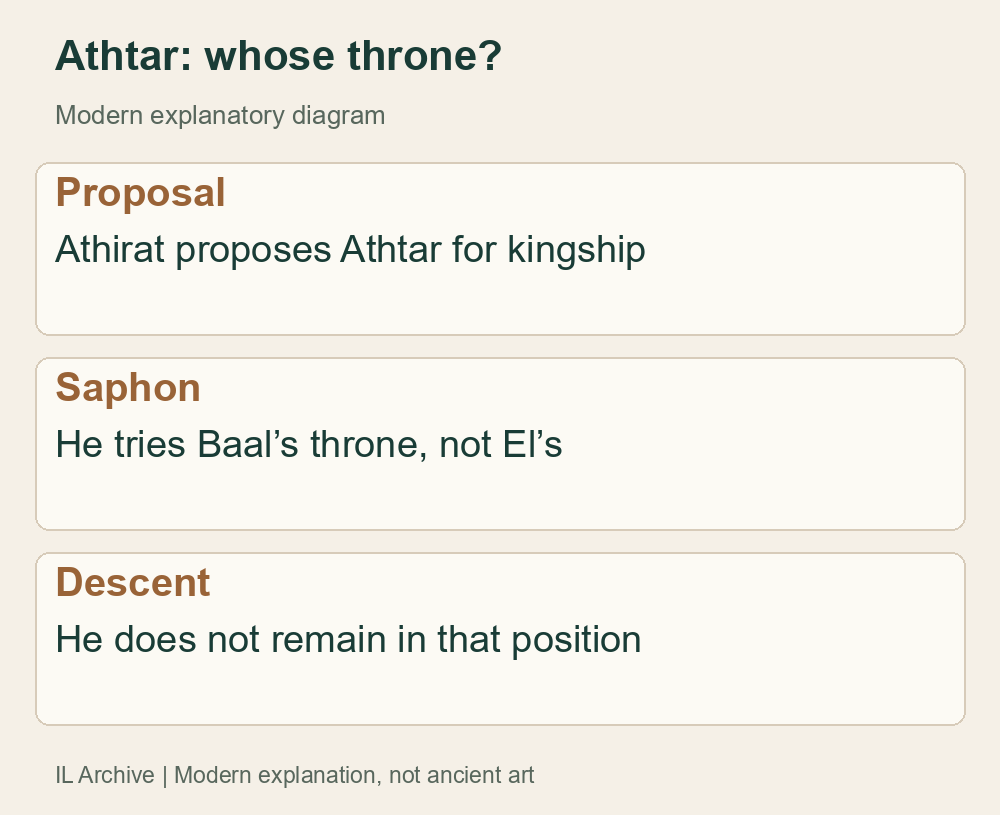
God who tries Baal’s throne on Saphon during his absence, then descends; it is not El’s throne.
Text
In KTU1.6I Athirat proposes Athtar for kingship. His feet and head do not fit BaalBaalStorm god and protagonist of Ugarit’s Baal Cycle; exercises active kingship while El retains importance and authorizes the palace.Glossary · Click to read the explanation’s throne; he declares he cannot rule on Saphon and descends. The text continues with rule in the earth, a debated expression.[1] It does not abolish every possible kingship or portray him as a fallen angel. Athtar should not be confused with Athirat or Astarte because of superficially similar names.
References and notes
- Nicolas Wyatt (2009). The Concept and Purpose of Hell: Its Nature and Development in West Semitic Thought. Numen 56, 161–184. DOI: 10.1163/156852709X404964. Pp.168–169, especially n.14 and KTU1.6I50–67 translation: Athirat proposes Athtar, Baal’s throne on Saphon, footstool, descent and rule in the earth. Wyatt’s discussion of earth/rebellion is an interpretation, not a consensus. Return to the text ↑
Research history
Substantive changes are retained here. Minor copy edits remain in the internal operational log.
-
Substantive record update
Suggest a correction · Suggest a source for this record
Cite this record
IL Archive, «Athtar», Edition 2, https://ilarchive.com/en/entities/athtar