Entity · Epigraphic designation
Raḥmānān
A reference page linking a name, group, or concept to the materials that discuss it.
- Names
- Rahmanan · Raḥmānān · rḥmnn
- Region
- Southern Arabian highlands and Ḥimyarite territories (Yemen; Ḥimā/Najrān, present-day Saudi Arabia)
Raḥmānān (rḥmnn), a divine designation in Late Sabaic inscriptions of Ḥimyar, found in Jewish and Christian contexts and debated in relation to Qur’anic al-Raḥmān.
Estimated reading time: 5 min Published Last reviewed:
Share article

Text
Introduction
What does Raḥmānān (`rḥmnn`) mean in Late South Arabian inscriptions, and how did its use vary between the Ḥimyarite court and Jewish and Christian settings? This entry distinguishes what the inscriptions say from scholarly proposals about the deity's identity, and then considers the separate Qur'anic use of al-RaḥmānAl-RaḥmānQuranic divine designation co-referring with Allah.Glossary · Click to read the explanation. An inscribed designation documents a particular devotional expression; it does not establish the religion of an entire population.
An inscribed name, not the biography of a separate god
Raḥmānān is the conventional vocalization of the Ancient South Arabian consonant sequence `rḥmnn`, usually understood as “the Merciful” or “the Compassionate.” The musnad script does not write the expected vowel signs, so this vocalization is a scholarly reconstruction rather than a sound preserved by the stone. The form belongs to the Semitic root for mercy and includes the Sabaic definiteness ending. The root is widespread in other Semitic languages: that fact alone cannot establish how the epithet reached Arabic. [1]
Ḥimyar and the transformation of public religious language
From the latter half of the fourth century CE, royal inscriptions of Ḥimyar, which controlled centres including SabaʾSaba: the ancient South Arabian kingdomAn ancient South Arabian kingdom centered in present-day Yemen and prominent in the first millennium BCE; its attestation does not establish the Queen of Sheba's biography.Glossary · Click to read the explanation, increasingly replaced the names of older South Arabian gods with expressions referring to one god: “Lord of Heaven,” “God,” and “Raḥmānān.” This change in the epigraphic record documents a transformation in the public representation of power and worship. It cannot show that every household and village changed its religious practice simultaneously. Christian Julien Robin proposes that the relative restraint of royal religious formulas helped maintain agreement among diverse communities. [2]
In the published abstract of a 2026 study, Iwona Gajda characterizes the late-fourth-century Ḥimyarite framework as Judaism or Judaizing monotheismMonotheismBelief that only one God possesses divinity in its fullest sense. Historically distinct from exclusively worshipping one deity without denying others; its theological forms vary.Glossary · Click to read the explanation, alongside Jewish communities and clearer evidence of local Christianity in the sixth century. This historical characterization requires qualification and debate; it is not proof that the whole population worshipped in one fashion. [3]
Buildings and blessings: adjoining designations need not be distinct gods
In building and prayer inscriptions, Raḥmānān appears beside phrases such as “Lord of Heaven and Earth.” The house inscription `Ibrahim al-Hudayd 1` mentions the help of the Lord of Heaven and Earth and the people of Israel, and asks Raḥmānān to protect the house. `CIH 543` names Raḥmānān, Israel and “their God, Lord of the Jews.” Sigrid Kjær considers these combinations possible evidence for different divine roles or objects of worship and discusses readings by Robin and Gajda. Yet syntax does not establish whether there are two gods, multiple epithets or modes of address for one deity, or a transitional scribal idiom. [4]
Inscriptions from the reign of Joseph ʾAsʾar
During the Ḥimyarite–Aksumite conflict in the 520s CE, texts associated with the army of King Joseph ʾAsʾar Yaṯʾar, called Dhū Nuwās in later accounts, were carved around Ḥimā near Najrān. `Ry 508` asks the God who possesses heaven and earth to grant victory, then invokes Raḥmānān to protect the inscription and asks for his mercy to spread. Other texts in the group refer to the “Lord of the Jews” and employ related protective formulas; `Ry 507` itself does not mention Raḥmānān in the published text. Distinguishing inscription identifiers prevents words being assigned to the wrong witness. [5]
These inscriptions attest prayer language and commemorative texts connected to military authority at a particular time. The idea that invoking Raḥmānān to guard a stone implies a separate “local god,” distinct from the God of Heaven, remains an interpretation requiring further evidence, not an explicit statement of the text.
The designation in Christian inscriptions
After the Aksumite campaign in Ḥimyar, the designation occurs in recognizably Christian writing. The edited inscription `Ist 7608 bis` names Raḥmānān alongside “his son, Christ the Victorious,” a clearer confessional marker than the divine designation alone. It continued in inscriptions of the sixth-century ruler Abraha. [6]
The Maʾrib stele `CIH 541`, also designated `Gl 618`, opens by invoking Raḥmānān's aid and mercy, “his Messiah,” and “the Holy SpiritHoly SpiritName present in Christian texts and worship, whose relation to Father and Son was defined in Trinitarian formulations.Glossary · Click to read the explanation,” before narrating Abraha's rule and activities. Corpus Coranicum publishes the Old South Arabian writing with readings and translations grounded in epigraphic editions. This is direct evidence for the designation in a particular Christian formula—not an image of the deity, and not evidence that earlier communities did not use the name. [7]
From Raḥmānān to Qur'anic al-Raḥmān
In the Qur'anThe QuranThe central scripture of Islam, consisting of 114 Arabic surahs; its study distinguishes Quranic discourse from manuscript history, reading traditions, and historical inference.Glossary · Click to read the explanation, al-RaḥmānAl-RaḥmānQuranic divine designation co-referring with Allah.Glossary · Click to read the explanation is a designation or attribute of the one God; Qur'an 17:110 places “Allah” and “al-Raḥmān” in parallel as names used in addressing the same deity. Its theological framing differs from the varying late-Ḥimyarite inscriptions, although the verbal resemblance and the Late Antique religious setting support meaningful comparison. A common Semitic root cannot prove direct borrowing from a particular stone, and Raḥmānān should not be turned into a separate “character” in every Qur'anic occurrence. [8]
The Ḥudaybiyya account: a later literary testimony
One version of the Ḥudaybiyya narrative in Ṣaḥīḥ al-Bukhārī relates that Suhayl ibn ʿAmr objected to the expanded invocation at the beginning of the treaty and requested the phrase “In Your name, O God.” Kjær proposes that the name al-Raḥmān may also have evoked for Meccan audiences memories of Abraha's Christian rule. The report, however, was compiled long after the narrated event; the proposed political and psychological link is a historical hypothesis, not something explicitly stated in a surviving Ḥimyarite treaty or the original Ḥudaybiyya document. [9]
What the evidence establishes—and what remains open
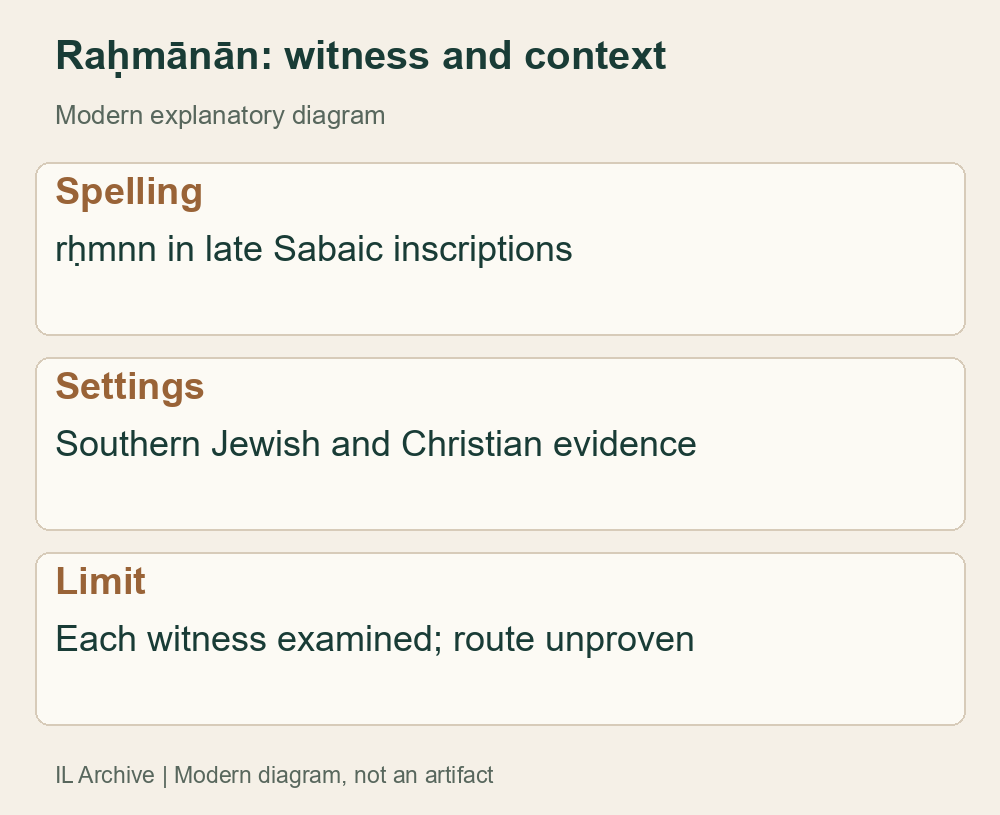
Taken together, the witnesses establish that `rḥmnn` circulated in Late Sabaic inscriptions across differing settings: texts identifying with Israel, royal Ḥimyarite inscriptions, and Christian writings naming Christ and the Holy Spirit. They do not determine every person's faith, settle whether every ambiguous formula distinguishes a local deity from the biblical God, or demonstrate one uninterrupted line of transmission into Qur'anic Arabic. Each claim must be checked against the inscription's identifier, provenance, legibility, edited reading and level of interpretation. The accompanying figure is a modern explanation of these limits, not a photograph of an archaeological object. [10]
References and notes (10)
- Sigrid K. Kjær, “'Rahman' before Muhammad: A pre-history of the First Peace (Sulh) in Islam,” Modern Asian Studies 56/3 (2022), 776–795. Sections read in the full online article: “The nature and origin of Rahman before the Quran” and start of the early era; no direct inspection of stone inscriptions. Return to the text ↑
- Christian Julien Robin, “The Judaism of the Ancient Kingdom of Ḥimyar in Arabia: A Discreet Conversion,” in Diversity and Rabbinization (Open Book Publishers, 2021), 165–270. Publisher’s chapter summary and indexed excerpts from pp. 232 and 247 only; the 105-page full chapter could not be retrieved. Return to the text ↑
- Iwona Gajda, “Religions of Ancient South Arabia From Polytheism to Monotheism in the Context of Political, Economic and Social Evolutions (Fourth–Sixth Centuries CE),” Arabian Archaeology and Epigraphy (online 10 February 2026), DOI 10.1111/aae.70017. Publisher abstract only; the 18-page article itself was not read. Return to the text ↑
- Kjær, “'Rahman' before Muhammad” (2022), “Rahman as a Jewish or Judaizing divinity,” especially Ibrahim al-Hudayd 1 and CIH 543. Relevant full HTML section and translated inscriptions; mediated by the article, not inspection of originals. Return to the text ↑
- Kjær, “'Rahman' before Muhammad” (2022), section on Joseph Dhū Nuwās, especially Ja 1028 and Ry 507, 508, 515. Quoted inscription readings in the article (especially Ry 507–508); no physical or primary photographic examination. Return to the text ↑
- Kjær, “'Rahman' before Muhammad” (2022), “Rahman-an under Christian rule,” passages concerning Ist 7608 bis and Ry 506. Relevant HTML section and quoted phrases; not the entirety of the original epigraphic editions. Return to the text ↑
- Corpus Coranicum (BBAW), “Old South Arabian stele of Abraha at the Maʾrib Dam” (TUK_1259), CIH 541 = Gl 618; transcription based on Walter W. Müller, Sabäische Inschriften nach Ären datiert (2010), 111–117; the portal additionally refers to Nebes (2005), 362–367. Examined primary-script presentation I.1–9, especially lines I.1–3, and the portal’s translation/context; not all 136 lines or the physical stele. Return to the text ↑
- Qurʾan 17:110 (Sūrat al-Isrāʾ), Arabic wording checked at Quran.com and translation compared with Quranic Arabic Corpus. Verse 17:110 only; not the entire sūra or an early manuscript. Return to the text ↑
- Ṣaḥīḥ al-Bukhārī, Book of Conditions, report of al-Ḥudaybiyya, nos. 2731–2732 in the Sunnah.com numbering; compare Kjær (2022), conclusion. Treaty drafting and invocation passage in an online translation; later narrative, not an extant original treaty document. Return to the text ↑
- Kjær, “'Rahman' before Muhammad” (2022), conclusion; Robin (2021), publisher synopsis and indexed concluding excerpt, p. 247. Kjær’s conclusion read in full; only excerpt and publisher summary for Robin. Return to the text ↑
Suggest a correction · Suggest a source for this record
Cite this record
IL Archive, «Raḥmānān», https://ilarchive.com/en/entities/rahmanan
Continue reading