Entity · Concept
Paleo-Arabic: Early Arabic-Script Inscriptions
A reference page linking a name, group, or concept to the materials that discuss it.
- Names
- Palaeo-Arabic · Paleo-Arabic
- Region
- The Hejaz, northern and western Arabia and the Levant; dispersed inscriptions, not a single political territory
Paleo-Arabic is an epigraphic stage of the developing Arabic script, attested by texts from the late fifth to the early seventh century CE; the entry distinguishes script from language and presents dated inscriptions.
Estimated reading time: 9 min Published Last reviewed:
Share article
Text
Introduction
Shortly before the earliest Qurʾānic manuscripts and Arabic papyri, people in the Hijaz, the Najran region, northern Arabia and the LevantThe LevantThe Levant is a regional name for lands along the eastern MediterraneanGlossary · Click to read the explanation were carving names and prayers in letter forms close to the Arabic script familiar today. Scholars call a particular group of these texts Paleo-Arabic. It is not a separate extinct language, nor a blanket name for every pre-Islamic Arabic text: it is a writing tradition marked by identifiable letter shapes, spelling practices and linguistic features. Its inscriptions preserve individual voices and shifts in public invocations, but they are neither a census of the population nor a full register of its beliefs. [1]
Guide to the article
- What the term means: writing system versus language
- The transition from Nabataean to Arabic writing
- Dated texts and the limits of dating
- Rīʿ al-Zallālah: how three lines were reread
- Allāh and al-ʾilāh in invocations
- SafaiticSafaiticAn Ancient North Arabian consonantal script used for rock inscriptions recording names, kinship, pastoral movement and prayers in the pre-Islamic deserts of Syria, Jordan and northern Arabia.Glossary · Click to read the explanation, the QuranThe QuranThe central scripture of Islam, consisting of 114 Arabic surahs; its study distinguishes Quranic discourse from manuscript history, reading traditions, and historical inference.Glossary · Click to read the explanation and later accounts
- Secure findings and competing interpretations
- Images and how to read them
What the term means: writing system versus language
EpigraphyEpigraphyThe study of writing preserved on physical objects and monuments: its documentation, reading, dating, translation, material context and historical interpretation.Glossary · Click to read the explanation distinguishes the language of a text from the script used to record it. Varieties of Old Arabic were written before Islam in several alphabets, including Ancient North Arabian traditions. Paleo-Arabic is a narrower label for inscriptions in an already recognizable Arabic script, displaying palaeographic, orthographic and linguistic traits that do not simply match the later early-Islamic norm. Christian Robin and colleagues introduced this label for inscriptions from Ḥimà in 2014; Ahmad Al-JalladAhmad Al-JalladResearcher in Arabian inscriptions, the history of Arabic and Semitic languages.Glossary · Click to read the explanation and Hythem SidkyHythem SidkyResearcher in Quranic manuscripts, reading traditions and written and oral transmission.Glossary · Click to read the explanation explained its value in a paper first published online in 2021 and in a 2022 journal volume. [2]
The coming of Islam did not mark a single instant when all regional practices disappeared: some non-standard forms may have survived beyond 632 CE. Conversely, it is misleading to call every older Arabic-language text Paleo-Arabic when it uses a different alphabet. The university-hosted OCIANAOCIANA: Ancient North Arabian InscriptionsOCIANA is an evolving academic database of ancient North Arabian inscriptions, with edited transliterations, translations, commentary, references, photographs and provenance; not a substitute for the stones.Glossary · Click to read the explanation resource describes a fully developed Arabic script with non-standard continuations into the first decades of the Islamic polity. [3]
From Nabataean to Arabic writing
The Arabic script developed over centuries from the Nabataean Aramaic writing tradition; it was not suddenly invented with Islam. Scholars use Nabataeo-Arabic for a transitional stage, broadly between the third and fifth centuries CE, before the repertoire of forms looks more recognizably Arabic. The shift was neither straight nor uniform. Letter shapes—including rāʾ, kāf, mīm and hāʾ—vary among inscriptions, and regional practices overlapped. The absence of later familiar dots and vowel marks does not mean the writer lacked a language: it does mean that readings sometimes remain open to alternatives. [2]
An older inscription may write br, an Aramaic-influenced spelling for “son of,” amid otherwise Arabic names and constructions. Editors therefore compare each trace and its position with parallel texts, formulaic contexts and findspots. The history of a script and the history of the language intersect, but one cannot stand in for the other.
Dated texts and the limits of dating
Among the earliest dated inscriptions classified as Paleo-Arabic are finds at Ḥimà near Najran. Al-Jallad and Sidky cite a specimen dated 470 CE and comparanda dated 513 CE. This does not mean Arabic writing began in 470: it marks the earliest relevant dates in the currently documented material. [1][2]
At Zabad in northern Syria, an Arabic text accompanies Greek and SyriacSyriacAn Aramaic literary language rooted in Edessa, first attested in non-Christian inscriptions and later prominent in Christian writing, scholarship, translation and liturgy.Glossary · Click to read the explanation texts on a basalt lintel of a Christian shrine associated with Saint Sergios. The Greek and Syriac evidence dates the building project to approximately 511–512 CE; whether the Arabic was inscribed at precisely the same time has been debated. The three languages are not verbatim translations: the Arabic records a prayer of remembrance and personal names, whereas the other texts include building information. The lintel is held by Brussels’s Art & History Museum as A 1308. The Arabic reading discussed here follows published editions, not an independent decipherment of the stone. [4]
The Jabal Usays and Ḥarrān inscriptions in Syria document related writing practices in the sixth century, though the reading of individual dates and names requires attention to editions, not casual online images. A French Ministry of Culture archaeological resource also records a pre-Islamic Arabic inscription by Wādī az-Zilliyyaṭ near Dūmat al-Jandal, dated 548/549 CE, in a Christian setting. These dates do not all rest on the same degree of evidence. [2][5]
Rīʿ al-Zallālah: how three lines were reread
At Rīʿ al-Zallālah, on a route north of Ṭāʾif, the history of the edition is unusually revealing. An early photograph of the rock was incomplete, and an editor read the writing as a prayer for an individual. In 2021 a survey team returned and photographed the surface in greater detail. The new images revealed the beginning of a blessing for the readers, followed by the writer’s self-identification and a patronymic. Comparison with the Ḥimà letter forms changed both the transcription and the palaeographic classification. [2]
The edition by Al-Jallad and Sidky reads the opening approximately as brk-[k]m rb-nʾ, “may our Lord bless you.” Yet the first letter of the writer’s name remains unreadable; presenting it confidently as “Qurrah” would suppress a real uncertainty. The text also uses br in the genealogical formula. The editors do not claim a specific calendar year: dating by letter forms points broadly to the late fifth through early seventh centuries, with local variation possible. This is the difference between what is visible on stone and what is restored by comparison. [2]
Allāh and al-ʾilāh in invocations
New fieldwork has rapidly changed the evidence base. In February 2026 Al-Jallad and Sidky discussed more than forty documented Paleo-Arabic texts. A March 2026 university lecture abstract by Al-Jallad speaks of approximately fifty. Both figures describe a moving research corpus, not all texts that ever existed or a sample proportionate to inhabitants. [1][6]
The 2026 study observes that explicitly Christian groups of inscriptions—at Ḥimà, Dūmat al-Jandal and in the Levant—may bear crosses and frequently address al-ʾilāh, “the God”; western Arabian Hijazi texts more commonly invoke Allāh in varied spellings, without overt crosses. Blessing, forgiveness and appeals to piety occur alongside ordinary names. Thus NRAA 4, west of Tabuk, contains a self-identification and a request for forgiveness, while FaS 7 addresses the Khazraj and urges devotion to God. These are documented formulas, not a claim that every inscription shares a single pattern. [1]
The contrast between Allāh and al-ʾilāh is a distribution within the extant corpus, not an immutable regional boundary or an automatic religious identity test. An inherited name such as ʿAbd al-ʿUzzā in JPICM 2 can outlive the religious practice once associated with that name. It does not by itself prove that its bearer worshipped al-ʿUzzā when the inscription was carved. Personal naming and direct invocation are different kinds of evidence. [1]
Safaitic: another evidential layer
Earlier Safaitic inscriptionsSafaiticAn Ancient North Arabian consonantal script used for rock inscriptions recording names, kinship, pastoral movement and prayers in the pre-Islamic deserts of Syria, Jordan and northern Arabia.Glossary · Click to read the explanation in northern Arabia and the Syro-Arabian steppe contain prayers to several deities, including Allāt; they differ from Paleo-Arabic in script, distribution and dates. The abstract only of an article by Al-Jallad published in 2025 reports material from MH09, in the northeastern Jordanian Ḥarrah, and proposes that one inscription portrays Allāh as a light-giving creator. We have not independently examined its full edition, photograph or critical apparatus. The abstract’s “roughly two thousand years ago” concerns that Safaitic case, not sixth-century Paleo-Arabic texts. [7]
This comparison illuminates change in the language of inscriptional prayer: older names invoked in direct appeals do not appear in the surveyed sixth-century Paleo-Arabic formulas. But a change on stone first tells us what was written, not everything every person believed. South Arabian history must also be considered separately: the religious shifts of the Himyarite kingdom had specific political and institutional dynamics. A single model should not be imposed on the entire peninsula. [1][8]
The inscriptions, the Quran and later narratives
The QuranThe QuranThe central scripture of Islam, consisting of 114 Arabic surahs; its study distinguishes Quranic discourse from manuscript history, reading traditions, and historical inference.Glossary · Click to read the explanation names al-Lāt, al-ʿUzzā and Manāt in 53:19–23 and presents a claim to intercession in 10:18. The known Paleo-Arabic invocations, by contrast, are addressed to Allāh or al-ʾilāh. The Quran’s polemic, a short commemorative graffito and later Islamic literary accounts are different kinds of witness. The Quran supplies early evidence of a religious argument, not a neutral inventory of every community’s ritualsRitualAn organised or distinguished practice meaningful to a community; it may leave traces, but its form alone does not reveal an associated doctrine.Glossary · Click to read the explanation. [1][9]
Al-Jallad and Sidky propose that devotion to a creator deity expanded while some formerly independent divine beings were reinterpreted as subordinate powers or intercessors. This synthesis attempts to reconcile inscriptional formulas, Quranic language and later narratives. Other scholars place greater trust in later accounts or object to inferring widespread monotheismMonotheismBelief that only one God possesses divinity in its fullest sense. Historically distinct from exclusively worshipping one deity without denying others; its theological forms vary.Glossary · Click to read the explanation from a selective epigraphic sample. The stronger finding is that one divine name dominates the extant invocations; the complete beliefs of Hijazi communities, and whether other cults continued or changed their meaning, remain historical reconstructions open to debate. [1]
Secure findings and competing interpretations
Direct, high-confidence evidence: Paleo-Arabic inscriptions exist in Late Antiquity; some have dates and others have palaeographic estimates; identified examples contain names, blessings and prayers to Allāh or al-ʾilāh. Likely within the known corpus: public invocational habits differed from those in certain earlier North Arabian inscriptions, after controlling for genre, date and region. Disputed or uncertain: when each locality shifted writing conventions, whether the Arabic on a multilingual monument is exactly contemporary with another portion, a writer’s creed from a short prayer, or the survival and reinterpretation of other supernatural powers. [1][2][4]
No cross does not prove a writer was not Christian. No older divine name does not prove the end of its cult in family life. The number of discovered inscriptions is not the number of inhabitants: survival, erosion, excavation, publication and who chose to write are all filters on the evidence.
Images and responsible use
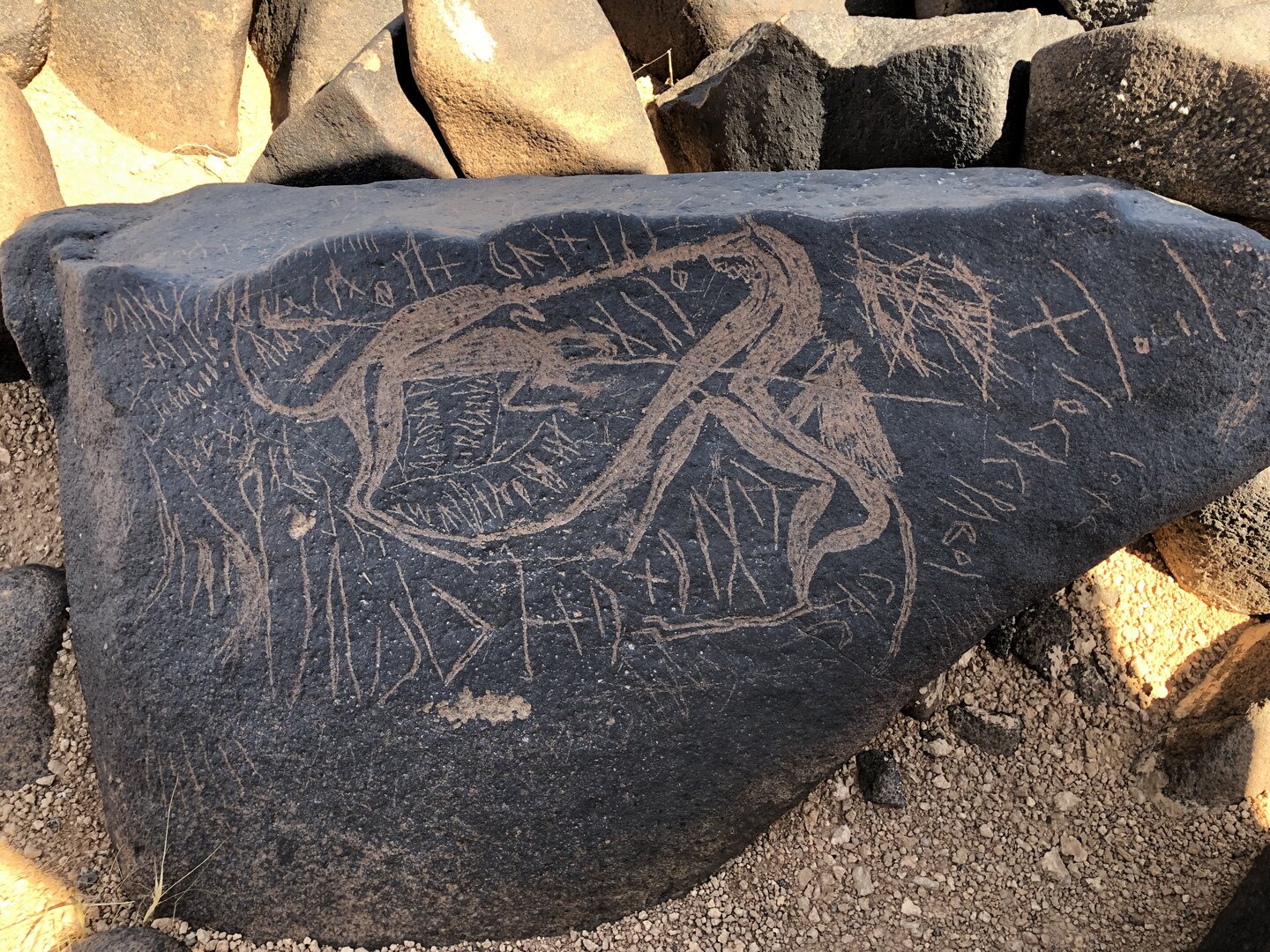
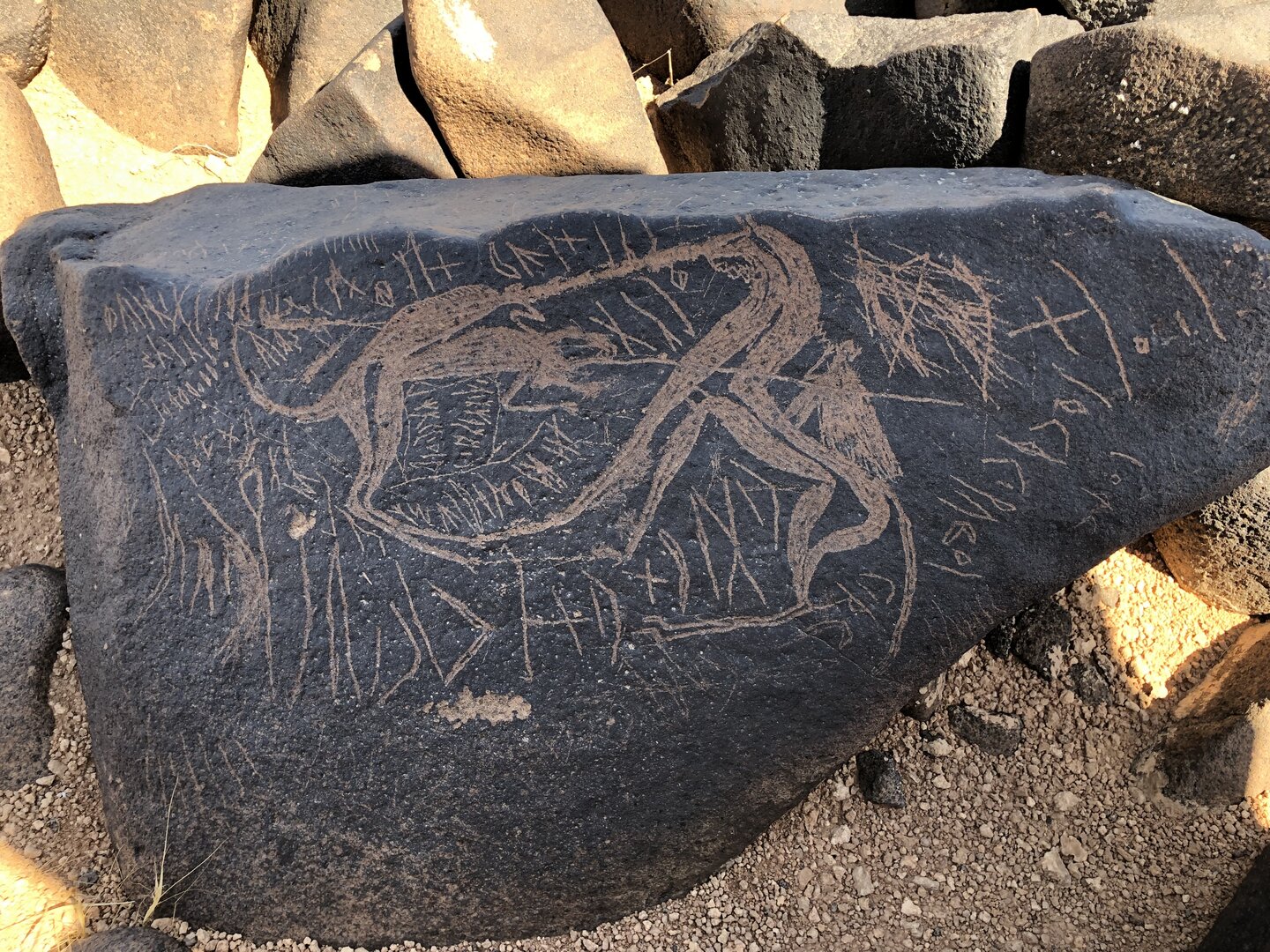
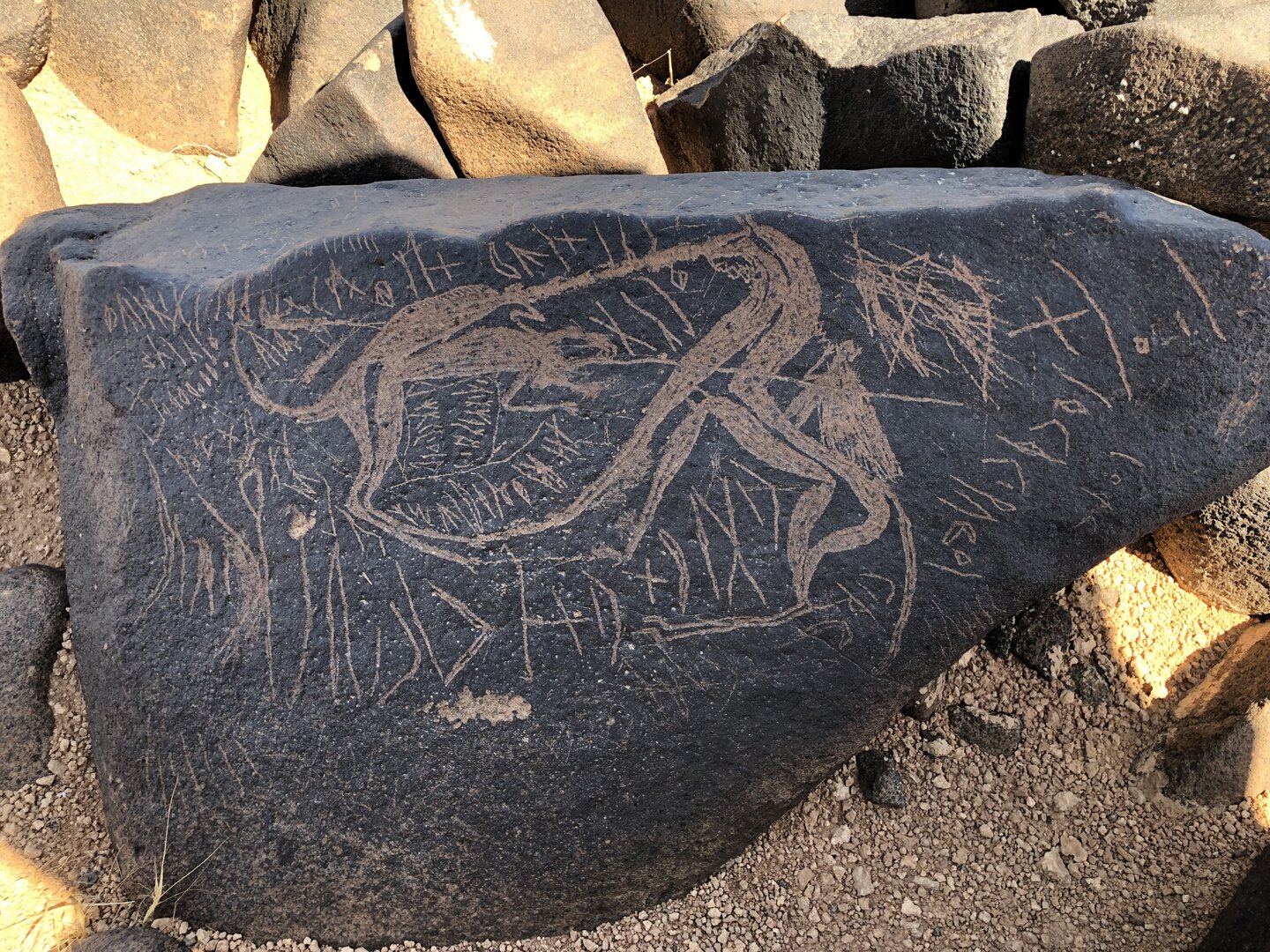
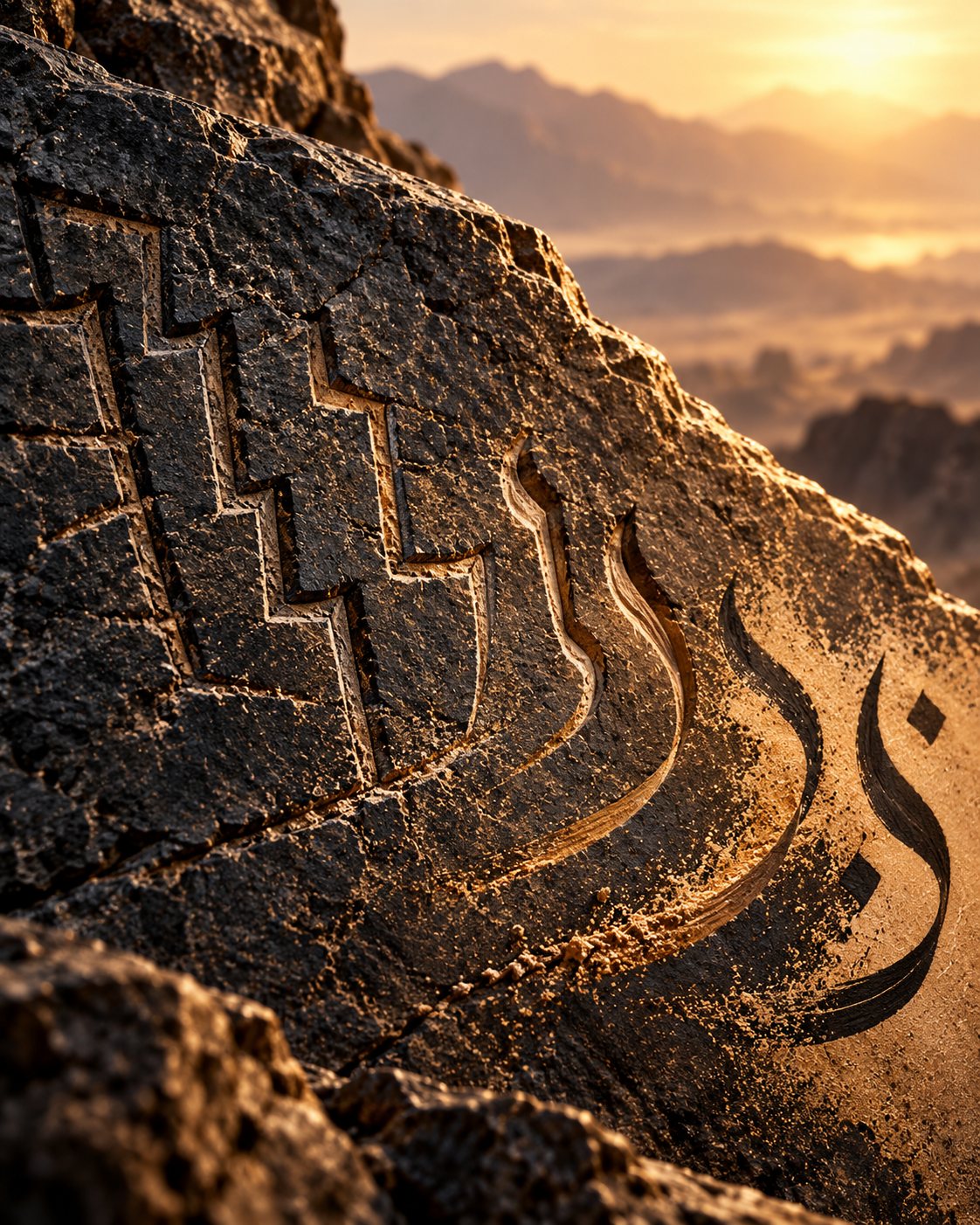
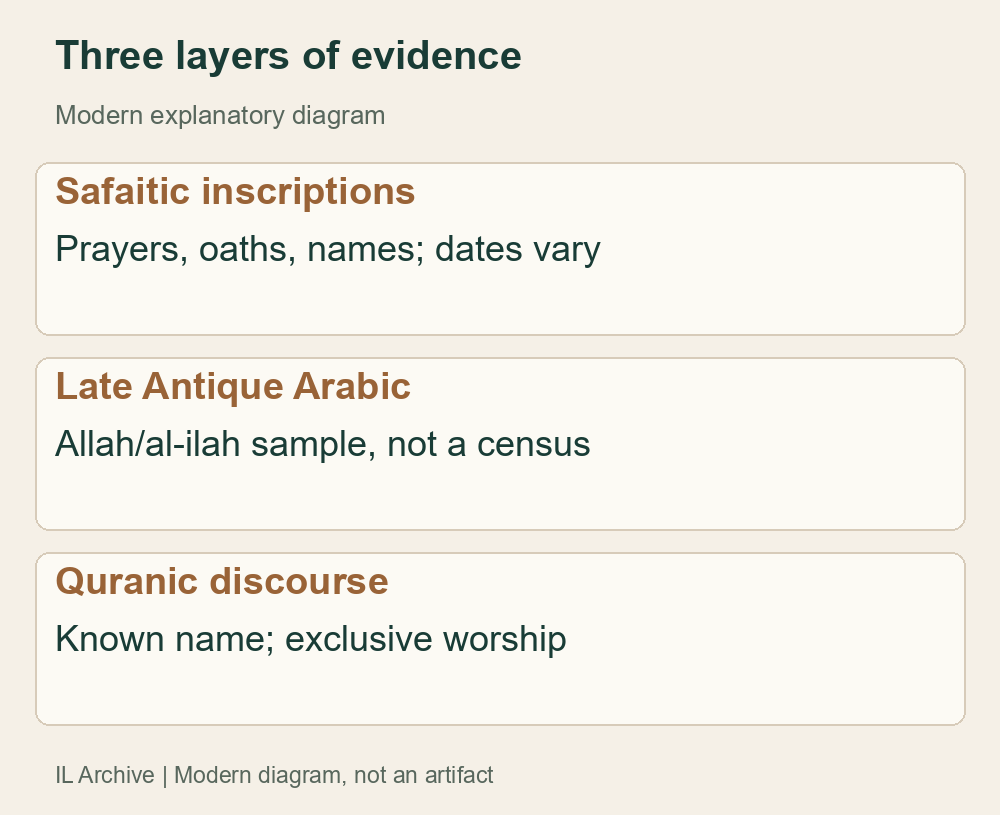
The cover is a modern AI-generated interpretive illustration of stone and the idea of changing scripts: it is not a photograph of an actual inscription, nor a scholarly reconstruction or facsimile of any particular object. The Three layers of evidence graphic is an original IL Archive explanatory diagram comparing Safaitic texts, Late Antique Arabic and Quranic discourse. It is neither an archaeological object nor proof of an inevitable chronological sequence. To assess individual letter readings and dates, consult photographs and critical editions rather than the diagram or cover. [2][3]
Conclusion
Paleo-Arabic matters not because it can prove that every community wrote alike or believed the same things. It offers direct access to changing spelling, script forms and the voices of particular writers on the eve of Islam. Read alongside earlier inscriptions, the Quran and later accounts, it provides a basis for comparison—not a final verdict on the entire peninsula’s religious life.
References and notes (9)
- Ahmad Al-Jallad & Hythem Sidky (2026), “Late Antique Allāh: Ancestral Arabian Religion and the Monotheistic Zeitgeist,” Arabian Archaeology and Epigraphy, online 15 Feb 2026, DOI 10.1111/aae.70019. Main article §§1–5 consulted via publisher HTML, especially §2, sample examples NRAA 4/FaS 7/JPICM 2, conclusions and relevant endnotes; not all cited studies independently read. Return to the text ↑
- Ahmad Al-Jallad & Hythem Sidky, “A Paleo-Arabic inscription on a route north of Ṭāʾif,” Arabian Archaeology and Epigraphy 33 (2022): 202–215, first online 20 Oct 2021, DOI 10.1111/aae.12203. Publisher HTML: §§1.1 and 2.1–2.4, especially dating, letter-shapes, damaged personal name and br genealogy; publication year is volume 2022, not the first online date 2021. Return to the text ↑
- OCIANA, Ohio State University, “Paleo-Arabic” (university epigraphy resource). Entire brief institutional overview and its cited bibliographical list consulted; glossary/scope only, not a full catalogue of every object. Return to the text ↑
- Paweł Nowakowski, Oxford Cult of Saints, E01817, “Greek, Syriac, and Arabic inscriptions ... in Zabad,” online resource, posted 2016, DOI 10.25446/oxford.13810994. Published edition/transliteration and translation of Greek, Syriac and Arabic portions and the object provenance / dating / discussion examined in specified sections; not a fresh reading from the stone. Date 511–512 and Arabic simultaneity debated. Return to the text ↑
- French Ministry of Culture, archaeological dossier “Dûmat al-Jandal,” section describing Wādī az-Zilliyyaṭ and a dated pre-Islamic Arabic inscription (548/549 CE). Selected archaeological-context paragraph only; no excavation report or object autopsy. Return to the text ↑
- University of Cambridge, Faculty of Asian and Middle Eastern Studies, public lecture announcement, Ahmad Al-Jallad, “Is Paleo-Arabic Classical Arabic?,” 9 March 2026. Only the online indexed lecture abstract (c. 50 texts) consulted, not the lecture or research manuscript; host page returned 403 on direct open. Return to the text ↑
- Ahmad Al-Jallad (2025), “Ancient Allah: An Epigraphic Reconstruction,” Journal of Semitic Studies 70(2): 693–748, DOI 10.1093/jss/fgaf012. Abstract ONLY at Oxford Academic; full article behind access barrier. MH09 and “roughly two thousand years ago” attributed to author’s abstract, not confirmed by inspection of the inscription. Return to the text ↑
- Iwona Gajda (2026), “Religions of Ancient South Arabia From Polytheism to Monotheism...,” Arabian Archaeology and Epigraphy, first published 10 Feb 2026, DOI 10.1111/aae.70017. Publisher abstract and introductory preview only; not the entire 18-page article; used only for independent regional differentiation. Return to the text ↑
- Quran, al-Najm 53:19–23 and Yūnus 10:18, as displayed by Quran.com/legacy.quran.com (text and translations). Only named passages consulted, not complete suras; 53 names three entities, 10:18 presents an intercession claim; their equivalence is not assumed. Return to the text ↑
Suggest a correction · Suggest a source for this record
Cite this record
IL Archive, «Paleo-Arabic: Early Arabic-Script Inscriptions», https://ilarchive.com/en/entities/paleo-arabic
Continue reading