Study
The Earliest Divine Names in Mesopotamia: When Writing Preserved the Name
An extended study of a topic, with evidence and references.
- Timeline
- From 3350 BCE to 2500 BCE
- Region
- Southern Mesopotamia — Uruk, Fara and Abu Salabikh
From Uruk tablets to Fara lists: Nanna, Ninlil, Inanna, Enlil and An, and what makes a divine name readable without equating first attestation with the beginning of worship.
Share article
Text
When a name could survive
One turning point in religious history concerns our ability to recover a god’s name, rather than the birth of a new god. Before writing, a building, figure, burial or ritualRitualAn organised or distinguished practice meaningful to a community; it may leave traces, but its form alone does not reveal an associated doctrine.Glossary · Click to read the explanation trace seldom supplies the name of the being associated with it. With writing at UrukUrukAncient city at Warka in southern Iraq, a major urban centre around 3200 BCE that preserved early writing and accounting tablets.Glossary · Click to read the explanation in the late fourth millennium BCE, clay began preserving something else: words and signs that can lead to divine names.[1]
Yet the earliest surviving name is not the first god humanity knew. Even within MesopotamiaMesopotamiaA historical region associated with the Tigris and Euphrates, home to many societies and civilisations.Glossary · Click to read the explanation, a definitive ranking is difficult because some signs are clear and others allow several readings. A useful question is when a name becomes recognizable, and with what confidence.
Before the written name
People could identify sacred beings through speech, ritual, place and imagery before recording them on tablets. A community might know whom an emblem represented or who received an offering, while an archaeologist cannot recover that knowledge from shape alone. Not every figurineFigurineSmall three-dimensional representations of people, animals or other beings. Size and appearance alone do not establish a toy, portrait, ritual object or deity; manufacture, discovery context and use require study.Glossary · Click to read the explanation is a god, and not every monumental building is a temple.
Nor must oral tradition disappear when a community vanishes: neighbours or descendants may transmit it. The difficulty is that transmission may leave no independently traceable record. Writing improves the chances of preservation without creating belief from nothing.
When do the tablets begin?
Early proto-cuneiformProto-cuneiformEarly Mesopotamian writing of the late fourth millennium BCE, combining numerical notation and signs, predominantly accounts with limited phonetic use.Glossary · Click to read the explanation at Uruk belongs to the late fourth millennium. CDLI catalogues use approximate ranges such as 3350–3200 BCE for Uruk IV and 3200–3000 for Uruk III. These are classificatory boundaries, not a precise date for writing’s invention; the relationship between script phases and find layers also requires investigation.[1][2]
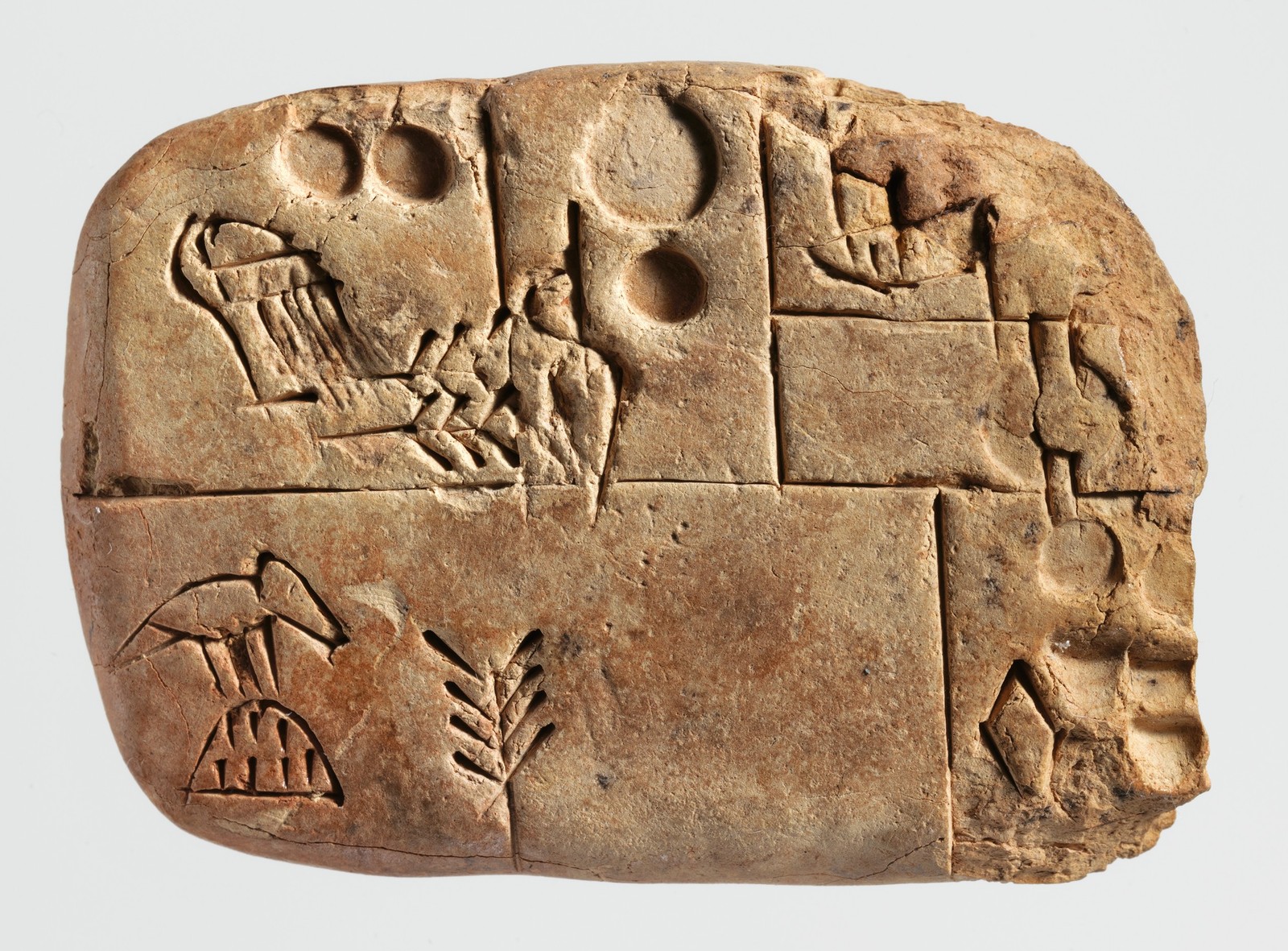
The tablet pictured here accounts for barley and emmer distribution. The Metropolitan Museum dates it to about 3100–2900 BCE and considers Uruk a probable origin. It illustrates writing’s administrative setting, rather than providing an image of a NannaNanna / Su’en / SinMoon god associated with Ur, with early name evidence that does not date every later myth.Glossary · Click to read the explanation or NinlilNinlilGoddess later associated with Enlil and Nippur; early writings require distinguishing sign labels from place context.Glossary · Click to read the explanation attestation.[12]
The first writing was not a complete story
Tablets recorded resources, quantities, people and institutions without representing language as later texts would. A scribe could understand an account that a modern reader cannot turn into a complete Sumerian sentence.
Nevertheless, the system was not silent pictures entirely without sound representation. Christopher Woods discusses early evidence of phonetic use alongside the inability to express many grammatical relationships. Limited recording of speech differs from having no relationship to speech.[1]
A sign for a word, a sign for a sound
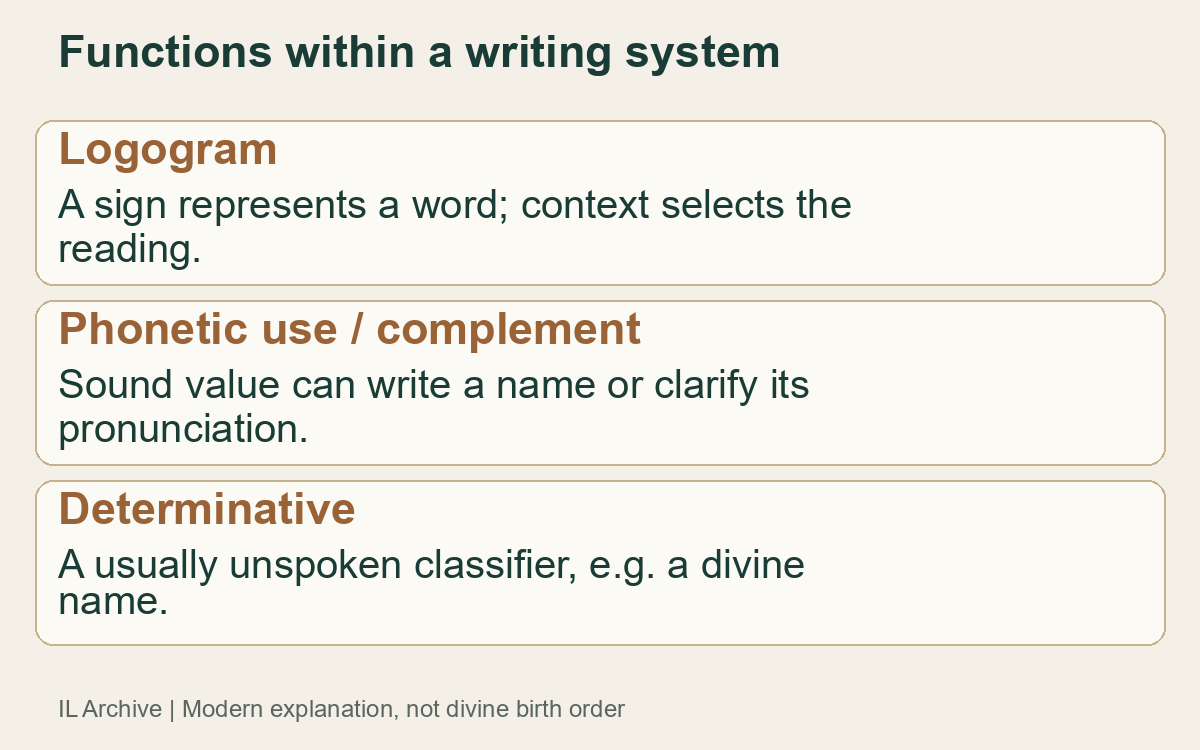
A logogramLogogramA sign representing a word or related words; context selects the reading, and a sign may also have phonetic uses.Glossary · Click to read the explanation can represent a word or semantically related words, while another sign may be used for its sound value. The rebus principleRebus principleUsing a word sign for its sound in another similarly pronounced word, extending writing beyond depictions of things towards language.Glossary · Click to read the explanation allows a sign depicting something to serve a word with a similar pronunciation. A phonetic addition can help clarify an intended reading.[1]
These functions can coexist. They should not become a universal sequence in which every society moves from religious symbol to picture and then sound in the same way. A modern catalogue’s sign name may itself derive from a reading established in later texts.
Why is a divine name difficult to identify?
Finding a sign on clay is a first step. Its context then matters: does it name a person, institution, city, resource or divine being? An emblem associated with a goddess may identify her household or institutional workers in an account, rather than show her as a character in a narrative.
Scholars therefore compare sign forms, name structures, parallel texts and later stages. Comparisons expand what can be read, without removing the distinction between the marks on a tablet and a scholarly reconstruction.[1][7]
AN: more than one function
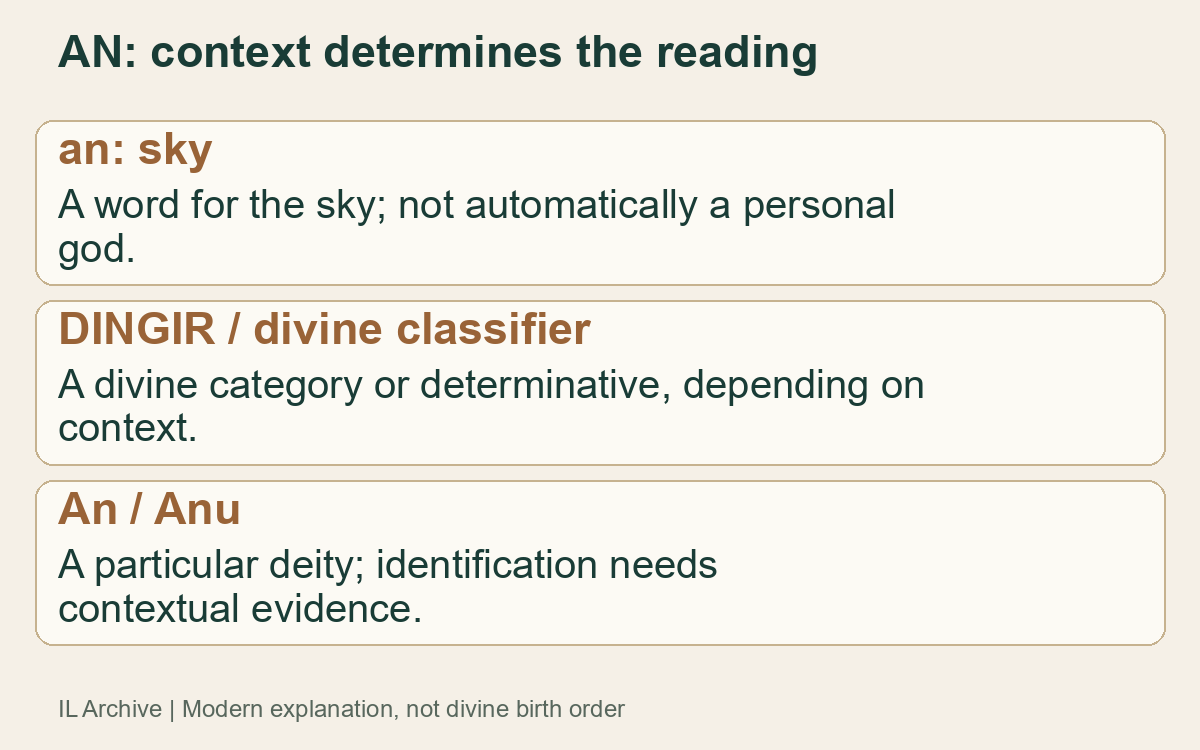
AN is a familiar example. In Sumerian tradition it is associated with “sky,” “god” and the name AnAn / AnuSumerian/Akkadian sky god; multifunctional AN alone cannot identify him in the earliest texts.Glossary · Click to read the explanation, and can function as a divine classifierDivine determinativeA usually unspoken sign classifying a name as divine; usage differs by language, period and name.Glossary · Click to read the explanation. Finding AN in an early text therefore does not by itself establish a reference to the personal godPersonal godAn analytical concept for a deity’s relationship with an individual or family; it may overlap city worship and does not identify the god from a name alone.Glossary · Click to read the explanation An.[3]
The difference concerns function and context as well as shape. The accompanying diagram presents functions known in Sumerian writing traditions; it does not claim they were equally explicit or settled in the earliest Uruk tablets.
What is a divine determinative?
A divine determinativeDivine determinativeA usually unspoken sign classifying a name as divine; usage differs by language, period and name.Glossary · Click to read the explanation classifies a name as divine and normally is not part of its pronunciation. Editors represent it with a raised d, or {d} in some digital transliterations. The Latin letter is a modern convention, rather than the mark an ancient scribe drew.[1]
Usage has exceptions. ORACC explains that Sumerian An normally lacks the determinative, whereas AkkadianAkkadianAn ancient East Semitic language written in cuneiform in Mesopotamia.Glossary · Click to read the explanation writings of Anu employ it. Its absence alone does not establish a nondivine name, and later conventions cannot simply be projected onto every early occurrence.[3]
An: an old sign and a clearer personality
An seems an obvious candidate for the earliest name because AN is ancient. Yet the sign’s age cannot decide its function in every occurrence. Evidence for a personal god An becomes clearer in the third millennium, including Fara lists and a dedication attributed to Mesanepada addressing An as his lordRabbTitle of lordship, ownership or care by context; applied to God in Lord of worlds.Glossary · Click to read the explanation.[3]
This concerns the clarity of surviving evidence, not proof that An was invented then. His cult may be older than an ambiguous early spelling can demonstrate. Reading a sign cannot alone fill the gap.
Nanna at the beginning of documentation
NannaNanna / Su’en / SinMoon god associated with Ur, with early name evidence that does not date every later myth.Glossary · Click to read the explanation, the moon god associated with Ur, is among ORACC’s strongest examples from the beginnings of written documentation, particularly personal names of late Uruk. The god also appears as Su’en and Sin in Mesopotamian traditions, but not every later name form should be assigned to the first tablets.[4]
A divine element in a human name matters because religious language enters a person’s or family’s relationship with a deity. Such a theophoric nameTheophoric nameA personal name containing the name of a deity or a divine element.Glossary · Click to read the explanation need not be a mythological text to preserve religious information.
A small example with phonetic evidence
Woods presents URI3+NA in connection with Nanna’s name as an example of recovering an early reading through a phonetic addition. This is more than drawing a moon and guessing which god it signifies: a combination of signs can itself help recover a spoken form.[1]
It does not prove that the whole system already represented complete language, or that every early name is equally secure. Its value is to prevent the opposite generalization that the first writing was wholly devoid of phonetic use.
The name arrives before the biography
Nanna’s name may establish that a tradition was known without a text of the same period preserving his birth, marriage or relationships with other gods. The name survives, but the dialogue or myth may not.
Later texts make the personality more visible. They may retain older traditions, introduce new formulations, or do both. A god’s antiquity does not automatically make every later story contemporary with the first attestation of the name.
Ninlil in early evidence
ORACC dates attestations of NinlilNinlilGoddess later associated with Enlil and Nippur; early writings require distinguishing sign labels from place context.Glossary · Click to read the explanation to Uruk IV and III, referring to Englund’s discussion. Her familiar identity as EnlilEnlilProminent Mesopotamian god associated with Nippur and Ekur, highly ranked in Early Dynastic texts before the earliest known Anunna attestation.Glossary · Click to read the explanation’s consort and her association with NippurNippur / NuffarMesopotamian city and major Enlil cult centre, connected with kings’ legitimacy beyond the city.Glossary · Click to read the explanation are clearer in later traditions.[5][7]
The inference needs restraint. Finding a writing classified under Ninlil does not transport every known detail of her marriage, children and rituals back into late Uruk.
A sign name does not decide every occurrence
The Proto-Cuneiform Sign List, PCSL, gives a sign the conventional name NINLIL, with its listed published occurrences in Uruk III. One example, DCCLT P000643, is a city list: the writing occurs in a geographical context.[6]
The catalogue label therefore does not turn all occurrences into four direct references to the goddess. Englund discusses conventional “Ninlil” within problems of identifying early writings. The sound approach retains a possible divine connection while specifying the text type and limits of the reading.[7]
Inanna: a visible emblem
InannaInanna / IshtarProminent Mesopotamian goddess with a major centre at Uruk, whose parentage and cult traditions vary rather than forming one fixed genealogy.Glossary · Click to read the explanation offers a different kind of evidence: a relationship between visual emblem and written sign. Visible Language publishes a real clay piece, VAT14540, from Uruk’s Eanna precinctEanna at UrukAn archaeological precinct and institutional centre at Uruk associated with Inanna; its name does not fix every early building’s function.Glossary · Click to read the explanation, dated to Uruk IV, about 3200 BCE. Its form is a post ending in a loop; the catalogue connects it with Inanna’s emblem and the writing of her name.[1]
Interpreting the shape through reed bundles or entrance structures is plausible and influential, but also a research question. Van Dijk-Coombes examines architectural origins of standards, rather than treating visual derivation as self-explanatory.[8]
What appears on the Warka Vase?
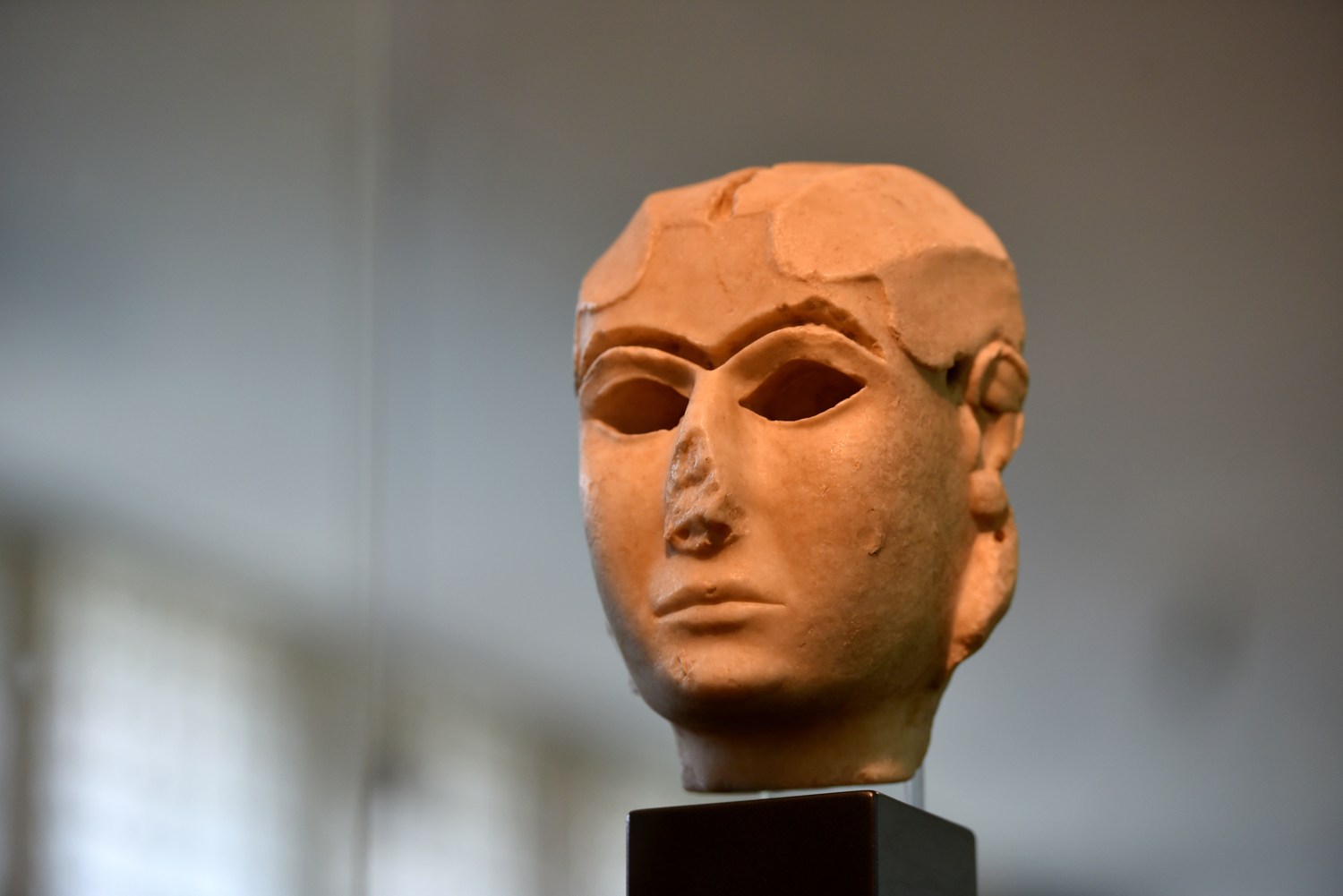
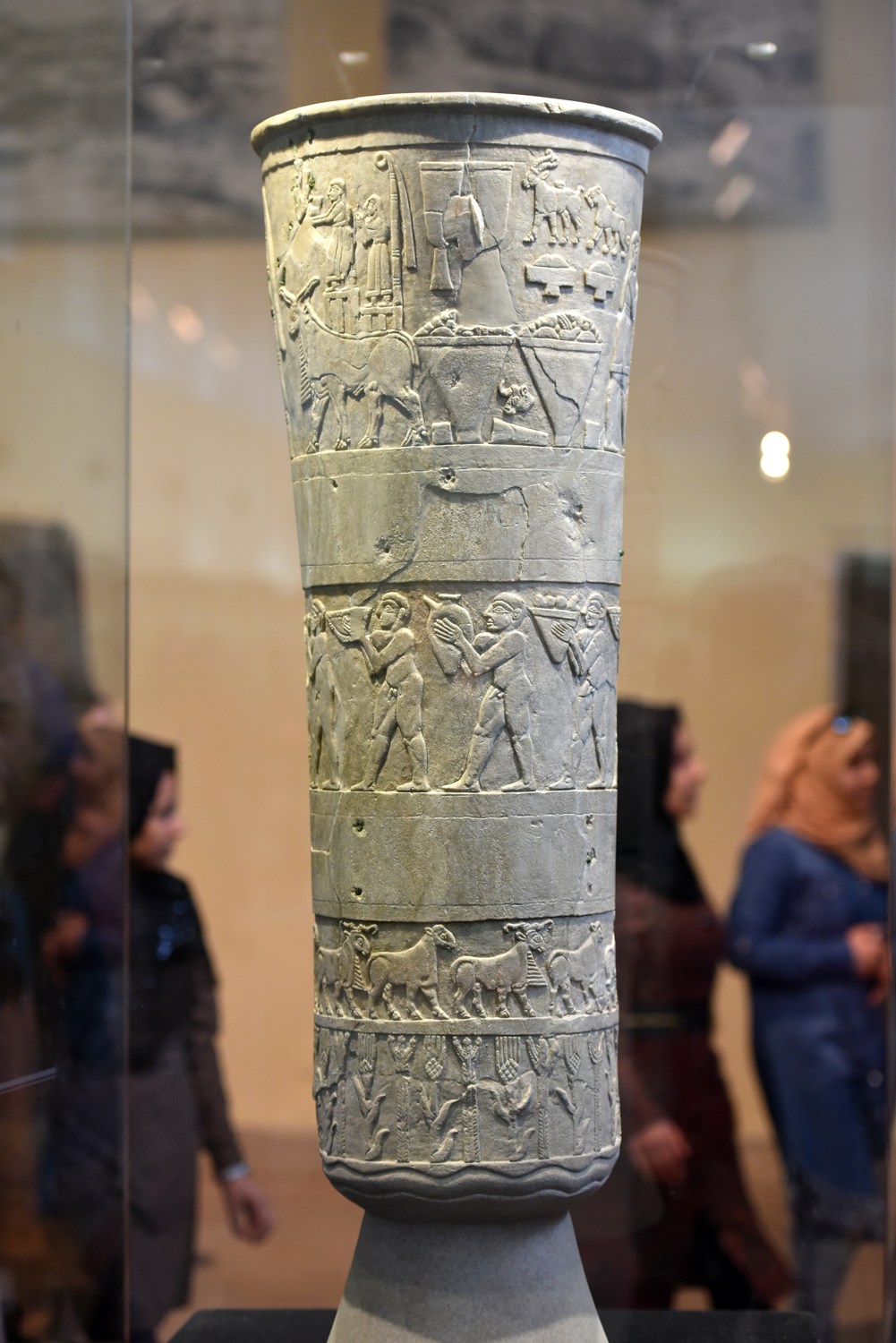
In the Warka Vase’s upper register, two looped emblems stand near a female figure. Comparisons support connecting the scene with Inanna’s sphere. Identifying the woman as the goddess herself or an associated priestess remains disputed.[8]
The image carries no inscription saying “this is Inanna.” An emblem can identify a religious setting without becoming an identity card for every nearby person. The photograph shows the actual vessel in the IraqIraqIraq is a modern country encompassing much of ancient MesopotamiaGlossary · Click to read the explanation Museum; parts have been restored.
From emblem to MUŠ3
The sign conventionally called MUŠ3 is associated with the writing of Inanna’s name. Comparing it with standards connects visual and written evidence, but each occurrence requires its own context.[1][8]
In an administrative account the writing may designate an institution associated with the goddess, while another text employs it in her name. Each repetition is not automatically her appearance or evidence of a particular myth. Institutional and religious meanings can overlap.
Enlil and Nippur: between place and deity
Enlil presents another problem. ORACC discusses a proposal that some earliest writings later used for his name originally designated Nippur. In this model the writing transferred from place to deity between Uruk and the Early Dynastic period.[9]
If correct, this would show the city and its god’s identity overlapping in writing history. It would not establish that Enlil’s cult began when the signs changed function: recording practices may change independently of a tradition’s age.
A hypothesis, not a settled date
ORACC reports Wang’s approximate range, 3200–2800 BCE, for this transfer, explicitly calling the issue highly contested. Englund also warns against excessive confidence in reconstructing some Uruk IV forms and readings.[7][9]
We therefore cannot state the year of Enlil’s “appearance,” or use an ambiguous early spelling to prove him younger than Nanna or Ninlil. The dispute concerns reading and classifying evidence; ranking divine ages is a different question.
The first names are not a complete pantheon
The earliest tablets do not supply a complete early version of the later familiar world: An in heaven, Enlil in authority, EnkiEnkiMesopotamian deity associated with deep fresh water, wisdom and Eridu, known as Ea in Akkadian tradition. The earliest preserved written mention does not date his cult’s origin or identify Ubaid Eridu’s deity.Glossary · Click to read the explanation in freshwater, and a family of spouses, children and messengers. Englund stresses that the clear Early Dynastic pantheonPantheonThe set of deities associated with a religious tradition, including their roles and relationships.Glossary · Click to read the explanation is not found in that form in the proto-cuneiform corpus.[7]
This describes surviving material, without denying broader traditions beyond it. Gods could be known orally while accounts and lists showed little interest in their relationships or stories.
When scribes collect divine names
Early Dynastic IIIa, about 2600–2500 BCE, provides a new window: god listsGod listsTexts collecting divine names for preservation, teaching and classification, with varying theological organization.Glossary · Click to read the explanation from Fara and Abu Salabikh. Fara SF1, accessible through CDLI, begins with An, Enlil, Inanna, Enki, Nanna and Utu. The catalogue places the Abu Salabikh god-list tradition in approximately the same period.[10][11]
Here the name belongs to a list devoted to divine names, making its function clearer than many archaic occurrences. Nevertheless, a list is not itself a creation story or complete genealogy. Collecting names and teaching spellings does not explain every relationship among the gods.
Three clocks, not one
Three dates must be separated: the beginning of a belief, its earliest surviving record, and the earliest evidence confidently interpreted. The first may precede the second; an ambiguous sign may precede a clear text by centuries.
A name can arrive before a myth, or an emblem before a readable name. These differences cannot be converted into fixed intervals. An identified attestation establishes a minimum age for that tradition, without measuring how long it existed earlier.
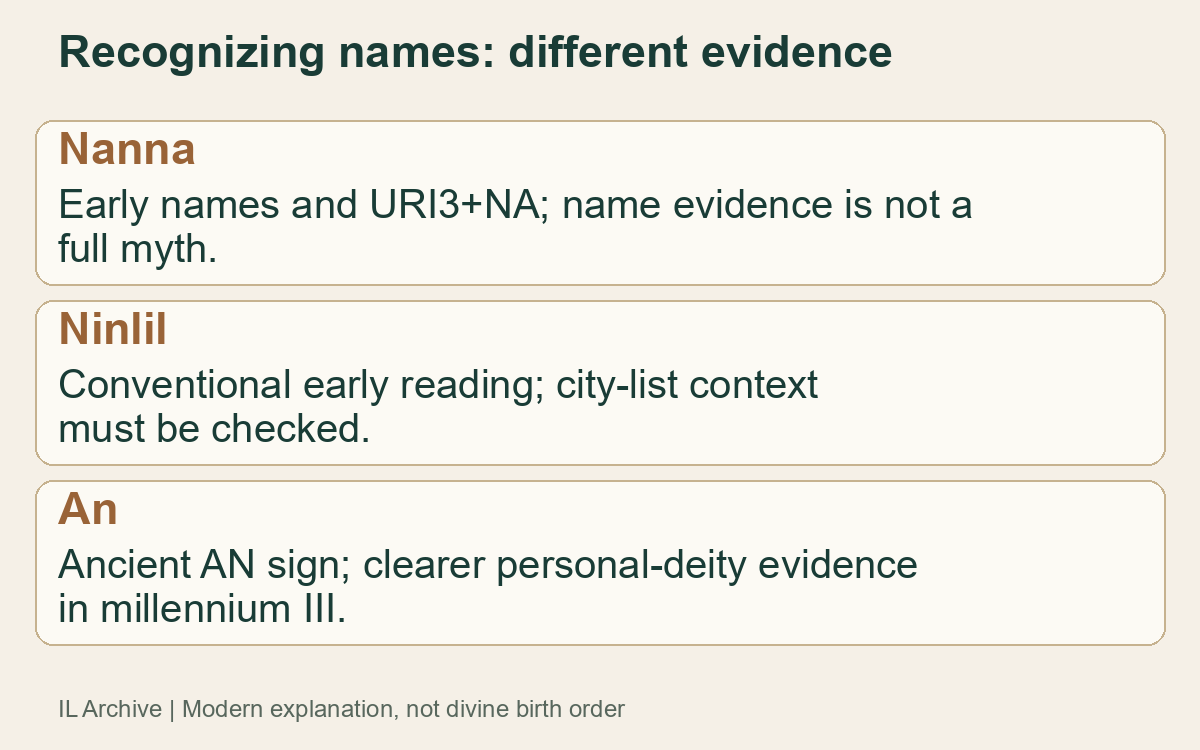
What do we know with different confidence?
Early writing preserves religious references, and some names are recognizable near the beginning of documentation, Nanna being a prominent example. Inanna’s emblem and associated writing provide strong early evidence. Ninlil’s conventionally identified attestations require geographical context to be distinguished from direct references to the goddess.[1][4][5][6]
Early Enlil writings remain contested, while AN requires separating sky, divinity and the personal god. The evidence offers no “birth certificate” for the first deity, but a map of what can be read with varying clarity.[3][7][9]
When clay preserved the name
Tablets initiated a new kind of religious survival for us. The earth preserved signs, some read as names and others as emblems, institutions or places. Later texts let us see divine characters speak, argue and act.
“What is the earliest divine name?” therefore always requires qualifications: in which region and corpus, and under what criterion of reading? The first recognizable name is not necessarily that of the first god humanity knew. It is a name that writing, preservation and scholarly reading succeeded in bringing to us.
References and notes
- Christopher Woods (2010), The Earliest Mesopotamian Writing; Joachim Marzahn, catalogue no. 39 (translated by Robert Wagner). In C. Woods, E. Teeter & G. Emberling, Visible Language. OIMP 32. Selected chronology/language passages; p. 43: URI3+NA and Nanna; p. 70, no. 39, VAT14540: clay Inanna emblem, page visually inspected. Not the whole book. Catalogue photograph not republished. Emblem origin balanced against van Dijk-Coombes. Return to the text ↑
- Cuneiform Digital Library Initiative. W09123d / VAT15253, P000003. Lexical tablet metadata: Uruk IV, ca. 3350–3200 BCE; language catalogued as undetermined. Evidence for catalogue dating, not a particular divine name. Uruk III range checked against Woods. Return to the text ↑
- Kathryn Stevens. An/Anu (god). Ancient Mesopotamian Gods and Goddesses, ORACC. Indexed original-site sections: AN functions, Sumerian An without determinative, clearer Fara/Mesanepada evidence. Direct access failed; Frayne’s underlying publication was not read. Return to the text ↑
- ORACC. Nanna/Suen/Sin (god). Ancient Mesopotamian Gods and Goddesses. Indexed sections on Ur, earliest documentation, late-Uruk personal names and differing name forms. Not all spellings projected into the earliest stage. Phonetic evidence checked against Woods, p. 43. Return to the text ↑
- Nicole Brisch. Ninlil (goddess). Ancient Mesopotamian Gods and Goddesses, ORACC. Indexed Uruk IV/III attestation statement citing Englund, plus later Enlil/Nippur associations. Does not make every archaic occurrence a direct divine name; compared with the sign list and Englund. Return to the text ↑
- ORACC PCSL. NINLIL, sign o0901578; DCCLT, P000643, Archaic Cities (W23998,1). Indexed table lists four published Uruk III occurrences, not four secure goddess references. City list P000643, obverse II 4: E2a NINLIL. Relevant indexed original-site passages read; direct access failed. Return to the text ↑
- Robert K. Englund (2011). Notes on KIDa. Cuneiform Digital Library Notes 2011:6. Discussion of conventional “Ninlil,” city/divine writings, speculative Uruk IV forms and the absence of a clear Early Dynastic pantheon in that form from the archaic corpus. An argument within debate, not a divine birth ranking. Return to the text ↑
- Renate Marian van Dijk-Coombes (2018). The Architectural Origin of Mesopotamian Standards in Late Uruk/Jemdet Nasr Period Iconography. Antiguo Oriente 16, 117–146. Selected pp. 117–126 on standards, MUŠ3 and architecture; pp. 123–124, notes 19–20 on vase, goddess/priestess alternatives and broken headdress. Figure 1 inspected in preceding work; identity passage reread here. Not the whole article. Return to the text ↑
- Adam Stone. Enlil/Ellil (god). Ancient Mesopotamian Gods and Goddesses, ORACC. Indexed passage reports Wang 2011, p. 245, place-to-deity transfer ca. 3200–2800, explicitly highly contested. Wang’s full book not read. Not a date for the beginning of Enlil’s cult. Return to the text ↑
- Cuneiform Digital Library Initiative. SF 001, VAT12760+, Fara god list, P010566. Shuruppak/Fara, not Uruk; Early Dynastic IIIa ca. 2600–2500. Obverse column 1, lines 1–6: An, Enlil, Inanna, Enki, Nanna, Utu. No full theological analysis of the entire list. Return to the text ↑
- Cuneiform Digital Library Initiative. Abu Salabikh God List composite, P499260 / Q000036. Composite lexical god-list entry, Early Dynastic IIIa ca. 2600–2500. Not one complete tablet; not all witnesses read. Not used to establish a fixed number of gods. Return to the text ↑
- The Metropolitan Museum of Art. Administrative account concerning distribution of barley and emmer, 1988.433.2. Tablet ca. 3100–2900 BCE, probably Uruk; grain account. Contextual early-writing photograph, not an attestation of any discussed divine name. Public Domain/Open Access checked; original preserved. Return to the text ↑
Suggest a correction · Suggest a source for this record
Cite this record
IL Archive, «The Earliest Divine Names in Mesopotamia: When Writing Preserved the Name», Edition 1, https://ilarchive.com/en/studies/earliest-divine-names-mesopotamia
Continue reading