Entity · Concept
Rank of Anu — anūtu
A reference page linking a name, group, or concept to the materials that discuss it.
An Akkadian term for supreme rank associated with Anu; dictionary and Enuma Elish examples clarify its attribution to other gods and its limits.
Estimated reading time: 4 min Published Last reviewed:
Share article
Text
Introduction
Anūtu is an AkkadianAkkadianAn ancient East Semitic language written in cuneiform from the third millennium BCE; its varieties include Babylonian and Assyrian, and it served in international diplomacy.Glossary · Click to read the explanation term for the supreme rank or function associated with AnuAn / AnuAn is the Sumerian sky god, called Anu in Akkadian. The sign AN by itself does not identify him: it also denotes sky or divinity.Glossary · Click to read the explanation, the sky god of Mesopotamian traditions. That standing could also be attributed to another god. What distinguishes bearing a god’s name from exercising his authority? Textual examples show a term for rank and prerogatives, not a new divine person.[1][2]
What the rank means
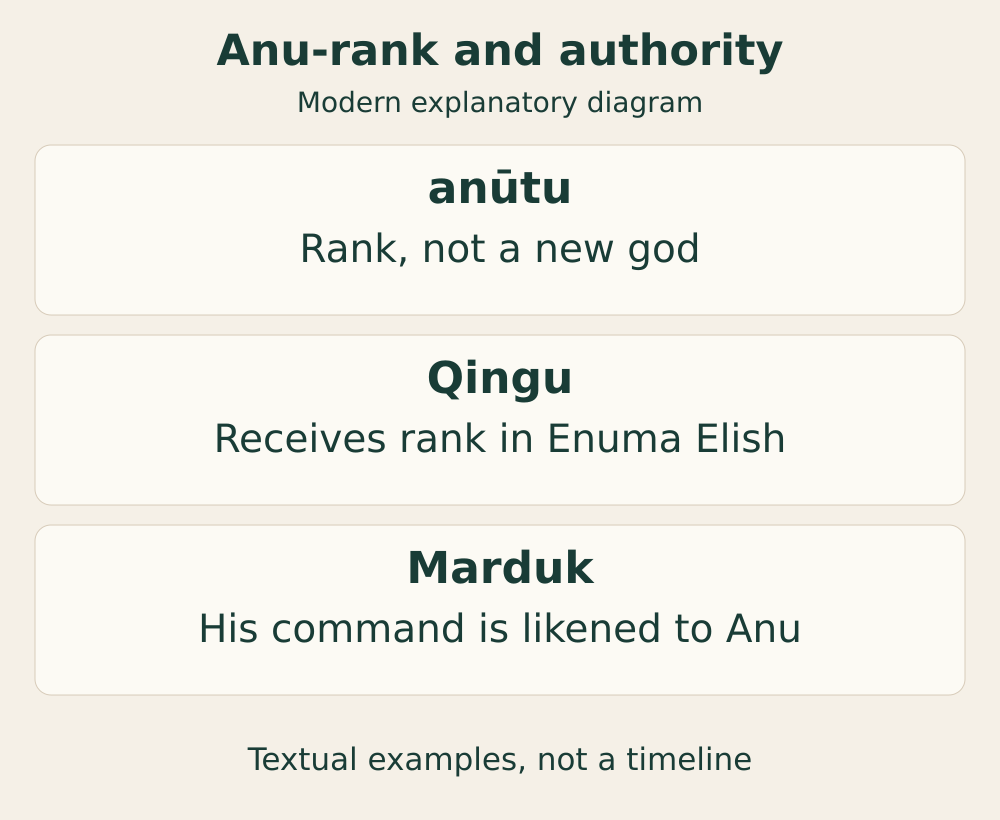
The Chicago Assyrian Dictionary defines the term as the function or rank of the highest god and cites examples involving several deities. It can describe a god’s standing or associated commands, garments and insignia. Examples include the mace of Ninurta, a warrior god in Mesopotamian traditions, and the crown of the moon god SinNanna / Su’en / SinMesopotamian moon god known as Nanna, Su’en and Sîn/Sin. Worshipped especially at Ur and Harran, he is associated with the crescent and lunar cycle; names and myths have different histories.Glossary · Click to read the explanation. “Anu-power” therefore concerns authority and rank here, rather than a measurable substance or energy.[2]
The dictionary also cites a hymn describing MardukMardukBabylon’s leading god, worshipped at Esagil and elevated in the Akkadian Enūma eliš. His symbols include a spade and mušḫuššu dragon. His earliest origins remain obscure; Nibiru is no evidence of a planetary homeland.Glossary · Click to read the explanation, BabylonBabylonBabylon is an ancient city in central present-day Iraq, south of BaghdadGlossary · Click to read the explanation’s god, as endowed with several divine ranks together, including Anu’s, rather than simply bearing Anu’s name. These constructions favour understanding the word as standing and prerogatives that can be combined or attributed, while each occurrence remains context-dependent.[2]
Two examples from the creation poem
In Enuma ElishEnuma ElishA seven-tablet Babylonian creation poem in Akkadian, recounting Marduk’s rise, victory over Tiamat, cosmic ordering and human creation, and culminating in praise through fifty names. Its composition date is debated; later manuscripts and recitation traditions preserve it.Glossary · Click to read the explanation, the Babylonian creation poem, TiamatTiamatTiamat is a primeval divine mother and watery figure in Enūma eliš who later opposes Marduk; he divides her body in making the cosmos. No Babylonian portrait of her is securely identified.Glossary · Click to read the explanation promotes the god QinguQinguQingu (Kingu): a god whom Tiamat appoints commander and gives the Tablet of Destinies; captured after Marduk’s victory, his blood is used to make humans in Tablet VI.Glossary · Click to read the explanation to lead her group and gives him the Tablet of Destinies. Tablet I, line 159 describes his acquisition of this standing. In Tablet IV, line 82, Marduk reproaches her for assigning him that prerogative. This is speech within the poem’s conflict, not a record of a historical appointment.[3]
The term itself can be seen in the modern edition’s transcription of I 159, rather than only in a scholar’s paraphrase:
The sense here is “when Qingu was elevated and acquired Anu-rank.” The words leqû ānūti belong to the account of his promotion and investiture. In IV 82, ana paraṣ ānūti, “to the prerogatives of Anu-rank,” occurs in the accusation that Tiamat gave Qingu a position unbefitting him. The dictionary registers an alternative reading e-nu-ti at this locus, whereas the 2025 transcription adopts ānūti; identical wording in every manuscript should not be assumed. The quotation is from an edited text assembled from witnesses, not a direct reading of the cover photograph.[2][3]
In Tablet IV, lines 4 and 6, the authority of Marduk’s command is compared with Anu. The image relates to the same idea, but the expression does not use the abstract noun anūtu: it likens the standing of the command to Anu’s. Keeping this distinction separates an occurrence of the term from a related illustration of its meaning.[3]
The short phrase in IV 4 and 6 is siqarka ānu, literally “your command is Anu”; in context, it means that the command is like Anu’s. The following verses proclaim the permanence of Marduk’s command and his ability to elevate and bring low. This supports a reading about authority more strongly than a declaration that Marduk and Anu are one person. The charge against Tiamat concerns Qingu’s entitlement to such authority, not the existence of the concept of rank.[3]
Keeping the dates distinct
- The epic’s action takes place in mythic beginnings; it does not date a human appointment or an event assignable to a particular year.
- Many scholars favour composition in the late second millennium BCE, though its precise dating remains debated. Enrique Jiménez presents what he interprets as a quotation from the epic under Marduk-nadin-ahhe, in the eleventh century BCE; a specific connection between its composition and Nebuchadnezzar I remains hypothetical.[4]
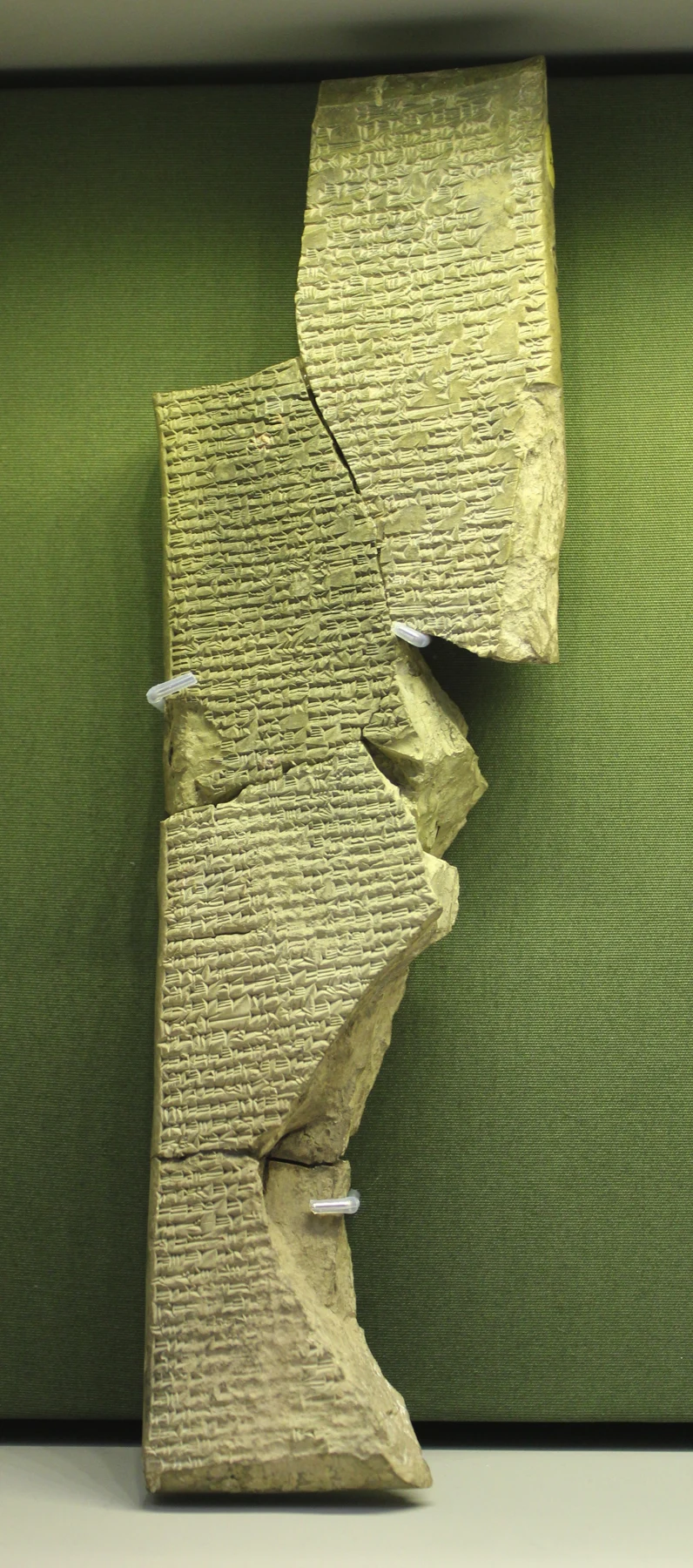
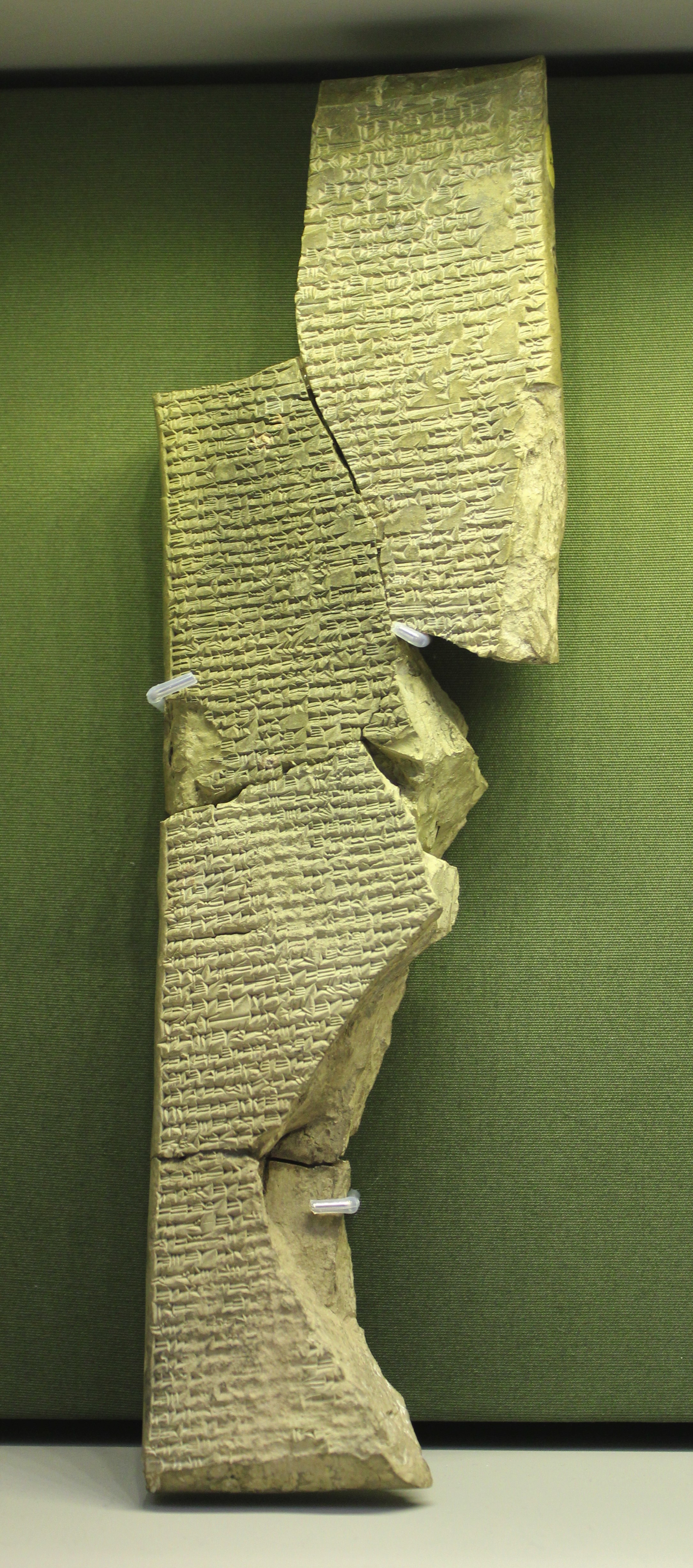
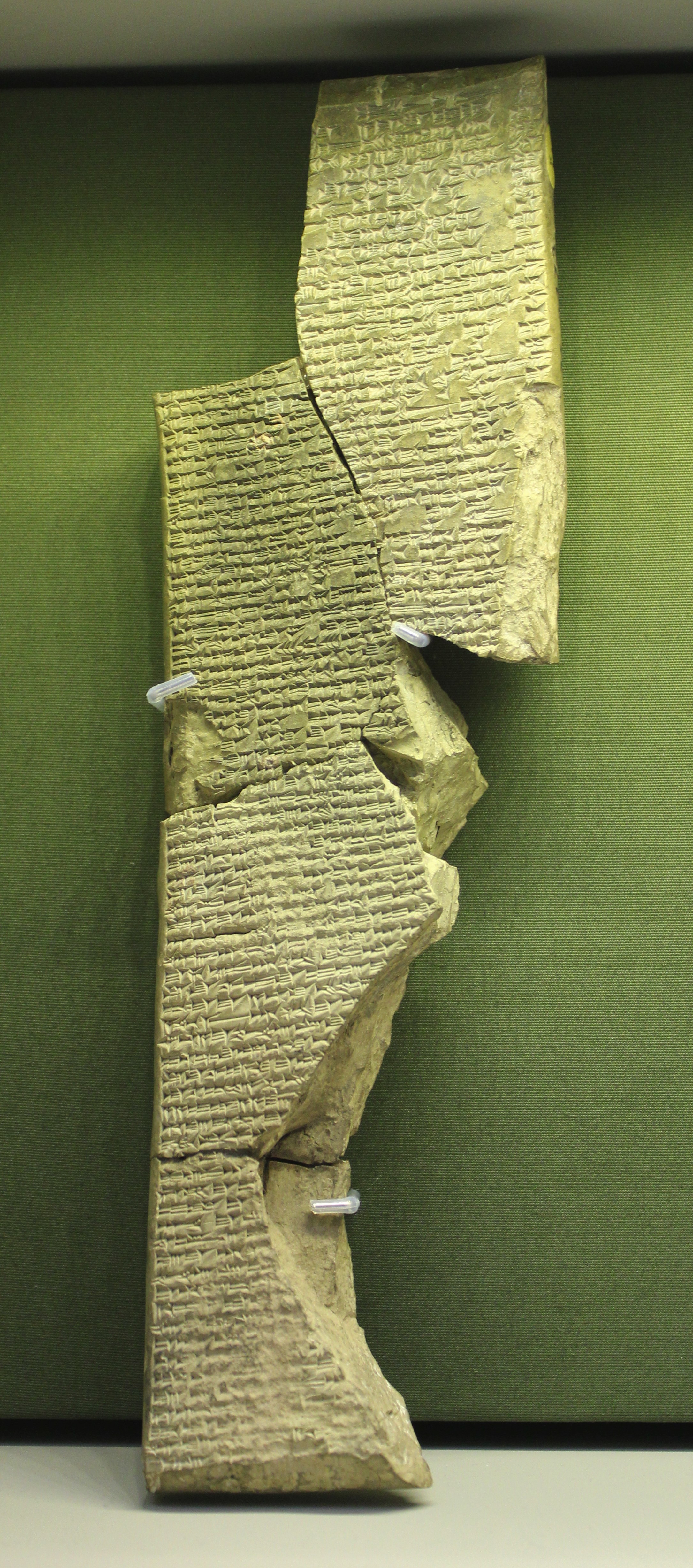
- The partial manuscript pictured on the cover comes from seventh-century BCE NinevehNineveh and KuyunjikNineveh is an ancient Assyrian city near Mosul in northern Iraq; Kuyunjik is one of its archaeological moundsGlossary · Click to read the explanation, in the Neo-Assyrian period. It witnesses Tablet III, not Tablets I or IV quoted here. The artifact’s date differs both from the poem’s composition and from the time of its narrative.[5]
Limits of the inference
Attributing the standing to Marduk or Qingu does not automatically make either an alternative name for Anu. Nor does a literary passage alone date the end of Anu’s cult or a single continuous succession to the gods’ throne. The question is how a particular text expresses a deity’s authority within traditions that maintained Anu’s status even as other gods gained prominence.[1]
References and notes (5)
- Kathryn Stevens, “An/Anu (god)”, Ancient Mesopotamian Gods and Goddesses, ORACC. Functions: Anu-rank, authoritative command and other gods sharing his functions; indexed passages from the original page. Return to the text ↑
- The Assyrian Dictionary of the Oriental Institute of the University of Chicago, A/2 (1968), s.v. anūtu. Pp. 150–151, complete anūtu entry: rank, mace/crown examples, Marduk hymn, and alternative reading at Enuma Elish IV 82. Examples checked as collected by the dictionary, not independently collated on every tablet. Return to the text ↑
- Adrian C. Heinrich (transcription) and Sophus Helle (translation), “Enuma Elish”, in Johannes Haubold et al. (eds.), Enuma Elish: The Babylonian Epic of Creation, Bloomsbury (2025). Tablet I 147–162; IV 1–35 and 75–86; pp. 34–35, 54–55 and 58–59. Heinrich’s transcription checked with Helle’s translation and commentary; short renderings follow these, not independent tablet collation. No restoration marks occur in the quoted short extracts from I 159 and IV 4. Return to the text ↑
- Sophus Helle, “Introduction”, and Enrique Jiménez, “Marduk and the battle with the sea: On the dating of Enuma Elish”, in Johannes Haubold et al. (eds.), Enuma Elish: The Babylonian Epic of Creation (2025). Introduction pp. 11–13 and dating discussion/conclusion pp. 105–106; distinction between the broad preferred date, a specific hypothesis and the dated quotation. Return to the text ↑
- Cuneiform Digital Library Initiative, P365283, manuscript witness of Enuma Elish Tablet III. Also the Wikimedia Commons file description. Artifact metadata: Nineveh, Neo-Assyrian period, K.3473+ joined fragments, British Museum; no identification of individual photographed lines from the image alone. Zunkir’s Commons description assigns the piece to the seventh century BCE, within the catalogue’s broader Neo-Assyrian period. https://commons.wikimedia.org/wiki/File:Enuma_Elish_K.3473.jpg Return to the text ↑
Suggest a correction · Suggest a source for this record
Cite this record
IL Archive, «Rank of Anu — anūtu», https://ilarchive.com/en/entities/anutu
Continue reading