Entity
Qingu
A reference page linking a name, group, or concept to the materials that discuss it.
- Names
- Kingu
A god in Enuma Elish, appointed commander by Tiamat and given the Tablet of Destinies. Captured after Marduk’s victory, he is condemned in Tablet VI and his blood is used to create humans.
Estimated reading time: 7 min Published Last reviewed:
Share article
Video
Enuma Elish: The first waters, the storm and the fifty names
The first waters, the storm and the fifty names. The whole story in four illustrated chapters, told from the ancient clay tablets; where the tablets are broken, the narration says so. Illustrations, narration voice and visual effects were created with AI tools by IL Archive; the text is a faithful retelling based on the ancient tablets.
The YouTube player loads only when you press play. Watch on YouTube
Text
Introduction
Qingu, also written Kingu, is a god in the AkkadianAkkadianAn ancient East Semitic language written in cuneiform from the third millennium BCE; its varieties include Babylonian and Assyrian, and it served in international diplomacy.Glossary · Click to read the explanation poem Enuma ElishEnuma ElishA seven-tablet Babylonian creation poem in Akkadian, recounting Marduk’s rise, victory over Tiamat, cosmic ordering and human creation, and culminating in praise through fifty names. Its composition date is debated; later manuscripts and recitation traditions preserve it.Glossary · Click to read the explanation. He commands the forces gathered by TiamatTiamatTiamat is a primeval divine mother and watery figure in Enūma eliš who later opposes Marduk; he divides her body in making the cosmos. No Babylonian portrait of her is securely identified.Glossary · Click to read the explanation against the other gods, receives the Tablet of Destinies from her, and becomes a prisoner after MardukMardukBabylon’s leading god, worshipped at Esagil and elevated in the Akkadian Enūma eliš. His symbols include a spade and mušḫuššu dragon. His earliest origins remain obscure; Nibiru is no evidence of a planetary homeland.Glossary · Click to read the explanation wins the battle. In Tablet VI, the divine assembly names him as the instigator of the conflict, and his blood is used to create humankind. His role brings together three connected questions: who has the authority to decree destinies, how defeated opponents are punished, and why humans must perform labor on behalf of the gods.
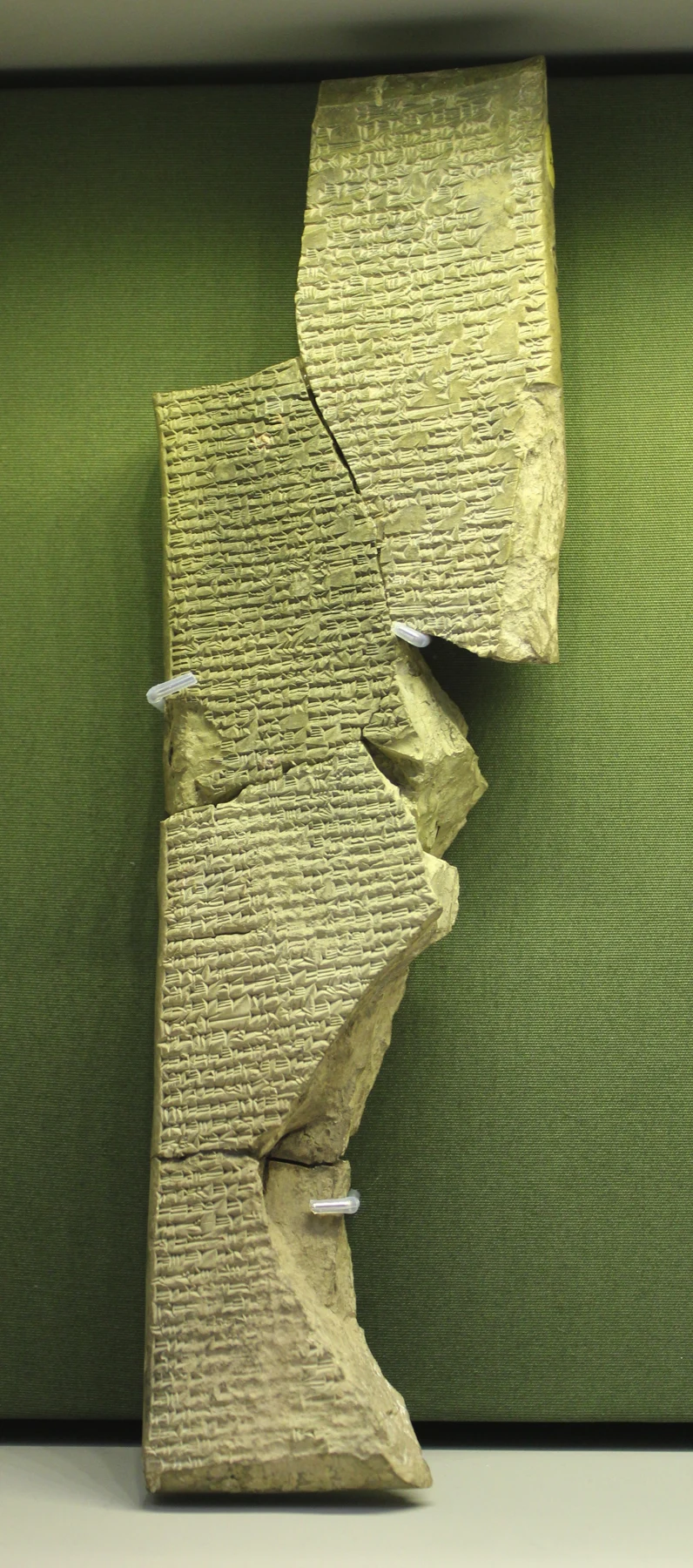
This article describes Qingu as a character in a transmitted literary work. It does not treat him as a datable historical person or the mythic creation of humanity as an archaeological event. It separates the wording of the poem, modern interpretations, and the limited information established by the surviving tablet shown in the photograph. [2]
Contents
- The name and its literary setting
- Tiamat appoints a commander
- Defeat, captivity, and the Tablet of Destinies
- The divine verdict and human creation
- A comparison with Atrahasis
- The photographed witness and the date of the poem
- What the image and the sources cannot establish
The name and its literary setting
Qingu and Kingu are modern ways of spelling the same name, not two different deities. In English, Qingu often follows the more scholarly spelling, while Kingu remains widespread. His principal narrative setting is a Babylonian poem on seven tablets, tracing the emergence of the gods, Marduk's ascent, and the ordering of the cosmos. Qingu is not another name for Marduk, nor is he the first human. The poem gives him a dramatic part, but no historically datable biography or securely attested portrait. We must not infer an independent cult history merely from his appearance in this episode. [1][2]
The conflict grows out of tensions between older and younger gods. ApsûApsûApsû: primordial watery ancestor in Enuma Elish, killed by Ea after plotting against the younger gods. Ea’s sanctuary later bears the same name; distinct in context from the broader cosmic Abzu.Glossary · Click to read the explanation is killed by EaEnkiMesopotamian deity also known as Ea, linked with Eridu and the Abzu (deep fresh waters), wisdom, incantations, and narratives of creation and cosmic order. Later written attestations do not identify the deity of Eridu’s earliest layers.Glossary · Click to read the explanation (Enki), and Tiamat's opposition develops in the aftermath. She is not presented from the outset as an unchanging embodiment of evil. Qingu's elevation belongs to this escalation and is not a title that he held at the beginning of the poem. [2]
Tiamat appoints a commander
In Tablet I, especially lines 147–162, Tiamat mobilizes her forces, appoints Qingu their commander, and elevates him as her consort and a leader among the gods. She places the Tablet of Destinies on his breast. Within the poem, this act confers the power to issue binding decrees: Qingu receives the emblem of authority from Tiamat rather than seizing it by himself. His appointment carries weight for her allies, but it does not guarantee his victory or the permanence of his position. [2]
The appointment can be read as a rival claim to the sovereignty the poem will establish for Marduk. Yet calling Tiamat's authority inherently illegitimate would turn the victorious side's narrative perspective into an independent historical verdict. At stake in this episode are divine kingship and the distribution of authority over destinies, not simply a confrontation between fantastic monsters. [2]
Defeat, captivity, and the Tablet of Destinies
Tablet IV recounts Marduk's defeat of Tiamat and the scattering of her army. In lines 119–123, Marduk binds Qingu, removes the Tablet of Destinies, and fastens it to his own breast. A modern translation associates the captive with the dead gods at this point, but the passage does not describe the shedding of Qingu's blood or the making of humans. Those acts belong to Tablet VI. Collapsing captivity, condemnation, and death into one scene obscures the sequence of the poem. [1][2]
The legendary Tablet of Destinies is not the clay tablet depicted with this article. One is a mythic object expressing authority to decide destinies; the other is an archaeological witness on which scribes wrote part of the poem. They should not be treated as the same object. [2][4]
The divine verdict and human creation
Early in Tablet VI, Marduk proposes that human beings be made to take over work so that the gods may rest. Ea proposes that one of the gods responsible for the disorder be surrendered. Asked who provoked the conflict, the IgigiIgigiCollective of deities called Igigi or Igigū in Akkadian sources from the Old Babylonian period onward. They labour and rebel in Atrahasis; their numbers and relation to the Anunnaki vary by text.Glossary · Click to read the explanation name Qingu. The narrative then says that he was bound and presented to Ea, that his punishment was imposed and his veins cut, and that humankind was created from his blood and assigned the toil of the gods. [2]
The allocation of agency matters: Marduk proposes the plan, the assembly makes the accusation, and the creation itself is associated with Ea in the context of the modern translation. Some general accounts say simply that Marduk created humanity from Qingu's blood. This expresses responsibility for the larger scheme but compresses the actors specified in Tablet VI, lines 1–36. The claim that Qingu fomented rebellion is the gods' verdict within the story, not a source-independent factual finding about his moral guilt. [1][2][6]
Blood here is part of a literary and religious account of what people are for, not a testable biological explanation of human origins. The poem makes human service the condition under which the gods are freed from burdensome tasks and Marduk's order can function. Qingu's death therefore belongs to the epic's account of cosmic and political authority, rather than being an isolated story about a slain god. [2][6]
A comparison with Atrahasis
The idea that humans take on the gods' work also occurs in the Epic of AtrahasisAtrahasis: Epic and HeroAkkadian narrative on human creation, relations with the gods and the flood, named for its survivor warned by Enki. Its surviving manuscripts differ in date and preservation; its hero must not be equated uncritically with every Utnapishtim version.Glossary · Click to read the explanation. The details are not the same. In the version presented by an online adaptation of Benjamin Foster's translation, a god called Aw-ilu is slaughtered and the birth goddess mixes his flesh and blood with clay. That god is not Qingu, and the presence of clay and the birth goddess are distinctive features of the other narrative. The parallel supports a shared concern with divine labor and the origins of humans; by itself it establishes neither identical characters nor a demonstrable line of borrowing between the two compositions. [7]
Other Mesopotamian creation narratives likewise differ in protagonists and sequence. Enuma Elish should not be presented as the one account uniformly believed in every Mesopotamian city or period. [6]
The photographed witness and the date of the poem
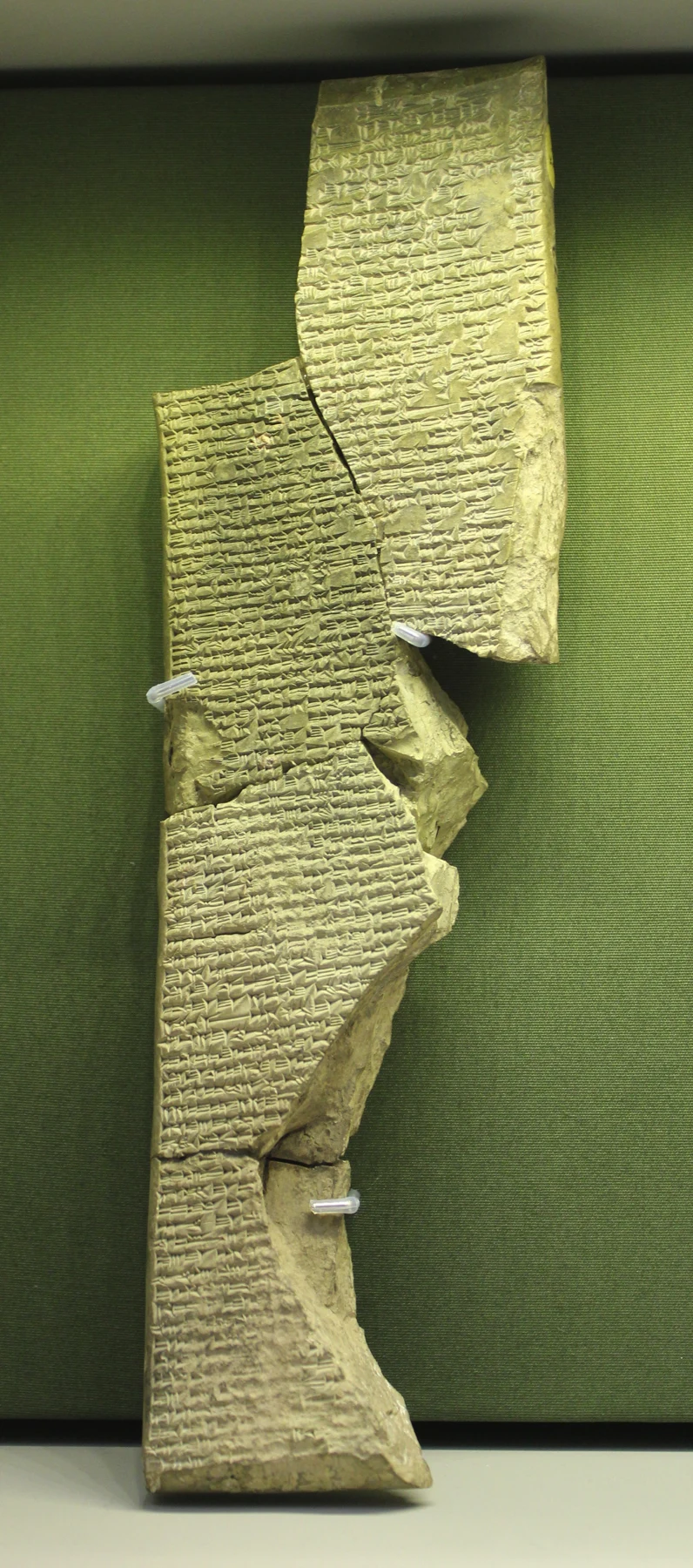
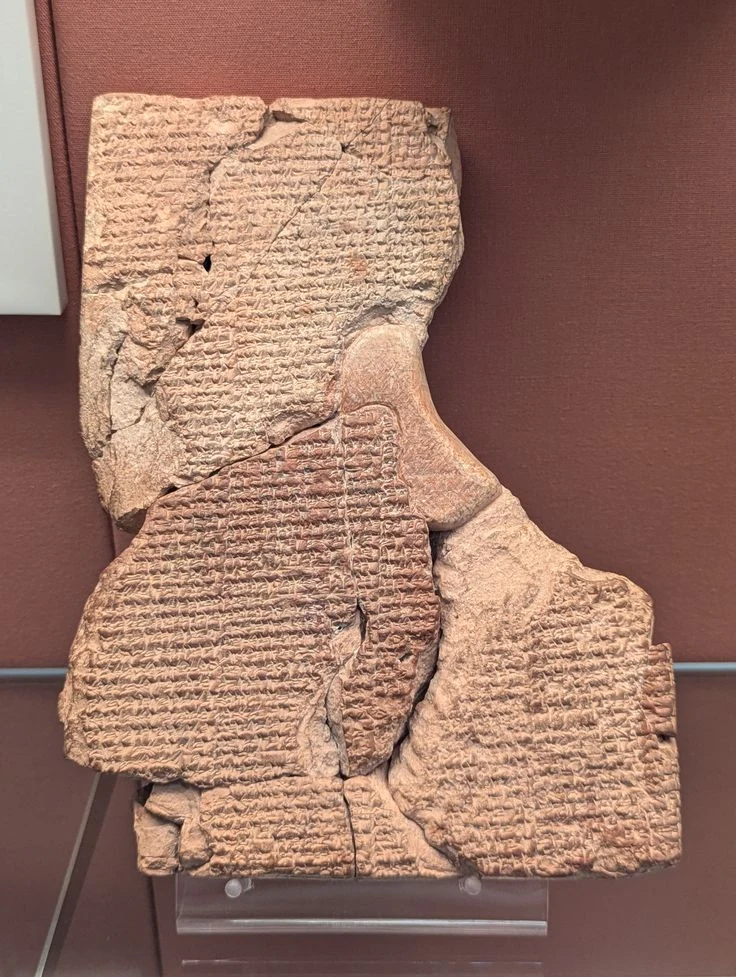
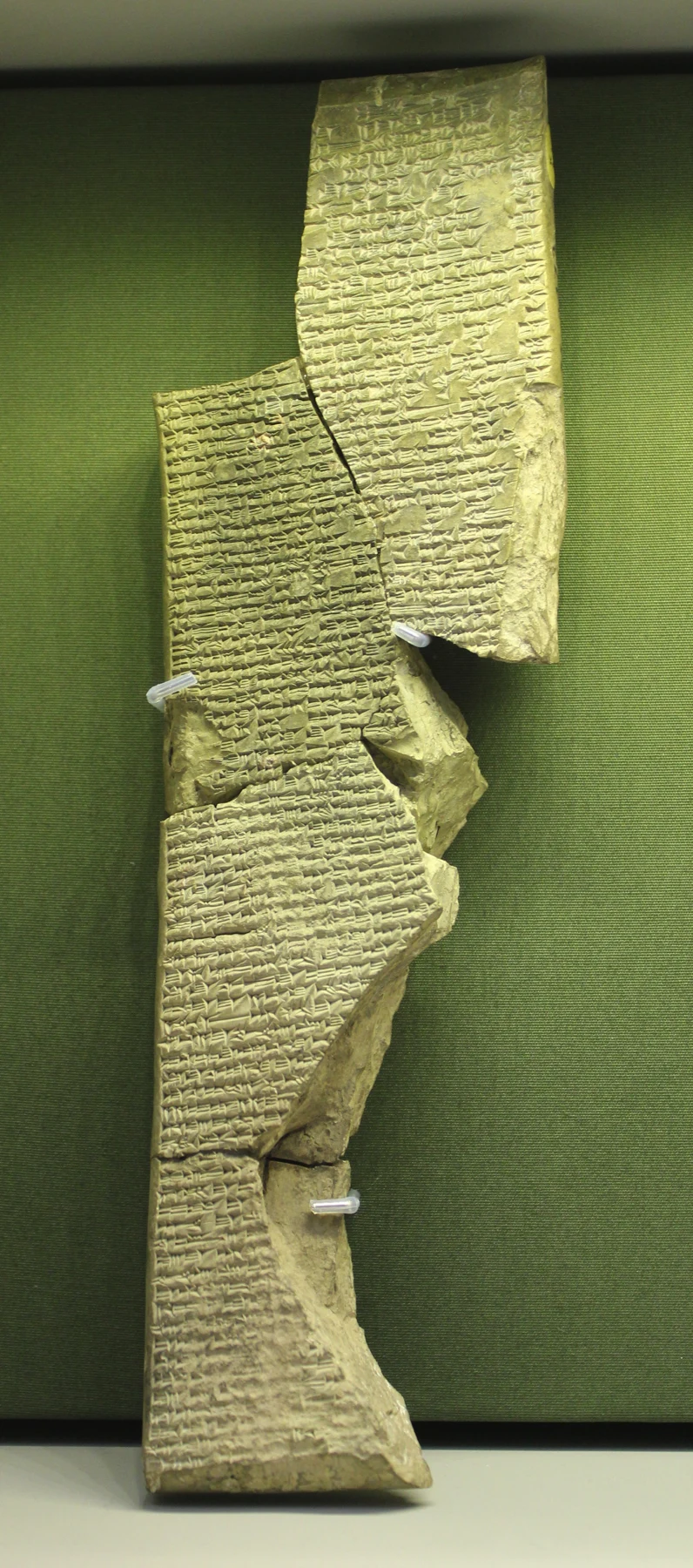
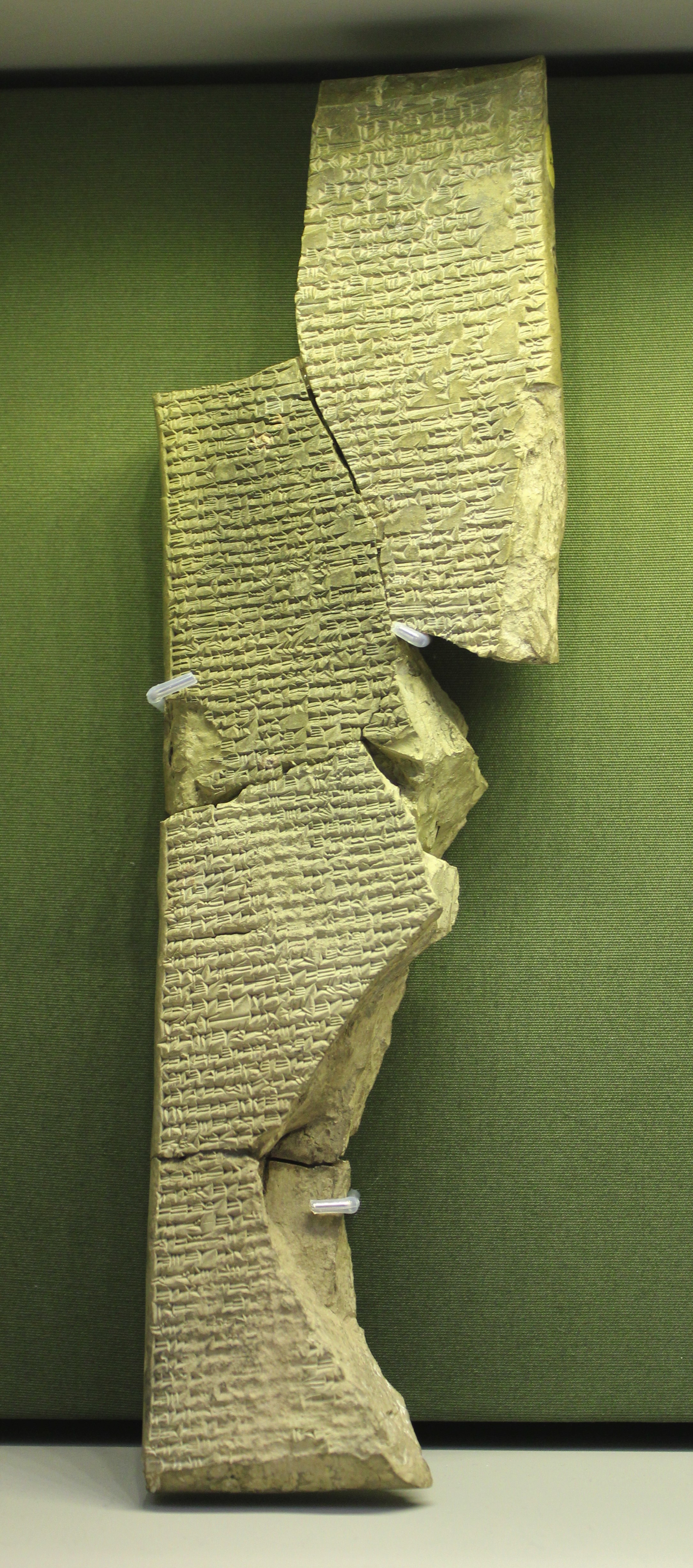
The cover photograph shows clay tablet K.3473 from Nineveh (Kuyunjik)Nineveh and KuyunjikNineveh is an ancient Assyrian city near Mosul in northern Iraq; Kuyunjik is one of its archaeological moundsGlossary · Click to read the explanation, now in the British Museum. The CuneiformCuneiformWriting with wedge-shaped signs, developed from Mesopotamian recording traditions and used for several languages from the third millennium BCE.Glossary · Click to read the explanation Digital Library Initiative identifies the relevant textual witness as part of Tablet III of Enuma Elish, under catalogue number P365283, and dates the material to the Neo-Assyrian period. Its record lists further fragment numbers in the object's joined or composite documentation; a photograph of one piece must not be equated with the full seven-tablet poem. Most importantly, Qingu's blood appears in Tablet VI, not Tablet III. The photograph documents the poem's transmission; it neither depicts Qingu nor directly preserves that creation scene. [3][4]
The photographed witness comes from the first millennium BCE and is commonly described as seventh-century BCE. Composition was probably considerably earlier. A widespread scholarly position places the poem in the late second millennium BCE; Wilfred Lambert associated it with the reign of Nebuchadnezzar I (1125–1104 BCE), while an earlier Old Babylonian date has also been proposed. Enrique JiménezEnrique JiménezAssyriologist and scholar of Babylonian literature, professor of ancient Oriental languages at LMU Munich, working on reconstructing and dating cuneiform texts.Glossary · Click to read the explanation discusses evidence for an allusion during the reign of Marduk-nadin-ahhe (1099–1082 BCE), providing a proposed latest possible period for composition. Such evidence does not yield a universally accepted precise year, let alone a date for the fictional life of Qingu. [2][3][4]
What the image and the sources cannot establish
The photograph used here was published on Wikimedia Commons by Zunkir, with a photographic date of 9 March 2020 and a CC BY-SA 4.0 license. The image is a WebP derivative converted previously from a JPEG photograph; these format details and the license are documented with the image. Nothing in the photograph supplies a physical portrait of Qingu: it shows cuneiform lines on broken clay. [5]
Qingu's role can be established confidently from specific passages of the poem. By contrast, the symbolism of the Tablet of Destinies, the justice of his punishment, the date of the poem's composition, and its relationships to other creation stories require qualified interpretation. Keeping these levels of evidence separate makes Qingu valuable for understanding authority, violence, and creation in Enuma Elish, without projecting a modern reconstruction onto the ancient words. [2][7]
References and notes (7)
- Alexander Heidel, The Babylonian Genesis, 2nd ed. (1951). Selected passages from this older translation were compared with the modern version; the entire book or all seven tablets were not read for this review. Tablets I, roughly lines 147–162; IV, roughly 119–123; VI, lines 1–36. Return to the text ↑
- Johannes Haubold, Sophus Helle, Enrique Jiménez and Selena Wisnom, eds., Enuma Elish (Bloomsbury, 2025 print imprint). Cuneiform transliteration by Adrian C. Heinrich; English translation by Sophus Helle. Specific translation passages, the introduction, and the dating discussion were consulted, not the complete book; composition dates remain scholarly proposals. Introduction, print pp. 11–12 (PDF pp. 24–25); Tablet I 129–162, pp. 34–35 (PDF 47–48); IV 95–123, p. 61 (PDF 74); VI 1–36, p. 75 (PDF 88); Jiménez on dating, approx. print pp. 99–106 (PDF 112–119). Return to the text ↑
- British Museum collection catalogue, K.3473. The object number and period were checked using indexed catalogue data and its CDLI cross-reference; direct access to the full museum page was blocked (403), so no full-page reading is claimed. Collection object W_K-3473 (K.3473), Nineveh / Neo-Assyrian; linked as a museum reference by CDLI. Return to the text ↑
- Cuneiform Digital Library Initiative, P365283 metadata history: a Neo-Assyrian Akkadian witness to Enuma Elish Tablet III from Nineveh, with joined fragment inventory. The displayed metadata history was read; this was not an independent reading of the cuneiform or every linked fragment. Artifact P365283, Literary 002718.03, ex. 001; period, provenience, accession_no, genres_comment, languages; update of 25 May 2024. Return to the text ↑
- Zunkir, Wikimedia Commons file description and license for Enuma Elish K.3473.jpg. The file page and CC BY-SA 4.0 statement were read; both the original image included as context and the preserved WebP version were inspected. File summary, Zunkir, 9 March 2020; original JPEG 2170×4908; CC BY-SA 4.0. Return to the text ↑
- Ira Spar, “Mesopotamian Creation Myths,” Metropolitan Museum of Art (April 2009). The complete online essay was read. Its broad attribution of creation to Marduk is an overview, supplemented here with the finer distinction of agents in the modern Tablet VI translation. Essay paragraphs on Enuma Elish, Tiamat, Qingu, and the creation of humanity (2009). Return to the text ↑
- Epic of Atrahasis, English translation on Livius adapted from Benjamin R. Foster. The sections on divine labor, the proposal, Aw-ilu’s death, and mixing clay with blood were read; no independent Akkadian collation or complete comparative edition is claimed. “Proposals by Ea, Belet-ili, and Enki” and “The Creation of Man”, displayed lines [a1]–[245]. Return to the text ↑
Suggest a correction · Suggest a source for this record
Cite this record
IL Archive, «Qingu», https://ilarchive.com/en/entities/kingu
Continue reading
Related readings