Person
Enrique Jiménez
Assyriologist and scholar of Babylonian literature, professor of ancient Oriental languages at LMU Munich, working on reconstructing and dating cuneiform texts.
Last reviewed:
Text
Enrique Jiménez researches Assyriology and cuneiformCuneiformWriting with wedge-shaped signs, developed from Mesopotamian recording traditions and used for several languages from the third millennium BCE.Glossary · Click to read the explanation literature. LMU Munich identifies him as professor of ancient Oriental languages. His work includes Electronic Babylonian Literature and joining fragments to reconstruct texts more fully. [1]
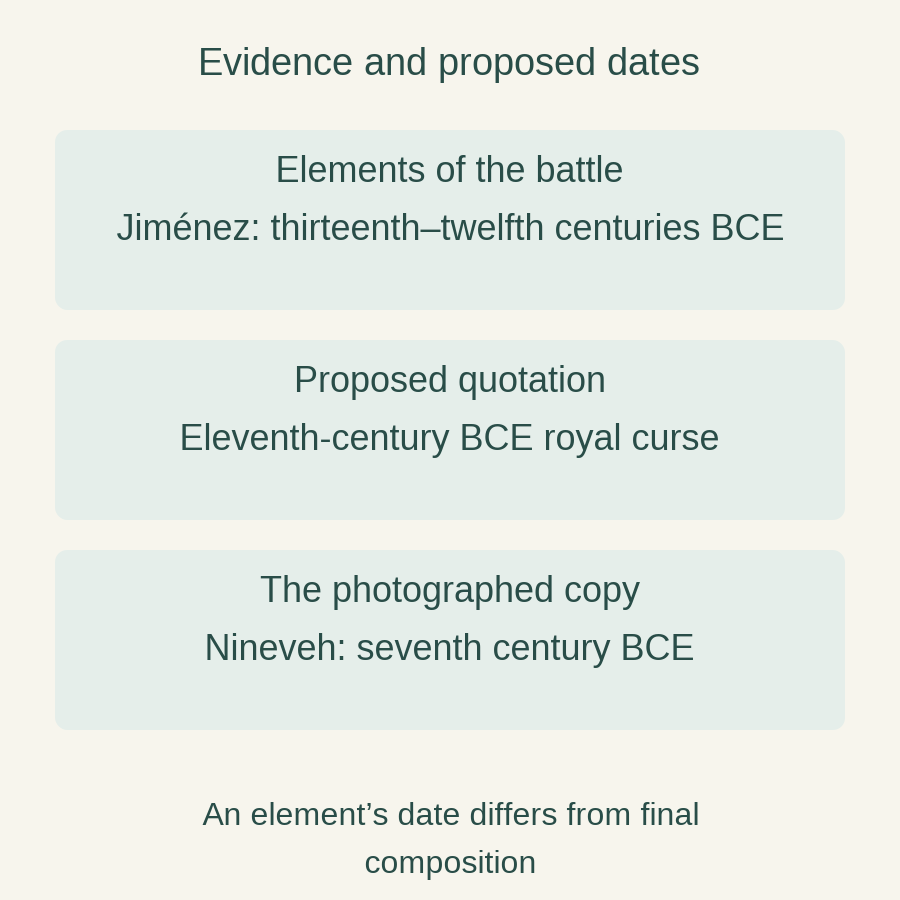
His chapter on dating Enuma ElishEnuma ElishA seven-tablet Babylonian creation poem in Akkadian, recounting Marduk’s rise, victory over Tiamat, cosmic ordering and human creation, and culminating in praise through fifty names. Its composition date is debated; later manuscripts and recitation traditions preserve it.Glossary · Click to read the explanation, in a volume bearing the year 2025, compares a phrase from MardukMardukBabylon’s leading god, worshipped at Esagil and elevated in the Akkadian Enūma eliš. His symbols include a spade and mušḫuššu dragon. His earliest origins remain obscure; Nibiru is no evidence of a planetary homeland.Glossary · Click to read the explanation’s battle with TiamatTiamatTiamat is a primeval divine mother and watery figure in Enūma eliš who later opposes Marduk; he divides her body in making the cosmos. No Babylonian portrait of her is securely identified.Glossary · Click to read the explanation to an eleventh-century BCE royal curse. The proposed quotation and the watery-disease tradition support an early date for elements of the narrative, while authorship and final composition under a particular king remain open. [2]
References and notes
- Official indexed biographical/project paragraph read, with the university’s short position page. Listed works are not thereby read. LMU, Filling in the Gaps, 2019; researcher paragraph and eBL project Return to the text ↑
- Jiménez pp. 99–106 and Frahm pp. 158–161 freshly read, with the specified translation passages. Earlier independent reading reused for remaining comparison passages, not the whole volume. Jiménez’s dated-quotation argument and Frahm’s probable literary-relationship position are preserved and attributed. Haubold, Helle, Jiménez & Wisnom (eds.), Enuma Elish, 2025 imprint/repository 2024; I 1–64, IV 1–35, 95–146, V 1–21, VI 1–65; Jiménez pp. 99–106, Frahm pp. 158–161 Return to the text ↑
Suggest a correction · Suggest a source for this record
Cite this record
IL Archive, «Enrique Jiménez», https://ilarchive.com/en/people/enrique-jimenez-assyriologist