Artifact
The Michaux Stone: A Babylonian Marriage Gift (BnF 702)
An object record bringing together its image, metadata, rights, and context.
- Timeline
- From 1100 BCE to 1083 BCE
- Region
- Mesopotamia
A dark stone records the gift of irrigated land from a Babylonian father to his daughter. Its measured boundaries, family oath and carved divine emblems show how the deed was meant to protect the transfer.
Estimated reading time: 4 min Published Last reviewed:
Share article
Photograph
Photograph by Marie-Lan Nguyen (Jastrow), via Wikimedia Commons. Public domain.
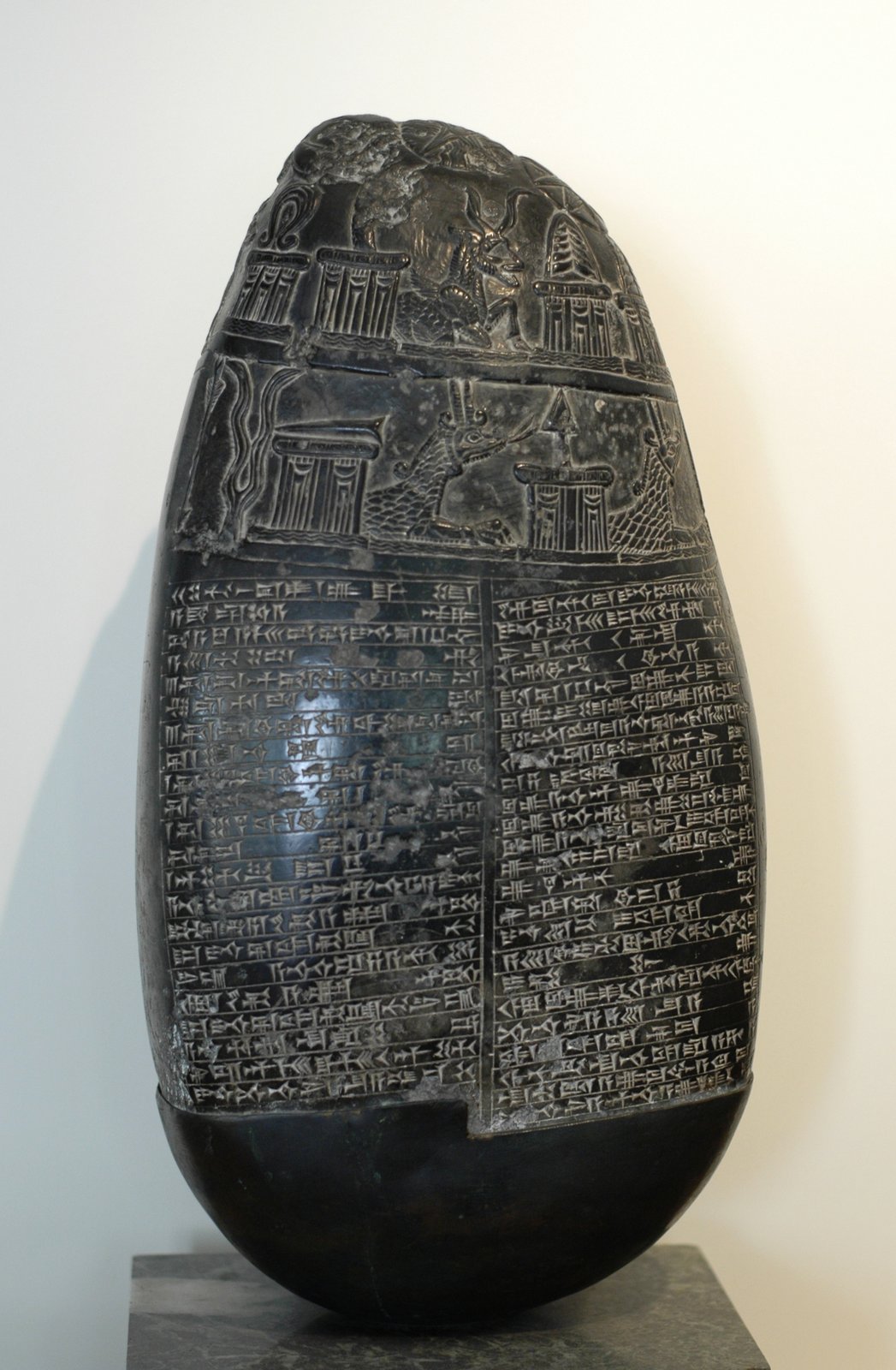
The Michaux Stone, BnF Chabouillet 702, showing a carved register above the cuneiform deed
Image sourceObject details
- Title
- The Michaux Stone: A Babylonian Marriage Gift (BnF 702)
- Timeline
- From 1100 BCE to 1083 BCE
- Region
- Mesopotamia
- Rights
- Public domain
Text
Introduction
The Michaux Stone is a Babylonian monument recording a grant of farmland that Nirah-nasir made to his daughter, Dur-Sharrukinaia’itu, on her marriage. The declaration is engraved in cuneiformCuneiformWriting with wedge-shaped signs, developed from Mesopotamian recording traditions and used for several languages from the third millennium BCE.Glossary · Click to read the explanation below carved divine emblems. The Bibliothèque nationale de France keeps the stone under the inventory number Chabouillet 702. It dates the object to the reign of Marduk-nadin-ahhe, around 1100–1083 BCE. [1][2][3][4]
The field, the deed and the recipient
The deed begins with the size and boundaries of the land. It locates the property near Kar-Nabu, beside a canal in the territory called Bit-Haban, in northeastern Babylonia. An account of the inscription published by Susanne Paulus gives the lengths of the eastern and western sides and the widths of the northern and southern sides. It also lists the neighbouring properties or districts. The French Ministry of Culture gives a modern estimate of 162 hectares. The canal mattered to the value of the gift because the land was used for irrigated agriculture. [3][5]
Nirah-nasir made the gift privately, without royal intervention. The text calls the transfer a mulugu, a marriage gift at the wife’s disposal. The library catalogue uses the familiar term “dowry.” The French Ministry of Culture distinguishes the mulugu from the customary dowry administered by the husband. Under its reading, Dur-Sharrukinaia’itu could manage the property herself or entrust its administration to her father-in-law, who swore in the text that he would not claim it for himself. The Ministry’s page does not name the husband or his father. The stone records the terms of the grant. How the field was managed later remains unknown. [1][3][5]
Writing the grant on stone
The BnF catalogues the material as black diorite and gives a height of 45 centimetres without the base. The Ministry’s label gives 46 centimetres. The inscription is arranged in four columns across the two main faces. The lettering uses deliberately old-fashioned Babylonian sign forms. The text gives no date. The Ministry’s historical account dates the stone by comparing a man named in the deed, Tab-ashab-Marduk, with other records and places it in the early eleventh century BCE, during the reign of Marduk-nadin-ahhe of the Second Dynasty of Isin. [1][2][3][4]
The Ministry’s label counts 21 divine symbols in the two registers above the text. They include celestial signs, divine attributes and fantastic creatures. The final clauses invoke divine curses if someone disputes the transfer or harms the monument. The Ministry’s commentary notes that the people envisaged as possible claimants include members of the woman’s own family, such as brothers and sons. The oath states the penalties for interfering with the gift. The carved emblems invoke the protection of the gods. [2][3][6][7]
Why it is called a kudurru
Scholars traditionally called monuments of this kind kudurrus, from the AkkadianAkkadianAn ancient East Semitic language written in cuneiform from the third millennium BCE; its varieties include Babylonian and Assyrian, and it served in international diplomacy.Glossary · Click to read the explanation word for a boundary. Kathryn E. SlanskiKathryn SlanskiYale scholar of Mesopotamia, studying texts, images, inscribed monuments, law and authority.Glossary · Click to read the explanation notes that most of the inscriptions in the group call the inscribed object a narû, a stone monument. Some examples speak of being set up in the presence of the gods. That language, and the architectural contexts of some finds, supports the interpretation that such monuments were often displayed in temples. The original place where the Michaux Stone stood in antiquity remains uncertain. [6][7]
The stone is named after the French botanist André Michaux. The BnF records a discovery in 1784 south of Baghdad and a purchase in 1800. The Ministry’s catalogue adds the vicinity of the ruins of Ctesiphon. In 1895 Jules Oppert presented a paper on the stone and recalled beginning his research with a cast. His paper records one stage of the study of the text, whose names and legal terms have been read differently since. [1][2][8]
Quick answers
What is the Michaux Stone?
It is a Babylonian stone monument recording a grant of farmland from Nirah-nasir to his daughter, Dur-Sharrukinaia’itu, on her marriage. [1][3]
What was the gift?
It was irrigated land near Kar-Nabu, estimated at 162 hectares by the French Ministry of Culture. The deed records the boundaries and identifies the gift as a mulugu. [3][5]
When was the stone carved?
It belongs to the early eleventh century BCE. Scholars use other records naming a man in the deed to date it to the reign of Marduk-nadin-ahhe. [1][4]
Where is it kept today?
It is in the Bibliothèque nationale de France in Paris, under inventory number Chabouillet 702. [1][2]
References and notes (8)
- Bibliothèque nationale de France, Département des Monnaies, médailles et antiques, “Kudurru,” Chabouillet.702 Object record. Inventory, inscription, material, height, date attribution, discovery and acquisition. Return to the text ↑
- Ministère de la Culture, Orient cunéiforme, “Le premier monument cunéiforme introduit en Europe” Object label and discovery context. Measurements, Ctesiphon vicinity, four columns and 21 symbols. Return to the text ↑
- Ministère de la Culture, Orient cunéiforme, “Que raconte le caillou Michaux ?” Opening and sections “Un cadeau de mariage” and “Une terre irriguée.” Script, parties, meaning of mulugu, land and management. Return to the text ↑
- Ministère de la Culture, Orient cunéiforme, “Le contexte historique” Opening and section “La dynastie d’Isin II.” Dating by the personal name Tab-ashab-Marduk. Return to the text ↑
- Susanne Paulus, “Kudurrus: Guardians of Property,” News & Notes 231, Oriental Institute, University of Chicago, autumn 2016 P. 6, translated excerpt from the opening of the Michaux inscription. Canal, field and four sides. Return to the text ↑
- Kathryn E. Slanski, “Classification, Historiography and Monumental Authority: The Babylonian Entitlement Narûs (Kudurrus),” Journal of Cuneiform Studies 52, 2000, pp. 95–114 Pp. 95–99 and fig. 1. Terms for the monuments, possible temple display, and the role of emblems and curses. Return to the text ↑
- Ministère de la Culture, Orient cunéiforme, “Les malédictions” Commentary on the oath and curses, potential claimants in the bride’s family and protective emblems. Return to the text ↑
- Jules Oppert, “Le caillou de Michaux,” Comptes rendus des séances de l’Académie des Inscriptions et Belles-Lettres 39, no. 2, 1895, pp. 108–113 Pp. 108–109. Oppert’s recollection of working from a cast and his early reading of the deed. Return to the text ↑
Archive records may be reviewed and refined as better evidence or sources become available. Suggest a correction
Suggest a correction · Suggest a source for this record
Cite this record
IL Archive, «The Michaux Stone: A Babylonian Marriage Gift (BnF 702)», https://ilarchive.com/en/artifacts/michaux-stone-kudurru-bnf702