Artifact
The Mithras Bronze Plaque Met 1997.145.3: Bull-Killing Imagery and the Limits of Reconstructing Ritual
An object record bringing together its image, metadata, rights, and context.
- Names
- Mithras bronze plaque 1997.145.3 · Mithras tauroctony bronze plaque
- Timeline
- From 150 CE to 230 CE
- Region
- Roman Empire (precise findspot undocumented)
A Roman bronze plaque, broadly dated from the mid-second to the early third century CE; the entry reads Mithras and the bull as actually pictured, without turning the scene into a record of ritual sacrifice.
Estimated reading time: 7 min Published Last reviewed:
Share article
Photograph
The Metropolitan Museum of Art, New York; Gift of Mr. and Mrs. Klaus G. Perls, 1997. Photographer not identified. · CC0
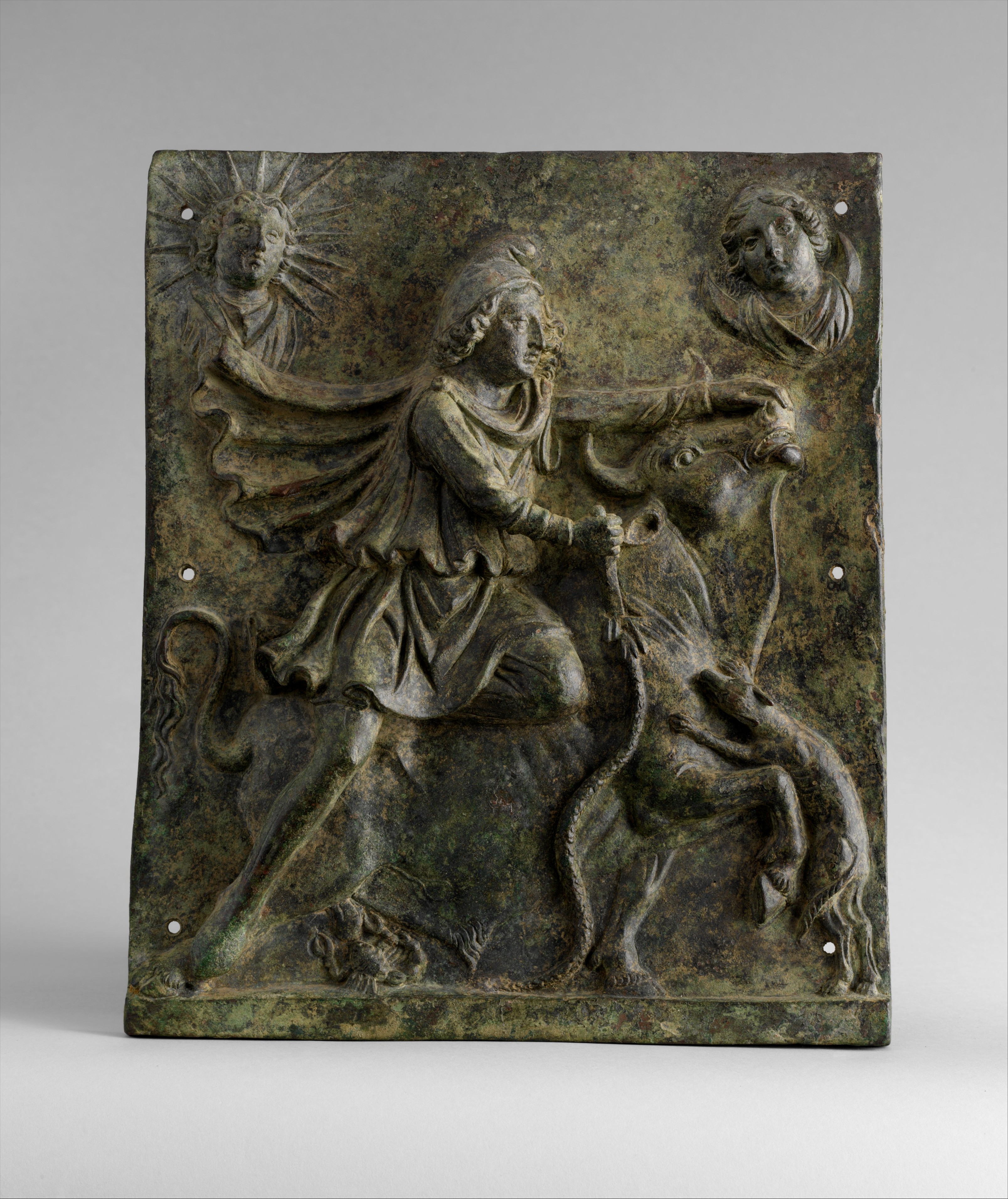
Bronze plaque of Mithras slaying the bull, The Met, 1997.145.3. Snake, dog and scorpion accompany the scene; Sol appears at the viewer’s upper left and Luna at the upper right. The visible holes do not establish its ancient mounting place
License · Image sourceObject details
- Title
- The Mithras Bronze Plaque Met 1997.145.3: Bull-Killing Imagery and the Limits of Reconstructing Ritual
- Timeline
- From 150 CE to 230 CE
- Region
- Roman Empire (precise findspot undocumented)
- Rights
- CC0
Text
Introduction
A Roman bronze plaque in The Metropolitan Museum of Art shows Mithras stabbing a bull, accompanied by animals and watched from above by the Sun and Moon. Can this image tell us what worshippers actually did when they gathered? This entry begins with the individual object, no. 1997.145.3, its physical features and cataloguing history, and then compares the image with excavated places of worship and with the interpretations proposed by scholars.
The central place of bull-killing imagery in the Roman cult of Mithras is supported by many monuments. The narrower question is where the testimony of this one plaque ends, and where reconstructions of a performed rite, a complete myth, or a cosmic symbolism begin.
A Roman object in bronze
The Metropolitan Museum of Art in New YorkNew York CityNew York City is in the United States and houses the Metropolitan Museum of ArtGlossary · Click to read the explanation holds this plaque under accession number 1997.145.3. It identifies it as Roman bronze of the Mid-Imperial, Antonine or Severan period. Its overall dimensions are 35.6 × 29.5 × 4.4 cm, and the current collection record dates it to the mid-second through early third century CE. The museum's 1997 acquisition notice instead favors the late second to early third century, on stylistic grounds. These slightly different ranges do not license an exact year.[1][2]
Its figures stand in relief on an approximately rectangular sheet-like panel, not in a written account of a rite. Six holes, arranged in three pairs, are visible near the edges.[3] Their presence supports consideration of an attached display, but without an excavation record or technical study it cannot date each perforation or establish a particular fastening method. The 1997 museum publication calls this a comparatively rare bronze rendering of a composition better known in marble and other media.[2]
Reading what is actually depicted
At the centre a youthful figure in a cap and short garments, with a cloak streaming behind him, braces the bull with a leg, draws back its head, and drives a pointed weapon into its upper side. This is the familiar representation of Mithras in the composition modern scholars call the tauroctony, or bull-killing scene. The animal twists beneath him as bodies and limbs overlap in a compact space. No explanatory inscription is visible on the pictured face of this plaque: the identification comes from comparison with a broad body of similar images.[4]
A snake approaches the wound; a dog reaches up toward the bull from the viewer's right; and a small scorpion appears beneath its belly. These are not, by themselves, a report that such animals were present at an actual ancient sacrifice. They are parts of a recurrent iconographic composition. Museum explanations sometimes assign them functions associated with the generation or obstruction of life, but those are readings of the symbolism, not ancient captions preserved on this object.[5]
At the viewer's upper left is a radiate head, conventionally identified as Sol, the Sun. At the upper right a head beside a crescent is identified as Luna, the Moon. That is the orientation in this particular image, even where a general account of tauroctonies reverses the sides. Nor should every conventional feature be imported into it: no distinct raven or pair of torchbearers can be identified here. Gaps in the image cannot simply be populated with presumed missing figures.[6]
A pictured killing is not a ritual report
Through visual narrative, the relief represents an act central to Mithras as imagined by the Roman worshippers. Yet it does not document an identified participant slaughtering a real bull in a particular sanctuary, nor does it describe an initiation sequence or a ceremony's order. A weapon and wound in a mythic image are not proof that an identical killing took place at every gathering; still less do they establish a rite of bathing in blood.[7]
One of the museum's audio explanations relates the scene to life generated from the bull, reads the serpent and scorpion as hostile forces, and refers to plants arising from blood. This is a modern explanatory interpretation, not a translation of words inscribed on the plaque. Scholars do not all assign the animals precisely the same meaning. The notion of creation through killing must therefore be attributed to an interpretation, rather than treated as a fact established by the object alone.[8]
From cult image to meeting room
More specific evidence for communal life comes from mithraea, meeting places of Mithraic groups excavated in different Roman regions. The historian Roger Beck describes spaces fashioned as caves or cave-like rooms, often with a central aisle bordered by raised platforms for sitting or reclining. Bull-killing images commonly occupied prominent positions. The benches and equipment of some excavated shrines support the reconstruction of communal meals; they do not provide a full ritualRitualAn organised or distinguished practice meaningful to a community; it may leave traces, but its form alone does not reveal an associated doctrine.Glossary · Click to read the explanation script for this individual plaque.[9]
The Met says that the plaque may well have decorated a mithraeum wall. The object’s shape and holes, together with parallels in securely documented shrines, make this plausible. They do not turn the museum's proposal into a findspot: the accessible object record does not provide a specific excavated provenance for this plaque. We cannot identify its original wall or prove that it remained in a ritual room at the end of its use. A plausible functional interpretation is not the same as direct archaeological context.[10]
Other evidence indicates the importance of shared meals and initiation for Mithraic communities. Larger reliefs sometimes include additional episodes, such as a feast of Mithras and the Sun. But a banquet represented on a different object, or a platform excavated in another sanctuary, cannot supply a missing scene on this plaque or determine the rank of its ancient audience or the particular stage of ceremony in which it was used.[11]
From motifs to cosmic interpretation
The conjunction of bull, animals, Sun and Moon has prompted sustained debate. Beck surveys interpretations that approach the scene as an episode of Mithras' myth, proposals for cosmic or astral meanings, and readings that connect the composition with conceptions of sacrifice. He himself argues for substantial astral significance, while acknowledging scholarly disagreement over the functions of the symbols and warning against reducing the image to a star chart that can be mechanically decoded.[12]
The animals visible on no. 1997.145.3 cannot automatically be turned into a complete list of constellations or a specific calendar. Testing a symbolic hypothesis requires comparison across monuments, external texts and built settings. This plaque alone cannot tell us which interpretation its former users held, or whether different communities agreed on one explanation.
The name Mithras and the apparently eastern costume raise a further, distinct issue. Scholars have long discussed possible connections with Mithra in Iranian traditions. Similar names and Persian-looking elements in the Roman mysteries do not, however, demonstrate an unbroken transmission of institutions and ceremonies from IranIranIran is the modern country containing Shush, ancient SusaGlossary · Click to read the explanation to each Roman mithraeum. Beck presents continuity and western reinvention as competing historical questions, not as an issue settled by this bronze object.[13]
Worshippers, missing texts and this object's unknown past
Research on Mithraic associations describes small groups with members drawn disproportionately from the military, administration and other sectors; participation was not necessarily exclusive of public cults. Thus labels such as “monotheistic religion” or “soldiers' cult only” cannot define the community behind every monument. Nor does the absence of a surviving complete Mithraic ritual book prove that oral narratives or teachings never existed. It means that reconstruction depends more heavily on images, buildings and testimony from outsiders.[14]
The plaque entered the Met as a gift from Mr. and Mrs. Klaus G. Perls in 1997. That establishes a modern acquisition event; it does not supply a chain of ancient owners or an excavated context. The accessible museum record likewise gives no detailed restoration chronology or technical assessment of the holes. Neither their age nor the conservation history can be recovered from the bronze's surface colour or the photograph alone. Such silence is a limit of the presently available record, not proof that further documentation never existed.[15]
What this plaque ultimately establishes
The plaque attests a Roman bronze version of the bull-killing image, with a particular set of visible elements, within the museum's broadly dated Imperial period. It helps us see how a represented act could stand at the centre of a cult's visual language. Claims that this very panel hung on a particular sanctuary wall, accompanied a defined initiation, or expressed one uniquely established doctrine of creation and the planets require independent evidence that the object does not itself provide.
Its historical value lies precisely in that distinction: we can examine an image associated with worship and its possible setting without claiming to have witnessed the rite enacted before it.
References and notes
- The Metropolitan Museum of Art, “Bronze plaque of Mithras slaying the bull,” object 1997.145.3; the current accession, classification, dimensions and dating, read directly from the object record. Artwork Details / Object Information: accession, material, dating and dimensions Return to the text ↑
- Ariel Herrmann (AH), “Mithraic Relief,” in “Recent Acquisitions, A Selection: 1996–1997,” The Metropolitan Museum of Art Bulletin, vol. 55, no. 2 (Fall 1997), printed p. 17. The publisher’s official landing page was opened, and the text on p. 17 was accessible in a search-indexed excerpt of the museum-hosted PDF; no page image or full Bulletin was read. The excerpt describes the bronze version as very rare and dates it stylistically to the late second or early third century CE. Ariel Herrmann (AH), “Mithraic Relief,” The Metropolitan Museum of Art Bulletin 55(2), 1997, printed p. 17; indexed publisher-PDF text, not a view of the page image Return to the text ↑
- The Met, original photograph on the record for 1997.145.3: six holes in three pairs are observable near the plaque’s edges. This is a visual description of the museum image, not a claim that the catalogue text enumerates the holes or that a technical examination established their date or fastening method. Attachment to a surface remains a limited functional possibility. Original photograph within Met object record 1997.145.3, edges of the plaque; visual observation, not a conservation assessment Return to the text ↑
- The Met, photograph of 1997.145.3, object description, and displayed transcript of audio Part 1; visual identification is corroborated by the record, without asserting any inscription on the photographed face. Original object photograph, record description and first audio transcript Return to the text ↑
- Roger Beck, “MITHRAISM,” Encyclopaedia Iranica (2002; updated 2012), “Roman Mithras”; describes the general iconographic type, not a catalogue of details guaranteed on this plaque. The Met photograph establishes the actual selection visible here. Roger Beck, “MITHRAISM,” “Roman Mithras,” paragraphs describing the standard tauroctony Return to the text ↑
- Kiki Karoglou, “Mystery Cults in the Greek and Roman World,” The Met (Oct. 2013), Mithras paragraphs. Its generic description reverses the Sun/Moon sides relative to this plaque; the orientation here follows the object photograph. Kiki Karoglou, “Mystery Cults in the Greek and Roman World” (2013), Mithras paragraphs; compare orientation with this image Return to the text ↑
- Beck, “MITHRAISM,” “Roman Mithras,” on the central mythical image. The evidentiary distinction is between a depiction and documentation of a particular practice; it is not a claim that no real animal sacrifice ever occurred anywhere. Roger Beck, “Roman Mithras,” cult-icon discussion; compare with object record Return to the text ↑
- The Met, “1201. Bronze plaque of Mithras slaying the bull, Part 1,” displayed transcript. Creation, evil and plants are presented in a modern educational interpretation, not as ancient lettering on 1997.145.3 or an established scholarly consensus. Met audio 1201, Part 1, displayed transcript: life, blood, snake, scorpion Return to the text ↑
- Beck, “MITHRAISM,” “Western Mithraism described”: cave-like mithraea, side benches and small communities. This is comparative evidence from excavated places, not the find context of Met 1997.145.3. Roger Beck, “Western Mithraism described,” cave-like shrines, benches and small communities Return to the text ↑
- The Met, description of 1997.145.3: the proposed mithraeum-wall function is explicitly qualified, and the accessible object record gives no specific excavated findspot. This is a limit of the record, not proof that no other archive exists. Object description, “may well have decorated the wall”; no documented excavation location in accessible record Return to the text ↑
- Beck, “MITHRAISM,” on the cult meal and the larger reliefs with supplementary episodes, including a banquet with the Sun. The account concerns comparative monuments; it does not place these scenes on the Met plaque. Roger Beck, “Western Mithraism described” (cult meal); “Roman Mithras” (additional episodes) Return to the text ↑
- Beck, “MITHRAISM,” “Roman Mithras,” surveying mythical, sacrificial and astral readings; he criticizes automatic star-chart decoding while arguing for serious astral symbolism and noting scholarly disagreement. Roger Beck, “Roman Mithras,” discussion of the tauroctony and astral interpretations Return to the text ↑
- Beck, “MITHRAISM,” section “From Iranian Mithra to Roman Mithras: Continuity versus re-invention,” assessing transmission and reinvention without proving a continuous institutional chain to this object. Roger Beck, “From Iranian Mithra to Roman Mithras: Continuity versus re-invention” Return to the text ↑
- Beck, “MITHRAISM,” on social profiles, voluntary nonexclusive participation and the absence of substantial surviving Mithraic sacred texts; silence does not rule out oral teaching. Roger Beck, “Western Mithraism described”: members, nonexclusive worship, missing extensive sacred texts Return to the text ↑
- The Met, object 1997.145.3, “Gift of Mr. and Mrs. Klaus G. Perls, 1997.” The accessible page contains no specific excavation findspot or restoration chronology; the modern gift is not an ancient provenance. Artwork Details, Credit Line; no specific excavation or conservation chronology supplied Return to the text ↑
Archive records may be reviewed and refined as better evidence or sources become available. Suggest a correction
Suggest a correction · Suggest a source for this record
Cite this record
IL Archive, «The Mithras Bronze Plaque Met 1997.145.3: Bull-Killing Imagery and the Limits of Reconstructing Ritual», https://ilarchive.com/en/artifacts/mithras-bronze-plaque-met1997-145-3