Artifact
Yaxchilán Lintel 24: Royal Bloodletting and the Date of a Carved Scene
An object record bringing together its image, metadata, rights, and context.
- Names
- Am1923,Maud.4 · Yaxchilán Lintel 24
- Timeline
- From 723 CE to 726 CE
- Region
- Yaxchilán, Chiapas (Mexico)
A limestone lintel, probably carved between 723 and 726 CE for an entrance at Yaxchilán, shows Lady K’abal Xook performing bloodletting before the ruler Itzamnaaj Bahlam; its inscription dates the occasion to 709 CE.
Estimated reading time: 8 min Published Last reviewed:
Share article
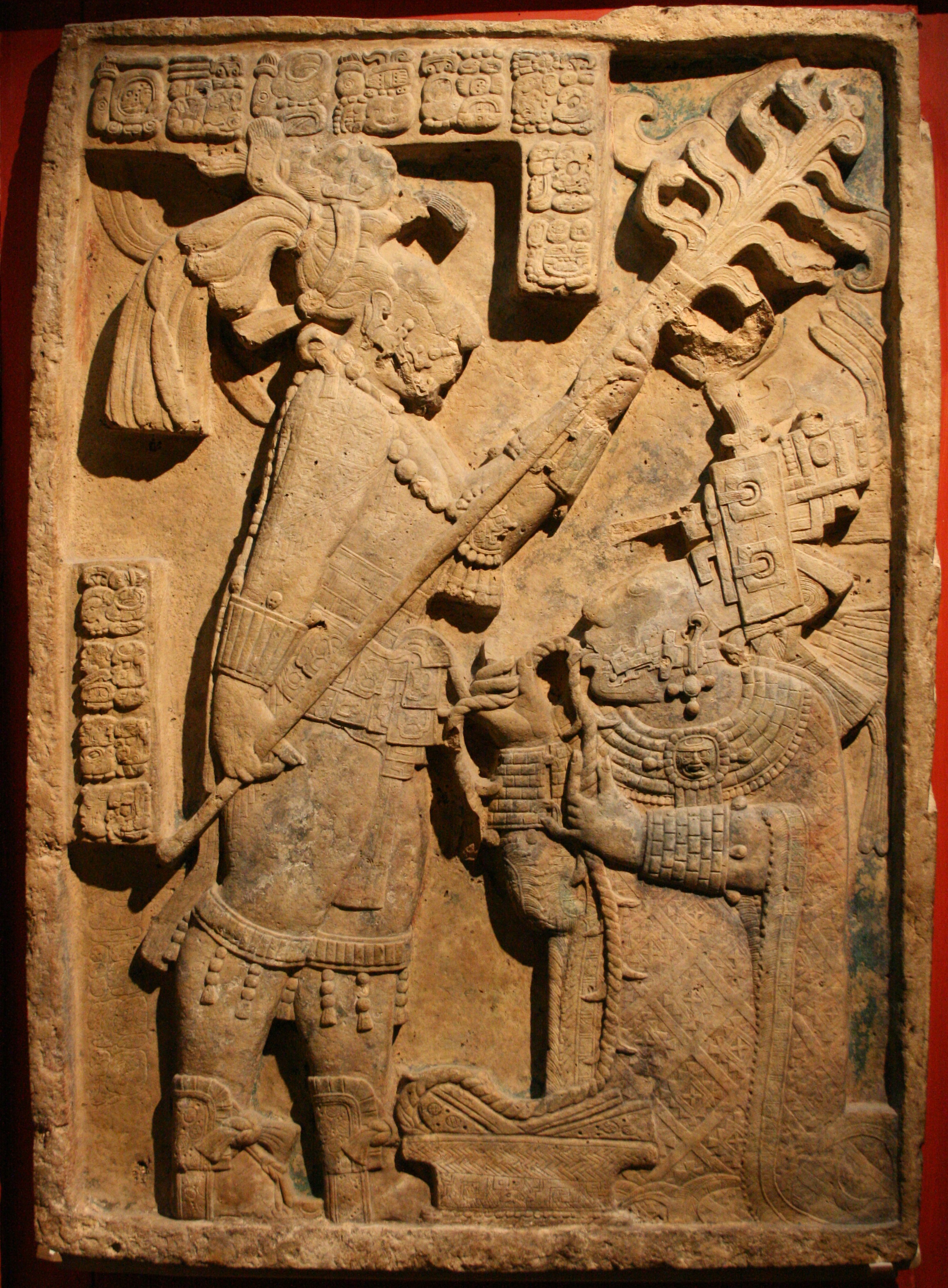
Photograph
Photograph by Michelwal, via Wikimedia Commons; object in the British Museum, Am1923,Maud.4; CC BY-SA 3.0 Unported, unmodified.
Yaxchilán Lintel 24, limestone from the southeastern entrance to Structure 23: a standing ruler with a flaming implement and Lady K’abal Xook kneeling with a cord by her mouth. The inscription is read as referring to 709 CE; the stone was carved later. A modern museum photograph does not settle the cord’s material or the precise nature of the receptacle
License · Image sourceObject details
- Title
- Yaxchilán Lintel 24: Royal Bloodletting and the Date of a Carved Scene
- Timeline
- From 723 CE to 726 CE
- Region
- Yaxchilán, Chiapas (Mexico)
- Rights
- CC BY-SA
Text
Introduction
On a carved lintel from the Maya city of Yaxchilán, a royal figure stands holding a torch as a kneeling woman draws a cord near her mouth. The inscription dates the represented occasion to 709 CE, yet the stone itself was carved later. Are we seeing a practice exactly as it occurred, or a representation that royal patrons chose to preserve?
This article examines Lintel 24 as one particular object: its image, writing and original setting over a doorway; the role of Lady K’abal Xook; and the effects of loss, trimming and museum display on what remains readable. It distinguishes evidence on the surviving stone from scholarly interpretations without reducing Maya ritualRitualAn organised or distinguished practice meaningful to a community; it may leave traces, but its form alone does not reveal an associated doctrine.Glossary · Click to read the explanation to a single formula.
A lintel over a royal doorway
Yaxchilán was a Classic Maya city on the Usumacinta River, in present-day Chiapas, Mexico. Lintel 24 originally stood above the left, southeastern entrance to Structure 23, a building associated with the royal woman Lady K’abal Xook. A lintel is not a freestanding picture: it spans a doorway, and visitors once passed underneath it rather than necessarily facing it as they do when viewing the stone vertically in a museum. It had fallen or been displaced before European investigators reached it; the present display does not fully recreate the experience of someone entering that building.[1]
The limestone relief belongs to the British Museum as Am1923,Maud.4. The museum dates its manufacture to 723–726 CE, listing 109 cm in height, 78 cm in width and 6 cm in depth, each expressly marked to be confirmed (tbc). These are not the measurements of the sculpted image alone. The Corpus of Maya Hieroglyphic Inscriptions (CMHI) gives a sculptured area 104 cm high and 74 cm wide, with a maximum relief depth of 4.5 cm; its entries for maximum stone width and thickness are unknown.[2] The Corpus measurement guide defines HSc and WSc as the dimensions of the sculptured area, and Rel as maximum depth of relief. They are therefore not competing measurements for the whole stone.[3]
What the relief depicts—and what descriptions dispute
At left, an elaborately dressed and ornamented royal figure stands holding a long object ending in depicted flames. At right, a richly adorned woman in a woven garment kneels, handling a cord beside her mouth and tongue. Epigraphic readings and royal context identify the standing ruler as Itzamnaaj Bahlam, called Shield Jaguar in some scholarly traditions, and the woman as Lady K’abal Xook. Those identifications arise from reading the inscriptions and related scholarship; they are not obtainable from facial likeness alone.[4]
The British Museum's first description calls the cord obsidian-studded, while a later curatorial account calls it thorned; Lauren Kilroy-Ewbank's article, available through Khan Academy, similarly speaks of a thorned cord. The photograph cannot determine the material of each small projection. It makes the depicted action visible but cannot substitute for a direct material examination of the implement represented in stone.[5]
The receptacle below the cord is likewise interpreted differently. A museum comment describes an open codex; Kilroy-Ewbank describes paper in a basket; and a specialized account interprets it as a ceramic cache vessel containing paper strips to absorb the blood. These readings share an idea of collecting blood below the kneeling woman, but the specific vessel and paper cannot be settled simply from the available photograph. Curving forms near her mouth are conventionally read as blood scrolls; they do not provide a measurement of actual blood loss.[6]
An inscribed occasion, not the date of carving
Groups of Maya glyphs occupy the top and side of the composition. CMHI publishes the date 9.13.17.15.12, 5 Eb 15 Mak and a passage representing the ruler in an act expressed by the term ch’ahb, with the flaming object described in wording commonly rendered as a “fiery spear.” A further passage names Lady K’abal Xook and her titles; another concerns the raising or making of a carving, but its reading is uncertain. This is a selective royal text accompanying an image, not a continuous eyewitness account of an entire ceremony.[7]
The British Museum and Kilroy-Ewbank's article convert the event date to 28 October 709 CE. CMHI prints 24 October 709, while the study by Ángel A. Sánchez Gamboa and Guido Krempel uses 29 October 709. The materials examined do not establish a securely documented reconciliation of the conversion conventions. This article therefore retains the original Maya date and the year 709 CE, attributing the divergent civil days to their publishers rather than inventing three events.[8]
The British Museum calls the ruler Shield Jaguar II, whereas CMHI and Sánchez Gamboa and Krempel call him Shield Jaguar III and the latter propose alternative, partly uncertain readings of his Maya name. These are scholarly numbering and naming conventions for the same ruler, not evidence for two people within the relief. Likewise, translating ch’ahb as “penance” does not automatically make it equivalent to atonement or penitence in another religious tradition; fasting or ritual abstention are also terms discussed in scholarship. Modern transcriptions retain question marks in names and the passage concerning the carving. They cannot justify a certain attribution of an artist's signature.[9]
Lady K’abal Xook and royal authority
Lady K’abal Xook is not merely a passive witness to the king's deed. The representation assigns the painful act to her and the inscriptions give her a name, titles and a place in the visual language of the royal household. The ruler holds the fiery implement. This division gives the royal woman's participation an active role in this particular presentation of political authority and ritual obligation. It does not establish how every Maya woman lived, nor whether this woman acted voluntarily or under compulsion; such conclusions cannot be drawn from a carved facial expression.[10]
In his discussion of Classic Maya sculpture, James Doyle places monumental works within the patronage of kings and queens, emphasizing the artists and court workshops that made them. Artists are named on some monuments, but that general fact is not a secure signature on Lintel 24. The carved scene records what patrons wanted an important audience to encounter, not a neutral recording of voices, pain or inner intentions at the represented moment.[11]
Three neighboring lintels, not a single session
Two other lintels from Structure 23 are numbered 25 and 26. Their arrangement may invite viewers to imagine consecutive episodes of one ceremony, yet the inscriptions and carving dates do not permit their scenes to be collapsed into a single session. The Vision Serpent and a figure emerging from its mouth belong to Lintel 25, not Lintel 24. Lintel 26 offers a different royal scene, often discussed in connection with martial equipment, and the monuments' inscriptions refer to different moments. They form a royal program assembled across time, not a continuous photographic record.[12]
The architectural threshold matters as well. Passersby encountered a carved image and text within a politically significant entrance. The act of passing underneath may itself have carried meaning. But the stone alone cannot tell us who crossed, the precise choreography of that passage, or whether the depicted rite took place at the doorway. Present museum illumination is no evidence of the original light conditions.
A truncated stone and modern conservation
CMHI reports that Lintel 24 was trimmed on all four sides surrounding the underside carving, while the inscription on its front edge was destroyed; traces of blue pigment survived on the background. Its account quotes a diary entry attributed to Alfred Maudslay, dated 19 March 1882, mentioning the fallen carved stone, earlier attempts to remove it and shaving it down. The diary is known here through the Corpus's quotation, not through independent inspection of the manuscript. Nor does that quotation allow every break and cut on the surviving stone to be assigned to a single person.[13]
A later history of conservation must be distinguished from those earlier losses. British Museum records describe 1994 cleaning, filling a crack near the nose and a corner, retouching and making a mount[14]; 1999 consolidation of lamination at the back and removal of gallery paint[15]; and 2010 stabilization of an old upper-corner break, removal of metal fittings and attention to other gaps[16]. The ancient pigments noted in the catalogue should not be conflated with modern display paint. The photograph by Michelwal does not identify each repaired spot with certainty. Moreover, its Commons file was uploaded in 2008, so it cannot document the subsequent 2010 treatment.
From Yaxchilán to London
The Corpus dates Maudslay's removal of the lintel to England to 1882. The British Museum's acquisition notes say that his original sculptures were deposited at the Victoria and Albert Museum in 1885, then that the originals arrived at the British Museum on 20 November 1893, followed by some casts on 22 November. The original objects were registered under their present numbers only in 1923, in the wake of administrative clarification of the collection and the casts. Thus Am1923,Maud.4 is neither a date of manufacture nor the first arrival in London, and an original limestone carving is not interchangeable with a cast.[17]
What the witness can—and cannot—recover
This lintel combines an inscribed date, a sculpted image and an identifiable royal architectural setting. It establishes that Yaxchilán's patrons chose to represent a named royal woman undertaking a bloodletting action; the text associates the occasion with 709 CE, while the stone was produced later as part of an architectural program. Loss of the front inscription, alteration of the stone and the later histories of removal and display further qualify what can be read today.
Neither the sculpted image nor its modern photograph measures blood loss, proves a physical vision or reveals a participant's internal motives. Even where royal Maya bloodletting is historically supported, it should not inherit the meaning of “atonement” from unrelated Near Eastern texts without independent evidence. The introductory statement of the original CMHI publishing project also made clear that accurate documentation through drawings and measurements is not identical with interpreting hieroglyphs: modern readings hosted alongside the corpus must not automatically be attributed to the 1977 documentation volume.[18]
References and notes
- British Museum, “Lintel 24,” Am1923,Maud.4: the original southeastern doorway of Structure 23, object description and present holding. Object details; Curator’s comments; Findspot Return to the text ↑
- CMHI, Yaxchilan, Lintel 24 entry: HSc=1.04 m, WSc=0.74 m and Rel=4.5 cm concern the carved area; the British Museum’s 109 × 78 × 6 cm (tbc) concerns the whole lintel. Lintel 24, DIMENSIONS; compare British Museum, Dimensions Return to the text ↑
- Peabody Museum, “Guide to Abbreviations,” “Abbreviations for Measurements”: definitions of HSc, WSc and Rel as sculptured-area height, width and relief depth. Measurements section, HSc/WSc/Rel Return to the text ↑
- British Museum, catalogue and curatorial comments; identification of Lady K’abal Xook and the ruler is epigraphic and contextual, not based on resemblance alone. Description; Curator’s comments, McEwan 2009 Return to the text ↑
- Lauren Kilroy-Ewbank, “Yaxchilán—Lintels 24 and 25,” Khan Academy text, Lintel 24 section; compared with the British Museum’s “obsidian-studded” and “thorned.” Steven Zucker’s photographs were not licensed for reuse here. “Lintel 24” section of an archived Khan Academy publisher-page text; Smarthistory was not accessed directly Return to the text ↑
- Ángel A. Sánchez Gamboa and Guido Krempel, “Monuments of Yaxchilan: Lintel 24,” p. 1: ceramic vessel and paper strips, differing from the museum’s “open codex” and Kilroy-Ewbank’s “basket.” These are interpreted descriptions, not direct material analysis. PDF p. 1, scene paragraph; compare BM Curator’s comments and Khan, Lintel 24 Return to the text ↑
- CMHI online Lintel 24 entry: Long Count date and the current site’s transcriptions/translations of A1–F3, G1–G4 and H1–H4. The live translation must not automatically be assigned to the 1977 Graham/von Euw documentation volume. DATES; TRANSCRIPTION/TRANSLITERATION/TRANSLATION; vol. 3.1 table p. 53 Return to the text ↑
- Sánchez Gamboa and Krempel, specialized study, p. 1, prints 29 October 709; CMHI gives 24 October, the British Museum 28 October. No read methodological explanation conclusively reconciles all three conversions; the Maya date and year are retained. PDF p. 1, dating lines; compare CMHI DATES and BM McEwan 2009 Return to the text ↑
- Sánchez Gamboa and Krempel, p. 1, passages A1–F3, G1–G4, H1–H4: uncertain Itzamnaaj?/Kokaaj? Bahlam III and Mo’ Chahk in the carving formula. Compare BM’s Shield Jaguar II and CMHI’s III; neither a definite artist signature nor cross-cultural atonement is established. PDF p. 1, all three transcribed passages and proposed translations Return to the text ↑
- Kilroy-Ewbank, “Structure 23” and “Lintel 24,” in an archived copy of the Khan Academy publisher page; women’s royal roles are context-bound interpretations, not claims about all women or personal motives. Structure 23; Three important lintels; Lintel 24 Return to the text ↑
- James Doyle, “Ancient Maya Sculpture,” The Met, 1 April 2016, passages on royal patronage and named artists. The example of another object, Met 1979.206.1047 by Chakalte’, is not assigned to Lintel 24. Paragraphs on royal patronage and named sculptors Return to the text ↑
- Kilroy-Ewbank, “Three important lintels” and “Lintel 25 & 26,” Khan Academy. The Vision Serpent belongs to Lintel 25; the adjacent panels need not portray one session. Sections on lintels 25/26 and architectural setting Return to the text ↑
- CMHI, Lintel 24, CONDITION and LOCATION; quotation from Maudslay’s diary dated 19 March 1882, not independently checked in the manuscript. The entry separates trimming, destroyed front inscription and surviving blue pigment. Lintel 24, CONDITION/LOCATION; diary quotation only Return to the text ↑
- British Museum, conservation treatment of 27 May 1994: cleaning, fills at a crack near the nose and a corner, local retouching and construction of a mount. Based on the preserved full museum-record text, not a new conservation examination. Conservation/Treatment 11968:1; 27 May 1994 Return to the text ↑
- British Museum, conservation treatment of 19 May 1999: consolidation of lamination at the reverse and removal of gallery display paint, which should not be confused with ancient pigment. Based on the preserved complete treatment record. Conservation/Treatment 11969:1; 19 May 1999 Return to the text ↑
- British Museum, conservation treatment of 13 May 2010: stabilization of an old upper-corner fracture, removal of metal fittings and treatment of gaps. Based on the preserved full museum record; Michelwal’s Commons file, uploaded in 2008, cannot document or locate the 2010 treatment. Conservation/Treatment 81352:1; 13 May 2010 Return to the text ↑
- British Museum, Acquisition notes: original sculptures at the V&A in 1885; originals transferred to the BM on 20 November 1893 and casts on 22 November; registration in 1923. CMHI LOCATION dates removal to England to 1882. This is museum collection history, not an independent legal judgment. Acquisition notes; CMHI Lintel 24, LOCATION Return to the text ↑
- Ian Graham, “Introduction to the Corpus” (1975), Scope: interpretive commentary excluded from the original documentation project; the Yaxchilan contents list vol. 3, part 1, p. 53 (1977). Neither the full 1977 volume nor Maudslay’s original diary was read. Scope; Yaxchilan volumes 3.1–3.3 table, Lintel 24 p. 53 Return to the text ↑
Archive records may be reviewed and refined as better evidence or sources become available. Suggest a correction
Suggest a correction · Suggest a source for this record
Cite this record
IL Archive, «Yaxchilán Lintel 24: Royal Bloodletting and the Date of a Carved Scene», https://ilarchive.com/en/artifacts/yaxchilan-lintel24-am1923-maud4