Entity · Concept
Textual harmonization
A reference page linking a name, group, or concept to the materials that discuss it.
Aligning parallel passages through additions or changes; may be deliberate editing, not proof of a copyist’s identity.
Text
Details can move between command and fulfilment or between parallel accounts. Ulrich explains recurring expansions in some Exodus/Numbers witnesses, beyond spelling mistakes. [1]
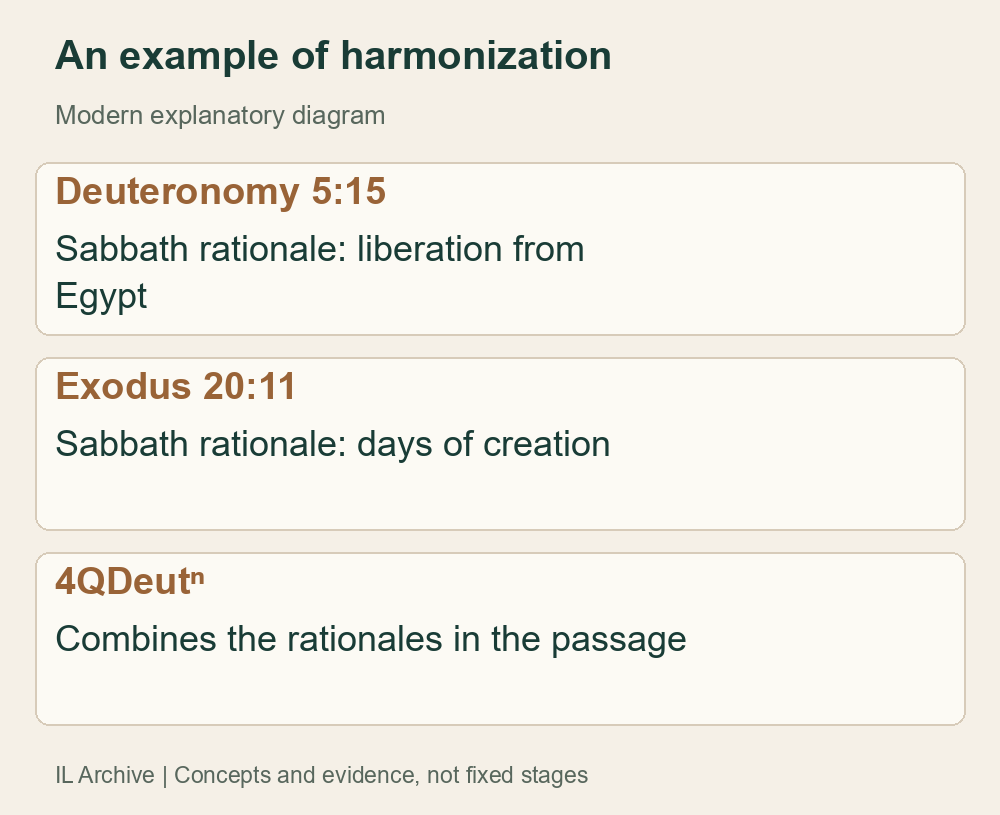
The diagram presents Sabbath rationales in 4QDeutⁿ from Deuteronomy5:15 and Exodus20:11. It does not match SP everywhere; harmonistic describes a procedure, not a copyist’s sect. [2]
References and notes
- Eugene Ulrich (2012). “The Evolutionary Composition of the Hebrew Bible.” In Editing the Bible, pp. 23–40. SBL. Pp.32,34: Exodus additions from Deuteronomy and explicit fulfilment of commands; 4QNumᵇ. Ulrich identifies editorial editions; not automatically every scribe’s practice. Return to the text ↑
- James C. VanderKam (2016). “Texts, titles, and translations,” pp.18–20: examples from Samuel and Deuteronomy. Pp.18–20: Samuel and 4QDeutⁿ harmonization of Sabbath rationales, Exodus20:11/Deuteronomy5:15. Greek agreement does not automatically identify a better reading. Return to the text ↑
Research history
Substantive changes are retained here. Minor copy edits remain in the internal operational log.
-
Substantive record update
Suggest a correction · Suggest a source for this record
Cite this record
IL Archive, «Textual harmonization», Edition 2, https://ilarchive.com/en/entities/harmonization