Person · Figure
Aurelian
- Names
- Aurelian · Aurelianus · Lucius Domitius Aurelianus
- Timeline
- From 270 CE to 275 CE
- Region
- The Near East and the Mediterranean
Roman emperor from 270 to 275 CE. In five years he took back the East from Palmyra and the West from the Gallic emperors, and began a new wall around Rome; coins and short histories tell more than the later legends.
Estimated reading time: 6 min Published Last reviewed:
Share article
Text
Introduction
Lucius Domitius Aurelianus, known in English as Aurelian, ruled the Roman Empire from the autumn of 270 until his murder in 275 CE. He came to power at a bad moment. The empire had split into three parts: a breakaway "Gallic" state in the West, the Roman centre, and an eastern block led from the desert city of Palmyra by Queen Zenobia in the name of her son Vaballathus. In five years Aurelian brought the pieces back together, and his coins called him "restorer of the world". [1][2][3]
Three kinds of evidence tell his story: coins made in his lifetime, short Latin and Greek histories of the fourth and fifth centuries, and a later collection of imperial lives, the Historia Augusta, whose colourful letters its modern editor shows to be largely invented. This entry keeps them apart. [4][5][6]
A soldier from the Danube
Aurelian came from the Danube provinces. The sources do not agree on his birthplace: Sirmium (near modern Sremska Mitrovica in Serbia) or "Dacia Ripensis", a district on the Danube. Dacia Ripensis was a province Aurelian himself later created, so that name is written with hindsight. The Historia Augusta says his mother was a priestess of the Sun god; its editor suspects the story grew out of Aurelian's own later devotion to the Sun. [2][3][4]
He rose as a cavalry officer. By about 269 he commanded the cavalry of the emperor Claudius II. When Claudius died of plague in 270, his brother Quintillus was proclaimed, but he held power only a short time, and the army chose Aurelian. [1][3]
Emperor in a crisis, 270–271
Germanic peoples from beyond the Danube and the Alps broke into Italy; the sources name the Juthungi, the Alamanni and the Marcomanni. The Historia Augusta reports a heavy Roman defeat near Placentia (modern Piacenza) and panic in Rome before Aurelian won back the field. The order of these battles is not certain. [1][3][4]
In Rome itself the workers of the imperial mint rebelled. They had been making coins with less silver than they should, and feared punishment. The ancient accounts differ: Eutropius says they killed their chief, the treasurer Felicissimus, while the Historia Augusta makes Felicissimus their leader. It also says the fighting cost 7,000 soldiers; its editor calls that figure greatly exaggerated. [2][4]
Rome had no walls of its own, because its frontiers had long been far away. Aurelian ordered a new wall around the city; the historian Zosimus says it was finished under the emperor Probus. Raised and repaired many times, it still stands in long stretches. At the Porta San Sebastiano visitors can walk about 350 metres along the top of it, although most of what they see there belongs to the rebuilding under the emperor Honorius in the early fifth century. [1][7]
On the lower Danube he gave up the old province of Dacia, north of the river (in modern Romania). He moved its Roman settlers south of the Danube and gave the new district the old name. The date, 271 or 272, is debated. [2][3][4]
Palmyra and the East, 272–273
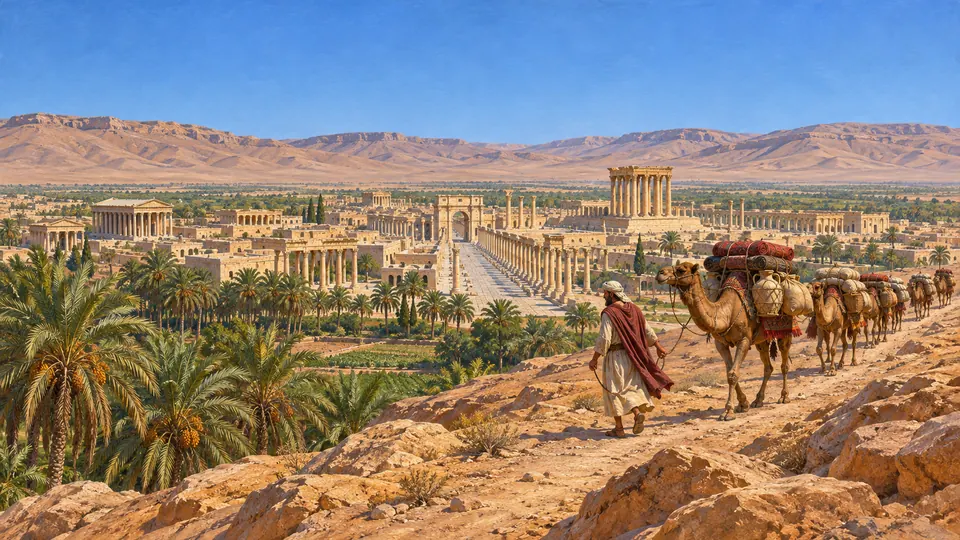
At first Palmyra did not openly reject him. When Palmyrene forces held Alexandria and Antioch, their mints struck coins with Aurelian on one side and Vaballathus on the other. One Alexandrian coin of 270/271 calls Aurelian "Emperor Caesar ... Augustus", and Vaballathus "consular, emperor, general of the Romans". It counts the year as Aurelian's first and Vaballathus's fourth, because the boy's years ran from his father Odaenathus's death in 267. Whether this was a real partnership or a polite cover is still debated. [5][8]
In the spring of 272 the cover dropped. New coins named Vaballathus and Zenobia as Augustus and Augusta, imperial titles of their own. Aurelian marched east. Cities in AnatoliaAnatoliaAnatolia is the region occupying the Asian part of present-day TurkeyGlossary · Click to read the explanation opened their gates, and after Tyana fell the road to Syria lay open. According to Zosimus, his cavalry beat the heavy Palmyrene horsemen near Antioch by pretending to flee until the enemy's horses were tired; a second victory followed at Emesa (modern Homs). Aurelian besieged Palmyra, and Zenobia was caught as she tried to cross the Euphrates. [1][8]
In 273 Palmyra rose again and proclaimed a new ruler. Aurelian, already on his way west, turned back, took the city and destroyed it. He also put down a revolt in AlexandriaAlexandria (Egypt)Alexandria is a city on Egypt’s Mediterranean coast, founded by Alexander the Great in 331 BCE and an important center of trade and culture.Glossary · Click to read the explanation. [1][3][4]
Gaul, the triumph and the Sun
In 274 he turned on the Gallic emperor Tetricus. Eutropius says Tetricus, unable to control his own troops, betrayed them in a battle near Châlons in north-eastern France. Aurelian then held a triumph in Rome in which Tetricus and Zenobia walked before his chariot. [2]
Aurelian built a richly decorated temple of the Sun in Rome, dedicated in 274. Zosimus says it held statues of the Sun and of Bel, the great god of Palmyra, adorned with spoils from the city. [1][3][4]
"Restorer of the world": the coins
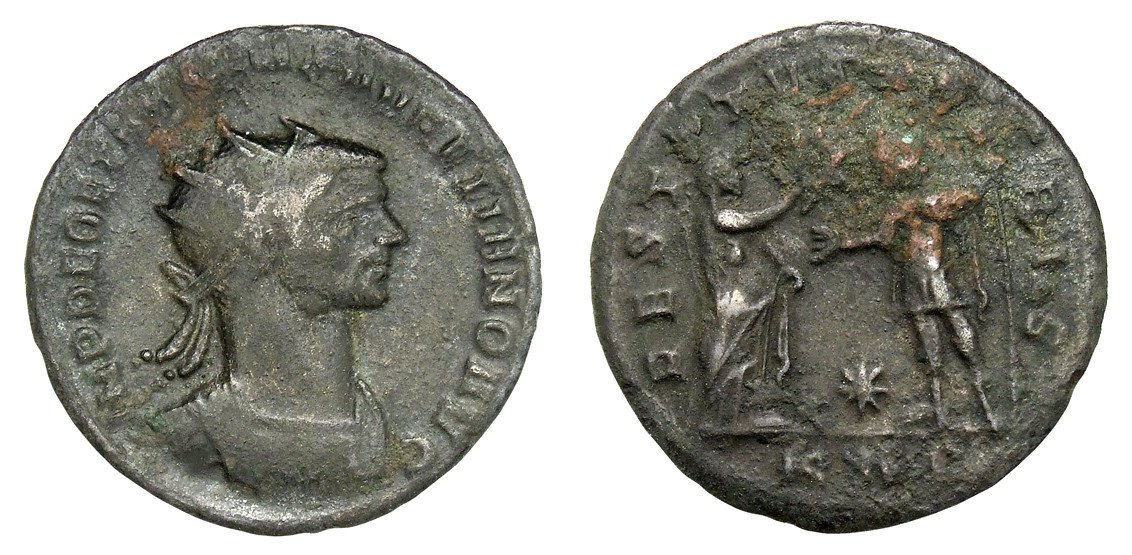
Coins were the news media of the Roman world: every coin in a market told people who ruled and what he claimed.
The coin in the picture was struck in 274 at Serdica, modern Sofia in Bulgaria. Its reverse reads "restorer of the world". Its front calls the living emperor "god and lord":
In plain English: "To the emperor, god and lord Aurelian, Augustus" (legend on the coin, Münzkabinett Berlin 18248272). [6]
The coin also carries the mark KA, part of Aurelian's attempt in 274 to fix a currency that had lost most of its silver. He restored the purity of the gold coin, called in bad money and issued a new standard coin. What KA meant, a value or a guaranteed share of silver, is still debated. [1][6]
Death and memory
In 275, while preparing a war against Persia, Aurelian was murdered in Thrace. Zosimus names a secretary called Eros who, fearing punishment, forged writing in the emperor's hand that made several officers believe they were about to be executed; they struck first. Eutropius places the murder at Caenophrurium, on the road between Byzantium (later ConstantinopleConstantinopleLate antique and medieval city on the historic peninsula of modern Istanbul.Glossary · Click to read the explanation) and Heraclea. The Historia Augusta names the clerk Mnestheus. The modern editor of the Historia Augusta dates the killing probably to October or November 275. The senate declared him a god, as it did for many emperors after their death. [1][2][4]
Eutropius calls him a fine soldier with a fierce temper, cruel but needed in his time. His reign was short, and the system that ended the century's crisis was built later by Diocletian, but he left Rome a single empire again, and a wall. [2][8]
Quick answers
Who was Aurelian?
A Roman emperor from 270 to 275 CE, a soldier from the Danube provinces who reunited the divided empire. [1][2]
Did Aurelian destroy Palmyra?
He captured it in 272 and, after a second revolt, destroyed it in 273. The city never regained its former power. [1][8]
References and notes (8)
- Zosimus, New History, book 1, English translation (London: Green and Chaplin, 1814), online at the Tertullian Project Book 1, the passages on Aurelian (printed pages 24–31 of the translation): the end of Claudius and Quintillus, the wars in Pannonia and against the Alamanni, the senators executed and the new wall of Rome (begun by Aurelian, finished under Probus), the march east through Ancyra and Tyana, the battles near Antioch and at Emesa, the siege of Palmyra and Zenobia's capture at the Euphrates, the second Palmyrene rising and the destruction of the city, the Alexandrian revolt, Tetricus, the triumph, the temple of the Sun with statues of the Sun and Belus, the new coinage, and the murder near Perinthus plotted by the secretary Eros. Return to the text ↑
- Eutropius, Abridgement of Roman History (Breviarium), book 9, chapters 13–15, translated by John Selby Watson (London: George Bell and Sons, 1886), online at the Tertullian Project Book 9, chapters 13–15 in full: origin in Dacia Ripensis, character, Tetricus at Catalauni, Zenobia's capture, the triumph, the mint workers' revolt and the killing of Felicissimus, the walls, the temple of the Sun, the abandonment of Dacia and the new Dacia south of the Danube, the forged list, the murder at Caenophrurium between Constantinople and Heraclea, the length of the reign (five years and six months) and the deification. Return to the text ↑
- Jona Lendering, “Aurelian,” Livius.org (last modified 10 August 2020) Whole page: names, birth date and the two birthplaces, cavalry command under Claudius II, accession in September 270, the year-by-year record of campaigns 271–275 (Juthungi, Vandals, Sarmatians, Dacia, Palmyra twice, Egypt, Tetricus), the title restitutor orbis, the coin reform, the wall of 271 and the temple of the Sun of 274. Return to the text ↑
- Historia Augusta, “The Deified Aurelian,” translated by David Magie, Loeb Classical Library (1932), on LacusCurtius, with the editor's notes The whole Life in its three web parts (chapters 1–15, 16–37.4, 37.5–50) with the editor's notes: birthplace and the note on Dacia Ripensis, the mother as priestess of the Sun (note 19), the forged letters and documents (notes 7, 34, 36, 37), the defeat near Placentia, the walls, Tyana, the Palmyrene campaign, the triumph, the temple of the Sun and its priests, the murder (Mnestheus, Caenophrurium; note 158 on the date), the mint workers' revolt under Felicissimus (note 142 on the exaggerated 7,000), the abandonment of Dacia (note 152), and the judgements on his severity. Return to the text ↑
- Roman Provincial Coinage Online, vol. X, type ID 75752 (Alexandria, Aurelian year 1 with Vaballathus year 4, AD 270/1) Whole type record: legends with edition and translation (Aurelian as Augustus; Vaballathus as consular, emperor, general of the Romans), portraits, date, metal, references to Bland 2011 nos. 32–34 and 40–42, specimens. Return to the text ↑
- Münzkabinett der Staatlichen Museen zu Berlin, object 18248272, “Aurelianus”, double denarius (antoninianus), Serdica, 274 CE Whole object record: legends IMP DEO ET DOMINO AVRELIANO AVG and RESTITVT ORBIS with the mark KA, description, weight and size, the dating to the fifth Serdica emission (second half of 274, after Göbl), literature (RIC V-1 305; Wienand, JNG 65, 2015), the commentary on the double denarius, Aurelian's reform of 274 and the debated meaning of KA, and the image rights. Return to the text ↑
- Museo delle Mura (Sovrintendenza Capitolina, Rome), “The Aurelian Walls” Whole page: the stretch of about 350 m of the wall walk open from the Porta San Sebastiano, its ten towers, the Honorian date of the visible structure, the joint between Aurelian's wall and Honorius's raising, and the later repairs. Return to the text ↑
- Byron Nakamura, “Palmyra and the Roman East,” Greek, Roman and Byzantine Studies 34 (1993): 133–150 Whole article with its notes, especially pp. 136–137 and 144–145 and the conclusion: the march through Asia Minor and the collapse at Tyana, the joint coinage of Aurelian and Vaballathus at Antioch and Alexandria and the question of Aurelian's junior or senior place (n. 50), the break of spring 272 and the Bostra milestone (AE 1904.60), and the flight to Emesa and Palmyra. Return to the text ↑
Suggest a correction · Suggest a source for this record
Cite this record
IL Archive, «Aurelian», https://ilarchive.com/en/people/aurelian