Person · Figure
Senusret I, the White Chapel and the Succession of Amenemhat I
- Names
- Kheperkara · Kheperkare · Senusret I · Senwosret I · Sesostris I
- Timeline
- From 1961 BCE to 1917 BCE
- Region
- Egypt
Senusret I built at Karnak and Lisht, where monuments preserve his names and titles. A relief and two literary works offer different evidence about his succession.
Estimated reading time: 5 min Published Last reviewed:
Share article
Text
Introduction
Senusret I was the second ruler of Egypt’s Twelfth Dynasty and the son of Amenemhat I. At Karnak he built the limestone structure known as the White Chapel. At Lisht, a plaque from his pyramid bears the name of the monument and links it with the king’s concern for the Two Lands, Upper and Lower Egypt. The objects preserve evidence of how his rule was presented during his lifetime. [1][2][3]
The dates of the reign depend on the chronology used. The Metropolitan Museum of Art dates the plaque to about 1961–1917 BCE, the range it associates with Senusret I. The Digital Karnak project gives 1971–1926 BCE. The question of when Senusret first exercised royal power also involves the possibility that he and his father ruled at the same time. [1][2][3]
Two royal names at Lisht
A limestone relief kept at the Met shows the names and figures of both Amenemhat I and Senusret I. Amenemhat wears a tall feathered crown. Only part of the other king’s horned crown survives. The museum identifies the figures as two rulers depicted in a temple dedicated to Amenemhat I. It interprets the scene as evidence of a coregency, a period when two kings held royal office at the same time. [4]
Dorothea Arnold also reads the reliefs with the two kings’ names as evidence for a shared reign. They had been reused in the foundations of Amenemhat’s funerary temple, and their original building had already been taken apart when the foundations were laid. Arnold uses this sequence to consider whether the funerary temple took its final form after the father’s death. UCL’s Digital Egypt sets out the suggestion that the reigns overlapped for about ten years and notes that Claude Obsomer argued against any such overlap. The blocks can be examined directly. The length and nature of any joint rule depend on how those blocks and other dated records are interpreted. [1][4][5]
The White Chapel at Karnak
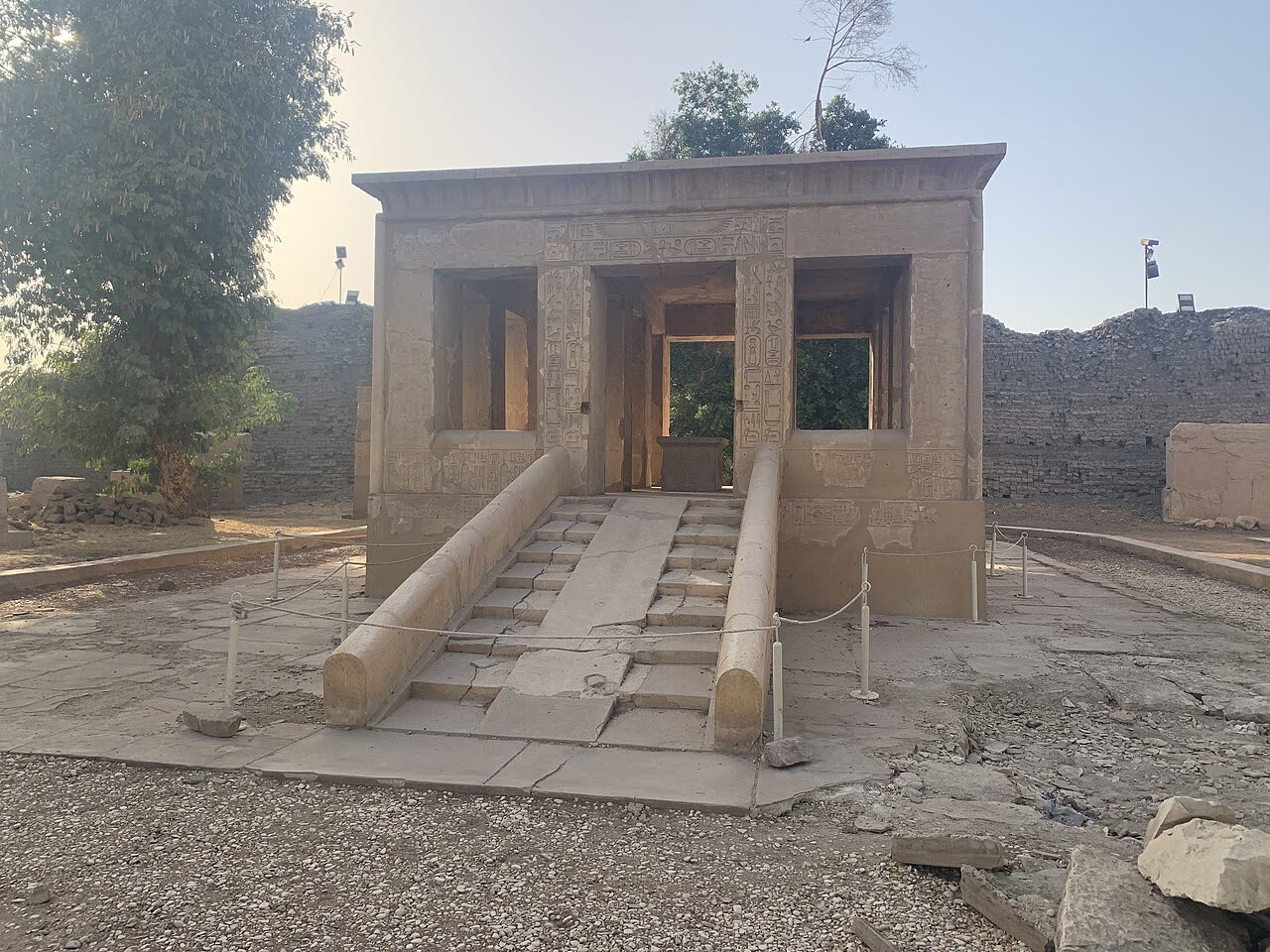
The White Chapel has four interior pillars and twelve more around the outside. Its carved decoration records the heb-sed, a royal jubilee. Traces of paint survive on the pillars, signs and cornices. Some scenes on the base represent the Nile, lakes and chapels. Its other sides record the regional districts of Egypt and figures for their measurements. The decoration thus gives the jubilee a setting that encompasses the land over which the king claimed to rule. [2]
The Digital Karnak project says the structure may originally have served as a pavilion for the jubilee. It proposes that it became a shrine for a ceremonial boat, or bark, under either Amenemhat III or Amenemhat IV. Later builders used its stones as filling in Karnak’s Third Pylon, a monumental gateway. The chapel now stands in the Open Air Museum, where it was reconstructed from reused blocks. Its original location remains debated. [1][2]
A pyramid and its foundation deposits
Senusret I was buried at Lisht. UCL compares the plan of his pyramid to those of the late Old Kingdom. Excavators found three intact foundation deposits under the pyramid. These were groups of objects laid down when the monument was built. They contained pottery, food offerings and small plaques naming the king and his building. The Met translates the pyramid name as Senwosret viewing the Two Lands. It suggests the name associates the king and pyramid with protection of the country. [1][3]
The plaque and the White Chapel both connect the king with the land. The plaque names a particular building and was deposited beneath it. The chapel sets out the districts on its visible base and depicts the king’s jubilee above. Their placement matters as well as their wording. One commemorated the foundation, and the other made the places of Egypt part of the setting of a royal ceremony. [2][3]
The Petrie Museum also holds shells inscribed with Senusret’s names. UCL lists his throne name as Kheperkare. That spelling and Kheperkara in the translation below refer to the same royal name. [1][6]
The king in Egyptian literature
At the start of the Tale of Sinuhe, the death of Amenemhat I is announced while Senusret is returning from a campaign. Messengers reach him and he leaves his army behind. Sinuhe overhears words connected with the succession and flees. Much later in the tale, a royal decree invites Sinuhe to come home. It names the king as Kheperkara, the form of Senusret’s throne name used in the UCL translation. The king’s first appearance sets the flight in motion, and his written decree makes the return possible. [1][6]
The Teaching of Amenemhat I takes the form of the older king’s advice to his son. Its opening addresses Senusret as the ruler for whom the advice is meant and places the speech in the voice of Amenemhat. UCL traces the work through later manuscripts, whose opening and closing formulas show that it was circulated as a composition in its own right. The stories give Senusret recognizable royal roles, as a successor, a recipient of instruction and the king who can recall an exile. The monuments at Karnak and Lisht give independent evidence of his royal names and buildings. [1][2][3][6][7][8]
References and notes (8)
- UCL Digital Egypt, Senusret I Read the overview, titulary, burial location, attested works and bibliography note on Obsomer’s position on the proposed coregency. Return to the text ↑
- Digital Karnak, White Chapel Read the building description and phases, including the pillar arrangement, festival imagery, district list, the proposed early function, conversion and reuse under Amenhotep III. Return to the text ↑
- Metropolitan Museum of Art, Plaque from a Foundation Deposit of Senwosret I Read the object’s dating, findspot, contents of the deposits and interpretation of the pyramid name. Return to the text ↑
- Metropolitan Museum of Art, Relief block with the names of Amenemhat I and Senwosret I Read the display description and object details on the crowns, temple setting and interpretation of the scene as evidence of a coregency. Return to the text ↑
- Dorothea Arnold, Amenemhat I and the Early Twelfth Dynasty at Thebes, Metropolitan Museum Journal 26 (1991) Read the discussion of the reused blocks, Figs. 19–21 and their relationship to the chronology of the funerary temple at Lisht. Return to the text ↑
- UCL Digital Egypt, Tale of Sanehat, text and translation Read sections 3–7, the death announcement and departure, and sections 35–36, Berlin 3022 lines 179–199, the royal decree recalling Sinuhe. Return to the text ↑
- UCL Digital Egypt, The Teaching of King Amenemhat I, Section I Read the transliteration, translation and names and titles commentary for the opening address to Senusret. Return to the text ↑
- UCL Digital Egypt, The Teaching of King Amenemhat I, dating Read the evidence from dated witnesses and the opening and closing formulas in the New Kingdom manuscripts. Return to the text ↑
Suggest a correction · Suggest a source for this record
Cite this record
IL Archive, «Senusret I, the White Chapel and the Succession of Amenemhat I», https://ilarchive.com/en/people/senusret-i