Person · Literary figure
Sinuhe, the Egyptian Courtier Who Flees and Returns
- Names
- Sanehat · Si-nuhe · Sinuhe
- Region
- Egypt
Sinuhe flees Egypt after the death of Amenemhat I and builds a new life abroad. A royal decree brings him home in a tale told in his own voice.
Estimated reading time: 4 min Published Last reviewed:
Share article
Text
Introduction
Sinuhe, called Sanehat in the translation published by UCL’s Digital Egypt, is the narrator of a Middle Kingdom Egyptian tale. He serves at the Egyptian court, flees after the death of Amenemhat I and finds a place in the household of a ruler in western Asia. The story ends with his return to Egypt, where he says that his king gave him a burial chapel. The British Museum identifies the tale as fiction. Its surviving manuscripts give evidence of how the story was copied and read. [1][2][3]
Sinuhe’s account is told in the first person. He recounts the fear that sent him away, describes a successful life abroad and reproduces a royal message inviting him to return. The narrative gives a reader access to the exile’s words, including the ways he explains his conduct to people who might judge it. [1]
A departure after the king’s death
The tale begins by giving Sinuhe titles and putting him in the service of Neferu, the wife of Senusret and daughter of Amenemhat. The army has been sent west, with Senusret in command. When Amenemhat dies, messengers go to find Senusret, who leaves the army. Sinuhe overhears a message concerning the royal children. He describes a sudden bodily fear and imagines bloodshed at the royal residence if he goes there. The story places his decision amid the uncertainty of a succession and gives his fear in his own words. [1]
Later Sinuhe tells a foreign ruler that he had faced no accusation. He says that his heart gave way when he heard the news. In the tale he keeps his allegiance to the new king in speech even as he builds a life in another country. When asked how Egypt can fare without Amenemhat, he says that the king’s son has taken his inheritance and praises Senusret’s judgment and strength. [1]
A household in Retjenu
Sinuhe says that he reached Byblos and continued to Qedem. After a year and a half there, a ruler called Amunenshi fetched him. The UCL translation describes Amunenshi as ruling the hinterland of Syria. The Petrie Museum’s description of a second manuscript calls his land Retjenu, in western Asia. These descriptions place the story in a region and allow the geographical names to be read as the tale presents them. [1][4]
Amunenshi gives Sinuhe a place among his children and settles him with his eldest daughter. Sinuhe is allowed to choose land and describes a place called Iaa with figs, grapes, grain and livestock. He receives company, land and rank. He also says that he became commander of Amunenshi’s army. A damaged papyrus from Harageh preserves part of that episode, which can be aligned with lines 103–110 in the Berlin version. The surviving fragment shows that the passage about Sinuhe’s military service circulated beyond the manuscript that preserves the fullest account. [1][3][4]
The invitation to return
The decree sent by Senusret calls on Sinuhe to prepare to see the residence where he was born. The king mentions his age and promises burial provisions, including wrappings, a procession and offerings at his tomb. The message addresses the future that Sinuhe faces as an older man. Return will give him a place among the king’s courtiers and a burial attended by the people who perform the rites in the story. [1]
Sinuhe describes being received at court and given a house, royal clothing and supplies. The last part of his account turns to the work of his tomb. He names the people who select the ground, draw the design, carve the stone and transport materials. He says that the king had an image made for him and that fields were assigned to sustain his burial cult. The tale ends with the narrator in the king’s favour. Its closing detail gives his return a setting that can endure after he dies. [1]
The story on papyrus and stone
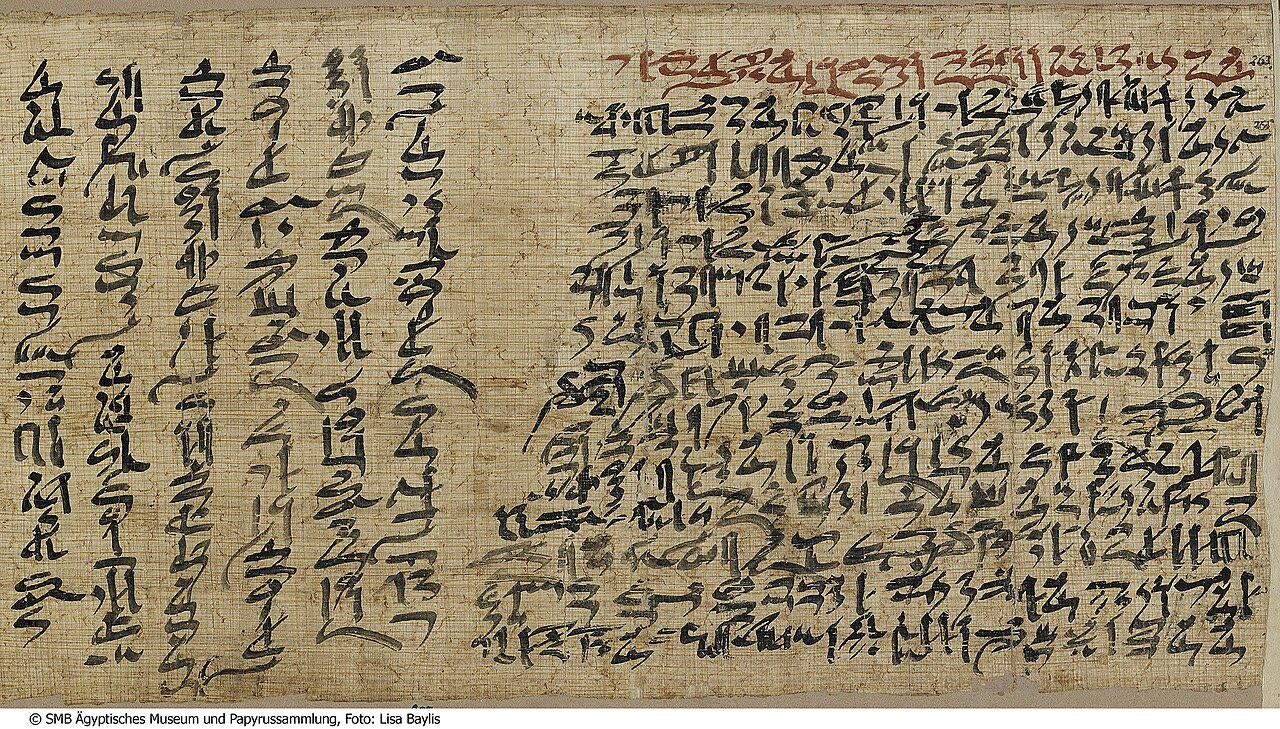
UCL identifies Berlin 3022 and Berlin 10499 as the two principal manuscripts. Berlin 3022, shown here, is a Middle Kingdom copy. Berlin 10499, also from the Middle Kingdom, was found in a tomb under the later Ramesseum precinct at Thebes. The Harageh fragment has parts of four vertical lines and a surviving red dot. UCL estimates its missing height by comparison with parallel copies. The museum can identify the episode the fragment preserves because there is another copy to read beside it. The same comparison lets its cataloguers estimate that the fragment has lost about half its original height. The mark in red survives even where much of the writing has disappeared. [3][4]
A later copy at the Louvre shows how the narrative also survived on ostraca, pieces of stone or pottery used for writing. The fragment E 33400 is limestone with black and red ink, dated by the Louvre to Dynasty Nineteen from its excavation context. It preserves part of the conversation in which Sinuhe tells Amunenshi about Amenemhat’s death. The survival of that conversation on stone and of Sinuhe’s service abroad on papyrus gives readers different views of the same character. The copies attest the circulation of his story across centuries. [1][3][4][5]
References and notes (5)
- UCL Digital Egypt, Tale of Sanehat, text and translation Read the opening, flight and exchange with Amunenshi, Berlin 10499 and Berlin 3022 lines 1–70, the household and military scenes at lines 75–110, the royal decree at lines 179–199, and the reception and burial at lines 290–310. Return to the text ↑
- British Museum, Hieroglyphs: unlocking ancient Egypt, large print guide Read The Tale of Sinuhe, pp. 88–89, on its fictional character, the broad narrative and limestone witness EA5629. Return to the text ↑
- UCL Digital Egypt, Sources for the Tale of Sanehat Read the list and descriptions of the principal witnesses Berlin 3022 and Berlin 10499, the provenance of the Harageh fragment and the list of later ostraca. Return to the text ↑
- UCL Collections Online, Tale of Sanehat papyrus fragment, P Harageh 1 Read the catalogue description of the four partial lines, red dot, comparison with lines 103–110 and identification of Sanehat’s role in Retjenu. Return to the text ↑
- Musée du Louvre, ostracon, E 33400 Read the object number, French translation of the dialogue, materials and Dynasty Nineteen date assigned from excavation context. Return to the text ↑
Suggest a correction · Suggest a source for this record
Cite this record
IL Archive, «Sinuhe, the Egyptian Courtier Who Flees and Returns», https://ilarchive.com/en/people/sinuhe
Continue reading