Person
Sneferu
- Names
- Senefru · Snefru · Snofru
- Region
- Egypt
The first king of Egypt’s Fourth Dynasty built the Bent and Red pyramids at Dahshur and is linked to Meidum. A later story in the Westcar Papyrus remembers him at a palace lake.
Estimated reading time: 5 min Published Last reviewed:
Share article
Text
Introduction
Sneferu, also written Snefru or Snofru, was the first king of Egypt’s Fourth Dynasty. Two great pyramids at Dahshur preserve different solutions to the problem of building a smooth-sided royal monument. A third pyramid at Meidum was reshaped from an earlier stepped structure and was remembered as his in antiquity. In the much later Westcar Papyrus, Sneferu appears at a palace lake, where a lost piece of jewelry interrupts a royal outing. The buildings and the story preserve different kinds of evidence for the same king. [1] [2] [3]
The king in the written record
Sneferu’s Horus name was Neb-maat. University College London’s inventory of attestations lists a seal impression from Hierakonpolis, inscriptions at Magharah in SinaiSinai: peninsula and biblical mountainSinai is a peninsula in eastern Egypt; in the Torah the name also denotes the mountain of revelation to MosesGlossary · Click to read the explanation, and a metal tool bearing his name. The Palermo Stone preserves a royal annal entry that mentions a campaign against Nubia. These records put the king’s name in several different settings, from administrative objects to inscriptions and royal annals. The UCL inventory also records a graffito at Meidum, where the date and context of the inscription matter for determining what it can establish about construction. [1] [2]
The Egyptian Ministry of Tourism and Antiquities gives a conventional reign of about 2613–2589 BCE. The length and sequence of the building program remain debated. Archaeologists compare masonry, dated marks where they survive, and the relationship between a pyramid and neighboring tombs. Even when a monument can confidently be assigned to Sneferu, the evidence for the year a particular stage began can be much weaker. [2] [4]
The three stages at Meidum
The visible tower at Meidum is a remnant of a building that changed shape at least twice. The labels E1, E2 and E3 refer to construction stages. E1 was a stepped pyramid, E2 enlarged it, and E3 filled out the steps to create smooth faces. An entrance high on the north face leads down into the bedrock. A corridor beyond the descent approaches a shaft that rises to the chamber, where courses of stone project inward to form a corbelled ceiling. The modern profile can obscure how much of this monument survives inside its ruined exterior. [2] [4]
The attribution of all three stages to Sneferu has been debated. One proposal assigns the first two stages to Huni and the conversion to Sneferu. Franck Monnier notes that no mention of Huni has been found near Meidum and that inscriptions naming Sneferu securely dated to the construction itself are also missing. New Kingdom visitors refer to the temple of Sneferu. Large tombs of people associated with his reign, including Nefermaat and Rahotep, lie at Meidum. This evidence supports the association of Sneferu with the complex, while the division of work among reigns remains a separate question. [2]
The southern pyramid at Dahshur
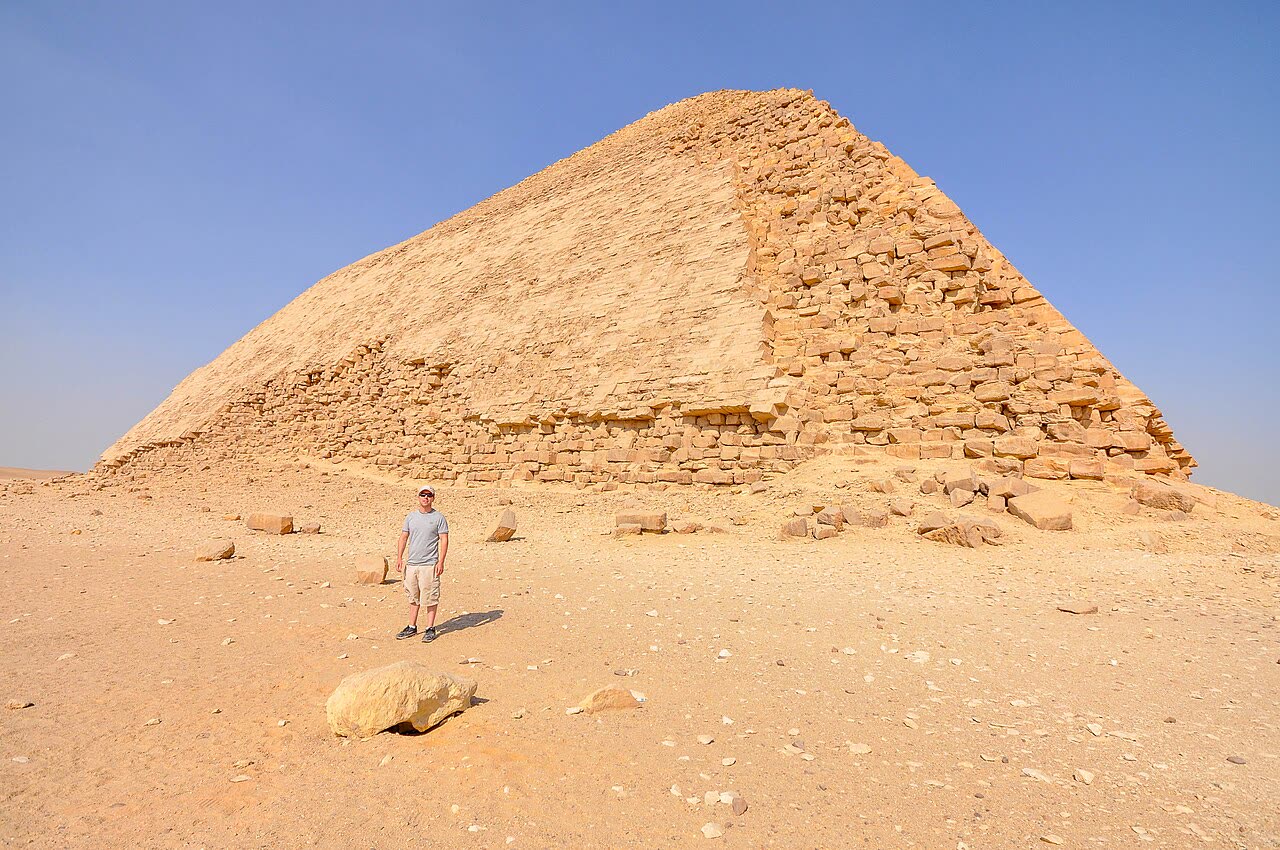
The Bent Pyramid’s lower face rises at roughly 55 degrees and its upper face at about 43 degrees. The change is conspicuous today because substantial stretches of exterior limestone casing survive. Egypt’s antiquities ministry explains the adjustment as a response to instability under the growing mass of masonry. Rainer Stadelmann relates the changes to subsidence and damage in the chamber system, while Monnier’s reconstruction also considers how the builders intended the lower exterior to be finished. The sharp change of slope is visible evidence of revision. The sequence of decisions that left it exposed requires reconstruction. [2] [5] [6]
Inside, passages from separate entrances on the north and west reach chambers at different heights. The western entrance is high in the side of the pyramid. The chamber reached from the north lies below ground level. Both employ corbelled roofs. In the surrounding complex, evidence for a continuing cult in the temples shows that the southern site remained in use after construction of the northern pyramid. [2] [5] [6]
The northern pyramid
At the Red Pyramid, farther north at Dahshur, the outer faces maintain a shallow slope from the base to the summit. Stadelmann describes a square base about 220 metres on a side and stone laid in horizontal courses. The exposed blocks give the structure its modern name. Originally, pale limestone from Tura covered them. A descending passage from the north reaches a succession of three chambers. The third is usually identified as the intended burial chamber. Stadelmann considers the remains of the eastern mortuary temple and traces of a mummified body grounds for suggesting that Sneferu was eventually buried here. [6] [7]
The king at the lake
In the Westcar story, Sneferu walks through his palace looking for a place to refresh himself. The chief lector priest Djadjaemankh proposes an excursion on the palace lake. During the outing, a rower drops a fish-shaped turquoise pendant. She stops rowing and insists on recovering the particular object she lost. The priest folds one side of the water over the other, retrieves the pendant from where it has come to rest on a shard, and returns the water to its former place. The king rewards him. [3]
The episode is told at Khufu’s court as a wonder from the time of a royal forebear. Its closing passage returns to Khufu, who orders offerings for Sneferu. The scene belongs to the king’s literary afterlife, alongside a cult that University College London describes as flourishing in the Middle Kingdom and another composition set in his reign, the Prophecy of Neferty. Sneferu’s name thus connects surviving architecture with later Egyptian writing about a remembered past. [1] [3]
References and notes (7)
- University College London, Digital Egypt, “Snefru” Royal names, attestations and Middle Kingdom reception Return to the text ↑
- Franck Monnier, “The satellite pyramid of Meidum and the problem of the pyramids attributed to Snefru” JAEA 3, pp. 5–12 and 17–20 Return to the text ↑
- Bibliotheca Alexandrina, The Westcar Papyrus, Digital Library of Inscriptions and Calligraphies English translation, the third tale set in the reign of Sneferu (the lake episode) and its frame Return to the text ↑
- Egyptian Ministry of Tourism and Antiquities, “The Pyramid of Meidum” Building phases and passage to the chamber Return to the text ↑
- Egyptian Ministry of Tourism and Antiquities, “The Bent Pyramid” Slope change, entrances and chambers Return to the text ↑
- Rainer Stadelmann, "The Pyramids of the Fourth Dynasty", in Zahi Hawass, The Treasures of the Pyramids (American University in Cairo Press, 2003) Chapter 10, pp. 116–119, the two Dahshur pyramids Return to the text ↑
- Egyptian Ministry of Tourism and Antiquities, “The Red Pyramid” Tura casing and internal chamber sequence Return to the text ↑
Suggest a correction · Suggest a source for this record
Cite this record
IL Archive, «Sneferu», https://ilarchive.com/en/people/sneferu