Person · Author
Strabo of Amaseia and the Geography of Egypt
- Names
- Strabo · Strabo of Amaseia · Strabon
- Region
- The Near East and the Mediterranean
Strabo went up the Nile with a Roman prefect and collected stories about the places he described. His account brings a visit to Memphis, a sandal legend and a frontier war into the same book.
Estimated reading time: 5 min Published Last reviewed:
Share article
Text
Introduction
When Strabo describes the sandy approach to a temple near MemphisMemphis in EgyptMemphis is an ancient Egyptian city near Mit Rahina south of present-day CairoGlossary · Click to read the explanation, he says he saw sphinxes there partly buried by the wind. A few lines later, he tells how an eagle carried a woman's sandal to an Egyptian king. Both passages belong to the Geography, a Greek work written under Roman rule. Strabo presents the sphinxes as something he saw and calls the story about the sandal fabulous. His own distinction helps a reader work out how to use the book. [1]
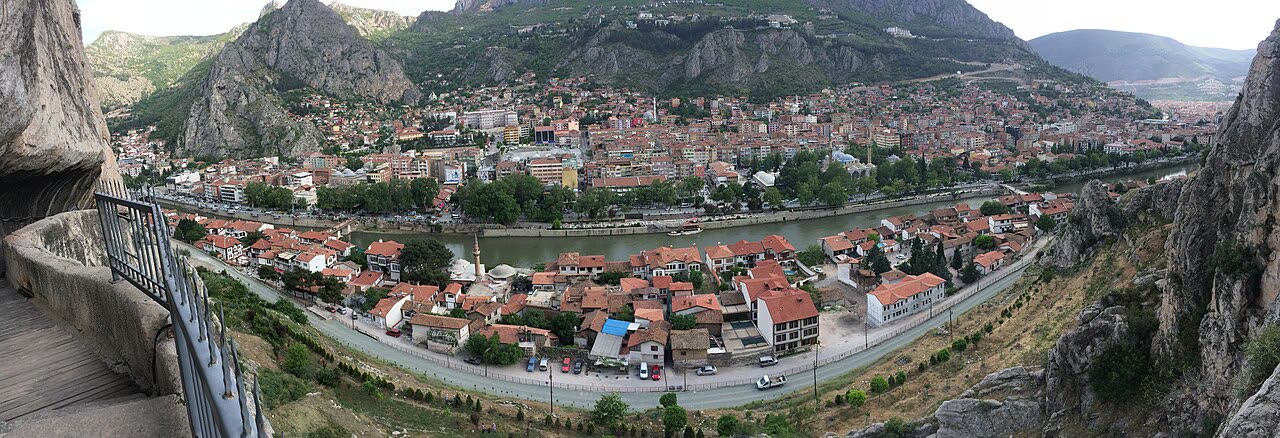
Strabo came from Amaseia, a city in Pontus, in what is now northern AnatoliaAnatoliaAnatolia is the region occupying the Asian part of present-day TurkeyGlossary · Click to read the explanation. He wrote about its river, rock defences and royal buildings with the familiarity of someone describing home. In another part of the work he explains how he brought together what he saw with reports from other people. [2][3]
A city he called home
In Book 12, Strabo traces the Iris River past the walls of Amaseia and calls the place his homeland. He describes a steep rock where the defences climbed from the inhabited riverbank toward two peaks. Inside the defences he puts the palaces and monuments of the kings. His description also tells a reader how the city worked. Two bridges connected the town, its suburbs and the land beyond, and passages cut through the rock led toward supplies of water. [2]
The Geography is the starting point for much of what is known about his life. Its translator, H. L. Jones, used Strabo's scattered remarks to place him in Rome and in Egypt. Jones dated the visit up the Nile to 25 and 24 BCE. Duane W. Roller places it probably in late 27 BCE or early 26 BCE, reasoning that it was an inspection trip early in the prefect’s term. Both dates are reconstructions from the surviving evidence. Strabo identifies the official with whom he travelled and the furthest point he reports reaching. [4][5][3]
What a traveller could find out
Book 2 says that Strabo accompanied Aelius Gallus, the Roman prefect or governor of Egypt, up the Nile as far as Syene and the frontier of the land the translation calls Ethiopia. In the same passage, he says he learned that 120 ships were sailing from Myos Hormos to India. He presents the voyage up the river as his own experience and the size of the trade as information he obtained. [3]
Strabo makes room for both kinds of knowledge. He compares assembling a geography to recognizing an apple from its colour, shape, flavour and other features. Any one observation gives part of the picture. In the same passage he compares geographers with commanders who need reports from places they cannot visit. His examples explain why a description of distant places might depend on testimony even when the writer had travelled widely himself. [3]
The sandal at Memphis
As Strabo moves from Memphis to the pyramids, he describes three conspicuous monuments. At the smallest, he reports a story about a woman whom some called Rhodopis. While she was bathing, an eagle supposedly took a sandal from her maid and dropped it into the lap of a king hearing cases outdoors. Strabo says the king had the owner found at Naucratis and married her. He reports that her burial was associated with the pyramid. The passage documents a story told about the monument in antiquity. The marriage and burial belong to that story. [1]
The queen on the southern frontier
Later in the same chapter, Strabo reports a war in his own time. He calls the opposing ruler Candacê. His account follows the Roman commander Petronius to Pselchis, Premnis and Napata, and gives the queen a role in negotiations as well as in the fighting. At the end, envoys go to Samos, where Strabo says Caesar grants their requests and lifts the tribute he had imposed. His explicit account of travelling with Gallus names a different official. The chapter on the campaign presents Petronius’s movements and the terms of the settlement as a continuous account. Strabo gives no account of joining Petronius’s forces. [6][3]
Alexandria and the limits of firsthand evidence
Strabo describes Alexandria as a city whose long sides face water, with the sea on one side and a lake on the other. He describes streets laid out to carry carts and riders and sets the Museum within the royal quarter. There he describes a walk, seating and a common dining hall for scholars who shared property. The Museum’s priest, he says, had once been appointed by the kings and was now appointed by Caesar. The detail links an institution founded under royal government to the arrangements Strabo knew under Rome. [7]
Roller points out that Strabo says elsewhere that he lived in Alexandria for a long time. The account of the city gives many particulars in the third person. Descriptions along the Nile likewise use the first person only in some places, including at HeliopolisHeliopolis, ancient IunuHeliopolis is the Greek name of Egyptian Iunu, at Matariya in northern present-day CairoGlossary · Click to read the explanation. That uneven usage makes it hard to decide from grammar alone which details came from a visit and which came from reports. The first person settles some cases, such as the sand-covered sphinxes. For other descriptions, a reader needs the surrounding evidence, including Strabo’s remarks about where he stayed, whose expeditions he joined and when he attributes information to someone else. [5][7][1][3]
References and notes (7)
- Strabo, Geography, translated by H. L. Jones, Loeb Classical Library, vol. VIII (1932) 17.1.31–33, especially the first-person note on sand-covered sphinxes in §32 and the description of the pyramids and the story of Rhodopis in §33. Read the English translation. Return to the text ↑
- Strabo, Geography, translated by H. L. Jones, Loeb Classical Library, vol. V (1928) 12.3.15 and 12.3.38–39, the Iris River, Amaseia, the fortifications, water passages, bridges and royal monuments. Read the English translation. Return to the text ↑
- Strabo, Geography, translated by H. L. Jones, Loeb Classical Library, vol. I (1917) 2.5.11–13, the account of personal travel and reported information, the apple and commander analogies, the expedition with Aelius Gallus, and the report of shipping from Myos Hormos. Read the English translation. Return to the text ↑
- H. L. Jones, introduction to Strabo's Geography, Loeb Classical Library, vol. I (1917) Introduction, pp. xiii and xxi–xxiv. Read the premise that the biography is reconstructed from Strabo and the discussion of Rome, the Egyptian trip and its dating. Return to the text ↑
- Duane W. Roller, The Geography of Strabo: An English Translation, with Introduction and Notes, introduction Read the Cambridge excerpt, pp. 2–3 and 8–10, on the probable date of Strabo’s birth, family in Amaseia, dating of the voyage with Gallus, and the limits of identifying firsthand observation. Return to the text ↑
- Strabo, Geography, translated by H. L. Jones, Loeb Classical Library, vol. VIII (1932) 17.1.54, the account of Petronius, Candacê, Pselchis, Premnis and Napata, and the embassy to Samos. Read the English translation. Return to the text ↑
- Strabo, Geography, translated by H. L. Jones, Loeb Classical Library, vol. VIII (1932) Read 17.1.7–8 on Alexandria’s streets, position between two bodies of water, and the Museum and its priest. Return to the text ↑
Suggest a correction · Suggest a source for this record
Cite this record
IL Archive, «Strabo of Amaseia and the Geography of Egypt», https://ilarchive.com/en/people/strabo