Person · Figure
Ullusunu of Mannea
- Names
- Ullusunu the Mannean · Ulusunu
- Region
- The Near East
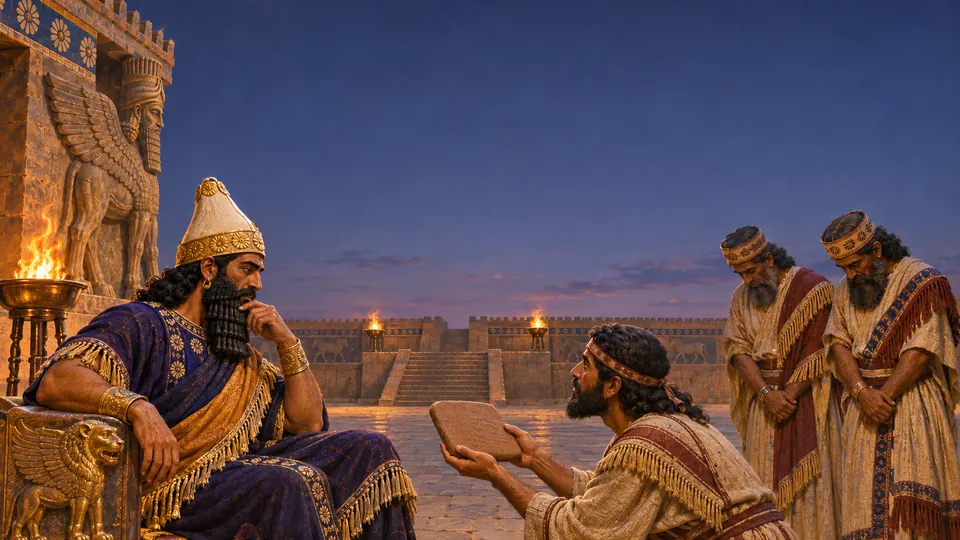
Ullusunu held the throne of Mannea while Assyria and Urartu fought over its borderlands. At Sirdakku in 714 BCE he supplied Sargon II’s army and petitioned for help against his rivals.
Estimated reading time: 5 min Published Last reviewed:
Share article
Text
Introduction
Ullusunu ruled Mannea during Sargon IISargon IISargon II was an Assyrian king of the late eighth century BCE; ORACC dates his reign about 721–705 BCEGlossary · Click to read the explanation’s campaigns in the Zagros in the late eighth century BCE. Assyrian records describe his alliance with Rusâ of Urartu, his submission to Sargon, and his provision of food and animals for the expedition of 714 BCE. The same records show an Assyrian king eager to claim the right to grant Ullusunu his throne. They also reveal what Ullusunu sought from that relationship, including military help and the restoration of his territory. [1] [2]
A disputed succession
Mannea’s royal city was Izirtu. The Assyrian sources place Ullusunu in the family of Iranzi, his father, and Azâ, his brother and predecessor. Sargon’s annals describe the violent death of Azâ and implicate Rusâ and local Mannean leaders in his overthrow. They present Sargon’s intervention as vengeance for the dead king and claim that Ullusunu owed his position to Assyria. The palace Display Inscription credits Mannean leaders with putting Ullusunu on the throne and says he gave Rusâ twenty-two strongholds. The texts agree on the struggle over Mannea. Their accounts assign the initiative for the succession differently. [1] [2]
The annals place Sargon’s attack on Izirtu in his sixth regnal year, 716 BCE. He boasts of burning the royal city and taking the fortified settlements of Zibia and Armaet. Ullusunu and his people then appear before him in submission, and the Assyrian king says he pardoned Ullusunu and restored him to the throne. In the Display Inscription, Ullusunu takes refuge in a mountainous district before coming down to meet Sargon. Grant Frame has identified a passage on a fragmentary Sargon cylinder from Melid that may refer to the same submission. He keeps the identification tentative. [1] [3]
The conflict over the strongholds continued. In narrating the following year, the annals say Rusâ took twenty-two fortresses from Ullusunu and encouraged a local governor, Dayukku, to break with him. Sargon claims to have captured the fortresses and incorporated them into Assyrian territory. He deported Dayukku and his family and set up a royal image at Izirtu. The Display Inscription also credits Sargon with giving Ullusunu twenty-two fortresses and two cities that he had taken from Rusâ and Mitatti. The accounts compress and arrange events differently, so the recurrence of the same number alone is insufficient to settle the disposition of every fortress. [1] [2]
Tribute and a banquet
The report of Sargon’s eighth campaign describes two meetings on Mannean territory in 714 BCE. Ullusunu first travels from Izirtu to the border fortress of Sinihinu with counselors, officials, and members of the royal family. He brings horses trained for the yoke with their drivers, as well as cattle and sheep. Later, at his fortress of Sirdakku, Ullusunu gathers flour and wine for the Assyrian army and presents more animals. The account also mentions his eldest son, a peace offering, and a stele in connection with securing the succession. The presence of the son gives the meeting significance beyond the immediate movement of troops through Mannea. [2] [4]
Sirdakku also served as a place of audience for other local leaders. The report says that the governors of Appatar and Kitpatai brought horses, cattle, and sheep there from Gizilbundu. Sargon next describes his departure for the fortress of Panzish, facing the lands of Zikirtu and Andia. He claims that he strengthened the defenses and stocked the place with provisions and military equipment. The sequence places Ullusunu’s contribution in a campaign that depended on encounters at strongholds and access to stores as Sargon moved farther into the region. [2]
Sargon says that Ullusunu and his leading men petitioned him to keep the people of Kakmê out of Mannean territory, defeat Rusâ, and restore a land whose population had been scattered. Sargon represents himself as able to promise all of this. He then describes a banquet in which Manneans sat with Assyrians and says that he raised Ullusunu’s throne above that of his father Iranzi. The same episode casts the visitors in language of humiliation. Read together, the requests, the supplies, and the banquet give some sense of both sides’ interests, filtered through the Assyrian king’s account. Sargon returned to the Zagros in 713 BCE and again lists Ullusunu among those who brought tribute. [1] [2] [4]
The clay tablet and the correspondence
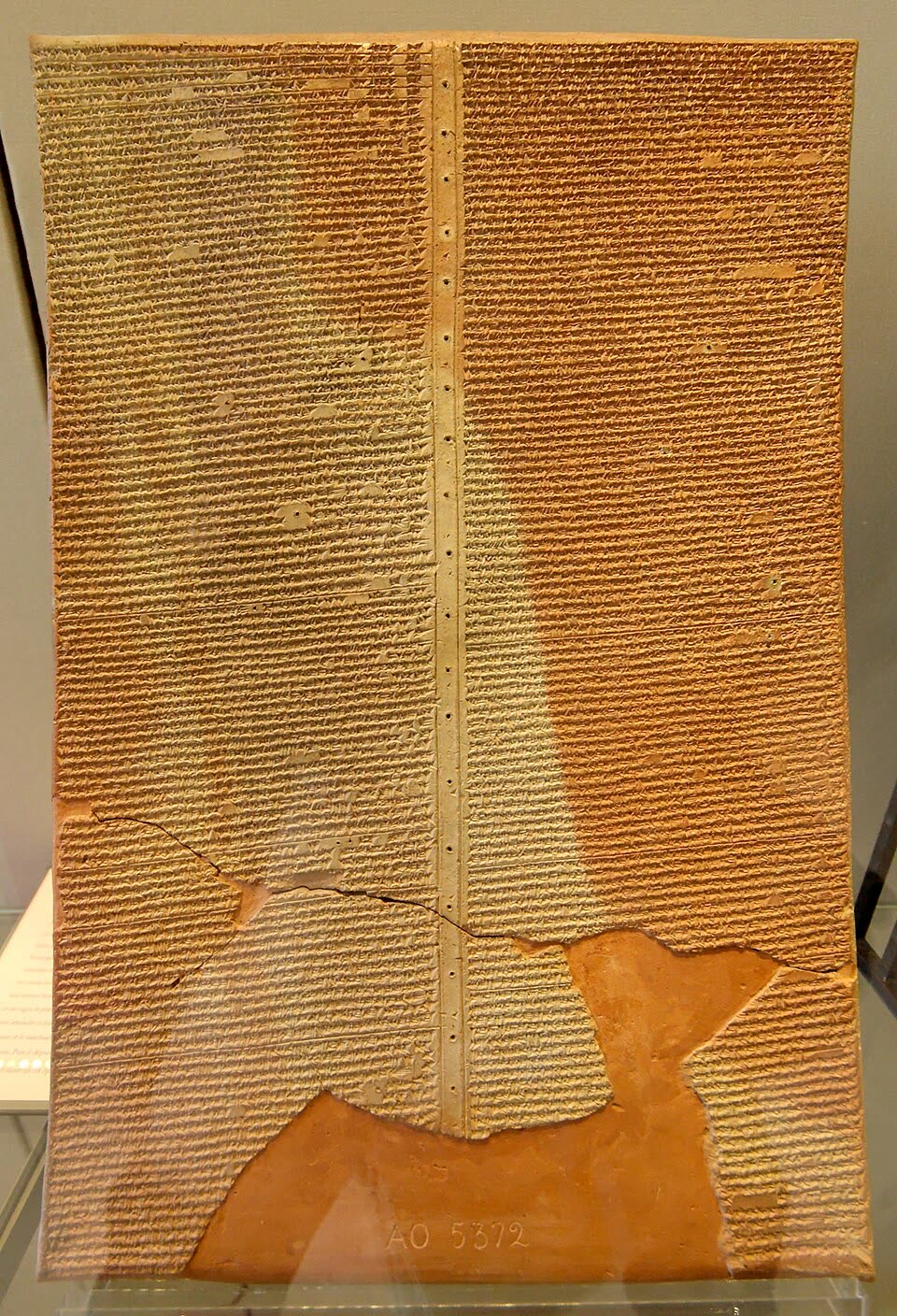
The Louvre preserves the main clay witness to the eighth-campaign account, AO 5372, from Assur. The French Ministry of Culture identifies the chief scribe Nabû-shallim-shunu in the colophon and describes the script as Babylonian in the main text, with Neo-Assyrian signs in the colophon. The report is a formal address to the god Ashur. Its descriptions of Ullusunu’s changing fortunes belong to Sargon’s presentation of the expedition before his god. [1] [5] [6]
The letters sent to Assyrian authorities use the language of reports. One fragmentary letter edited in State Archives of Assyria records that Ashur-le’i of Karalla received horses from the Mannean king. Another, which the editors suggest may belong near the decisive confrontation of 714 BCE, gives Sennacherib’s report that Rusâ had entered Mannean territory. The editors caution that many letters lack explicit dates. Their evidence helps trace what Assyrian officials knew and when they might have learned it, while the royal inscriptions provide the named places, tributes, and public claims through which Ullusunu’s dealings are best documented. [7]
References and notes (7)
- Grant Frame, The Royal Inscriptions of Sargon II, King of Assyria (721–705 BC), RINAP 2 Introduction pp. 27–29 and text 1, Khorsabad Annals, lines 78b–109a and 165b–170a Return to the text ↑
- Daniel David Luckenbill, Ancient Records of Assyria and Babylonia, vol. 2 Sections 10, 12–13, 24, and 56 on Mannea in the palace inscriptions, sections 139 and 144–150 on the report of the eighth campaign Return to the text ↑
- Grant Frame, A “New” Cylinder Inscription of Sargon II of Assyria from Melid P. 77, commentary on lines 19–20 and parallel passages on Ullusunu’s submission Return to the text ↑
- Josette Elayi, Sargon II, King of Assyria Pp. 133–136, Mannea’s succession and Sargon’s meeting with Ullusunu at Sirdakku Return to the text ↑
- Musée du Louvre, Tablette de la huitième campagne de Sargon II AO 5372, inventory, title, date of the campaign, and findspot Return to the text ↑
- French Ministry of Culture, Orient cunéiforme, Eighth Campaign Tablet Object label for AO 5372, material, script, colophon and chief scribe Return to the text ↑
- Giovanni B. Lanfranchi and Simo Parpola, The Correspondence of Sargon II, Part II Introduction, The Datable Letters and The War with Urartu, letter 218 and Sennacherib’s report Return to the text ↑
Suggest a correction · Suggest a source for this record
Cite this record
IL Archive, «Ullusunu of Mannea», https://ilarchive.com/en/people/ullusunu