Person · Figure
Zosimus and the Palmyrene War
- Names
- Zosimos · Zosimus
- Region
- The Near East
Zosimus wrote the Greek New History in late antiquity. His account of Aurelian’s war against Zenobia preserves a campaign narrative that can be read alongside contemporary coins and a conflicting account of the queen’s fate.
Estimated reading time: 5 min Published Last reviewed:
Share article
Text
Introduction
When Aurelian reached Antioch, the surviving Palmyrene troops had already left, according to the historian Zosimus. Their commander had paraded an imperial lookalike through the city to make people think Aurelian was a prisoner. The episode comes from Book 1 of the Greek New History, written more than two centuries after the war. It is one of several scenes in which Zosimus gives a turn of events a human cause and a memorable setting. [1] [2]
The man who wrote the New History
The ninth-century reader Photius calls Zosimus a comes, or count, and a former advocatus fisci, a legal officer concerned with the public treasury. Photius describes a six-book history that passes quickly across the early emperors before narrowing its attention to later reigns. He objects to the author’s attacks on Christians and praises his prose for its clarity and brevity. Those judgments come from a reader who examined the work centuries after its composition. [3]
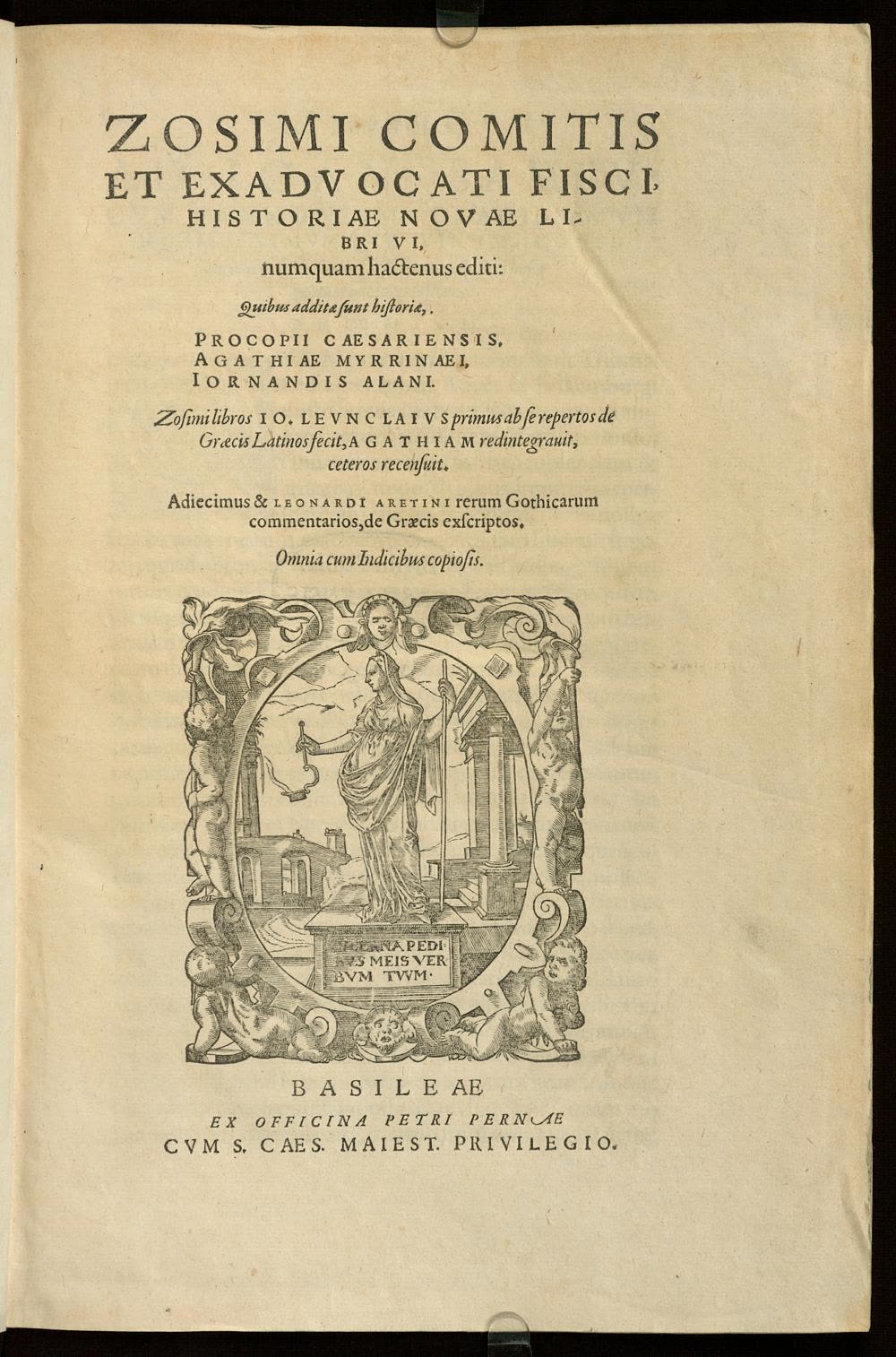
Zosimus probably worked in Constantinople, an inference from his titles and the career paths available to treasury advocates. He described the abolition of a tax repealed in 498, a clue that places the writing after that date. The later historian Evagrius reports that Eustathius of Epiphania used the work, but the date of Eustathius’s own chronicle is uncertain, leaving room for different estimates of when Zosimus finished writing. The principal surviving Greek manuscript, Vaticanus Graecus 156, is medieval and the history breaks off during the events of 410. By about 1576, Johannes Leunclavius’s Latin translation appeared in print at Basel. [2] [4]
From Antioch to the Euphrates
Zosimus gives Zenobia a position of command as the Palmyrene regime takes Egypt and extends its reach into Asia Minor. In the war narrative he traces Aurelian’s advance through cities including Ancyra and Tyana to the region of Antioch. It is here that he places the story of the substitute emperor. The general whom the older English translation calls Labdas uses the deception to leave Antioch by night with Zenobia and the rest of her army. Others who had fled the city out of fear of punishment return, says Zosimus, after Aurelian publishes an offer of pardon. [1]
A second battle is set outside Emesa. After defeat, Zenobia and her advisers fall back to Palmyra. Zosimus describes the city under siege and says that its leaders sent the queen to seek Persian assistance. Roman horsemen caught her as she was crossing the Euphrates. After the surrender, he moves the action back to Emesa for a trial in which Zenobia blames several advisers. One of them, Longinus, receives a death sentence. The writer’s praise for Longinus and his books gives the account of the executions a different tone from the preceding military scenes. In Zosimus’s telling, Longinus is composed enough to comfort the friends who grieve for him. That detail gives a voice to someone otherwise known here through the accusation and verdict. [1] [5]
What the coins add
A type struck in AlexandriaAlexandria (Egypt)Alexandria is a city on Egypt’s Mediterranean coast, founded by Alexander the Great in 331 BCE and an important center of trade and culture.Glossary · Click to read the explanation in 270–271 bears Aurelian’s portrait and his title Augustus on one side and the portrait and titles of Vaballathus on the other. The two rulers have different year numbers, Aurelian’s first and Vaballathus’s fourth on this example. A separate Alexandrian type from 272 bears a diademed image of Zenobia and calls her Augusta. Its reverse has a year-five mark and a bust identified by the current catalogue as Selene, accompanied by a crescent. Both types survive in multiple specimens. [6] [7]
Roger Bland’s study brings the coins of Antioch and Alexandria into the same chronology, comparing the issues with date formulas in Egyptian papyri. The paired coinage precedes the brief issues in which Zenobia and Vaballathus claim imperial titles. This sequence gives the political change its own dates and vocabulary. Zosimus supplies a route and a series of encounters. A coin preserves a public title someone authorized a mint to strike. Reading the two together gives firmer ground for discussing the break with Aurelian than the actions or motives assigned to any one person in the campaign. [1] [5] [6] [7]
How the story ends
At this point in Book 1, Zosimus pauses to explain what he hopes to accomplish. Polybius told readers how Rome gained its empire in a short time. Zosimus says he means to show how Romans lost it through their own conduct. He follows that declaration with oracles said to foreshadow Palmyra’s defeat. At an oracle of ApolloApolloGod of music and prophecy in Greek traditions, also participating in the Iliad’s events.Glossary · Click to read the explanation at Seleucia, one response speaks of a single falcon commanding many doves. For Zosimus, these stories belong to an age in which the gods still rewarded observance of the rites. Their place in the book shows how readily he moves from a campaign to an argument about Roman decline. [1]
When he resumes the story, he reports only that Zenobia is said to have died, of illness or lack of food, and that others of the captives drowned in the strait. The Historia Augusta gives her a public role in Aurelian’s triumph, then says he spared her and that she lived with her children at Tibur. The coin with her portrait can establish that a mint called her Augusta in 272. Her fate after capture depends on later accounts whose versions diverge at precisely the point when she is being taken out of the lands she ruled. [1] [7] [8]
References and notes (8)
- Zosimus, New History, English translation of 1814 Book 1, especially §§50–61 and the comparison with Polybius at §57 Return to the text ↑
- Matthew Ryan Hassall, Political Debate in the Age of Justinian I pp. 36–38, career, transmission and dating Return to the text ↑
- Photius, Bibliotheca, translated by J. H. Freese Codex 98, description and assessment of Zosimus Return to the text ↑
- Universitätsbibliothek Basel, Zosimi comitis et exadvocati fisci, Historiae novae libri VI UBH Bc II 117, title and bibliographic description of the Latin printing Return to the text ↑
- Roger Bland, The Coinage of Vabalathus and Zenobia from Antioch and Alexandria Numismatic Chronicle 171, pp. 140–144 and 151–157, chronology and sequence Return to the text ↑
- Roman Provincial Coinage, type 75752 Alexandrian type of Aurelian and Vaballathus, date and legends Return to the text ↑
- Roman Provincial Coinage, type 75761 Alexandrian type of Zenobia, date, legends and images Return to the text ↑
- Historia Augusta, Lives of the Thirty Pretenders, translated by David Magie 30.24–27, triumph and later life in the text’s account Return to the text ↑
Suggest a correction · Suggest a source for this record
Cite this record
IL Archive, «Zosimus and the Palmyrene War», https://ilarchive.com/en/people/zosimus