Site · Region
The Field of Reeds and Field of Offerings
- Names
- Field of Hotep · Field of Offerings · Field of Reeds · Field of Rushes · Sekhet-Hetep · Sekhet-Iaru
- Region
- Egypt
Egyptian funerary texts name the Field of Reeds and Field of Offerings in accounts of the hereafter. Spell 110 and its images show waterways, divine encounters and work in the fields.
Estimated reading time: 5 min Published Last reviewed:
Share article
Text
Introduction
The Field of Reeds, also translated as the Field of Rushes, is a place in Egyptian funerary literature. The Field of Offerings is a related name that can appear beside it in the same composition. In the Book of the Dead, the heading of Spell 110 speaks of reaching the Field of Rushes and dwelling in the Field of Offerings. The speaker expects to move among lakes and settlements and to carry out familiar activities there. [1][2]
The fields can be read in different settings across the surviving sources. Pyramid Texts associate the Field of Rushes with purification and passage to the sky. Coffin Texts give more attention to what the deceased receives there. Paintings in the tomb of Sennedjem and vignettes in the Papyrus of Ani render parts of the landscape as plots, waterways and places to meet gods. [2][3][4][5]
From the Pyramid Texts to the Coffin Texts
Harold Hays traces changes in the contexts where the field appears. In the Old Kingdom Pyramid Texts, purification is its most frequent immediate context. Several utterances place an opening of the sky’s doors, ascent and cleansing in the field in the same sequence. Another passage describes the field filling with water so that Teti can be ferried to the eastern side of the sky. Hays notes that purification in the field and travel from there to the sky recur together in these texts. [3]
In the Middle Kingdom Coffin Texts, provision is more prominent. A spell can speak of occupying a booth in the Field of Rushes, while placing the deceased’s abundance in the Field of Offerings. Hays follows that paired wording across a Pyramid Text and related Coffin Text versions. Robert Gresser also discusses Coffin Text Spell 404, where knowledge of the spell leads to bread, beer and a plot with grain to be reaped by the Followers of Horus. Land, food and the work of harvesting can all be part of what is provided. [3][6]
Coming to know the field
The opening of Spell 110 lists things a person seeks to do in the hereafter. They include attaining the two fields, becoming effective or blessed there, ploughing, reaping, eating and drinking. Later in the spell the speaker describes knowing the settlements, districts and lakes in the field of Hotep. He speaks of paddling on its lakes so that he can reach those settlements. The words of the spell give the deceased a route and describe the ability to act on arrival. [1]
The names of the two fields are worth keeping visible in translation. Hays identifies an earlier text that places a booth in the Field of Rushes and abundance in the Field of Offerings. The heading of Spell 110 pairs them again, with the verbs of reaching and dwelling. The images that accompany the spell give a spatial form to parts of this language. Their divisions into waterways and strips of ground organize the scenes, while the words can describe movement among several places within the region. [1][2][3]
Ani’s papyrus
On the British Museum’s illustrated sheet from the Papyrus of Ani, areas of land are arranged between bands of water. Ani presents offerings to three gods, takes a boat across the Lake of Offerings and pays respect to figures identified as the Western Falcon and the Heron of Plenty. Other scenes show him reaping, winnowing and ploughing. The boat of Wennefer, a name of OsirisOsirisOsiris was an ancient Egyptian deity associated with the dead, life after death, renewal, and kingship. His roles appear in changing funerary texts, rituals, and judgment scenes, notably the weighing of the heart.Glossary · Click to read the explanation, appears moored at the bottom. [2]
The vignettes make several parts of the spell visible at the same time. They show one person appearing at different moments and carrying out related tasks. Ani can approach a group of gods, take to the water and return as a worker among cultivated plots. The museum describes the composition as schematic. Fields and water appear as forms the viewer can follow across the sheet as well as places a speaker can name and move through. [1][2]
A wall in the tomb of Sennedjem
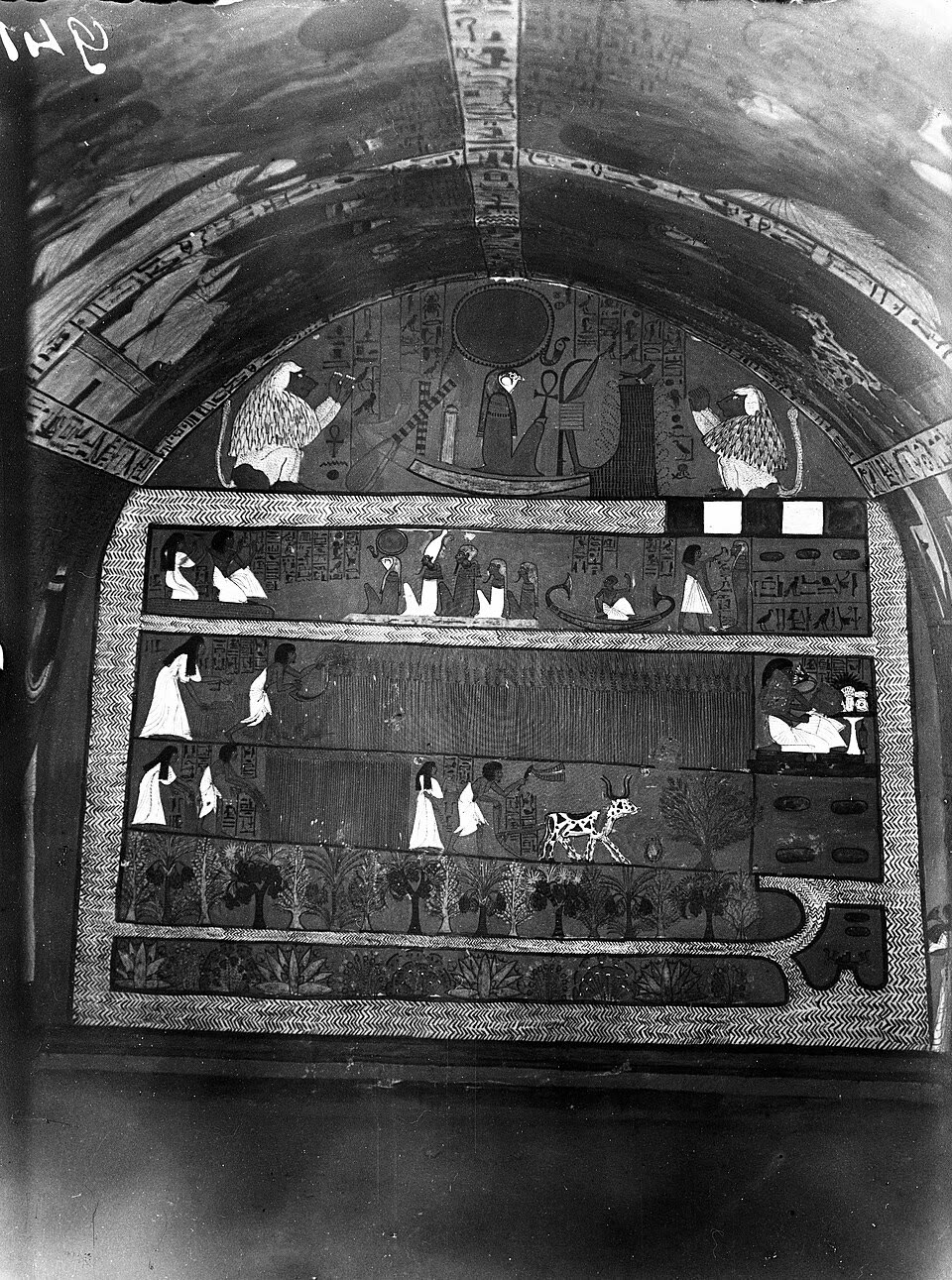
At Deir el-Medina, a version of the scene occupies the east wall of Sennedjem’s burial chamber. The lower registers contain the agricultural scenes associated with Spell 110, beneath a solar boat. The Metropolitan Museum’s catalogue describes Sennedjem and his wife Iineferti harvesting grain, sowing and pulling flax in the fields. The setting allows the images of work to be read together with the divine scene above them. [4][5]
The photograph is a historical view of the actual east wall from the Museo Egizio archive. It shows how the scene fits under the vault and how the activities occur across horizontal registers. The layout differs from the papyrus sheet made for Ani, while both use waterways, acts of worship and cultivated land to give form to the destinations named by the funerary text. [1][2][4][5]
The tomb also places scenes from other spells on neighboring walls. On the south wall, Sennedjem and Iineferti appear before guardians of portals that the deceased must pass. The Museo Egizio connects that scene to Spells 145 and 146. In the chamber, a visitor can see the work of the fields alongside a different part of the funerary journey, where the task is to gain passage. [4]
The fields remain recognizable across these sources through what people do there. The spells describe being cleansed, receiving provisions, identifying passages and cultivating the ground. The images give some of those actions the places and implements with which to carry them out. [1][2][3][4][5][6]
References and notes (6)
- Thomas George Allen, The Book of the Dead or Going Forth by Day, Spell 110 Read the opening and selected subsequent passages on reaching and dwelling in the fields, naming settlements and lakes, paddling, ploughing and reaping, pages 87–90. Return to the text ↑
- British Museum, Papyrus from the Book of the Dead of Ani, Spell 110 Read the object description and identification of the offerings, lake, birds, farming and boat of Wennefer in the vignette. Return to the text ↑
- Harold M. Hays, Transformation of Context: The Field of Rushes in Old and Middle Kingdom Mortuary Literature Read the Old Kingdom passage and purification groups, Teti’s ferrying passage and the Middle Kingdom discussion of provision and the two fields. Return to the text ↑
- Museo Egizio Photo Archive, TT1, Tomb of Sennedjem Read the east-wall entries including B00941, identification with Spell 110, position below the solar barque, photograph date and CC0 dedication. Return to the text ↑
- Metropolitan Museum of Art, Sennedjem and Iineferti in the Fields of Iaru Read the catalogue description of the original tomb scene documented in the facsimile, including the location and named agricultural acts. Return to the text ↑
- Robert Gresser, The Field of Rushes in Egyptian Funerary Texts Read the sections on purification, provision, the Middle Kingdom Coffin Text Spell 404 and the continued use of field language in the Book of the Dead. Return to the text ↑
Suggest a correction · Suggest a source for this record
Cite this record
IL Archive, «The Field of Reeds and Field of Offerings», https://ilarchive.com/en/sites/field-of-reeds