Site · City
Hadrach and Hazrak
- Names
- Hadrach · Hatarikka · Hazrach · Hazrak · Hazrek
- Region
- The Near East
Hazrak is the fortified place where Zakkur of Hamath and Luash says he was besieged. Scholars relate it to Assyrian Hatarikka and biblical Hadrach, and commonly propose Tell Afis as its site.
Estimated reading time: 5 min Published Last reviewed:
Share article
Text
Introduction
Hazrak is the fortified place where Zakkur, king of Hamath and Luash, says an alliance led by the king of Damascus besieged him. His account is inscribed in Old Aramaic on a stone monument now in the Louvre. Scholars commonly relate Hazrak to the Hatarikka of Assyrian records and the Hadrach named in Zechariah. Tell Afis, in northwestern inland Syria, is a leading candidate for its location. [1][2][3][4]
The evidence for these connections comes from several kinds of records. Zakkur names the city while claiming divine help in a siege. An Assyrian chronicle names a target of several campaigns. The biblical verse speaks of a land and names Damascus. The excavated buildings at Tell Afis offer evidence for the importance of a settlement that scholars have associated with those written forms. [1][3][4][5][6]
Hazrak in Zakkur’s account
Zakkur places his rule at Hazrak under the protection of Baalshamayn. He presents the alliance arrayed against him as led by Bar-Hadad, son of Hazael, king of Damascus. The surviving text includes Arpad and a number of other allies. The list is damaged, and some readings depend on restoring names. The king describes the earthworks raised against his defenses and says that he raised his hands to the god. Baalshamayn, he reports, answered through seers and diviners and promised to save him. [1]
The inscription connects the siege with work done at Hazrak afterward. In Scott Noegel’s translation of the surviving lower part of the account, Zakkur speaks of building up the city, fortresses around it and temples in his territory. Breaks interrupt several of those statements. The monument gives an ancient name to the city and records the sort of work the king claims as a result of his deliverance. Its remaining lines leave the extent of that work open to interpretation. [1][2]
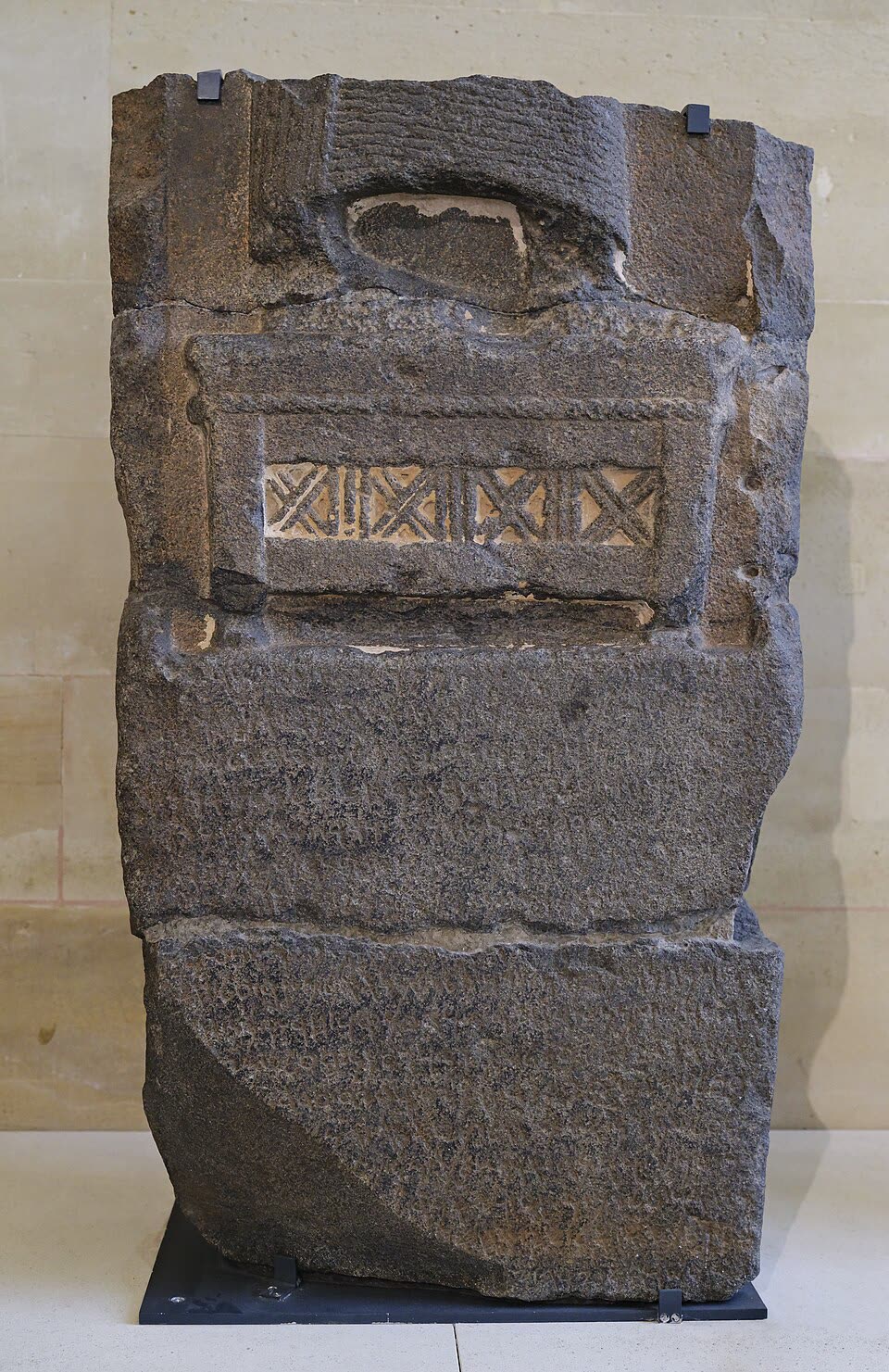
The Zakkur stele survives as a rejoined lower portion. Above the inscribed surface are traces of a standing figure whom the Louvre identifies as Zakkur, with the lower part of his robe and the platform beneath him. The inscription and the partial figure are evidence from the same object. Reading the place name depends on the signs on the stone, whereas the museum’s account of the figure draws on the surviving relief. [1][2]
Hatarikka in Assyrian notices
The Assyrian eponym chronicle sets historical events against the officials whose names identified individual years. It records campaigns against Hatarikka in entries placed at 772, 765 and 755 BCE. These brief notices record the object of the campaign. The entry for 765 also mentions plague, and the ones for the other two years give their own dated officials. The repeated name shows that the city or territory remained a target after the period commonly associated with Zakkur. [3][5]
Zechariah 9:1 speaks of the land of Hadrach in an oracle that also names Damascus. The wording refers to a land, giving the name a geographic scope that can be wider than the walls of a single settlement. Reading the biblical, Aramaic and Assyrian references together has helped scholars make the case for a connection among the names. The separate sources preserve different details about that geography. [1][3][4][5]
The case for Tell Afis
The Louvre catalogues Afis as the discovery place of the stele. Matthieu Richelle notes a gap in the discovery record. Henri Pognon did not disclose the exact provenance in his account, and the traditional attribution was made afterward. A portable monument could also have been moved in antiquity. This makes the museum’s place entry one piece of the case for the identification, alongside evidence from the excavation and the texts. [2][3]
Tell Afis itself has monumental Iron Age remains. Stefania Mazzoni’s study describes successive temple phases on the acropolis. The excavators identified earlier stone foundations incorporated into a later building. The large temple of the final phase had deeply founded outer walls with courses of limestone and basalt and a vestibule to the south. The foundations include layers of cobblestones between courses of larger blocks. Mazzoni interprets this building as the latest stage in a process in which the main temple was enlarged and the surrounding area took shape as a precinct with other structures. Such remains show the investment made in the town’s religious center and give independent evidence that the mound held more than a small settlement. [6]
An inscribed potsherd from Tell Afis also enters the argument. In the reading summarized by Richelle, it may mention Iluwer, the deity to whom Zakkur dedicates the stele. That supports a possible local connection. The same god could be invoked in several settlements, and the inscription also names a place read as Apish or Pṣ that could be distinct from Hazrak. One proposal takes it to be a quarter or sanctuary precinct within Hazrak. The identification depends on what that damaged passage denotes. [1][3]
Richelle also discusses an alternative placing Hatarikka near Damascus, based in part on an Assyrian letter from a governor there. The letter concerns a man installed in Hatarikka whose return the governor sought. Its use as geographical evidence depends on how closely the governor’s authority is taken to have followed his immediate district. Tell Afis combines a traditional association with the monument and a well-documented Iron Age site. The placement of Hazrak there remains a historical identification to evaluate through both the objects and the place names. [2][3][6]
References and notes (6)
- Scott Noegel, The Zakkur Inscription Read the edition’s discussion and translations of the coalition, divine response, building projects and damaged Apish passage on pages 307–309. Return to the text ↑
- Musée du Louvre, Stèle de Zakkur, AO 8185 Read the identification, script, surviving lower relief and reported findspot and discoverer. Return to the text ↑
- Matthieu Richelle, The Fluctuating Borders of Hamath Read the argument for and against Tell Afis, the discovery report, ostracon, possible reading of Pṣ, Assyrian campaign notices and alternative near Damascus. Return to the text ↑
- Zechariah 9:1, NET Bible Read the verse and the translator’s notes on the land of Hadrach and the relation of Damascus to the oracle. Return to the text ↑
- Assyrian eponym chronicle, Limmu List 858–699 BCE Read the translated entries for 772/771, 765/764 and 755/754 BCE concerning campaigns against Hatarikka. Return to the text ↑
- Stefania Mazzoni, Temples at Tell Afis in Iron Age I–III Read the excavation discussion of temples AII and AI, superimposed foundations, construction materials, vestibule and acropolis development. Return to the text ↑
Suggest a correction · Suggest a source for this record
Cite this record
IL Archive, «Hadrach and Hazrak», https://ilarchive.com/en/sites/hadrach-hazrak
Continue reading