Site · Region
Lesbos in Archaic Greek Literature
- Names
- Lesbos · Lesvos
The cities of Lesbos shared an island and a language of song while keeping distinct civic identities. Alcaeus, Sappho and Herodotus link the island with exile, worship and travel across the sea.
Estimated reading time: 5 min Published Last reviewed:
Share article
Text
Introduction
Alcaeus pictures a speaker separated from Mytilene who can see other Lesbians gathering at a sanctuary. Sappho's poetry places prayers for travellers and memories of heroic voyages alongside worship on the island. Herodotus traces another route, from Mytilene to Egypt and back, in his account of Charaxus and Rhodopis. These sources describe Lesbos as a place of several communities, some at odds with one another, whose inhabitants could nevertheless speak of a common sacred place or travel overseas and still be known by their city. [1][2][3]
An island with several cities
Herodotus includes Lesbos in his description of Aeolian settlements. He counts five cities on the island in his account and explains that there had been a sixth, Arisba, whose inhabitants were enslaved by the people of Methymna despite their shared ancestry. The example makes a distinction that matters throughout the island's literary record. The inhabitants of two places could be recognized as kin while belonging to cities capable of taking action against each other. Counting the settlements gives a different picture of the island from treating it as a single city. [4]
Strabo places Lesbos across from the coast of Asia Minor and describes its capes, cities and passages in terms of their distances from one another. He calls Mytilene the largest city and gives it two harbours. The southern one could be closed, while the deeper northern harbour was protected by a mole. His description is much later than the poets it also discusses. It shows how a geographer explaining Mytilene to a reader situated the city in relation to the other Lesbian towns and the waters between the island and the mainland. His account also gives Eressus its own profile. It stood on a hill beside the sea and was remembered as the birthplace of Theophrastus and Phanias. [5]
Songs of political separation
Strabo attributes some of Alcaeus' songs to the conflicts within Mytilene and names Pittacus, Myrsilus and Melanchrus among the subjects of his attacks. He also portrays Alcaeus as involved in the disputes and tells his own story of how Pittacus used power and gave it up. That account belongs to the later reception of the poems. In the surviving fragments, the immediate voice can speak as one excluded from the city, longing for a place in its affairs. It can also address the community that shares the sanctuary outside it. [1][5]
In fragment 129 the precinct is described as common to the Lesbians. In fragment 130b the speaker is alone there while assemblies and festivities are possible around him. Gregory Nagy traces the identification of this sacred place with Messon to Louis Robert, who compared the poems with later inscriptions naming the sanctuary. Timothy Power accepts Messon as a likely setting in the song while arguing that the imagined experience of exile need not correspond to an actual performance there. Their readings show how much can depend on the distinction between the scene described and the place where the words were first sung. [1][6]
Worship at Messon
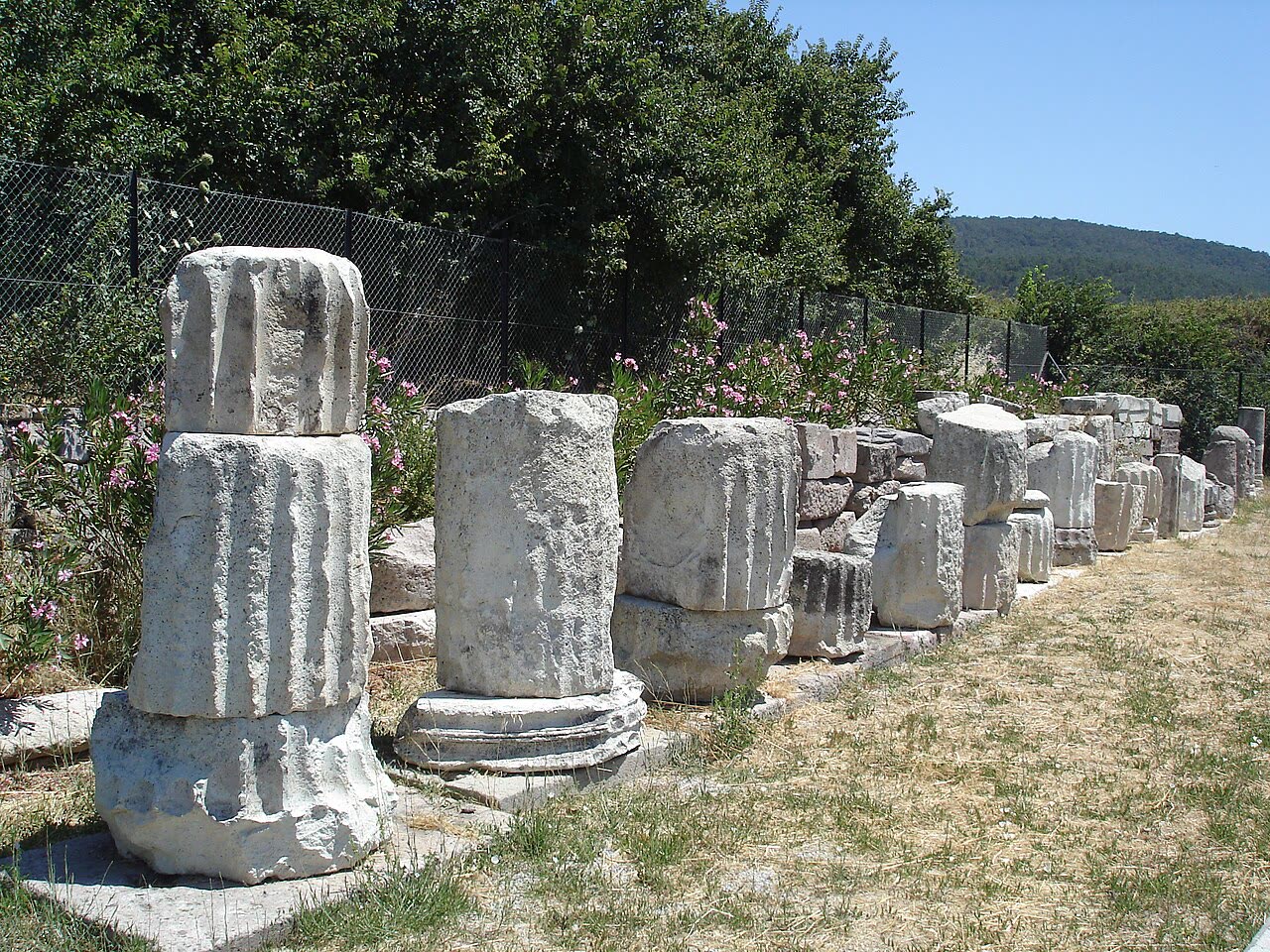
The sanctuary of Messon lies in the middle of Lesbos, near Mesa. The archaeological site description identifies an Archaic religious building and a successor temple around 300 BCE dedicated to ZeusZeusZeus is the sky god and leading deity in many Greek traditions. In the Iliad he presides over divine gatherings while others can still speak and object.Glossary · Click to read the explanation, Hera and Dionysus. The visible stones belong to the history of the sanctuary across several periods. Its later uses also include a Christian basilica. The association with the songs rests partly on the literary descriptions and inscriptions, which give a basis for connecting the landscape with the community the poems evoke. [1][7]
In Sappho's fragment 17, Hera is addressed in a song that also names Zeus and Dionysus and recalls the sons of Atreus returning from Troy. The myth places a concern with safe passage inside the worship of a community. Nagy reads the words about a festival and the participation of women and girls as evidence for a cult occasion in the represented setting. Other scholars allow more room for the song to evoke a festival in a performance elsewhere. Both readings depend on features of the surviving words, and neither supplies a fixed record of what every singer or audience at Messon did. [2][6]
Mytilene and Naucratis
Herodotus names Charaxus as a Mytilenaean and Sappho's brother. In his account, Xanthes of Samos brings Rhodopis to Egypt, and Charaxus pays for her freedom. Rhodopis stays in Egypt and sends a dedication to Delphi. Charaxus goes back to Mytilene, where, according to Herodotus, Sappho rebukes him in a poem. The account places an island resident within a story that links several ports and a mainland sanctuary. Herodotus also uses the date he assigns to Rhodopis to dispute a story crediting her with a pyramid. [3]
In the surviving song usually called the Brothers Poem, a speaker wants to pray to Hera for Charaxus to bring his ship safely back and hopes for Larichus to take on adult responsibilities. The place of travel is unspecified in the poem, and modern readings differ on how to understand the opening reference to the ship. The verses put the emphasis on waiting and hoping for return. Alongside Herodotus, they show how a voyage could be made part of a family story and how the fortunes of an absent traveller could be spoken of through prayer on Lesbos. [3][8]
References and notes (8)
- Gregory Nagy, Alcaeus in Sacred Space Read the treatment of fragments 129 and 130b, the common precinct, Louis Robert's identification and the ritual scene. Return to the text ↑
- Gregory Nagy, A Poetics of Sisterly Affect in the Brothers Song and in Other Songs of Sappho Read sections 120–129 on the Atreids, Hera's festival, the other gods and the references to girls and women. Return to the text ↑
- Herodotus, Histories 2.134–135, translated by A. D. Godley Read the dating argument about Rhodopis, Charaxus's city and return, Naucratis and the dedication sent to Delphi. Return to the text ↑
- Herodotus, Histories 1.149–151, translated by A. D. Godley Read the list of Aeolian cities, the five cities on Lesbos and the account of what happened to Arisba. Return to the text ↑
- Strabo, Geography 13.2.1–4, translated by H. L. Jones Read the location of Lesbos, its cities, the harbours of Mytilene and the testimony about Alcaeus, Pittacus and Sappho. Return to the text ↑
- Timothy Power, Sappho's Parachoral Monody Read the treatment of Sappho fragment 17 and Alcaeus fragments 129 and 130b in Genre in Archaic and Classical Greek Poetry, with the distinction between scene and performance. Return to the text ↑
- Hellenic Heritage, Sanctuary of Messon Read the location, the Archaic building, the succeeding temple of the Lesbian Triad and later phases at the site. Return to the text ↑
- Dickinson College Commentaries, Sappho, The Brothers Poem Read the Greek, commentary on the opening verbs and the passages about the return of Charaxus, Hera and Larichus. Return to the text ↑
Suggest a correction · Suggest a source for this record
Cite this record
IL Archive, «Lesbos in Archaic Greek Literature», https://ilarchive.com/en/sites/lesbos