Ancient text
Middle Assyrian Laws A
A text for line-by-line reading, with transliteration, translation, and resources.
Cuneiform marriage and household provisions distinguishing widowhood, betrothal and residence.
Last reviewed:
Text
CuneiformCuneiformWriting with wedge-shaped signs, developed from Mesopotamian recording traditions and used for several languages from the third millennium BCE.Glossary · Click to read the explanation provisions including marriage, women and household matters, preserved on VAT10000 from AssurAshur, Qal’at SherqatAncient Tigris city in Iraq, an Assyrian political and religious centre.Glossary · Click to read the explanation, dated by CDLI to approximately 1400–1000 BCE. [1]
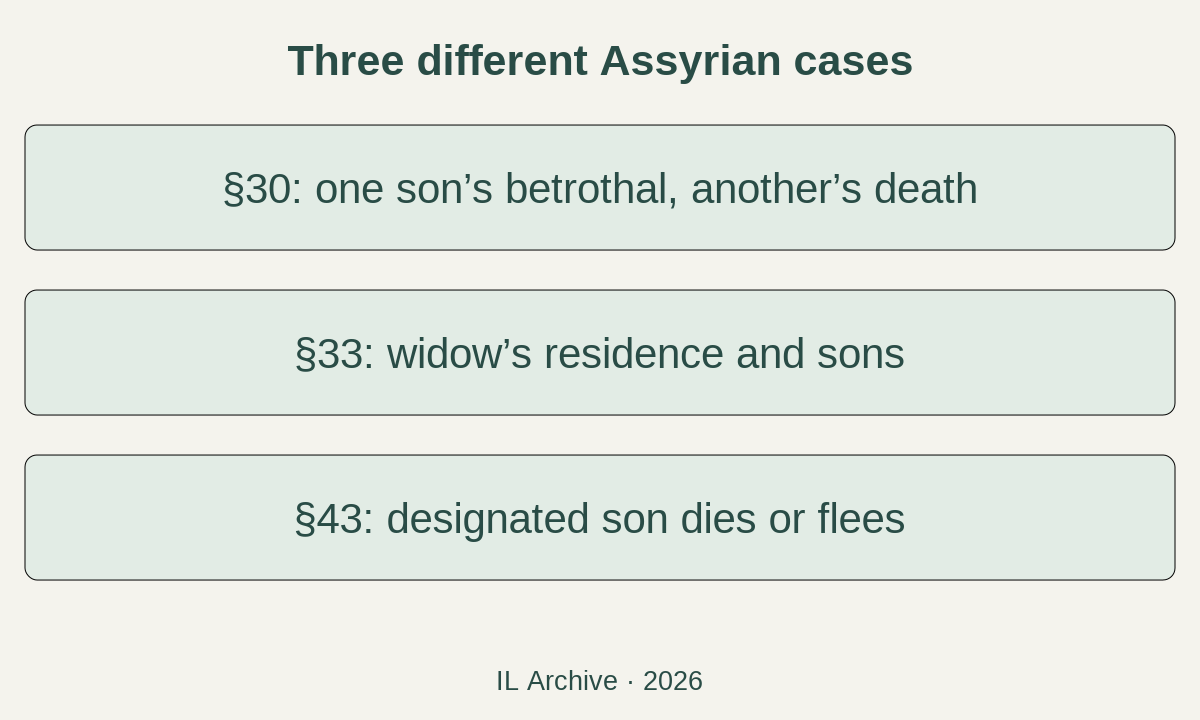
Cases 30,33 and 43 differ: rearranging marriage after another son’s death, a widow’s residence, and death or flight of the son designated for a union. Section 33 has a large gap, requiring distinction between preserved text and reconstruction. [2]
References and notes
- CDLI P281779, VAT 10000: tablet metadata and selected Akkadian transliteration for §§30, 33 and 43; not the entire collection or a museum-image reuse grant. Return to the text ↑
- Marten Stol, Women in the Ancient Near East, 2016, translated by Helen and Mervyn Richardson: complete pp. 296–299, PDF 308–311, and appendix pp. 672–674, PDF 684–686; not the whole book. Return to the text ↑
Archive records may be reviewed and refined as better evidence or sources become available. Suggest a correction
Suggest a correction · Suggest a source for this record
Cite this record
IL Archive, «Middle Assyrian Laws A», https://ilarchive.com/en/texts/middle-assyrian-laws-a