Ancient text · Tablet
The Plague Prayers of Mursili II
A text for line-by-line reading, with transliteration, translation, and resources.
- Names
- CTH 378 · Plague Prayers of Muršili II · The Plague Prayers of Mursili II
- Region
- The Near East
Mursili II asked the gods to end a calamity he said had afflicted Hatti for twenty years. Different prayers connect the suffering to an oath, neglected offerings and obligations inherited from his father.
Estimated reading time: 5 min Published Last reviewed:
Share article
Text
Introduction
The Plague Prayers of Mursili IIMursili IIHittite king of the late fourteenth century BCE, party to a loyalty treaty with Amurru’s ruler.Glossary · Click to read the explanation are Hittite royal appeals for an end to a deadly affliction. In the prayer to the Storm-god of Hatti, Mursili says people had died in the time of his father and brother and were still dying in his own reign. He gives the duration as twenty years. Other prayers address the Sun-goddess of Arinna or an assembly of gods and goddesses. They preserve several ways he described the suffering and pleaded on behalf of his country. [1][2]
Mursili asks what the gods require and what he can do about a wrong committed before his reign. He cites old tablets and describes looking for answers through an oracle, a way of seeking a decision from the gods. The events he recalls are woven into that appeal. The surviving text shows how a ruler argued for relief within the religious obligations he believed bound him and his people. [1][3]
An oath to Tudhaliya
In the prayer conventionally called the First Plague Prayer, Mursili addresses gods and goddesses called to witness an oath. He also invokes mountains, rivers, springs and subterranean watercourses. He tells the assembly that the affair of Tudhaliya the Younger had troubled him and that he sought an answer about it by oracle. In his account, his father and other leading figures of Hatti had sworn loyalty to Tudhaliya, and Tudhaliya was later killed after leading men went over to his father. The broken lines leave parts of the sequence obscure. [1][3]
Mursili presents the suffering as a consequence of that affair. He says his father’s reign had once been prosperous and insists that the people who committed the wrong have already died. Because the matter now affects him, he offers restitution from his own household. In the prayer, the present ruler’s responsibility to set things right follows from his inheritance of the kingship and its burdens. Izabella Sylwia Czyzewska notes that the king appears before the gods as a servant making an argued plea. The appeal combines his offer of restitution with a statement about his own conduct. [1][3]
Two tablets named in the Second Prayer
In the prayer to the Storm-god of Hatti, Mursili recounts finding two old tablets. He says one dealt with a rite for the Mala River, the Euphrates, that earlier kings had performed. The other concerned Kurustamma and an oath linking Hatti and Egypt. He describes the Hittite attacks on Amqa, the Egyptian request for a Hittite prince and a later conflict. The prayer says captives brought back after the subsequent fighting carried the affliction into Hatti. That is the account given during a plea about a breached oath. It gives neither the evidence needed to identify the disease nor an independent record of each stage of its spread. [1][4]
The king says that an oracle confirmed the significance of the oath and the neglected rite. He asks the Storm-god to take pity, says he has acknowledged his father’s wrongdoing and offers to make further restitution if the deity asks for it. In one passage he compares himself to a servant who brings a problem before a lord. In another he asks for the reason to be shown in a dream, through an oracle or through a person who speaks for a deity, if what he has already identified is insufficient. His prayer keeps returning to the possibility of learning what had been overlooked. [1][3]
A prayer to the Sun-goddess
The shorter prayer to the Sun-goddess of Arinna uses some of the same language about the suffering lasting across three reigns. In its surviving lines, Mursili describes a child who may be lost and an adult who may never reach old age. Parts of the description are damaged. He also fears that the remaining people who prepare bread offerings and pour libations may die. A libation is an offering of liquid. The prayer asks the gods to end the affliction while pointing out that deaths were leaving fewer people to maintain the acts of worship the gods received. [1]
What survives on the tablets
The numbers used for these prayers are editorial conventions. Singer’s edition places the short appeal to the Sun-goddess before the texts conventionally called the Second and First Prayers. The individual titles identify different compositions, while the CTH numbers refer to entries in a modern catalogue of Hittite texts. That distinction is helpful because several tablets or fragments can preserve the same prayer. [1][2]
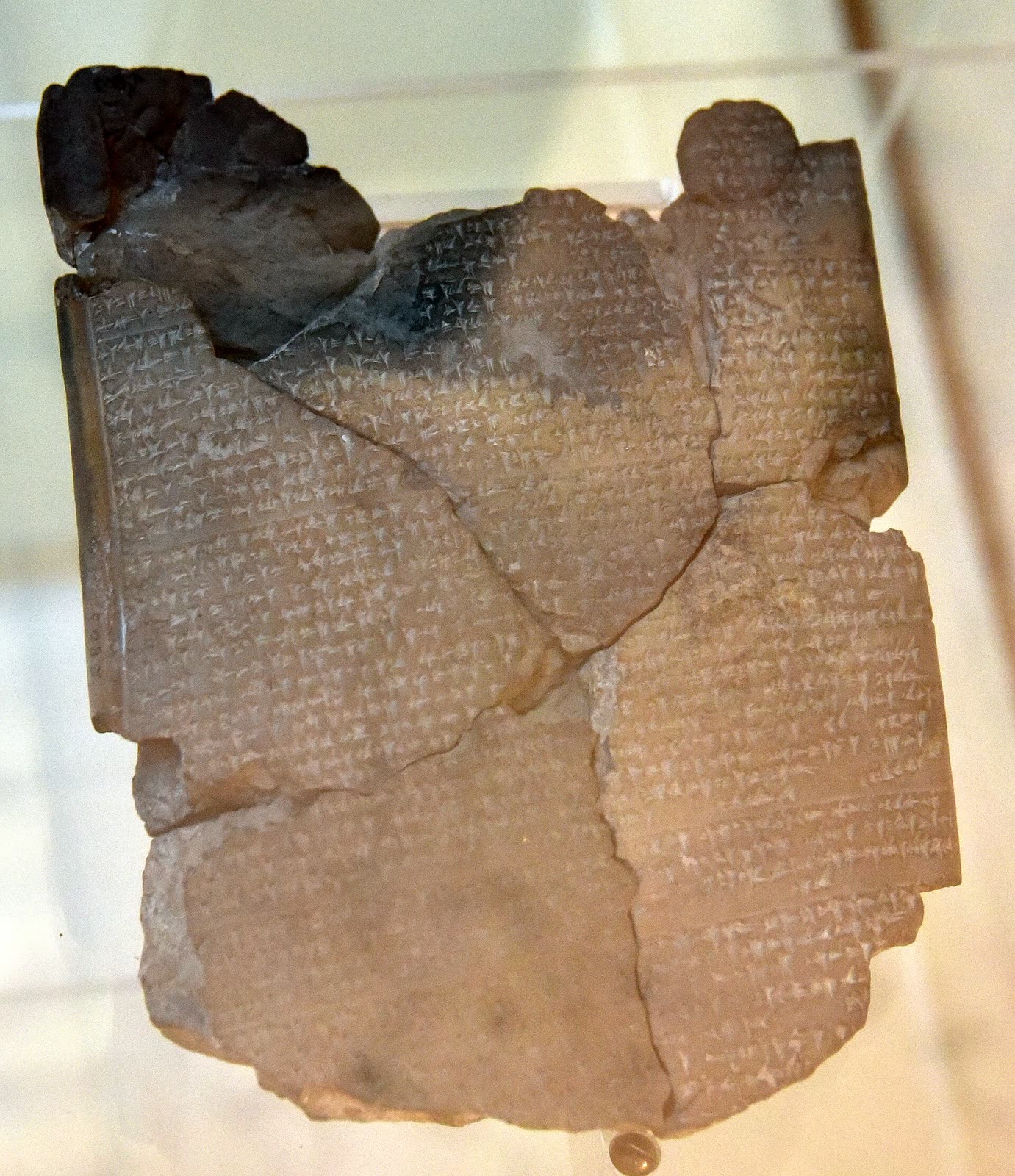
The Hethitologie Portal Mainz catalogues the prayers under CTH 378 and distinguishes copies and fragments of individual compositions. KUB 14.8, inventory Bo 2803, is a copy of the Second Prayer from Hattusa, now in Istanbul. The LAMAN catalogue also lists the place names preserved on the tablet, including Mala, Kurustamma and Amqa. Their place in the same text shows how the prayer brings a river rite and events involving Egypt into one petition. [2][5]
Copies can preserve different wording. Jared L. Miller notes that the formulation about sending troops and attacking again appears in KUB 14.8, where part of it is written across the edge and onto the back. Other witnesses to the prayer do not preserve both clauses in that form. This matters when readers try to count distinct attacks or to align the prayer with a diplomatic letter. The collection preserves the king’s repeated petitions as well as the work of the scribes who transmitted them. [1][2][4][5]
References and notes (5)
- Itamar Singer, Hittite Prayers, nos. 10–12 Read pp. 56–64, including the prayer to the Sun-goddess of Arinna, the Second Prayer’s §§1–11 and the First Prayer’s account of Tudhaliya and restitution. Return to the text ↑
- Hethitologie Portal Mainz, Konkordanz der hethitischen Keilschrifttafeln, CTH 378 Read the manuscript records for the First and Second Prayers, including KUB 14.8, tablet joins and the Hattusa and Istanbul fields. Return to the text ↑
- Izabella Sylwia Czyzewska, How to Pray to Hittite Gods, SOAS, University of London Read the discussion of the king as servant and the gods as judges in the plea prayers, and the appendix opening of the First Plague Prayer with the manuscript descriptions. Return to the text ↑
- Jared L. Miller, Amarna Age Chronology and the Identity of Nibhururiya in the Light of a Newly Reconstructed Hittite Text Read pp. 268–270 on the limits of matching the prayer to diplomatic events, including note 72 on the physical location of the clause in witness A and the forms in B and C. Return to the text ↑
- LAMAN, KUB 14.8, CTH 378.2.A, Bo 2803 Read the Hattusa findspot and Istanbul location, text classification, place-name attestations and note on manuscript joins. Return to the text ↑
Archive records may be reviewed and refined as better evidence or sources become available. Suggest a correction
Suggest a correction · Suggest a source for this record
Cite this record
IL Archive, «The Plague Prayers of Mursili II», https://ilarchive.com/en/texts/mursili-ii-plague-prayers